A Fed chair who has publicly rejected forward guidance is about to deliver the most closely watched policy speech of the year. Every silence, every adjective, every omission in Kevin Warsh’s Jackson Hole address on Friday 28 August will be parsed for the very guidance he has refused to give. The paradox is not a footnote to the speech. It is the speech.
That matters because his predecessors used this podium differently. Janet Yellen and Jay Powell narrated a rate path. Warsh has said, on the record, that he will not. The refusal does not shrink the speech’s market consequence; it moves the signal. Instead of living inside explicit commitments, the information now sits in framework language, adjective choice, and what he leaves out. The stakes for misreading the signal are asymmetric, and the probability data explain why.
Here is the framework for decoding a speech that is deliberately designed not to be decoded in the usual way. What follows is not a prediction of what Warsh will say. It is a map of where the signal actually lives, what the probability distributions already tell you about how uncertain this moment is, and why a structural layer most investors are ignoring, the inflation measurement task force, makes the uncertainty wider than the headline numbers suggest.
The signal that lives inside the silence
Warsh’s opposition to forward guidance is not a stylistic preference. It is a documented, repeatedly reinforced communication philosophy. He has framed his role as “framing the big questions” and has explicitly dismissed what he calls “myopic” debates over quarter-point moves. At Sintra earlier this year, he acknowledged falling inflation risks while reaffirming a firm commitment to price stability, and he did so without a single explicit promise about the tempo of tightening. The policy nuance lived entirely in the adjectives.
The June 2026 communication overhaul established the precedent for how markets should interpret Warsh’s silences: the two-year Treasury yield surged 18 basis points intraday as professional bond markets repriced the entire expected rate path in a single afternoon, demonstrating that framework shifts carry real pricing consequences even without explicit guidance.
“The central bank is not constrained by market prices.”
That statement, Warsh’s own, is the clearest articulation of what his regime communicates. Policy will be data-dependent, not calendar-dependent. The Fed will not feel bound by futures pricing. Any hint of urgency or concern he expresses on Friday will carry weight precisely because it arrives without the scaffolding of explicit guidance.
What “data-dependent” means when the chair means it
Prior Fed chairs used the phrase “data-dependent” as a rhetorical hedge while still providing sequencing. Warsh’s version carries literal operational weight. When he says data-dependent, he means that each incoming release, not each FOMC communication, is where the informational burden sits.
Public commentary ahead of Jackson Hole consistently frames the address as one of principles and frameworks, not meeting-specific signals. The Jackson Hole function, calibrating market expectations and providing a lens for reading future policy, remains fully operative. Warsh will use it differently from his predecessors, but the function itself has not been retired.
Federal Reserve communication on forward guidance has historically framed the Jackson Hole symposium as a venue for calibrating market expectations rather than issuing binding commitments, a function that remains operative under Warsh even as the delivery mechanism shifts from explicit sequencing to framework language.
For you as an investor, this shifts the analytical task from reading a rate path to reading a reaction function. That task is harder, more ambiguous, and carries more repricing risk when the read is wrong.
When big ASX news breaks, our subscribers know first
What the probability distributions are actually telling you
Start with the headline figure: the Atlanta Fed Market Probability Tracker and futures-based tools place roughly a 92% probability on at least one rate hike by December 2026. That sounds like conviction. It is not.
Break it down by meeting and the picture fractures. September 2026 is roughly evenly divided between a hike and a hold, with positioning leaning marginally toward inaction. October 2026 presents a scattered distribution in which no individual outcome holds better than even odds. The standalone probability for December 2026 comes in at around 45%.
The FOMC vote distribution from July 2026, a nine-to-three hawkish split with Cleveland, Minneapolis, and Dallas all preferring an immediate hike, is the most concrete recent evidence that committee conviction is internally fragmented, which is part of why no single meeting currently holds better than even odds.
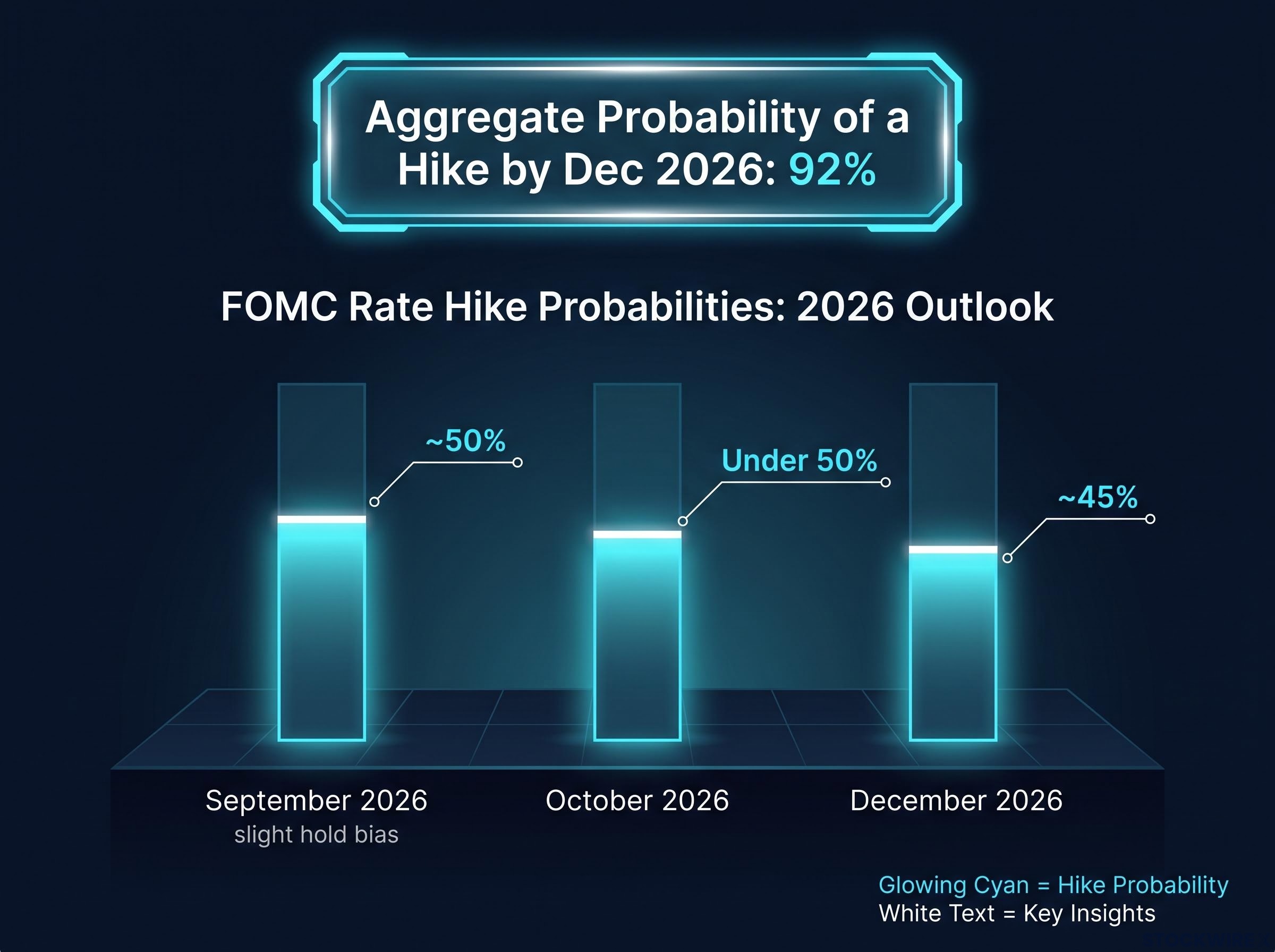
| FOMC Meeting | Standalone Hike Probability | Distribution Shape |
|---|---|---|
| September 2026 | ~50%, slight hold bias | Biased toward hold |
| October 2026 | No scenario above 50% | Dispersed, low conviction |
| December 2026 | ~45% | Sub-majority |
The apparent contradiction between 92% aggregate confidence and sub-50% meeting-level odds resolves through optionality. Markets are saying: tightening somewhere in this window is likely, but we cannot confidently locate it in time. Investors are expressing conviction about the state space (a hike is plausible) without expressing conviction about the specific node (which meeting).
That is precisely the pattern you would expect when a chair refuses to narrow the path. Across all horizons out to December, the likelihood assigned to one hike, two hikes, and three hikes has been sliding steadily since the start of August, introducing a temporal dimension that compounds the existing uncertainty. The distribution is not waiting to be resolved by the next data print. It is the market’s honest representation of a regime where the chair has refused to collapse it.
The speech will not tell you directly which meeting matters most. What it will do, if you know where to look, is signal something about the framework signals that carry the real information:
- Warsh’s characterisation of the policy stance (accommodative, neutral, or restrictive)
- His inflation language and adjective choices
- Any reference to the inflation task force scope or timeline
- How he frames structural uncertainty and the need for nimbleness
- Language on Fed independence and bond-market stress
Understanding the optionality logic prevents a costly mistake: treating a high aggregate probability as a high single-meeting probability. They are not the same thing, and strategies built on the confusion between them are exposed.
Below the probabilities: what the inflation measurement task force changes
Beneath the meeting-by-meeting odds most investors are already watching sits a layer of uncertainty that does not show up in any probability tracker. The Federal Reserve’s July 2026 Monetary Policy Report commissioned an independent task force to examine how inflation is measured and how policymakers respond to the data. Findings are expected before year-end.
The task force is evaluating whether the Fed’s preferred gauge, currently the Personal Consumption Expenditures (PCE) price index, should evolve, and whether methodological changes in how data are gathered and interpreted should alter how a given print maps onto perceived distance from the 2% target. This is not a theoretical exercise. It has leadership, a mandate, and a deadline.
The inflation data diagnostics that matter most in this environment separate the headline CPI signal from the core PCE trajectory: a 1.3 percentage-point gap between the two measures in May 2026 reflected an energy-driven uptick rather than a demand-fuelled spiral, which is precisely the kind of structural distinction the task force review may eventually formalise into the reaction function.
Why correct inflation forecasts may not be enough
Consider the logic. If the measurement framework changes, a 2.4% PCE print that today reads as “still above target” may be interpreted differently after the task force reports. Investors who correctly forecast headline inflation data may still face uncertainty about how the Fed’s reaction function translates that data into action, because the benchmark itself is under review.
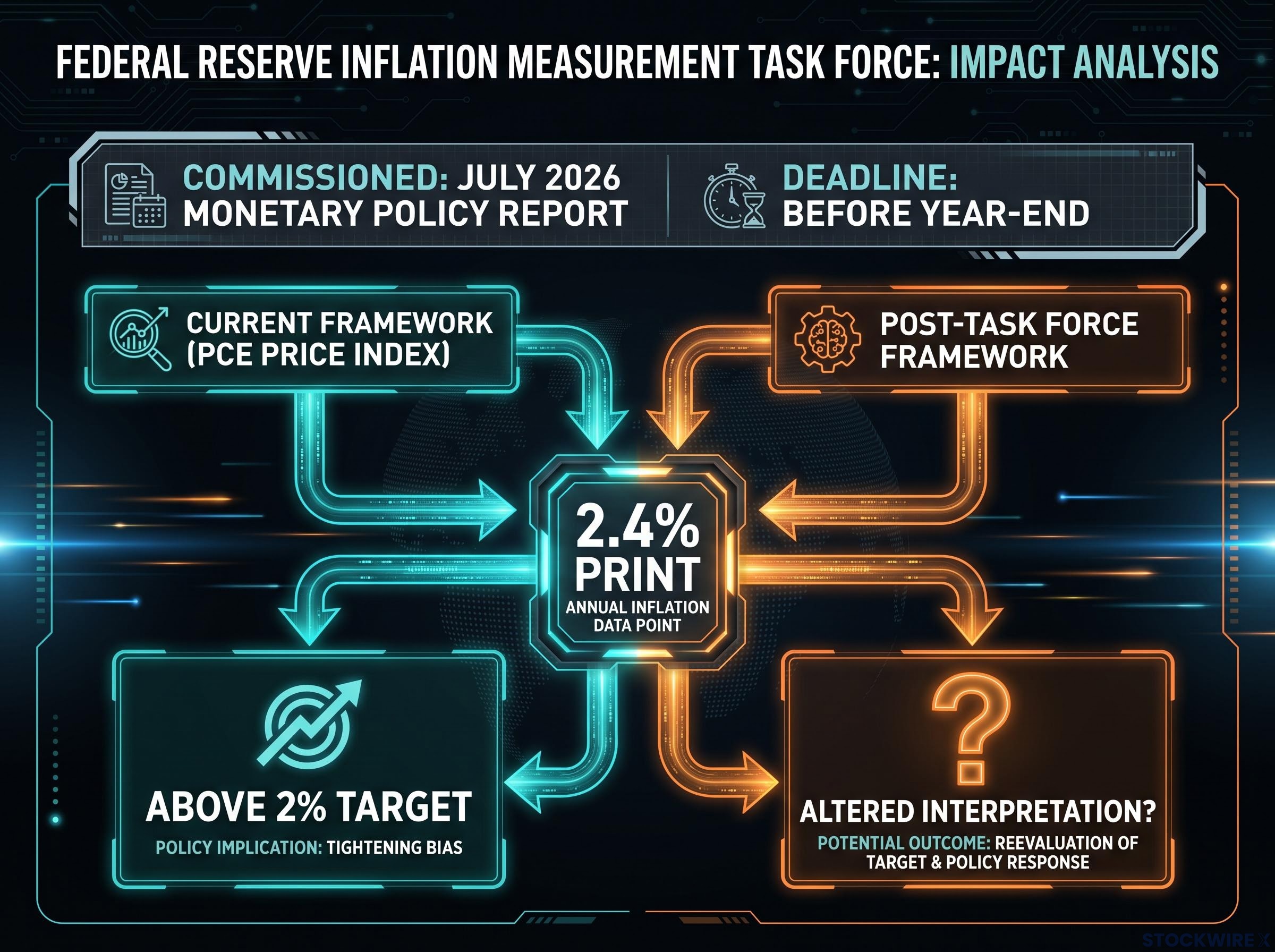
This connects directly to the Warsh communication philosophy. A chair who refuses to commit to a rate path is also running a process that may change the yardstick against which “appropriate policy” is judged. The two sources of ambiguity compound each other.
If you are modelling rate probabilities purely off headline PCE or CPI forecasts, you are working with an input that may be reweighted by the committee itself before the year is out. The uncertainty in rate timing is larger than the probability distributions alone reflect.
The Federal Reserve’s July 2026 Monetary Policy Report described the commissioning of an independent task force to explore inflation frameworks and evaluate methodological changes in how data are gathered and interpreted.
This article is for informational purposes only and should not be considered financial advice. Investors should conduct their own research and consult with financial professionals before making investment decisions.
Five signals worth watching when Warsh takes the podium
The paradox is clear. The uncertainty is quantified. Now the operational question: what do you actually listen for on Friday?
None of the following require forward guidance in the traditional sense. They are framework signals, and each one carries genuine policy information.
- Characterisation of the policy stance. Does Warsh call policy accommodative, neutral, or restrictive? A single word here can tilt the perceived bias of the committee without specifying a meeting or an outcome. If he calls the current 3.50-3.75% rate “accommodative,” that is a hawkish read. If he calls it “appropriate given the data,” that is patience.
- Inflation language. Listen for the adjectives. Is inflation framed as “progress but still too high” or “risks have come down materially”? His Sintra remarks demonstrated how much policy nuance sits in the modifier, not the commitment. The hawkish version emphasises persistence. The patient version emphasises trajectory.
- Inflation task force references. Any mention of the scope, timeline, or favoured direction of the framework review changes how models translate future data into projected rate paths. Even an indirect reference signals internal weight being placed on the review. Silence on the task force is also information: it may suggest findings are not yet influencing committee thinking.
- Uncertainty and nimbleness framing. If Warsh emphasises structural uncertainty and the need for nimbleness, read it as a subtle hawkish tilt, keeping options open in both directions and resisting premature easing. If he frames uncertainty as a reason for caution, that is patience.
- Independence and bond-market stress. Given recent bond-market anxiety and political pressure for rate cuts, comments that stress Fed independence and a willingness to tolerate market discomfort should be read as a firm stance on staying the course, not a dovish accommodation of market pressure.
Fed independence under Warsh was a contested variable from the moment of his confirmation by a narrow 54-45 Senate vote, with markets using bond yields, the dollar, and equity valuations as the real-time scorecard for whether early policy signals tracked economic data or presidential preferences.
Here is the asymmetric risk that ties these together. Markets appear to have mentally converted Warsh’s ambiguity into implicit patience. Positioning in rates and risk assets leans toward a shallower, more delayed tightening path. If even one of these five signals reads as concern rather than confidence, the market reaction could be disproportionate to the absence of explicit guidance, because no one is positioned for hawkish tone without hawkish commitments.
These statements are speculative and subject to change based on market developments and Federal Reserve communications.
What investors who misread the regime will get wrong
The failure modes in this environment are specific, and they compound.
- The regime misread. Treating Warsh’s refusal to guide as the absence of a signal, rather than a different kind of signal that requires different decoding. Investors who dismiss Friday’s speech as “no news” because it lacks explicit rate commitments will miss the framework information the speech is designed to carry.
- The probability misread. Converting the 92% aggregate probability into high confidence about a single meeting’s outcome. The wide distribution across September, October, and December means strategies that concentrate in one meeting are structurally exposed.
- The task force blind spot. Modelling rate paths purely off current inflation prints without accounting for the possibility that the measurement framework itself may shift before year-end. Correct data forecasts feeding into a changing reaction function can still produce wrong positioning.
These errors stack. An investor who misreads the regime is more likely to misread the probabilities, because they will be looking for the wrong kind of clarity. An investor who misreads both is almost certain to miss the task force layer, because it requires attending to institutional process rather than market pricing.
Warsh’s stated priorities are revealing here. His publicly expressed focus on “framing the big questions” rather than granular quarter-point debates tells you where his analytical attention is directed, and it suggests the speech will reward analytical flexibility over conviction.
The most dangerous position to hold into Friday’s speech is the one with the highest confidence in a specific timing outcome. Strategies that hedge across a range of meetings and attend to framework signals are better aligned with a regime that rewards interpretation over reading.
Why the wide distribution is the answer, not the problem
Probability mass spread thinly across the remaining 2026 FOMC meetings does not represent a consensus that has failed to form and is waiting for resolution. It is the rational market response to a chair who has chosen not to compress the range of plausible outcomes. Investors who hold off acting until the distribution concentrates are misreading the new regime; under Warsh, that compression may never arrive the way it did under Powell or Yellen.
Two resolution points sit ahead. The first is Friday’s speech itself, which will reveal how Warsh’s framework translates onto the current data environment. The second is the inflation task force findings, due before year-end, which could alter the reaction function that sits beneath every probability estimate.
The regime Warsh is establishing rewards analytical flexibility over conviction. The signal will always live in the framework, and the framework will always require interpretation rather than reading.
The gradual fade in hike probabilities since the start of August points to a market that is already operating within the Warsh regime. Rather than repricing in sharp steps following explicit commitments, positioning has adjusted incrementally as data have arrived, which is precisely what you would expect from a regime built on data-dependency rather than forward guidance. That behaviour is likely to continue. Investors who were accustomed to a Fed that compressed timing uncertainty on a predictable schedule need to update their approach: the relevant signals are in tone and framework rather than explicit guidance, risk should be spread across the timing window rather than concentrated in one meeting, and the measurement uncertainty introduced by the task force adds a structural dimension that no single speech will resolve. The five framework signals outlined above serve a purpose beyond this week’s event. They are the standing analytical toolkit for navigating the Warsh era.