OpenAI is reportedly racing to raise about $30 billion at a valuation of more than $1.4 trillion. That figure would sit more than 60% above the $852 billion mark reported after its March 2026 financing. Reuters reported the talks on Monday, 19 October 2026, citing people familiar with the matter.
The timing matters as much as the size. Anthropic is expected to list in mid-November, and a private round lets OpenAI fix a headline price before a rival’s public debut shows what investors will actually pay for a frontier AI company.
The raise also comes as AI stocks are only just steadying after a selloff driven by worries over debt-funded spending.
This piece covers what the reported figures show, why the sequencing matters, and four tests you can use to judge whether a trillion-dollar AI price has support beneath it.
What do the numbers say about a $1.4 trillion price tag?
OpenAI is pitching investors on about $50 billion in annualised revenue. It is targeting $70 billion by year-end and links that growth to the launch of its GPT-6 Astra model. Anthropic is presenting a different kind of number: $16.8 billion of revenue in a single quarter.
| Metric | OpenAI | Anthropic |
|---|---|---|
| Revenue figure | ~$50B annualised ($70B year-end target) | $16.8B in Q3 |
| Basis | Company-represented run rate | Quarterly, shown at pre-IPO meeting |
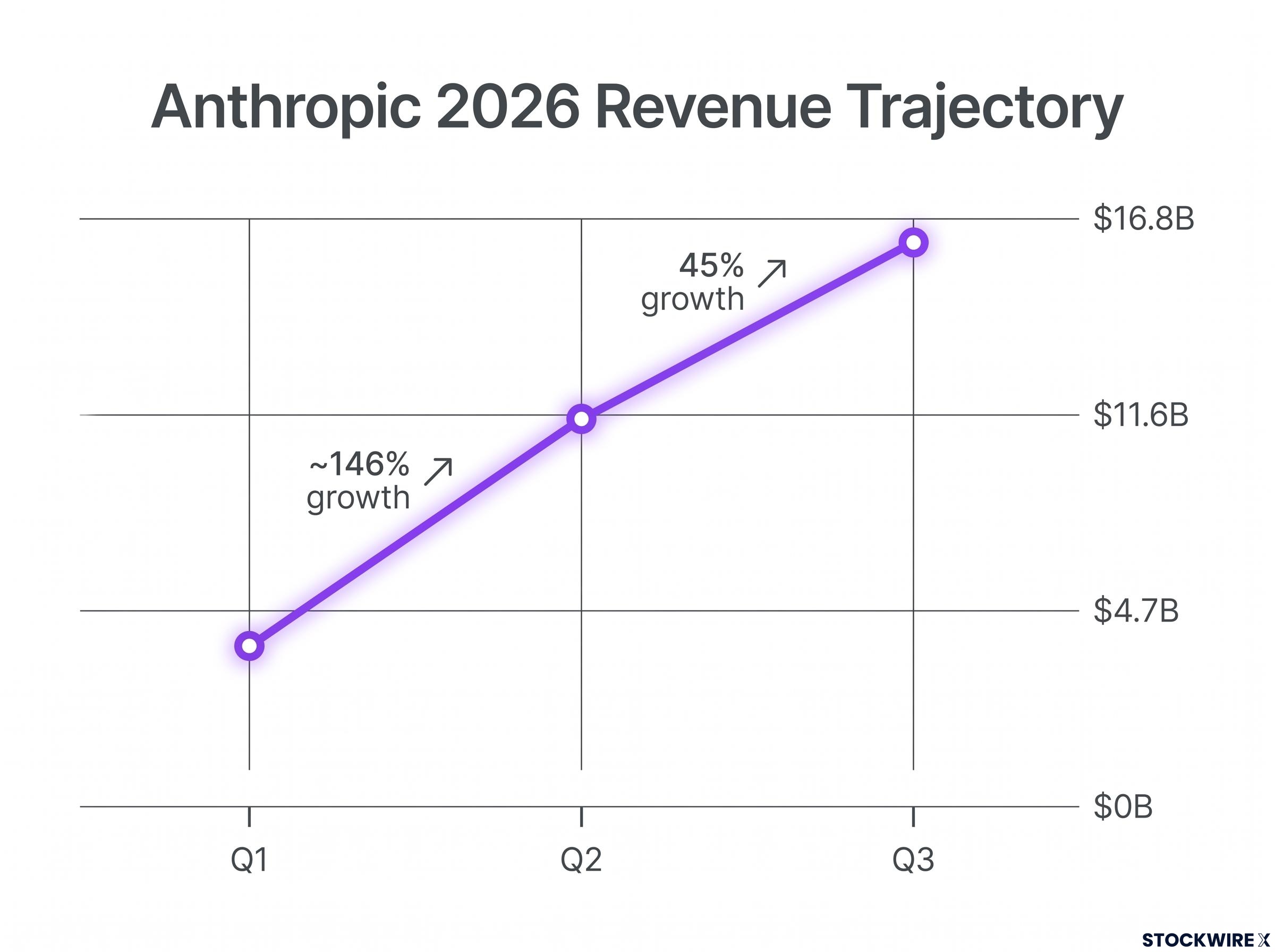
| Growth signal | Expected lift from GPT-6 Astra | 45% sequential in Q3, down from ~146% in Q2 |
| Profitability | ~$7B Q1 2026 loss; $2.22 spent per $1 of revenue | Profitable on an adjusted basis in Q3 |
| Valuation reference | More than $1.4T (proposed) | ~$1.5T IPO talk, down from ~$2T |
Anthropic’s quarterly revenue rose from $4.7 billion in Q1 to $11.6 billion in Q2, then to $16.8 billion in Q3. That deceleration is what moved expectations. Reuters reported on 14 October that Anthropic was targeting more than $2 trillion, but a day later said investors were discussing about $1.5 trillion.
Behind the reset, Anthropic’s IPO valuation talk slid by roughly $500 billion in two weeks as customer switching and token price deflation fed through to growth expectations.
The multiple in question PitchBook senior analyst Harrison Rolfes calculated that a $2 trillion Anthropic valuation would equal roughly 31 times its July annualised revenue.
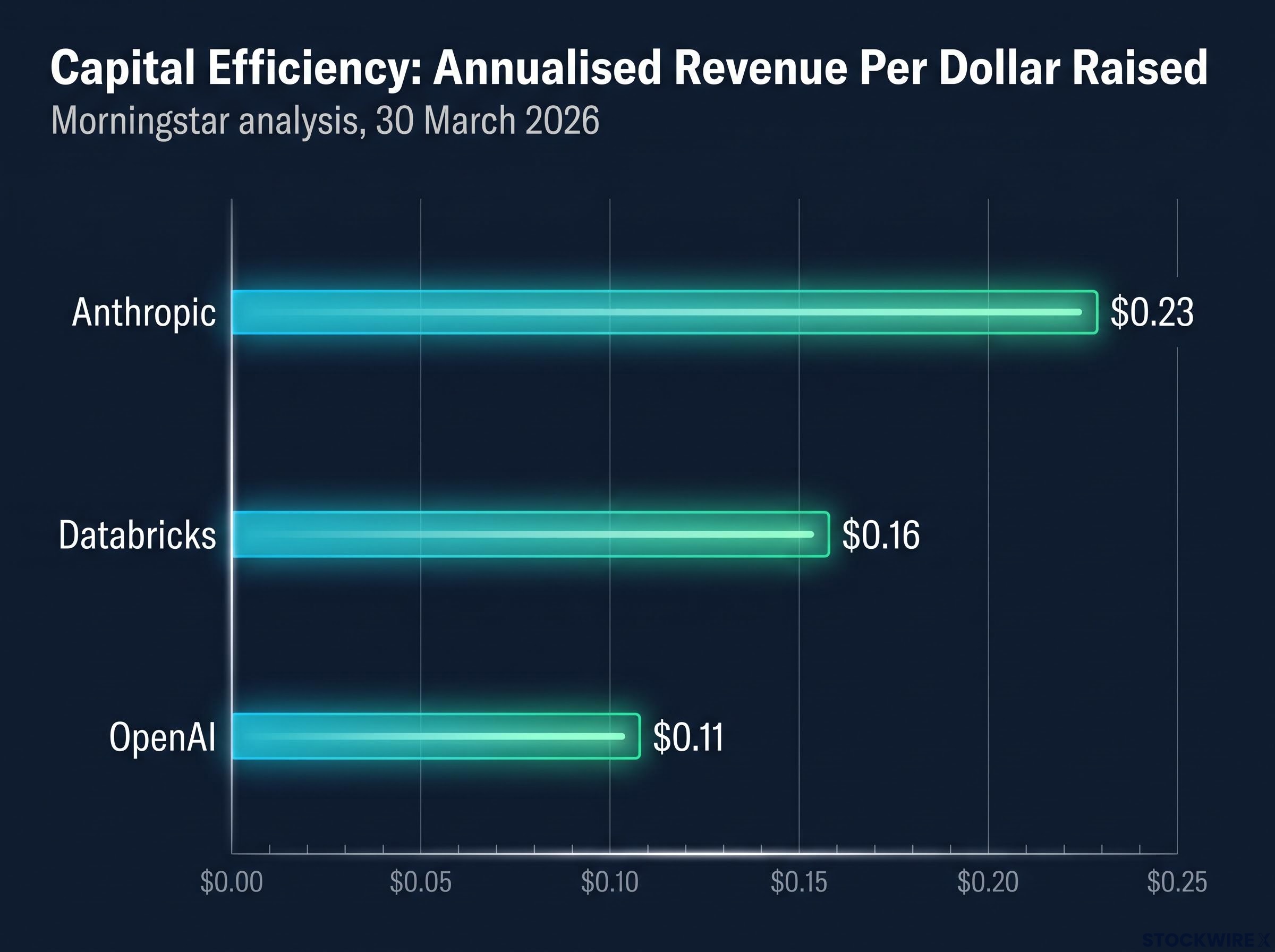
Capital efficiency adds another gap. A Morningstar analysis from 30 March 2026 found $0.23 of annualised revenue per dollar raised at Anthropic, $0.16 at Databricks and $0.11 at OpenAI.
Neither company’s figures come from an audited public filing. OpenAI’s price therefore rests on projected growth and a run rate the company chose to present, so those are the figures you should scrutinise first.
When big ASX news breaks, our subscribers know first
Why is OpenAI racing to lock in sovereign and institutional money before Anthropic lists?
The logic follows from the sequence. Once Anthropic trades publicly, its share price becomes a benchmark that could either support private AI valuations or pull them down. By raising first, OpenAI gets its price on record before that benchmark exists.
The cheques are expected to come from familiar backers. Existing investors SoftBank Group and MGX, Abu Dhabi’s technology-investment vehicle, are in talks to take part. SoftBank recently sold $11.1 billion of high-yield bonds, which are below-investment-grade corporate debt, to fund AI investments. Reuters described it as the largest such sale globally at the time.
The money has plenty of uses. Frontier AI developers need ongoing funding for:
- GPUs and networking equipment
- data-centre construction and power procurement
- model training and inference
- long-term cloud and semiconductor commitments
- operating losses while usage scales
What sovereign wealth brings that public markets cannot
Sovereign funds can write very large cheques and hold for decades. They may also want strategic exposure to AI infrastructure for reasons beyond financial return. A round anchored by investors like these also signals validation before any IPO.
That validation comes with terms. Anchor investors may negotiate preferred equity, information or board rights, or structured financing. The $1.4 trillion headline is a negotiated figure with conditions behind it, so it tells you less about fair public value than a listed share price would.
Why did the AI selloff make this raise land in a nervous market?
On the surface, Monday looked calm. The Nasdaq had its best session in two weeks, and a chip-sector gauge ended an eight-session losing run.
| Index | 19 October 2026 close |
|---|---|
| S&P 500 | +0.41% |
| Nasdaq Composite | +1.11% |
| Dow | -0.07% |
| Note: 20 October futures (03:17 ET) | Dow +0.3%, S&P 500 +0.1%, Nasdaq 100 -0.2% |
The gains rested on a narrow base. Deutsche Bank analysts pointed out that the S&P 500 rose even though nearly two-thirds of its constituents fell, because technology carries so much index weight. By early Tuesday, the AI trade had turned lower again, weighing on South Korea’s KOSPI and Japan’s Nikkei. Definitive closing figures for 20 October were not yet available.
The underlying worry is debt, and it has several parts:
- Chips, servers and data centres are increasingly financed with borrowed money.
- CoreWeave shares fell more than 25% amid concerns over about $50 billion of debt.
- Analysts estimate that the six largest US tech companies could spend more than $7 trillion on AI infrastructure through 2030 while remaining free-cash-flow negative.
- S&P Global warned that AI-linked liabilities may be larger than currently visible.
The funding squeeze is tied to hyperscaler capex plans of roughly $720-$745 billion this year, much of which depends on revenue from two loss-making labs.
Higher Treasury yields raise the return these projects must clear. S&P Global Ratings’ Vishal Merani described this as a higher hurdle rate. For you, a rising index on a narrow base offers weak reassurance, and funding costs now shape how every AI valuation gets judged.
How can you test whether an AI valuation holds up?
You do not need a model of your own to challenge a trillion-dollar headline. Four checks do most of the work.
- Revenue multiple. Compare Rolfes’ 31x with Windsor Drake’s 6-10x forward revenue for capital-intensive GPU and neocloud firms. A neocloud is a GPU cloud provider separate from the traditional hyperscalers. Windsor Drake’s benchmark for public data-infrastructure software is about 11x EV/revenue, which is enterprise value divided by revenue. The comparison is imperfect, but the gap is wide.
- Capital efficiency. At $0.11 of annualised revenue per dollar raised, OpenAI ranked lowest of the three companies in Morningstar’s March analysis.
- Free-cash-flow durability. PitchBook estimated that OpenAI needs about $100 billion of free cash flow by 2030 to support its implied scale.
- Financing structure. Rolfes warned of circular flows, where hyperscalers fund customers who then spend the money on those same hyperscalers’ cloud capacity and chips.
The revenue hurdle Gartner estimates AI data-centre owners need about $8.5 trillion of cumulative revenue through 2030 to cover capital spending, financing costs and a 12% return.
The case for patience
Anthropic’s $16.8 billion quarter shows that some AI demand is turning into substantial revenue. Its adjusted profit is a non-GAAP measure, meaning it excludes certain costs that standard accounting rules include. Even so, the result counts for something. Strategic investors may also accept lower near-term returns in exchange for compute access and national competitiveness.
The case for caution
Morningstar compares the build-out to past infrastructure booms, where the technology had real value but capacity grew faster than the eventual winners could use. Supply could also become a problem if Anthropic, OpenAI and Databricks list close together. A valuation that passes none of these tests is a bet on narrative rather than cash flow.
What the raise settles, and what Anthropic’s IPO will test
The raise shows that capital is still available at very high prices. Private pricing and public pricing remain separate tests, however, and only the second involves open-market buyers.
Three things are worth watching next:
- Anthropic’s final IPO valuation and offering size. No size has been announced, and earlier talk of $100 billion was hypothetical.
- Whether OpenAI’s round closes at $1.4 trillion or higher.
- The next moves in Treasury yields and AI credit spreads.
If Anthropic prices well below its private talk, you have your answer on how far the public market’s view differs from the private one.
Investors worried about passive exposure to AI listings can read our deep-dive into the AI valuation trap, which explains how index inclusion rules could force buying at prevailing prices.
This article is for informational purposes only and should not be considered financial advice. Investors should conduct their own research and consult with financial professionals before making investment decisions. Past performance does not guarantee future results. Financial projections are subject to market conditions and various risk factors.