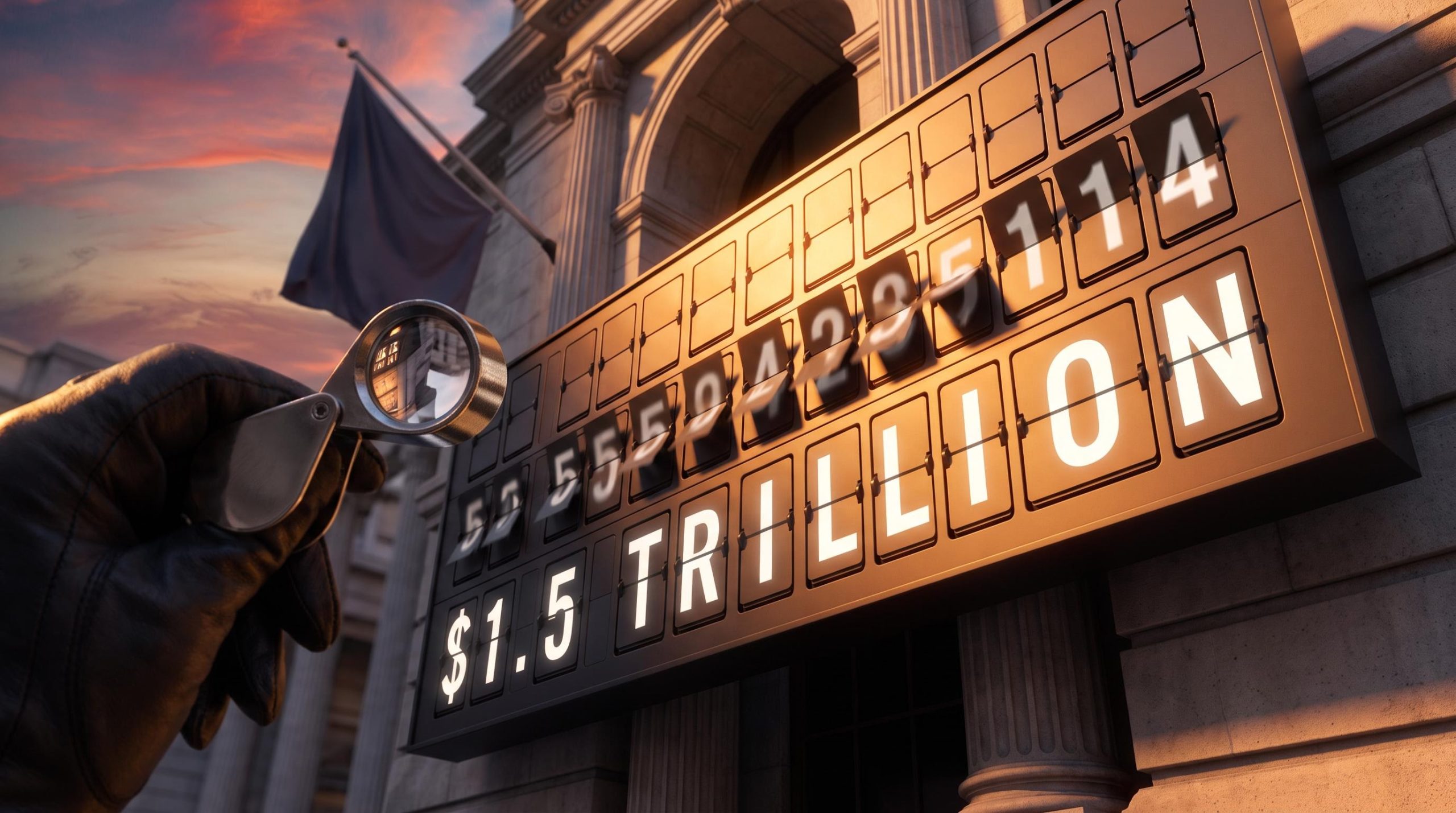
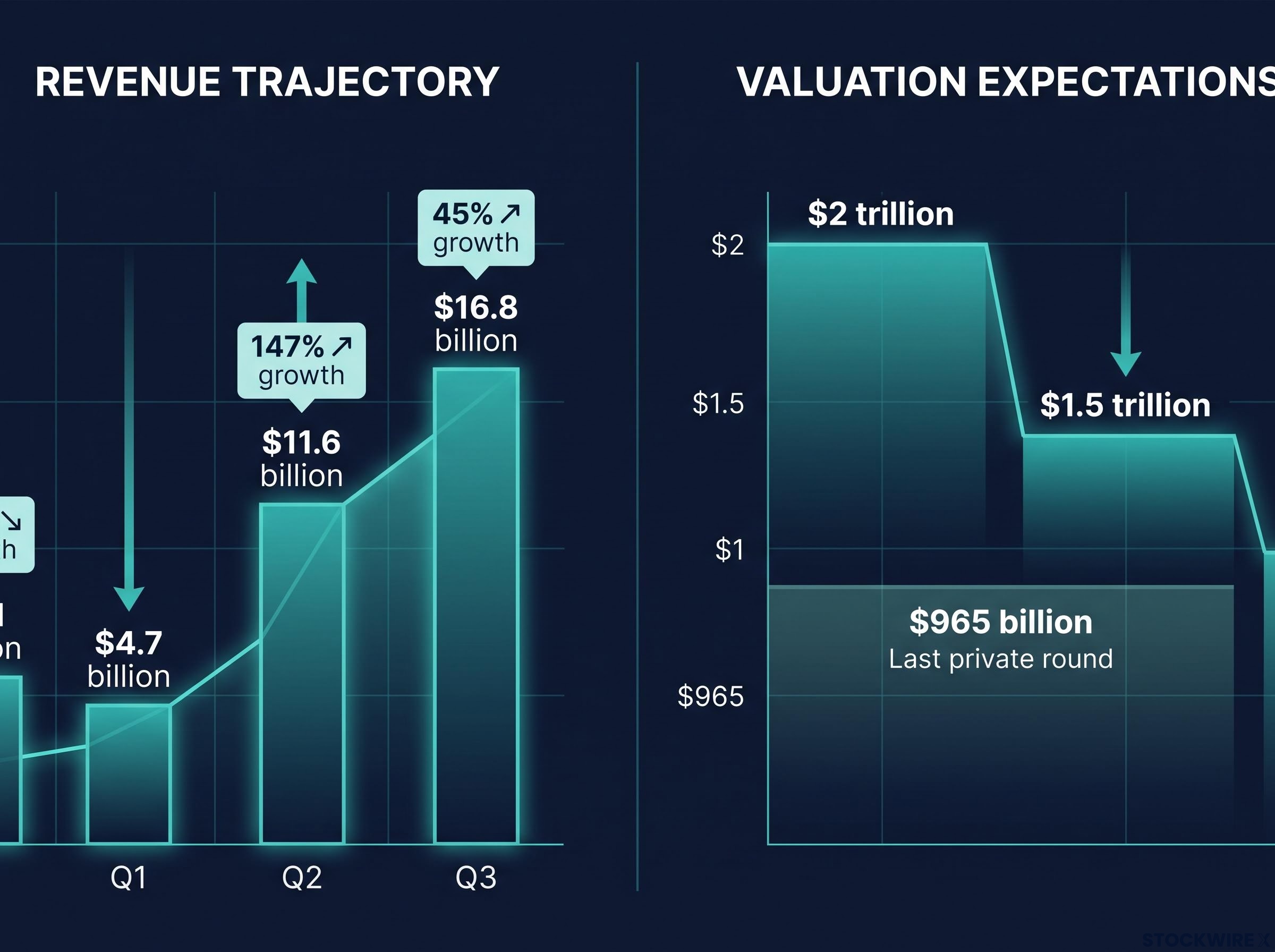
Some of Anthropic’s existing investors are now talking about a stock market listing priced near $1.5 trillion. About two weeks ago, the figure in circulation was closer to $2 trillion, which means roughly $500 billion has come off the expected IPO valuation in a fortnight.
Yet the company’s revenue grew 45% quarter on quarter to $16.8 billion. Most businesses would celebrate that number. For Anthropic, it was the trigger for the markdown.
The revision followed Anthropic’s investor day on 14 October 2026, where sequential growth was shown to have slowed from about 147% in Q2 to 45% in Q3. According to Reuters, the $1.5 trillion figure reflects discussion among some investors. It is not an announced price or a company target, and it still sits well above the $965 billion valuation from Anthropic’s last private round.
Three questions decide where the price lands: what the slowdown actually means, who benefits if AI models become interchangeable, and what could still derail the timing. Here is how the evidence answers each one.
Is the Anthropic IPO valuation reset about weaker spending or customers switching?
Start with the trajectory. Revenue climbed from about $4.7 billion in Q1 to $11.6 billion in Q2, then to $16.8 billion in Q3, and Reuters reported in August that the annualised run-rate had passed $65 billion. In absolute terms, the business is still growing at a pace few companies have ever matched.
The debate is about why the rate fell. Tapper Strickland of Moomoo suspects customers are moving to alternatives. The other explanation is that companies are simply spending less per unit of work.
| Provider | Share of Ramp businesses paying (October 2026) | Month-over-month change |
|---|---|---|
| Anthropic | 43.8% | +0.25 pp |
| OpenAI | 40.6% | +1.12 pp |
Evidence for switching
- CNBC reported in June that AI startup Lindy shifted 100% of its traffic from Anthropic to DeepSeek on cost grounds.
- Ramp data show a record 8% of US firms switched paid AI providers in September (a monthly share measured over a three-month window).
- About 79% of Anthropic customers also pay for OpenAI, so moving workloads between providers is easy.
Evidence for weaker spending intensity
- Investing.com, citing Ramp data, reported that token volumes kept rising while total spend was flat or down from its late-July peak.
- Large customers such as Meta and Microsoft are leaning more on their own tools.
Both stories fit the data. What the evidence does not show is collapsing demand; it shows customers buying differently.
That distinction matters for you. If usage is rising while revenue per unit falls, the slowdown signals price deflation, and a premium multiple is then paying for volume growth that may not convert into revenue at the same rate.
When big ASX news breaks, our subscribers know first
How falling token prices turn AI models into a commodity
That gap between usage and revenue has a mechanism behind it. A token is a small chunk of text, roughly a word or part of a word, that an AI model reads or writes. AI labs charge customers per token, so the price of each token sets how much revenue a given volume of work produces.
Enterprise AI token costs show why usage and revenue can diverge: agentic workloads consume far more tokens per task, yet buyers route routine jobs to cheaper models, so the vendor’s revenue per unit of work keeps shrinking.
Think of it like an electricity bill. If households use more power but the rate per kilowatt-hour keeps dropping, the utility’s revenue can stall even as demand climbs.
Price decline estimate One analysis estimated that token prices have fallen by as much as 1,000x since early 2023. Treat this as a single-source figure rather than an industry consensus.
Five forces are pushing prices down:
- Inference efficiency: inference is the work a model does to answer a request, and techniques plus custom chips (a 12 September analysis cited Google TPUs, Amazon Trainium, Meta MTIA and Microsoft Maia) are making it cheaper.
- Cheaper rivals: open-weight models, whose underlying settings are published for anyone to run, and low-cost options such as DeepSeek.
- Task routing: customers send routine jobs to cheap models and keep frontier models for hard reasoning.
- Scale: higher utilisation spreads fixed costs over more tokens.
- Benchmark convergence: when “good enough” models score close to the best, buyers pay less for the top tier.
| View | Core argument | What it implies for valuation |
|---|---|---|
| Pricing power | Frontier labs keep premium pricing on the hardest reasoning, coding and agentic work; autonomous agents could sharply raise token demand (Investing.com) | Volume growth may offset lower unit prices |
| Commoditisation | Routine workloads become interchangeable and API access starts to resemble a utility | Capability gains struggle to become lasting margins |
The research does not settle which view wins. What it does tell you is where the risk sits: a premium valuation depends on turning capability gains into durable margins, and commoditisation attacks exactly that step.
Why hyperscalers may win whichever model wins
If models become interchangeable, the question becomes who still gets paid. An analysis published in July argued the answer is the hyperscalers, the giant cloud providers. Google, Microsoft and Amazon sell the following regardless of which model a customer chooses:
- Cloud computing capacity
- Custom chips
- Networking
- Storage
Then they add a second layer, because each can also sell its own competing models. Every route a customer takes passes through their infrastructure, and some routes end at their products too.
Strickland argues commoditisation does not derail the AI infrastructure story. It shifts the story toward the largest players, especially those with their own models.
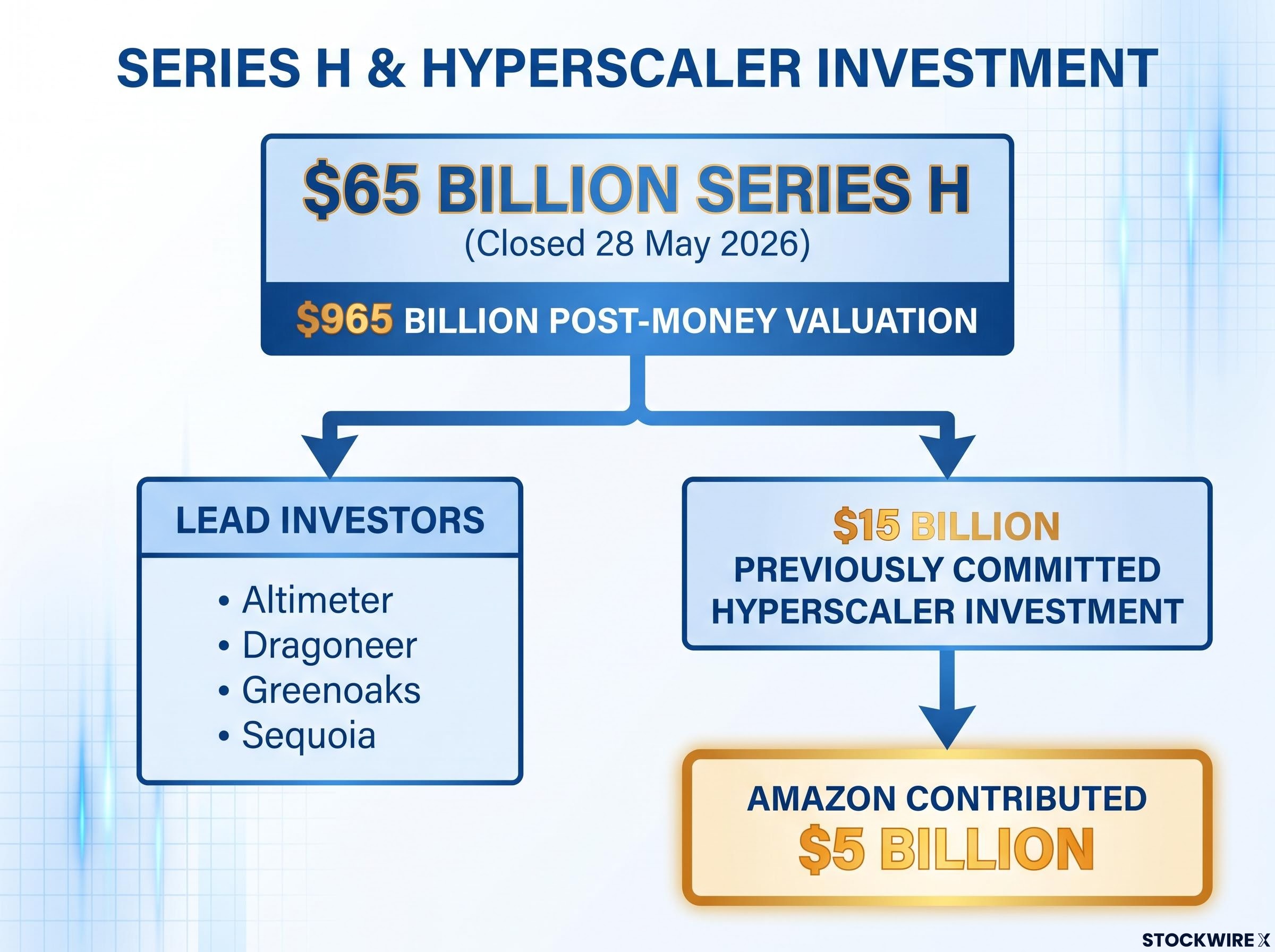
Amazon complicates the picture. It contributed $5 billion of the $15 billion in previously committed hyperscaler investment within Anthropic’s $65 billion Series H, which closed on 28 May 2026 at a $965 billion post-money valuation, led by Altimeter, Dragoneer, Greenoaks and Sequoia. Amazon is therefore an Anthropic investor, infrastructure partner and potential rival at the same time.
Anthropic’s counterargument is that differentiated Claude models keep premium demand alive in high-value enterprise work. That cushion is narrowing. If you are weighing AI exposure, the infrastructure owners may carry less model-specific risk than a standalone lab priced at $1.5 trillion.
Governance, compute commitments and IPO timing: what could still derail the listing
The slowdown is the visible problem. Three other pressures sit beneath it, and they interact with it.
Governance and the Levine letter
On 14 October 2026, New York City Comptroller Mark Levine wrote to Anthropic urging it to pause the IPO until it addressed safety, governance and development-speed concerns. He asked for details on audits, controls and timelines. Bloomberg reported on 16 October that Anthropic had opened talks with him.
Levine’s warning Levine argued that a major safety incident after listing would damage the stock, and that going public could raise pressure to put growth ahead of unresolved safety questions.
Anthropic is a public-benefit corporation, a company legally required to weigh a stated public mission alongside profit. Reporting that has not been independently confirmed says its Long-Term Benefit Trust holds special Class T rights designed eventually to elect a board majority, with separate reports of enhanced founder voting rights. Supporters say this shields the safety mission from short-term pressure; critics say public investors would carry the economic risk without matching control.
Compute commitments and margins
Anthropic reportedly expects at least $518 billion in compute and infrastructure commitments over roughly a decade across six partners. A related analysis said it cut a gross-margin projection to about 40% from 50% because inference costs ran higher than expected. The risks compound:
- Fixed contracts could squeeze margins if token prices fall faster than volumes rise.
- Customer shifts to cheaper or in-house models could leave capacity underused.
- Reliance on a few providers concentrates execution risk.
- Large commitments may discourage slowing development when conditions warrant it.
Timing
A draft S-1 (the registration document filed with the Securities and Exchange Commission (SEC) before a listing) was confidentially submitted on 1 June 2026, and no public version exists yet. Bloomberg reported marketing could begin the week of 9 November, with a possible debut before Thanksgiving. Nothing is confirmed, and everything depends on SEC review and markets.
Put together, these mean public shareholders may carry economic risk without ordinary control. That is a reason to discount any headline valuation.
Investors exploring the earlier $2 trillion target can read our deep-dive into Anthropic’s leaked prospectus financials, which unpacks the burn ratio behind the valuation.
What the weak IPO record says about pricing a $1.5 trillion debut
Even with those risks priced, Anthropic would be listing into a difficult market.
| Measure | Renaissance IPO Index | S&P 500 comparison |
|---|---|---|
| Q3 2026 | -11.5% | +2.3% |
| 2026 year to date (to 1 October) | +15.9% | +12.7% |
| Week reported 18 October | -8.2% | -1.9% |
The year-to-date gain hides a sharp Q3 reversal. Coverage of Anthropic’s plans cited weak 2026 IPO performance as a reason other companies had postponed their debuts.
The original commentary adds a harsher benchmark. Excluding the record SpaceX and SK Hynix listings, more than 100 recent IPOs show a weighted average return of -9.7% over the past year, against +14% for the S&P 500 and +19% for the Nasdaq.
Comparability note Renaissance’s year-to-date figures and the trailing one-year figures use different windows and methods, so they should not be read as directly comparable.
The 2021 tech IPO cohort showed how private enthusiasm can overstate public value once rates rise and investors focus on margins. Anthropic’s $500 billion reset is that pattern playing out before listing. For you, the point is that a cut valuation must still clear a weak base rate, and $1.5 trillion still assumes strong growth, healthier margins and friendly rates.
Long-run data on IPO investing show newly listed companies trailing comparable established peers by about 3.3% a year over five years, so even a trimmed valuation faces a structural headwind.
Past performance does not guarantee future results. Valuation discussions and listing timelines are speculative and subject to change.
What the reset changes, and what it does not
Anthropic’s growth remains large in absolute terms. What has changed is the question: not whether Anthropic is a leader, but what a leader is worth if models become interchangeable, token prices keep falling and the IPO market stays cautious.
The $1.5 trillion figure remains investor discussion. The final price will depend on the public S-1, the roadshow and market conditions on the day.
Three variables will tell you most:
- The public S-1: gross margin trend, revenue by quarter and compute contract terms.
- Ramp switching data: whether the record 8% rate keeps climbing.
- Governance terms: what control public shareholders would actually hold.
If those disclosures confirm durable margins, the reset may prove conservative. If they confirm deflation, it may not be the last.
This article is for informational purposes only and should not be considered financial advice. Investors should conduct their own research and consult with financial professionals before making investment decisions.