Oil pushed to near two-week highs overnight as Middle East tensions escalated, with Brent crude futures settling about 1.8% higher near US$106.5 a barrel, according to the Morning Report. Chip stocks dragged on Wall Street, while the ASX 200 had already locked in its best close in two weeks.
Higher oil prices, a firmer US dollar and a sharp semiconductor pullback all arrived in the same session. Each touches a different part of an Australian portfolio: petrol and energy stocks, the Australian dollar and gold, and the US tech exposure inside many super funds.
ASX 200 futures point to a modest gain of about 0.1% at Tuesday’s open.
Why oil is rising even though barrels are still flowing
The trigger was a run of attacks. The Houthis, Yemen’s Iran-aligned movement, claimed a missile strike on King Khalid International Airport in Riyadh, and the UK Maritime Trade Operations agency (UKMTO) reported two tankers hit near the Strait of Hormuz. Reuters reported Brent at US$105.48 and West Texas Intermediate (WTI) at US$92.44 on 11 October, before the overnight session lifted Brent closer to US$106.5. Reuters also reported casualty figures from Riyadh that have not been independently confirmed.
The route matters. Hormuz normally carries roughly 20% of global oil and fuel flows, so any threat there moves prices quickly.
Yet the barrels have not stopped. Middle Eastern crude exports had recovered above pre-war levels on several days in late September, according to reports. What traders are buying is insurance against a disruption that has not yet happened.
That insurance has a price, known as a risk premium: the extra amount built into oil above what current supply and demand alone would justify.
Analysts argue that the geopolitical risk premium embedded in triple-digit crude can collapse within a day of a credible de-escalation signal, which is why traders treat today’s price as a bet on sentiment as much as supply.
Goldman Sachs’ estimate Analysts led by Daan Struyven put the geopolitical risk premium at just over US$20 a barrel and lifted their December Brent forecast from US$85 to US$90, as reported by Reuters (not independently confirmed).
Goldman’s base case is that Gulf producers keep adapting their logistics, eventually pulling prices lower. Several offsets are already capping the rally:
- The G7‘s planned release of 100 million barrels of emergency diesel and crude stocks
- A reported US-Russia diesel arrangement, with Russia said to release 300,000 tonnes immediately
- Hopes for a Russia-Ukraine ceasefire on energy infrastructure
- Rising Middle Eastern exports
How the diesel deal and ceasefire will actually be implemented remains unclear. For you, the takeaway is that this price reflects fear rather than shortage. If exports keep flowing, the premium can drain away quickly; if attacks broaden, it could jump just as fast.
How oil, a firmer US dollar and chip weakness rippled across markets
The oil shock did not stay in oil. It firmed the US dollar, which in turn weighed on gold and the Australian dollar, while Wall Street used the moment to trim its most expensive holdings.
Wall Street: chips lag, the Dow holds
In a holiday-thinned session, with US bond markets shut for Columbus Day, the S&P 500 slipped about 0.1% and the Nasdaq fell about 0.4%. The Dow rose about 0.4%, energy led the sectors, and the PHLX semiconductor index dropped about 2.7%.
Micron fell nearly 4%. Microsoft gained about 1.1%, pushing its market value above US$4 trillion after plans to deploy its own AI chips, while Salesforce added about 2% on a broker upgrade and Chipotle shed nearly 4% after Starbucks ruled out a takeover.
The chip sell-off looks like profit-taking after a huge run; the semiconductor index had reportedly climbed about 73% year to date by late September (not independently confirmed), alongside questions about AI revenue and valuations. A rising Dow signals money rotating toward established companies, not a broad retreat from risk.
Chip stocks have increasingly met record earnings with selling, a sign of valuation discipline from investors who now demand that results justify prices already paid rather than simply confirm the AI story.
| Market | Level or move | Driver |
|---|---|---|
| S&P 500 | -0.1% | Tech drag offset by energy |
| Nasdaq | -0.4% | Chip and AI weakness |
| Dow | +0.4% | Rotation into established names |
| Semiconductor index | -2.7% | Profit-taking, AI valuation doubts |
| Brent | +1.8%, near US$106.5 | Middle East attacks |
| Gold | -0.6%, US$4,191 | Firmer US dollar, higher oil |
| Copper | +0.8% | Mine supply concerns |
| Aluminium | -1.4% | Firmer US dollar, eight-month low |
| AUD | About 69.6 US cents | US dollar strength |
Commodities, currencies and Europe
Copper touched its highest in over two weeks, and iron ore held near US$90 a tonne. Europe outperformed, with the STOXX 600 up about 0.6% and the FTSE 100 about 1%, led by banks. LVMH reported weaker-than-expected third-quarter sales after the close.
If your super fund or portfolio leans heavily on US tech, this was a pullback concentrated in richly valued chip stocks, not a market-wide break.
What the ASX open and Tuesday’s calendar mean for Australian investors
The local market enters Tuesday on a firm footing. The ASX 200 closed up 66.6 points, or about 0.8%, at 8,783.2, led by banks and miners (source figures vary slightly), and futures suggest a further 0.1% gain.
Higher oil splits the market. Energy and LNG producers gain from higher realised prices, while airlines, transport and fuel-heavy industries face margin pressure.
The event that could change the tone lands mid-morning. The Reserve Bank of Australia (RBA) releases minutes from its 29 September meeting, when it lifted the cash rate 25 basis points to 4.60%. The question is whether the Board sees energy shocks hardening into persistent inflation.
The RBA’s central worry is energy costs passing through into wages and broader prices, even though soft money supply growth and weakening household demand argue the tightening cycle could risk overshooting.
Hawkish minutes would support yields and the Australian dollar. A focus on temporary energy shocks would ease expectations of further hikes, which matters directly if you hold a mortgage or bank shares.
- 11:30am AEDT: RBA September meeting minutes
- September business confidence and conditions data
- Telstra and Baby Bunting AGMs
- Overnight: US bank earnings, plus Johnson & Johnson, UnitedHealth and existing home sales
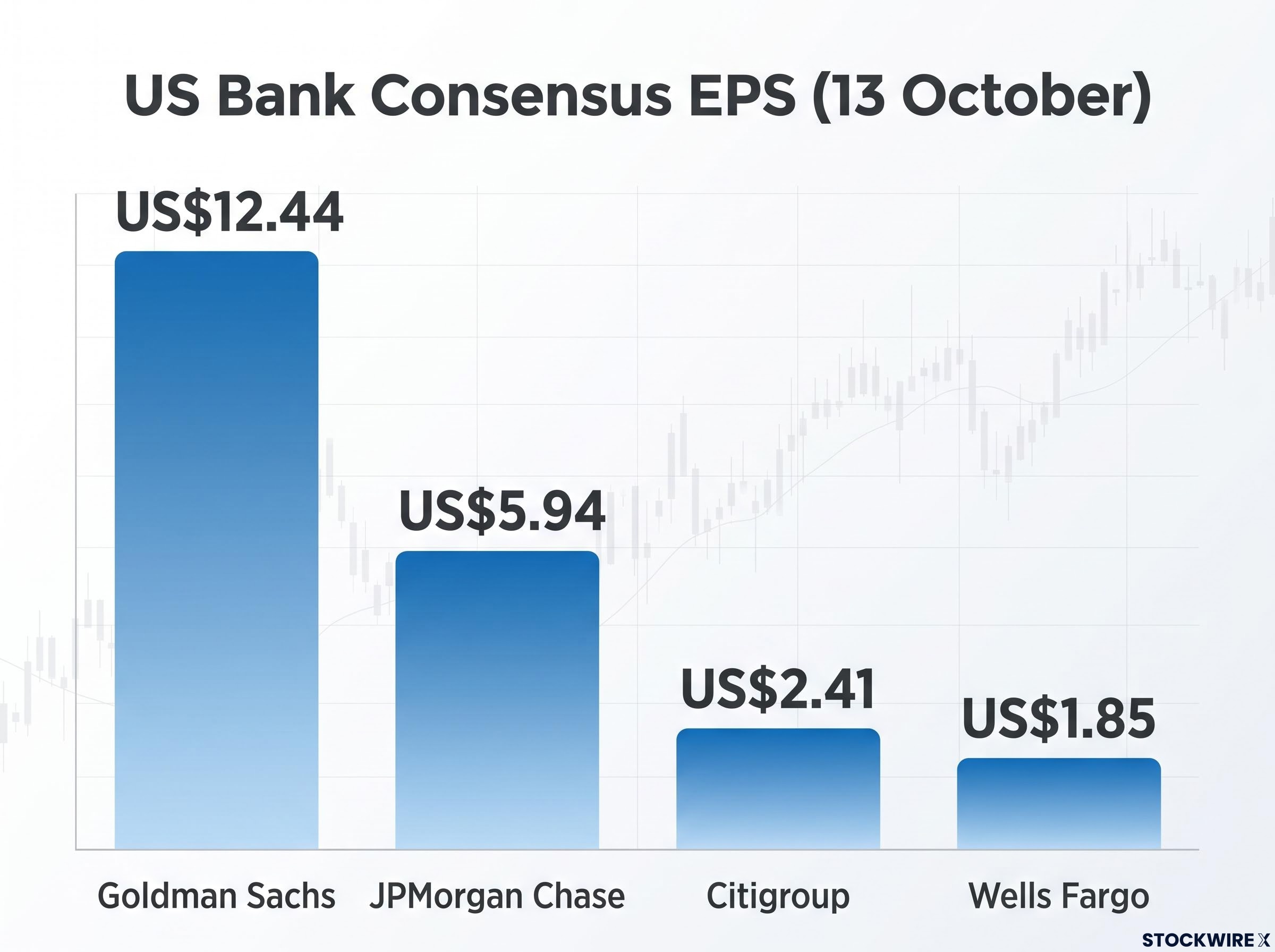
Consensus estimates from Reuters, using LSEG data, are not independently confirmed.
| Bank | Date | Consensus EPS |
|---|---|---|
| JPMorgan Chase | 13 October | US$5.94 |
| Goldman Sachs | 13 October | US$12.44 |
| Citigroup | 13 October | US$2.41 |
| Wells Fargo | 13 October | US$1.85 |
| Morgan Stanley | 14 October | Due Wednesday |
| Bank of America | 14 October | Due Wednesday |
Watch net interest income, trading and investment banking revenue, and credit quality.
What to hold in mind as the day unfolds
One thread ties the session together: markets are pricing a credible risk of a larger supply interruption, not reacting to one that has happened. That explains elevated oil, chip profit-taking, and resilience in Australian and European shares.
Two swing factors follow. The RBA minutes will show whether the Board treats oil as a lasting inflation threat, and US bank earnings will test whether the rotation away from tech holds.
A confirmed Hormuz disruption would change the picture entirely. Continued exports would more likely let the premium fade.
This article is for informational purposes only and should not be considered financial advice. Investors should conduct their own research and consult with financial professionals before making investment decisions. Past performance does not guarantee future results. Financial projections are subject to market conditions and various risk factors.