
The Czech National Bank (CNB) raised its main interest rate on Thursday, yet the koruna fell. The 25 basis point hike took the repo rate to 4.00% on 5 November 2026, but the currency slipped by as much as 0.3% against the euro. The board’s vote was only 4-3.
That narrow margin became the real headline. Markets largely expected the move to 4%, so traders looked past the rate itself and focused on how close the board came to holding.
That matters to anyone tracking central bank signals, or holding exposure to European rates and currencies. Investors often read the split vote, not the decision, as the message about what comes next.
Three pieces explain where Czech rates and the koruna may go from here: the vote, the CNB’s projected rate path, and an argument about whether 4% is now the “normal” level of interest rates.
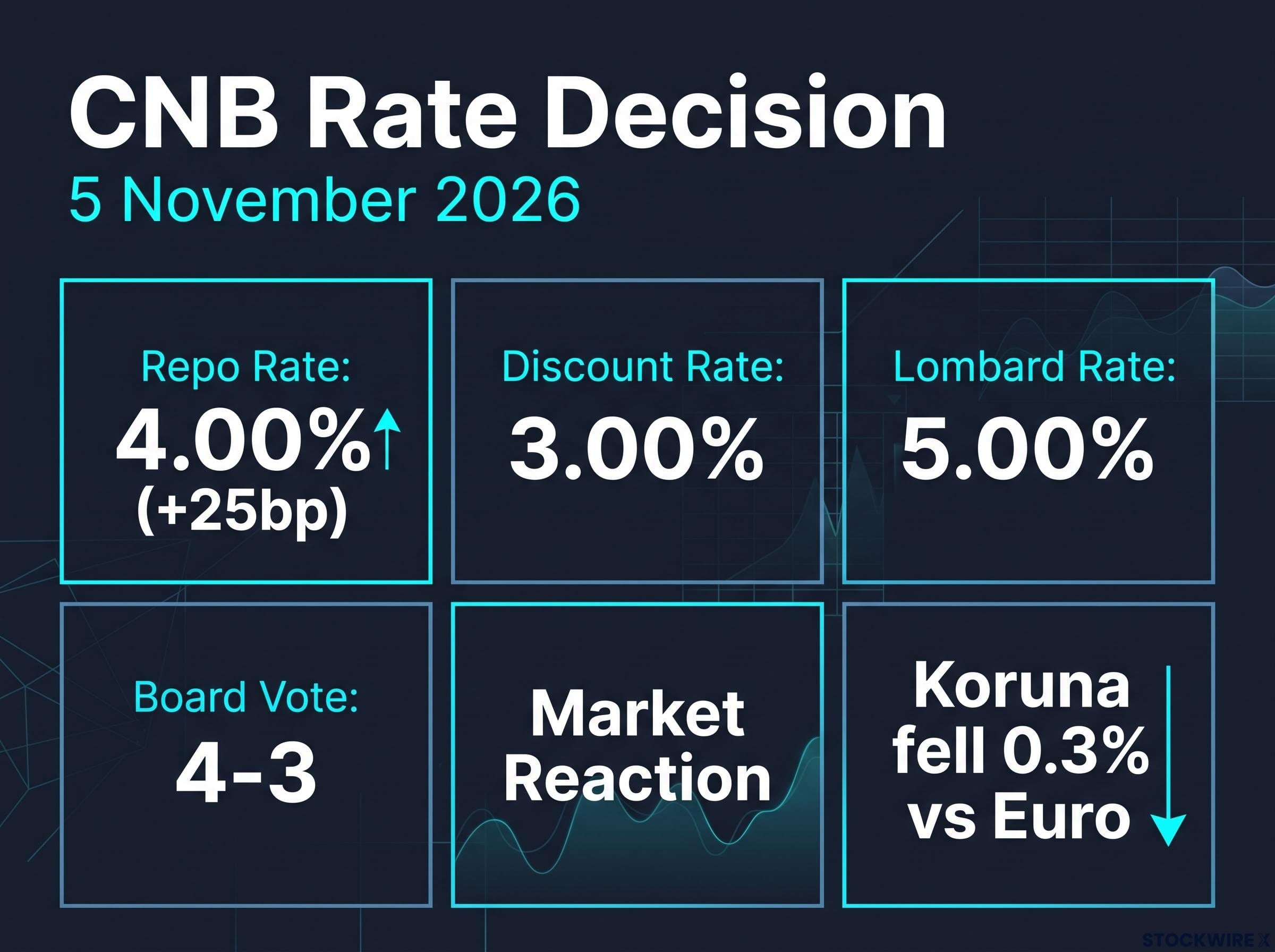
The 5 November 2026 CNB decision saw a 4-3 vote for a repo rate of 4.00% (+25bp), accompanied by the koruna falling 0.3% against the Euro.
Why a 4-3 vote turned a hike into a dovish signal
A rate hike usually supports a currency. This one did the opposite.
After the announcement, the koruna weakened by up to 0.3% against the euro, and traders cut their bets on further tightening. Bloomberg and related reporting linked the reaction to the unexpectedly close vote. Markets read it as a board reluctant to go further. Commerzbank took the same view, saying the narrow vote shows limited room for more tightening.
| Item | Detail |
|---|---|
| Decision date | 5 November 2026 |
| Effective date | 6 November 2026 |
| Repo rate | 4.00% (up 25bp) |
| Discount rate | 3.00% |
| Lombard rate | 5.00% |
| Vote | 4-3 (individual votes not disclosed) |
Why the CNB still acted
The CNB pointed to domestic pressures that headline inflation does not capture:
- Sticky core inflation, led by services
- Rapid wage growth and a tight labour market
- A weaker currency
- Elevated property price growth
- Fast credit growth
Headline inflation looks calm by comparison. The Czech Statistical Office’s flash estimate put October CPI at 2.4% year on year, close to the 2% target. ING estimates core inflation, which strips out volatile items such as energy and food, at about 3.2%, although that is not an official release.
Governor Aleš Michl described the move as fine-tuning rather than the start of a new hiking cycle. He said its purpose was to stop higher energy costs turning into second-round effects, meaning lasting increases in wages and other prices.
The CEE currencies outlook ahead of the meeting turned on domestic drivers such as wage growth above 6% and resilient demand, which also explains why the NBP in Poland followed a different path from the CNB.
The cycle explains the caution. The CNB finished easing in May 2025, hiked in June 2026, paused, then moved again this week.
For you, the lesson is that the size of the majority told markets more than the rate level did. When you judge currency moves, the expected path of rates matters more than where they sit today.
What does the CNB’s rate projection actually promise?
The CNB published its autumn forecast on 6 November, alongside a projected path for short-term rates. That path shows rates rising to about 4.5%, cuts starting in Q2 2027, and rates of about 3.5% by the end of 2028. ING noted that the 4.5% peak sits close to existing market pricing.
| Variable | 2026 | 2027 | 2028 |
|---|---|---|---|
| Inflation (annual average) | 2.1% | 3.2% | 2.3% |
| GDP growth | 1.7% | 2.5% | 2.5% |
| 3M PRIBOR (average) | 3.9% | 4.1% | 3.6% |
| CZK/EUR | 24.3 | 24.3 | 24.2 |
The forecast also cut 2026 growth to 1.7% from 2.2%. The 3M PRIBOR is the three-month interbank lending rate in Prague.
The path is not a promise. Economists call it endogenous, which means the model produces it rather than the board choosing it in advance:
- Project the economy. The model forecasts inflation, demand, wages, the exchange rate, credit and output.
- Apply a rule. It assumes how the central bank typically reacts to those conditions.
- Find the path. The result is the rate path that returns inflation to target.
- Update with data. If the outlook changes, the path changes.
The CNB said future decisions depend on the koruna, fiscal policy, the labour market, commodity price pass-through, demand and foreign central banks.
The CNB autumn inflation report documents the model assumptions behind the rate path, including the exchange rate and wage inputs that determine when the projected cuts begin.
The real-rate tension The CNB says “all options are open”, yet its forecast keeps inflation above 3% through much of 2027 while nominal rates fall. A falling nominal rate during above-target inflation means a falling real rate (the rate after inflation), which loosens conditions. ING argues this weakens the credibility of that message.
Treat the projected cuts as a scenario that depends on inflation expectations staying anchored. If markets take them as early easing, the koruna may weaken and partly offset the tightening.
Past performance does not guarantee future results. Financial projections are subject to market conditions and various risk factors.
Is 4% the new neutral rate, and who disagrees?
That conditional path sets up the bigger question. Where do rates settle once the shock passes?
What neutral rate means
The neutral rate is the interest rate that neither speeds up nor slows down the economy. Nobody can observe it directly, so economists argue over where it sits.
ING’s David Havrlant and František Taborský see 4% as the new neutral. They expect weakening activity to cap further hikes and doubt that a steep cutting cycle is convincing while inflation runs higher and growth is softer. ING expects core inflation near 3% until about mid-2027 unless housing and rent growth cool.
The CNB’s own endpoint points lower. Its forecast has 3M PRIBOR averaging 3.6% in 2028. The case for lower rates rests on weak euro-area demand, cooling credit and housing, and inflation returning near target in 2028.
| Source | Rate view | Timing | Koruna or key reasoning |
|---|---|---|---|
| CNB | Peak near 4.5%, then about 3.5% | Cuts from Q2 2027 | Restrictive policy cools demand |
| ING | 4% as new neutral | Doubts steep cuts | Services, wages and housing keep pressure on |
| Komerční banka | Hold at 4% through 2027 | First cut February 2028 | View dated 29 October 2026, before the decision |
| Commerzbank | Limited room to tighten | Not specified | Inflation may outrun hikes, leaving real rates low or negative |
Komerční banka sits in the middle. Commerzbank’s warning matters most for the currency: with the koruna around 24.3 per euro, inflation that outpaces rate hikes would leave it exposed.
The disagreement is about where neutral sits and how fast inflation pressure fades, not about whether rates eventually fall. If neutral is nearer 4% than 3.5%, you should expect rates to stay higher for longer than the CNB path implies, with the koruna hinging on how persistent inflation proves.
What to watch as the CNB tests 4%
The hike set 4% as the level, the vote capped expectations, and the neutral-rate debate will decide how far and how fast rates fall.
Three variables will show which view wins:
- Services and core inflation, measured against ING’s mid-2027 marker
- The koruna, with EUR/CZK near 24.3
- Wage, housing and credit data, for signs that pressure is cooling
The full Monetary Policy Report, due on 13 November, adds the next layer of detail. If core stays near 3%, expect the higher-for-longer view to gain ground.
This article is for informational purposes only and should not be considered financial advice. Investors should conduct their own research and consult with financial professionals before making investment decisions.