President Trump announced on 28 August 2026 that the United States has struck a deal handing American government entities partial control over Venezuela’s oil reserves for the next century, and Bank of America is already warning clients the arrangement carries debt risks that legacy creditors may not have fully priced in.
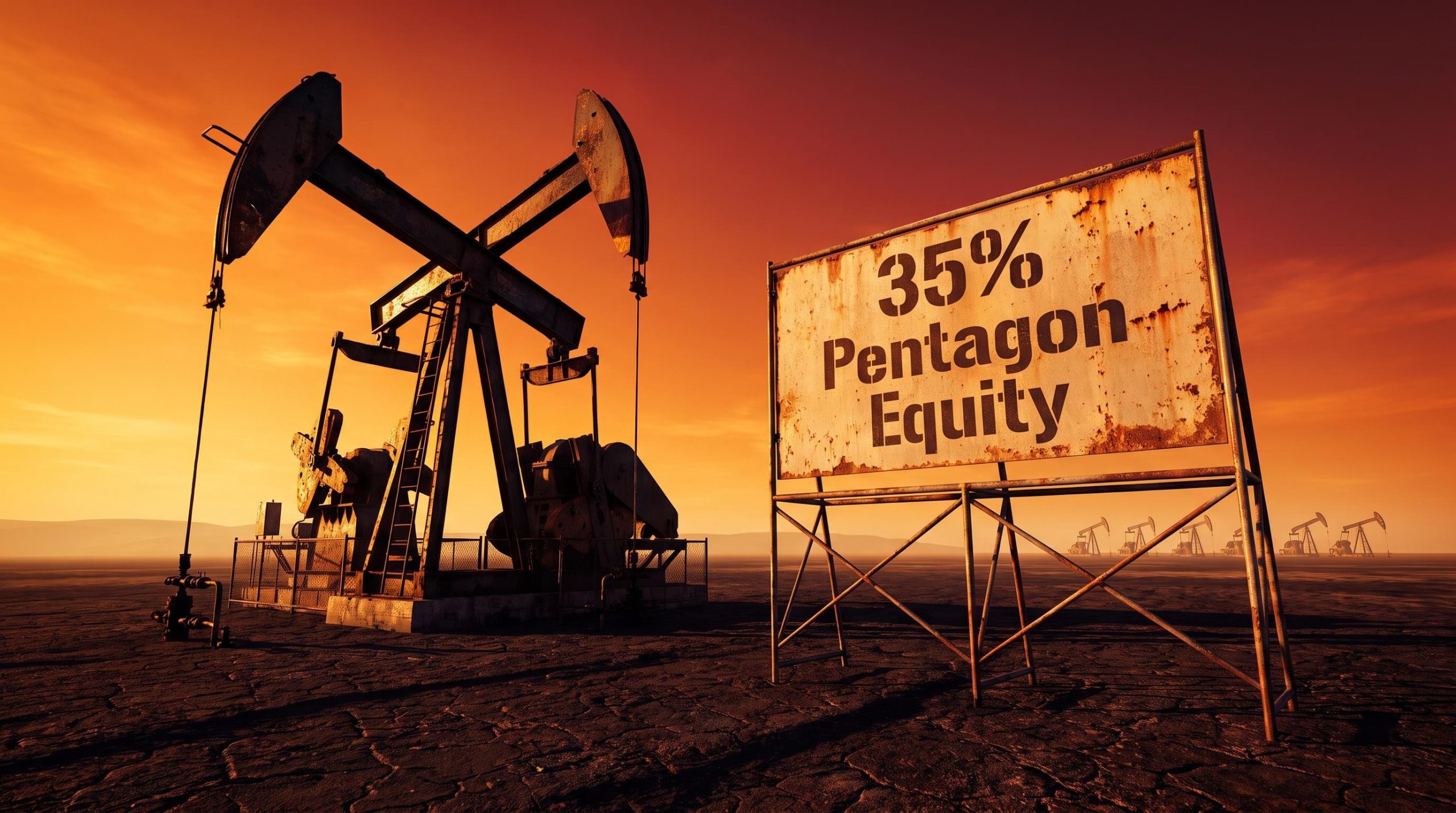
North American Blue Energy Partners (NABEP) has received 100-year concessions to 17 Venezuelan oil fields holding roughly 65 billion barrels of proven reserves. The Pentagon’s Office of Strategic Capital takes a 35% equity stake in NABEP’s corporate parent, and the State Department holds the right of first refusal on 80% of production.
Bank of America analyst Anne Milne published an assessment on 2 September 2026 flagging the deal as an ambiguous development for holders of Venezuela’s long-defaulted debt, pointing to an untested production structure and genuine uncertainty about where fiscal revenues will flow. This piece breaks down the deal’s mechanics, what the Bank of America analysis actually says about production timelines and creditor risk, and the specific structural questions that remain unresolved for anyone holding Venezuelan sovereign or PDVSA debt.
A century-long bet on Venezuela’s oil fields: what the U.S. actually agreed to
Start with the concession itself. The Venezuelan government has granted NABEP the right to drill 17 oil fields containing approximately 65 billion barrels of proven reserves, roughly one-fifth of Venezuela’s entire proven reserve base. The concession runs for 100 years.
Then layer on the U.S. government’s stake. The Pentagon’s Office of Strategic Capital takes a 35% equity holding in NABEP’s parent company. The State Department secures a right of first refusal to purchase 80% of NABEP’s output, plus the right to buy 20% of production at cost.
Now the money. NABEP has committed to invest $100 billion under the deal, and the White House projects the arrangement will generate an estimated $200 billion in royalty and tax payments over the first 25 years. The agreement was signed by Secretary of State Marco Rubio and Defense Secretary Pete Hegseth, with the White House fact sheet released on 31 August 2026.
White House characterisation The Pentagon’s equity stake represents “hundreds of billions in value and dividends for the United States.”
| Term | Detail | Significance |
|---|---|---|
| Concession scope | 17 fields, ~65bn barrels proven reserves | Roughly one-fifth of Venezuela’s total reserves |
| Concession duration | 100 years | Multi-generational commitment on both sides |
| Pentagon equity stake | 35% of NABEP’s parent | U.S. government as direct equity holder |
| State Dept. offtake rights | Right of first refusal on 80% of output | Physical control of crude flows |
| Cost purchase right | 20% of production at cost | Direct energy-security benefit |
| NABEP investment | $100 billion | Capital deployment benchmark |
| Projected royalties (25 yrs) | $200 billion | Fiscal return to the U.S. and Venezuela |
NABEP is described across multiple outlets as Venezuela’s second-largest private oil producer after Chevron, and the Trump administration selected it as the principal private-sector partner rather than inviting broad international oil company participation. Many of the 17 fields previously belonged to Russian or Chinese firms.
The terms on paper are extraordinary in scale. But scale alone does not answer the real question: whether a 100-year concession to a private Venezuelan firm with U.S. government equity is a genuine precedent, or an arrangement whose durability rests entirely on political continuity in both Caracas and Washington.
The Venezuela deal was structured and signed against the backdrop of the Hormuz shipping disruption, which kept commercial transit at 5-12% of pre-war capacity even after Iran’s official declarations of an open waterway, amplifying the strategic logic behind the U.S. securing a Western Hemisphere supply base outside the Gulf chokepoint.
When big ASX news breaks, our subscribers know first
Can Venezuela actually pump that much oil, and when?
Venezuela is currently producing below 1 million barrels per day on independent estimates. OPEC’s secondary-source figure for July 2025 put output at 914,000 bpd, while Venezuela’s own direct communication to OPEC claimed 1,084,000 bpd for the same month. That gap between self-reported and independently verified numbers has persisted for years, and the more conservative secondary-source figure is the one most analysts trust.
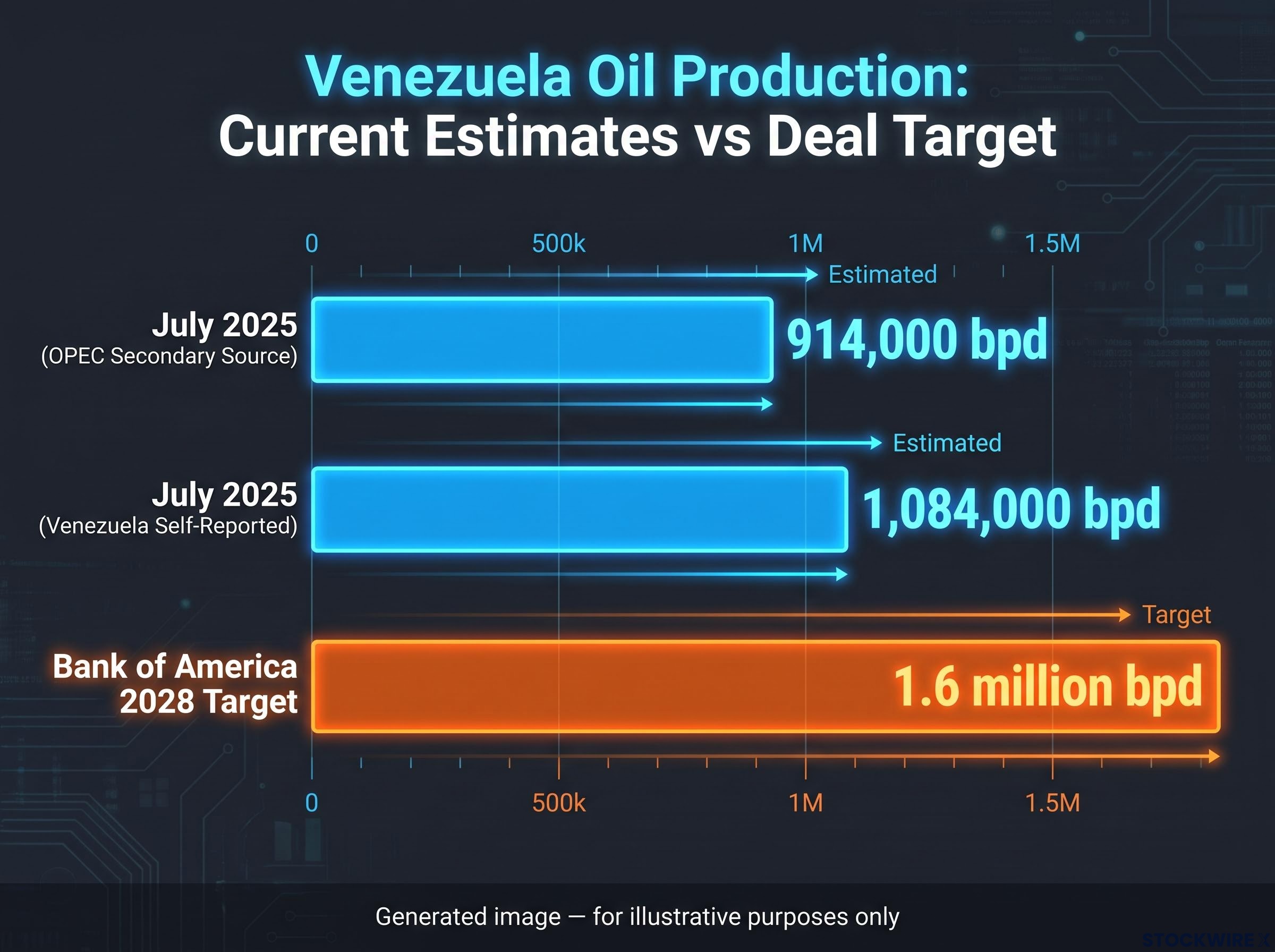
Set that baseline against Bank of America’s target of 1.6 million bpd, and the distance the deal has to cover comes into focus. Closing it means overcoming the specific difficulties of Orinoco extra-heavy crude, which is technically demanding to extract and refine and routinely trades at a steep discount to benchmark prices because of its quality.
Venezuela’s roughly 914,000 bpd baseline sits within a global oil market where OPEC’s production share has already contracted to approximately 27-28% of global crude supply, a structural shift that directly shapes how much pricing leverage any coordinated production increase from Caracas could actually exert.
The structural barriers standing between the current baseline and that target are concrete:
- Aging upgraders and pipelines that require substantial refurbishment or entirely new construction
- Diluent supply gaps needed to convert extra-heavy oil into exportable blends
- Limited access to capital and technology after years of sanctions-related constraints
- Contract instability and Venezuela’s nationalisation history, which have made major international oil companies cautious about long-term capital commitments
For investors, the space between today’s roughly 914,000 bpd and Bank of America’s 1.6 million bpd target is exactly where the deal’s value gets created or evaporates. The technical barriers to closing that gap are the primary reason the analyst timeline has already slipped.
What BofA’s revised timeline signals
Bank of America pushed its production achievement window from late 2027 to sometime during 2028, citing the need for market participants to assess the implications of the newly announced framework. The 1.6 million bpd target itself remains unchanged.
That combination matters. Holding the target while moving the date is not a retreat from the bull case; it is constrained optimism.
The 2028 revision is not a minor technical adjustment. It signals that even the most constructive institutional read of this deal treats rapid production scale-up as genuinely uncertain, and you should treat that uncertainty as a core variable in any Venezuelan energy thesis rather than a footnote to it. Bank of America also noted that under the deal’s terms, output could potentially surpass 1.5 million bpd if the projected investment materialises.
What the deal means for holders of Venezuela’s defaulted debt
The temptation is to read the deal as either a rescue or a threat for creditors. Anne Milne’s note, dated 2 September 2026, refuses both, and the ambiguity is the point.
On one side, the deal could stimulate production capacity in a sector where major international firms had been reluctant to invest, lifting Venezuela’s overall economic output and, in principle, its capacity to service claims. On the other, the fiscal picture is genuinely unresolved.
- Potential positives for creditors: Stimulated production and investment could raise Venezuela’s economic output in an area where foreign capital had stalled, improving the theoretical capacity to service legacy claims.
- Identified risks for creditors: It is unclear how much fiscal revenue reaches the Venezuelan state in Caracas versus NABEP and U.S. government entities, and the untested production model adds a further layer of uncertainty to the debt outlook.
The core structural problem is distribution. Venezuela’s sovereign and PDVSA debt has been in default for years, and the deal introduces a new stakeholder, the U.S. government, with its own financial interests that may compete directly with those legacy creditors.
Bank of America cautioned that existing creditors with legacy claims could face downside risk if U.S. priorities shift toward national reconstruction rather than debt servicing.
For anyone holding Venezuelan sovereign or PDVSA bonds, that is a direct signal. The deal’s structure as currently disclosed does not clarify the path to creditor recovery, and it may actively complicate it. The uncertainty here is no longer about whether Venezuela can produce oil. It is about who the revenues will ultimately serve.
The governance questions hanging over the deal’s long-term credibility
Move from the macro structure down to the specific people and legal facts, and the deal’s durability starts to look contingent on factors well outside the oil sector. Three distinct risk categories stand out, in order of immediacy:
- Operator legal exposure. Alejandro Betancourt, NABEP’s controlling shareholder, remains under active investigation in Switzerland and Spain for alleged money laundering and tax fraud, according to El País (2 September 2026), which described him as the “architect, broker, and main beneficiary” of the contract. An operator facing unresolved foreign criminal investigations sits at the centre of an agreement signed by two U.S. Cabinet secretaries.
- Geopolitical friction with displaced concession holders. Many of the 17 fields were previously held by Russian or Chinese firms, raising the prospect of contested reallocation.
- Structural novelty of Pentagon equity. The Office of Strategic Capital’s 35% stake is unprecedented in scale, introducing political and oversight risk that future administrations and Congress could revisit.
Betancourt’s alignment with Venezuela’s oil-opening strategy predates this deal. His NABEP signed the first Contrato de Participación Productiva Petrolera under Venezuela’s Ley Antibloqueo in April 2024, an arrangement that gave a private company greater participation than the prior framework allowed. Venezuela’s interim President Delcy Rodríguez granted the current concessions on the Venezuelan side.
The presence of an operator under active foreign criminal investigation is not a reputational footnote. It is a variable that could trigger legal challenges, Congressional pushback, or sanctions complications that directly affect whether the deal remains operable.
Geopolitical friction from displacing Russian and Chinese interests
Russia and China, as former concession holders in a number of the 17 fields, may contest or resist the reallocation through diplomatic, legal, or commercial channels. Displacing state-linked energy interests from two major powers is rarely a quiet process.
The displacement of Russian and Chinese concession holders from NABEP’s 17 fields sits within the same U.S. sanctions architecture that has pushed China to scale RMB invoicing and CIPS settlement capacity as alternatives to dollar-denominated energy trade, giving displaced state-linked firms additional financial levers to contest or resist reallocation through non-legal channels.
Available reporting does not detail the specific mechanism by which NABEP acquired these fields from their prior holders. That gap is itself an unresolved risk, because how the transfer was executed will shape how easily it can be challenged later.
What investors should watch before the deal’s promises become production
The deal is announced, but its value to anyone holding Venezuelan equity, debt, or commodity exposure depends entirely on execution variables that will only resolve over years. The paper terms are settled; the signals that matter are not.
Venezuelan production volatility is one variable within a market that has already absorbed historically significant oil supply shock patterns, and the historical relationship between major supply disruptions and equity sector rotation provides context for how markets are likely to price incremental Venezuelan output against an unstable geopolitical baseline.
Here is a structured watchlist for the months ahead:
- NABEP production figures measured against Bank of America’s 1.6 million bpd target and its revised 2028 timeline
- Progress on the $100 billion NABEP investment commitment as the capital-deployment indicator
- Fiscal revenue transparency disclosures showing how much reaches Caracas versus NABEP and U.S. entities
- Congressional hearings and oversight of the Pentagon’s 35% equity stake
- Any movement on Venezuelan sovereign debt restructuring or creditor engagement
The 100-year duration means the near-term signals will disproportionately set the narrative frame for years. First-year production data, the pace of investment flows, and Washington’s political reaction to Pentagon equity will tell you more than the deal’s headline terms ever could.
Milne’s ambiguity framing remains the most honest characterisation of where institutional analysis currently sits. For now, the next 12 months of production data, revenue reporting, and Congressional response are the variables worth tracking, not the announcement itself.
This article is for informational purposes only and should not be considered financial advice. Investors should conduct their own research and consult with financial professionals before making investment decisions. Past performance does not guarantee future results, and financial projections are subject to market conditions and various risk factors. Forward-looking statements are speculative and subject to change based on market developments.