
How $100 Oil Killed Fed Rate Cut Expectations for 2026

Key Takeaways
- Markets now price a 73% probability of no Fed rate cuts in 2026, a complete reversal from expectations of two cuts at the start of the year.
- The federal funds rate remains on hold at 3.50%–3.75% following the 18 March 2026 FOMC meeting, with a 40% chance of a rate hike by October 2026.
- Oil prices sustained above $100 per barrel due to the Persian Gulf conflict are the primary driver keeping inflation elevated and blocking the Fed's easing path.
- Bond markets remain sceptical of near-term rate cuts with the 10-year Treasury yield breaking above 4.5%, even as equity markets rallied on ceasefire developments.
- The Fed's next policy decision hinges on oil price trajectory, CPI and PCE inflation readings, and labour market data ahead of the 28-29 April 2026 FOMC meeting.
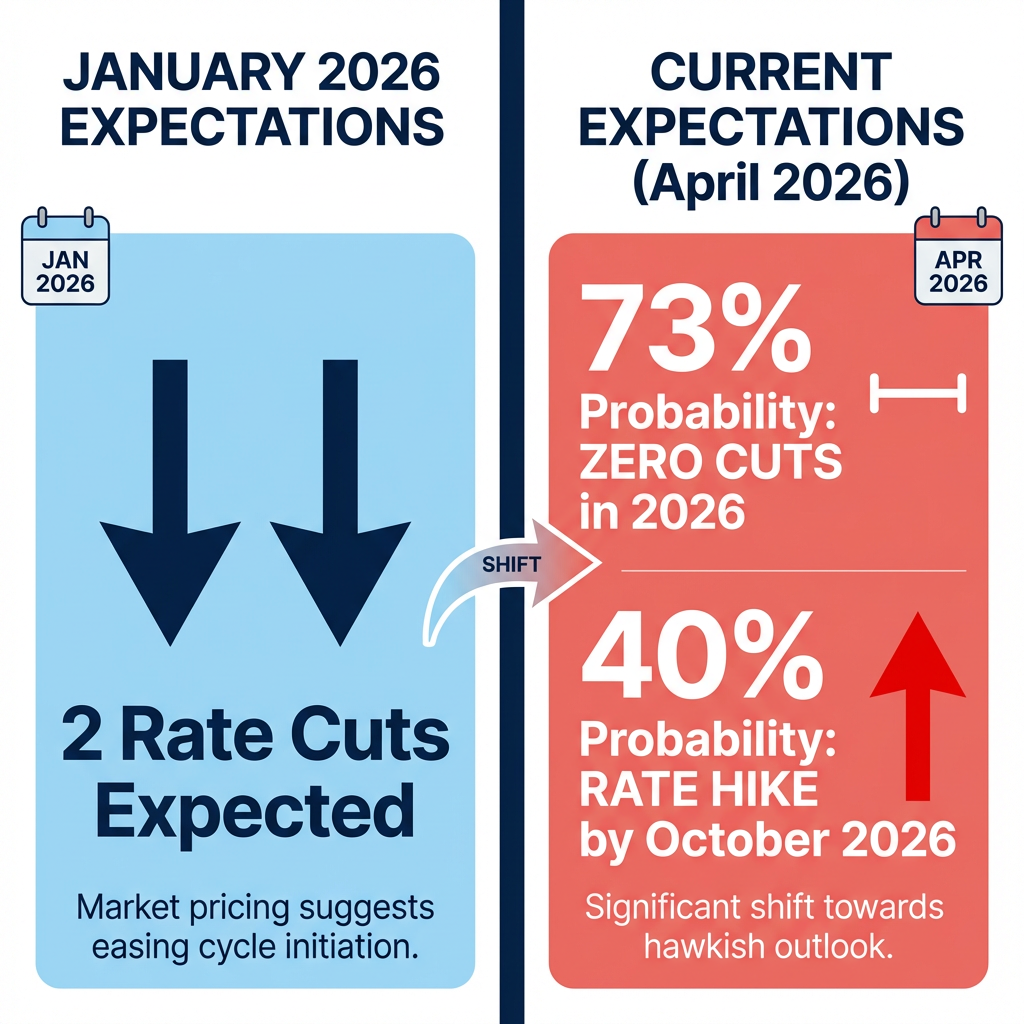
Expectations for Fed rate cuts have reversed dramatically in recent months. At the start of 2026, markets priced in two rate reductions. Today, there’s a 73% probability the Federal Reserve will make no cuts at all this year, with a 40% chance of a rate hike by October 2026.
The shift reflects three converging pressures: oil prices sustained above $100 per barrel following Middle East conflict, inflation remaining above the Fed’s 2% target, and uncertainty about how geopolitical shocks will affect the US economy. What began as a clear easing path has become a wait-and-see stance as policymakers navigate volatile energy markets and persistent price pressures.
Where the Fed Stands Today: Rates on Hold at 3.50%-3.75%
The federal funds rate target range sits at 3.50% to 3.75%, unchanged since the 18 March 2026 FOMC meeting. The Fed cut rates by 100 basis points in 2025 and another 75 basis points in early 2026 before pausing at the current level.
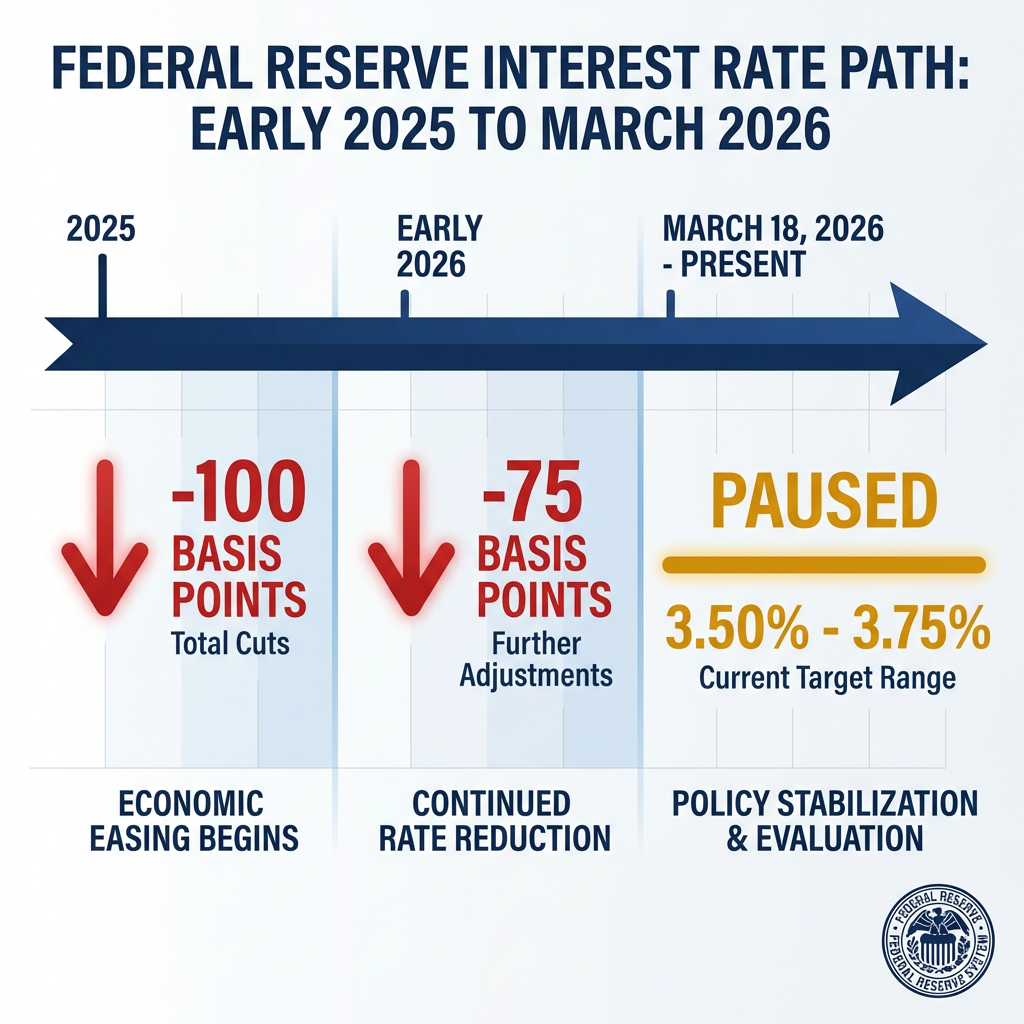
The March FOMC statement noted that “uncertainty about the economic outlook remains elevated” due to “implications of developments in the Middle East for the U.S. economy.” This language signals the Fed’s caution about making further policy moves whilst geopolitical risks remain high.
> FOMC Statement, 18 March 2026
> “Uncertainty about the economic outlook remains elevated” due to “implications of developments in the Middle East for the U.S. economy.”
The median dot plot projection shows one quarter-point cut expected in 2026 and another in 2027, unchanged from December 2025 forecasts. The next FOMC meeting is scheduled for 28-29 April 2026, where the Fed is widely expected to hold rates steady as it assesses incoming data on inflation and economic activity.
When big ASX news breaks, our subscribers know first
How Federal Reserve Rate Decisions Affect the Economy
The federal funds rate is the interest rate banks charge each other for overnight loans. It serves as a benchmark that influences rates throughout the economy. The Fed raises rates to cool inflation by making borrowing more expensive, which slows spending and investment. It lowers rates to stimulate growth by making credit cheaper and encouraging economic activity.
Fed rate decisions ripple through multiple areas of the economy:
- Mortgage rates: Higher Fed rates typically push up fixed and variable mortgage costs, affecting homebuyers and refinancing activity
- Credit card APRs: Most credit cards have variable rates tied to the federal funds rate, so changes directly impact borrowing costs
- Auto loans: Vehicle financing costs rise or fall with Fed rate movements, influencing consumer purchasing decisions
- Savings account yields: Higher rates benefit savers through improved returns on deposits and money market accounts
- Business investment: Companies factor borrowing costs into expansion plans, with higher rates potentially delaying capital projects
The Fed operates under a dual mandate: maximum employment and price stability, defined as 2% annual inflation. Current conditions create tension between these goals. Inflation remains elevated whilst the labour market shows signs of softening, forcing policymakers to balance price control against economic support.
The Federal Reserve’s dual mandate framework—maximum employment and price stability, defined as 2% annual inflation—provides the statutory authority that guides all FOMC policy decisions and creates the tension between inflation control and economic support discussed throughout this analysis.
The Oil Shock Factor: How Energy Prices Are Blocking Rate Cuts
The Persian Gulf conflict that began in late February 2026 triggered an oil price surge that has sustained prices above $100 per barrel for much of the period since. This sudden jump in oil prices is the primary factor keeping inflation elevated and complicating the Fed’s ability to cut rates.
The International Energy Agency has described the current situation as the greatest global energy security challenge in history, with implications extending far beyond immediate price movements to fundamental questions about supply reliability and geopolitical stability.
Oil prices have surged due to Middle East conflict, sustaining above $100 per barrel, though recent ceasefire news has allowed prices to fall from their highs. However, prices remain elevated compared to pre-conflict levels, indicating markets remain cautious about supply risks.
Higher oil prices increase production and transportation costs across the economy, which flow through to consumer prices. Producer prices have climbed in response to elevated energy costs. The Fed has characterised inflation as “notably above” the 2% goal, with goods inflation escalating over the last year.
Understanding why energy prices have become the dominant force driving inflation in 2026 is critical to evaluating whether the Fed can deliver anticipated rate cuts or will be forced to maintain restrictive policy longer than markets currently expect.
Bond markets have responded to sustained oil prices by pushing yields higher. The 10-year Treasury yield has trended upward since April 2026, breaking above 4.5% at times amid inflation concerns. Bond traders are pricing in inflation persistence, which reduces expectations for near-term rate cuts.
Market Expectations Have Shifted Dramatically
Market pricing of Fed policy has evolved substantially over recent months. In January 2026, markets anticipated two rate cuts for the year. By early April, this shifted to one cut, edging toward zero. Following ceasefire developments, there’s now a 73% chance the Fed makes no cuts in 2026.
> Market Probability
> Markets now price a 40% chance of a rate hike by October 2026, a complete reversal from expectations just months earlier.
Equity and bond markets are sending different signals about the outlook. Stocks rallied on ceasefire news. Bond markets remain more sceptical. Municipal bonds, corporate bonds, and Treasuries all remain below pre-conflict levels. Bond traders aren’t convinced the Fed will cut rates anytime soon, reflecting concerns about inflation persistence.
Examining how equity markets recovered from the initial geopolitical shock provides context for understanding current investor sentiment and whether the recent rally reflects sustainable fundamentals or temporary relief that may not last if the Fed holds rates higher for longer.
The disconnect between equity markets rallying despite sustained energy price pressures and bond markets pricing in inflation persistence raises questions about whether stock investors are underestimating the Fed’s commitment to fighting inflation.
The next major ASX story will hit our subscribers first
What Fed Officials and Economists Are Saying
Fed Chair Jerome Powell has highlighted the unclear implications of war-related shocks on the economy. Most Fed officials predict at least one 2026 cut but advocate standing firm given the magnitude of inflation following prior cuts (75 basis points in 2026 after 100 basis points in 2025).
> Fed Vice Chair Michelle Bowman, 20 March 2026
> Forecasts three cuts in 2026 to support the labour market, representing the more dovish end of Fed projections and emphasising emerging labour market softening.
Brian Coulton, Fitch Chief Economist, stated on 24 March 2026 that two cuts are possible if the oil shock proves short-lived, shifting focus to labour market conditions. Otherwise, he recommends holding through the next meeting. This conditional view represents the consensus amongst private sector economists.
Major Wall Street firms including Morgan Stanley, Fidelity, and J.P. Morgan share the view that the energy shock has upended dot plot expectations. Markets have removed previously anticipated cuts as inflation data and oil prices remain elevated.
What Comes Next: Key Factors to Watch
Oil price trajectory is the critical variable determining the rate path. Fed projections anticipate oil-driven pressures waning later in 2026, which would allow a return toward the 2% inflation target and potentially open the door to cuts. This assumption carries high uncertainty given geopolitical dynamics and the risk of renewed conflict.
Key indicators to monitor include:
- Oil price trajectory: Sustained decline toward pre-conflict levels would ease inflation pressures and support rate cuts
- Inflation readings: CPI and PCE data will show whether price pressures are moderating or remaining elevated
- Labour market data: Employment figures and unemployment rate trends will indicate if economic softening justifies supportive policy
- Middle East ceasefire developments: Geopolitical stability will determine whether oil price declines prove durable
- FOMC meeting statements: Upcoming policy announcements will provide guidance on the Fed’s evolving assessment of conditions
The Fed faces a challenging trade-off. Labour market softening creates potential need for supportive policy to prevent unnecessary economic weakness. Cutting rates whilst inflation remains elevated risks entrenching higher prices and undermining credibility. The path forward depends heavily on factors largely outside the Fed’s control, namely global oil markets and geopolitical stability.
This article is for informational purposes only and should not be considered financial advice. Investors should conduct their own research and consult with financial professionals before making investment decisions.
Frequently Asked Questions
What is the current Federal Reserve interest rate in 2026?
The federal funds rate target range currently sits at 3.50% to 3.75%, unchanged since the FOMC meeting on 18 March 2026 after cumulative cuts of 175 basis points across 2025 and early 2026.
Why are Fed rate cuts being delayed in 2026?
Three converging pressures are blocking rate cuts: oil prices sustained above $100 per barrel following Middle East conflict, inflation remaining above the Fed's 2% target, and elevated uncertainty about how geopolitical shocks will impact the US economy.
What is the probability of a Fed rate hike in 2026?
Markets currently price a 40% chance of a rate hike by October 2026, a dramatic reversal from expectations at the start of the year when two rate cuts were anticipated.
How do oil prices affect Federal Reserve rate decisions?
Higher oil prices raise production and transportation costs across the economy, pushing consumer prices up and keeping inflation above the Fed's 2% target, which prevents policymakers from cutting rates without risking entrenching higher prices.
When is the next FOMC meeting and what is expected?
The next FOMC meeting is scheduled for 28-29 April 2026, where the Fed is widely expected to hold rates steady as it continues to assess incoming inflation data and economic activity against a backdrop of geopolitical uncertainty.


