
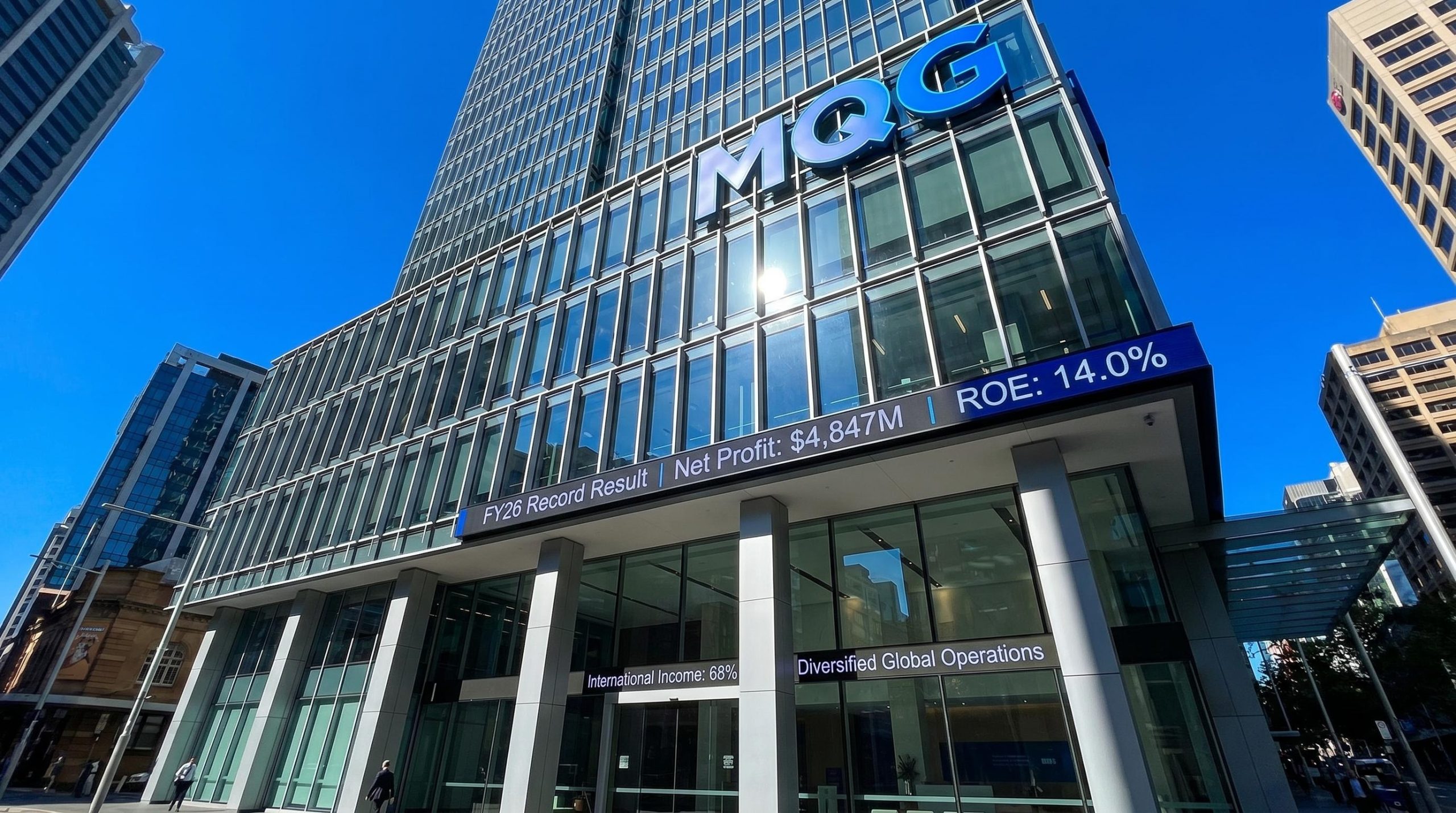
Macquarie Group delivers record $4.85 billion profit in FY26
Macquarie Group has reported a net profit after tax of $4,847 million for the year ended 31 March 2026, representing a 30% increase on FY25. The second half of FY26 delivered a record half-year result of $3,192 million, up 93% on 1H26, demonstrating significant earnings momentum across the diversified financial services group.
Earnings per share rose 30% to $12.77, while return on equity improved to 14.0% from 11.2% in FY25, signalling enhanced capital efficiency. International income accounted for 68% of total income in FY26, underscoring the group’s global diversification strategy across its four operating divisions.
Shemara Wikramanayake, Managing Director and Chief Executive Officer
“Each of our businesses used its specialist expertise in navigating the current environment, identifying opportunities that support long-term growth and delivering positive outcomes for our clients and communities.”
The result was supported by net operating income of $19,477 million, up 13% on FY25, whilst operating expenses rose 5% to $12,748 million. Income tax expense increased 40% to $1,860 million, with the effective tax rate rising to 27.6% from 26.2% in FY25, primarily driven by the geographic composition and nature of earnings.
When big ASX news breaks, our subscribers know first
Operating group breakdown reveals broad-based strength
All four operating groups delivered double-digit profit growth during FY26, with Commodities and Global Markets (CGM) leading the performance. CGM contributed $4,221 million, up 49% on FY25, primarily driven by a gain on sale from the divestment of the OnStream meters platform and increased risk management income from client hedging activity across Global Gas and Power and Global Oil businesses. The division also benefited from higher inventory management and trading income resulting from supply and demand imbalances in North American Gas and Power and oil trading.
Macquarie Asset Management (MAM) delivered a net profit contribution of $2,602 million, up 27% on FY25. The result reflected higher performance fees and was supported by the completion of the sale of MAM’s public investments business in North America and Europe during 2H26.
Banking and Financial Services (BFS) contributed $1,610 million, up 17% on FY25, driven by growth in the loan portfolio and BFS deposits. This increase was partially offset by lower margins reflecting changes in portfolio mix and lending and deposit competition, as well as higher technology expenses to support business growth and scalable operations.
Macquarie Capital’s net profit contribution reached $1,491 million, up 43% on FY25, reflecting higher income from equity investments, mergers and acquisitions fees, brokerage, and the private credit portfolio. This was partially offset by higher impairment charges and an increased share of net losses from associates and joint ventures.
| Operating Group | FY26 Net Profit Contribution | FY25 Comparison | Change % |
|---|---|---|---|
| Commodities and Global Markets (CGM) | $4,221 million | $2,829 million | +49% |
| Macquarie Asset Management (MAM) | $2,602 million | $2,049 million | +27% |
| Banking and Financial Services (BFS) | $1,610 million | $1,380 million | +17% |
| Macquarie Capital | $1,491 million | $1,043 million | +43% |
CGM and MAM together contributed over $6.8 billion in net profit, demonstrating the strength of Macquarie’s asset-light fee-generating model. The diversified nature of the operating groups allows the business to capture upside from both transaction-driven opportunities and recurring income streams.
What drives Macquarie’s diversified earnings model
Macquarie operates as a diversified financial services group with four distinct business lines, each serving different client needs and market opportunities. The structure comprises two annuity-style businesses and two markets-facing divisions, creating a balanced earnings profile that supports sustainable performance across market cycles.
MAM and BFS generate recurring income from asset management fees, lending activities, and banking services. These annuity-style businesses provide stability and predictable cash flows, serving as a foundation for the group’s earnings base. MAM manages infrastructure assets, real estate, and alternative investments on behalf of institutional clients, whilst BFS provides retail and business banking, mortgages, and financial advisory services.
CGM and Macquarie Capital are more transaction-driven, capturing opportunities from market volatility, commodity price movements, and capital markets activity. CGM operates across commodities trading, asset finance, and global markets activities, whilst Macquarie Capital focuses on mergers and acquisitions advisory, equity capital markets, and principal investing.
The group’s 68% international income contribution diversifies geographic risk and provides exposure to structural growth trends across North America, Europe, and Asia. The improvement in return on equity from 11.2% to 14.0% indicates the group is generating stronger returns on shareholder capital, an important metric for income-focused investors assessing the efficiency of capital deployment.
Dividend and capital position underpin shareholder returns
The Board has declared a final ordinary dividend of $4.20 per share (35% franked), bringing the total FY26 ordinary dividend to $7.00 per share (35% franked). This represents a 2H26 payout ratio of 50% and a full-year FY26 payout ratio of 55%, within the group’s stated dividend policy range of 50-70% annual payout.
The final dividend has a record date of 19 May 2026 and a payment date of 2 July 2026. Shares issued under the Dividend Reinvestment Plan (DRP) will be at a discount of 1.5% to the prevailing market price, with the group retaining the option to purchase shares on-market in part or in full if issuing becomes impractical or inadvisable.
Balance sheet strength exceeds regulatory requirements
Macquarie’s financial position continues to exceed the Australian Prudential Regulation Authority’s (APRA) Basel III regulatory minimum requirements. The Bank Group APRA Basel III Level 2 Common Equity Tier 1 (CET1) capital ratio stood at 12.8% (Harmonised: 17.5%) at 31 March 2026, in line with 31 March 2025.
Key capital and liquidity metrics include:
- Bank Group CET1 ratio: 12.8% (Harmonised: 17.5%)
- Leverage ratio: 4.7% (Harmonised: 5.3%)
- Liquidity Coverage Ratio (LCR): 173%
- Net Stable Funding Ratio (NSFR): 116%
- Total deposits: $221.5 billion (up 25% on 31 March 2025)
- Term funding raised during FY26: $29.9 billion
The group concluded its on-market share buyback programme as at 7 May 2026, having acquired $1,013 million of ordinary shares at an average price of $189.80 per share. The Board resolved to conclude the buyback given significant business growth over recent periods and prevailing market conditions, with no expectation of further share purchases under the extended programme.
The substantial increase in deposits to $221.5 billion provides a stable funding base to support growth opportunities, whilst the strong capital ratios and liquidity metrics create a buffer for deployment in new initiatives. The combination of dividend yield and the completed buyback programme demonstrates capital return discipline aligned with growth investment priorities.
Management outlook signals continued cautious optimism
Macquarie maintains a cautious stance with a conservative approach to capital, funding, and liquidity that positions the group to respond to the current environment. Management identified a range of factors that may influence short-term performance, including global economic conditions, inflation, interest rates, significant volatility events, and the impact of geopolitical events. Additional considerations include completion of period-end reviews and transactions, the geographic composition of income and foreign exchange impacts, and potential tax or regulatory changes and tax uncertainties.
Board changes
Jillian Broadbent has decided to step down from the Macquarie Group Limited (MGL) and Macquarie Bank Limited (MBL) Boards in December 2026, having served eight years.
Shemara Wikramanayake
“Macquarie remains well-positioned to deliver superior performance in the medium term with established, diverse income streams; deep expertise across diverse sectors in major markets with structural growth tailwinds; patient adjacent growth across new products and new markets; ongoing investment in our operating platform; a strong and conservative balance sheet; and a proven risk management framework and culture.”
Management’s cautious positioning acknowledges near-term headwinds whilst highlighting structural growth tailwinds across the group’s operating divisions. The emphasis on diverse income streams, geographic reach, and conservative balance sheet management suggests a defensive posture that does not abandon growth ambitions, positioning the group to capture opportunities as market conditions evolve.
Want to Track Macquarie Group’s Performance as It Unfolds?
Macquarie’s record $4.85 billion profit and 30% earnings growth demonstrate the strength of its diversified global operating model. The combination of annuity-style businesses and markets-facing divisions creates a balanced earnings profile that supports sustainable performance across market cycles.
To stay updated on Macquarie Group’s quarterly results, dividend announcements, and strategic initiatives as they’re released, visit the Macquarie Group investor centre for comprehensive coverage and real-time ASX announcements.