
Meta Platforms beat Wall Street on revenue, posting $64.601B for the September quarter, up 26%. Yet its operating income fell 37% to $12.988B, and the stock still climbed roughly 4% in after-hours trading.
The gap comes down to one line item. Meta booked a $9.89B legal charge tied to its August settlement with 52 US state attorneys general, and that charge distorted the headline Meta Q3 2026 earnings figures. The company also announced a new nonvoting share class and raised its full-year expense guidance.
The results landed after the US market close on 21 October 2026. They give investors three separate questions to answer, and only one of them is about the settlement.
Here is how to tell which numbers are one-off noise, which point to lasting cost pressure, and what the new Class C shares do and do not change for your holding.
Why did a revenue beat come with a 37% fall in operating income?
On the top line, the quarter looked strong. Revenue cleared consensus by more than $1B, and diluted earnings per share (EPS, the profit attributed to each share) came in above forecasts. The profit line moved the other way.
| Metric | Q3 2026 reported | YoY change | Consensus |
|---|---|---|---|
| Revenue | $64.601B | +26% | About $63.2B-$63.37B |
| Diluted EPS | $3.83 | +265% | About $3.56-$3.57 |
| Operating income | $12.988B | -37% | About $18.66B-$20.9B |
| Operating margin | 20% | Down from 40% | Not consistently reported |
Consensus figures vary slightly by source, depending on whether forecasters adjusted for the one-time item. Meta said that excluding the charge, EPS would have been about $7.40 and operating income about $22.88B.
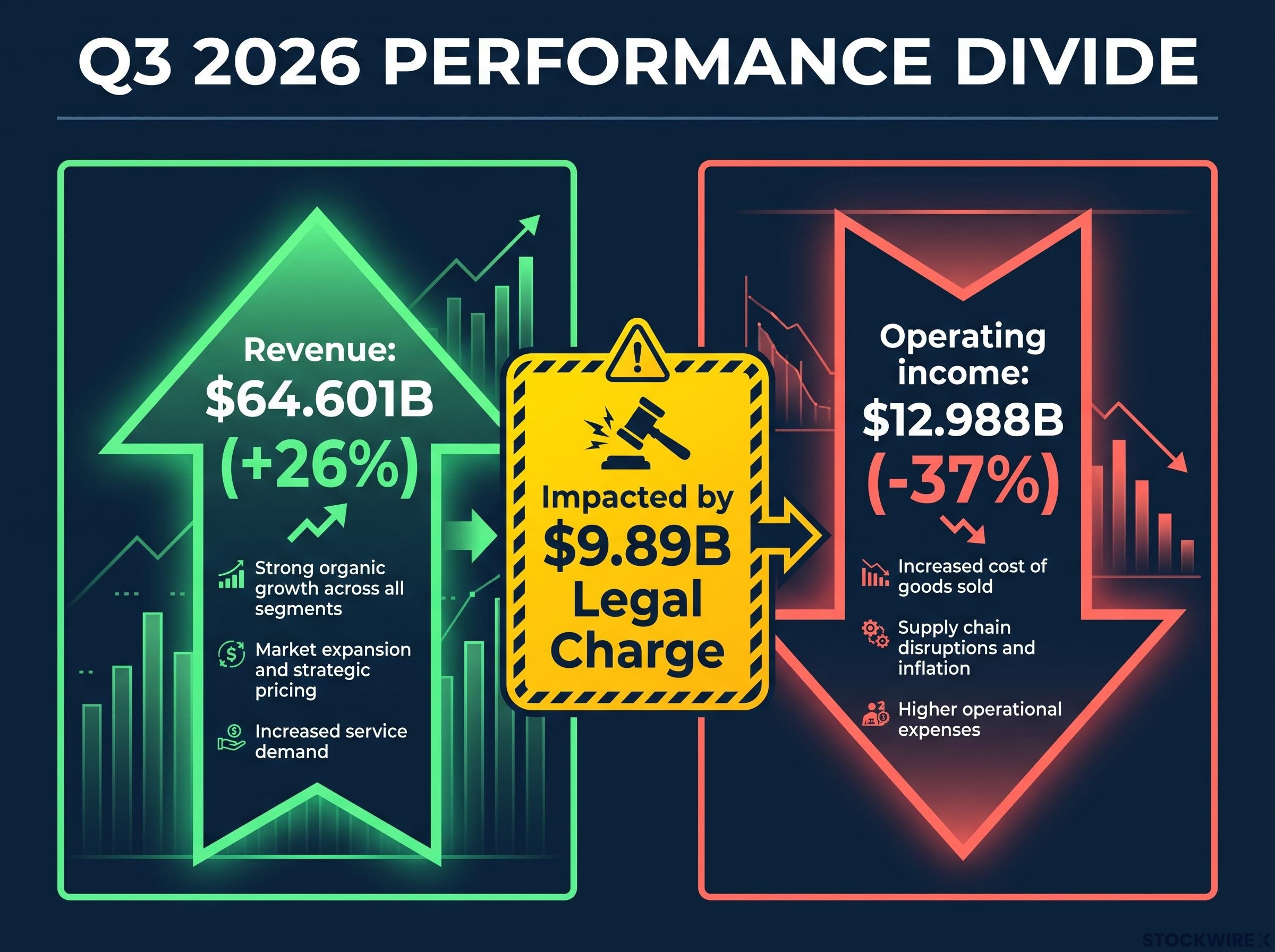
That single charge explains most of the gap. It does not explain all of it.
Chief Executive Officer Mark Zuckerberg kept the focus on artificial intelligence (AI):
“We hit major milestones this quarter toward delivering personal superintelligence for everyone, including launching Muse and Muse Wonder, our first frontier model,” said Mark Zuckerberg, Chief Executive Officer.
For you, the GAAP EPS figure is not a clean read on earnings power this quarter. GAAP refers to the standard accounting rules companies must report under. The revenue beat is the more reliable signal of how the business is performing.
What the legal charge actually is
The $9.89B is a general-and-administrative expense linked to Meta’s August agreement with the state attorneys general. That agreement resolved litigation over teen mental health and social media.
The charge reflects the August settlement, which Citi framed as converting an open-ended liability into a finite one, with roughly $12-13 billion guaranteed over about 10 years and a conditional tranche tied to rival platforms.
The charge is an accounting expense recorded in Q3, not a cash payment of that size. The agreement allows for payments of up to about $18.59B, so the larger cash exposure still sits ahead of Meta.
When big ASX news breaks, our subscribers know first
Where the quarter was strong, and where it was not
The advertising business delivered. Ad revenue reached $63.061B, and Family of Apps, which covers Facebook, Instagram, WhatsApp and Messenger, beat revenue forecasts comfortably.
| Segment or metric | Reported | YoY | Consensus |
|---|---|---|---|
| Advertising revenue | $63.061B | +26% | About $61.85B |
| Family of Apps revenue | $64.158B | +26% | About $62.75B |
| Family of Apps operating income | $17.117B | -31% | About $23.3B |
| Reality Labs revenue | $443M | -6% | About $518M |
| Reality Labs operating loss | $4.129B | Narrowed from $4.432B | About $5.1B |
Then comes the harder number. Family of Apps operating income missed by more than $6B. Reality Labs, the virtual and augmented reality unit, missed on revenue but lost less than expected. Family daily active people reached 3.64 billion, up 3% and just shy of the 3.65 billion forecast.
Using Meta’s own figures, the adjusted operating income implies a margin of roughly 35%. That is an estimate, not a company figure, and it remains well below last year’s 40%.
- Bullish reading: 24/7 Wall St. argued the settlement effectively explains the EPS shortfall, with adjusted EPS well above consensus and ad demand intact.
- Bearish reading: InvestingLive coverage stressed the severity of the operating income miss, raising the question of whether spending is rising structurally.
If even the adjusted margin trails last year, treat part of this profit squeeze as a cost trend. It will not necessarily disappear once the settlement is behind Meta.
Can $135B-$145B of AI capex pay for itself?
That cost trend runs straight into Meta’s spending plans. Capital expenditure (capex, money spent on long-term assets such as data centres and servers) is now guided at up to $145B for 2026.
Meta’s spending sits inside a wider hyperscaler capex wave, with Amazon, Microsoft, Alphabet and Meta together guiding to roughly $725 billion in 2026, much of it funded by record debt issuance.
| Guidance item | New guidance | Prior or comparison |
|---|---|---|
| 2026 total expenses | $175B-$179B | $165B-$169B (new range includes legal charge) |
| 2026 capex | $135B-$145B | $130B-$145B |
| Q4 2026 revenue | $73B-$76B | About $73.57B expected; about 1% currency headwind |
| Reality Labs 2026 loss | $18B-$19B | Possibly about $15B next year |
Meta still expects 2026 operating income to exceed 2025 even excluding the charge. The two sides of the argument look like this:
- Bull case: Meta says AI is already lifting engagement, content recommendations and ad monetisation, and should support strong revenue growth through 2027.
- Bear case: Depreciation (the gradual expensing of assets over their useful life) and data centre running costs rise as infrastructure comes online, while Reality Labs keeps losing billions and third-party analysts flag pressure on free cash flow.
Reuters reported that Mike Proulx of Forrester summed up the shift in sentiment:
Meta’s AI spending was easier to celebrate while margins were expanding, and harder once those costs showed up in the financial statements, according to Proulx’s comments as reported by Reuters.
The question for the shares is no longer whether Meta can grow revenue. It is whether that growth outpaces depreciation and infrastructure costs, which decides how much of each revenue dollar you actually see as profit. The market has not answered that yet.
Past performance does not guarantee future results. Financial projections are subject to market conditions and various risk factors.
What the new nonvoting Class C shares change for shareholders
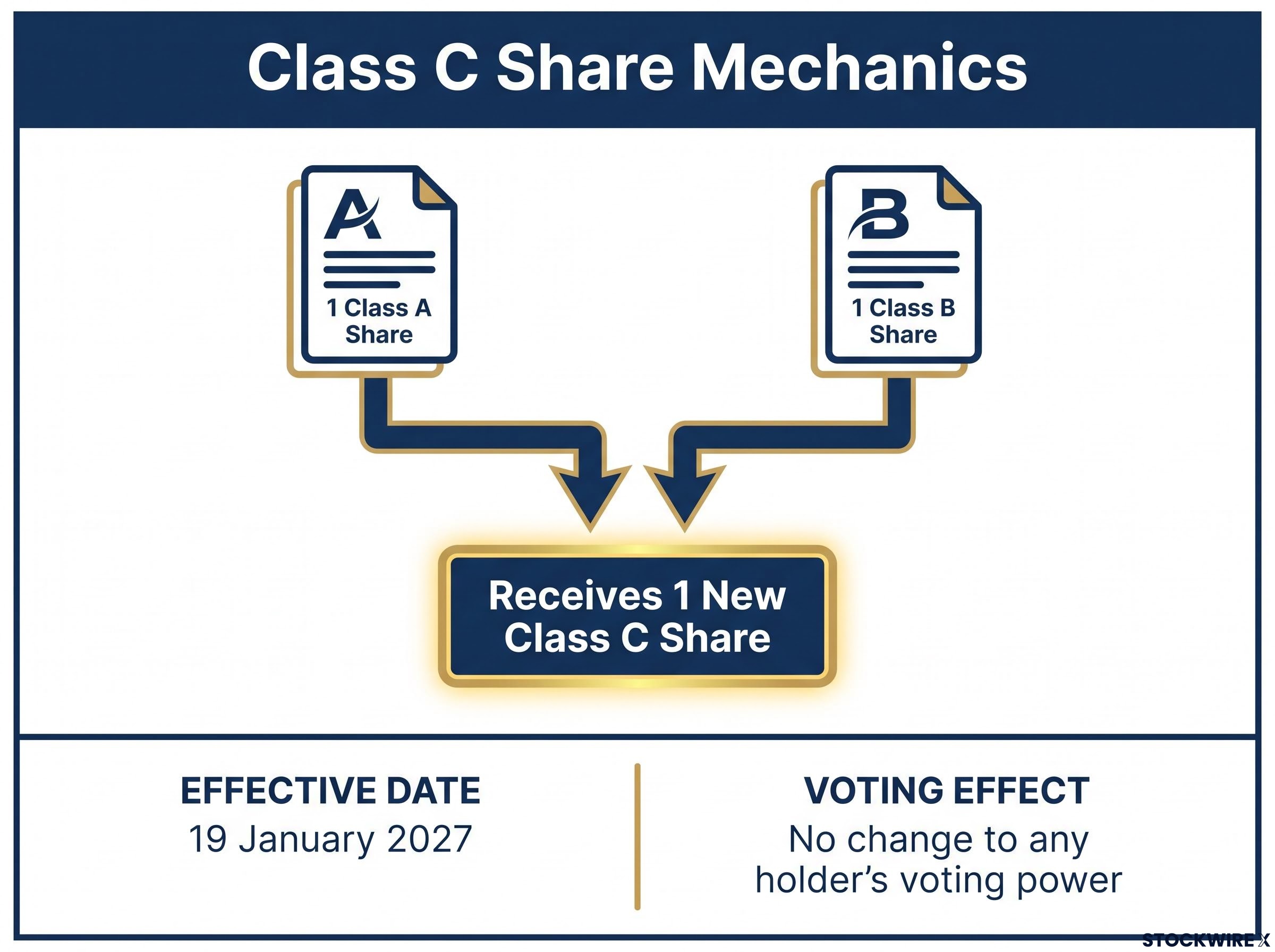
The governance news starts with reassuring mechanics. Meta will pay a one-time stock dividend of one new Class C share for every Class A and Class B share, subject to its amended Delaware certificate of incorporation taking effect.
| Term | Detail |
|---|---|
| Ratio | One Class C share per Class A and Class B share |
| Effective date | 19 January 2027 |
| Listing | Class A stays on Nasdaq; Meta intends to qualify Class C for Nasdaq |
| Voting effect | No change to any holder’s voting power |
| Record and payment dates | Not yet set |
Meta expects the market price effect to resemble a two-for-one split. It has also signed a Founder Alignment Agreement with Zuckerberg covering his Class C sales, his service and future Class C dividends, though details were not disclosed. Moelis advised the independent special committee, and Morgan Stanley advised Meta.
The closest comparison is Alphabet, whose publicly traded Class C shares are also generally nonvoting.
Dilution and control: the open questions
Voting dilution is off the table for now. Economic dilution is not.
The dividend creates no cash on its own. It becomes a financing tool only if Meta later issues Class C shares for compensation, acquisitions or funding, which would shrink your slice of future earnings while leaving Zuckerberg’s control intact. No named ISS or Glass Lewis criticism of the proposal has been identified so far.
What to watch after this earnings report
The advertising strength is real, the GAAP profit figures are distorted, and the lasting issue is whether AI spending outpaces cost growth. Three markers will show which way that is heading:
- Outcomes of scheduled youth-safety trials and the timing of settlement cash payments.
- Family of Apps operating margin once the legal charge drops out.
- The Class C record and payment dates, plus any later Class C issuance.
The Q4 report is the next test, with the $73B-$76B revenue guide as the benchmark against rising costs.
For readers comparing quarters, our detailed coverage of Meta’s Q2 results breaks down the $42 billion expense base and the free cash flow collapse.
These statements are speculative and subject to change based on market developments and company performance. This article is for informational purposes only and should not be considered financial advice. Investors should conduct their own research and consult with financial professionals before making investment decisions.