Meta Platforms settled with 52 state attorneys general on 27 August 2026 for up to $18 billion over teen safety practices on Facebook and Instagram, closing one of the most consequential regulatory cases in the company’s history. The figure is the largest social media safety settlement ever reached in the United States.
The number sounds severe. Citi analyst Ronald Josey does not think it is. He maintained a Buy rating and an $800 price target on the same day the deal was announced, calling the settlement a de-risking event rather than a thesis-breaking one.
The gap between the headline and the analyst reaction tells you something worth understanding. The settlement’s financial structure, the user segment it covers, and the regulatory exposure it removes each complicate the story in ways that favour Meta shareholders. Here is what Meta actually agreed to, what it will cost in practice, and whether this changes anything material for investors holding or evaluating META.
The terms Meta actually agreed to, and who it covers
The consent order applies to Facebook and Instagram users who fall within the 13 to 17 age bracket. The coalition includes all 52 attorneys general plus several U.S. territories. Meta has not admitted wrongdoing, and the settlement terms remain subject to final court approval.
The New York Attorney General’s settlement announcement details the full consent order terms, including the coalition of 51 attorneys general, the age verification requirements, and the parental opt-out provisions that form the operational backbone of the agreement.
The core operational restrictions are specific and narrow:
- A default two-hour daily usage limit for minors, adjustable by parents
- Nighttime access blocked by default from midnight to 6 a.m.
- Notifications muted during school hours
- Session-length nudge prompts after extended continuous use
Beyond the time restrictions, Meta agreed to a second layer of platform changes:
- Stronger age verification mechanisms
- Enhanced parental controls
- Limits on social-comparison features, including hiding visible like counts
- An opt-in non-algorithmic feed option for minor users
YouTube and TikTok were referenced as potentially joining the same settlement framework, a detail that matters for the competitive picture covered later.
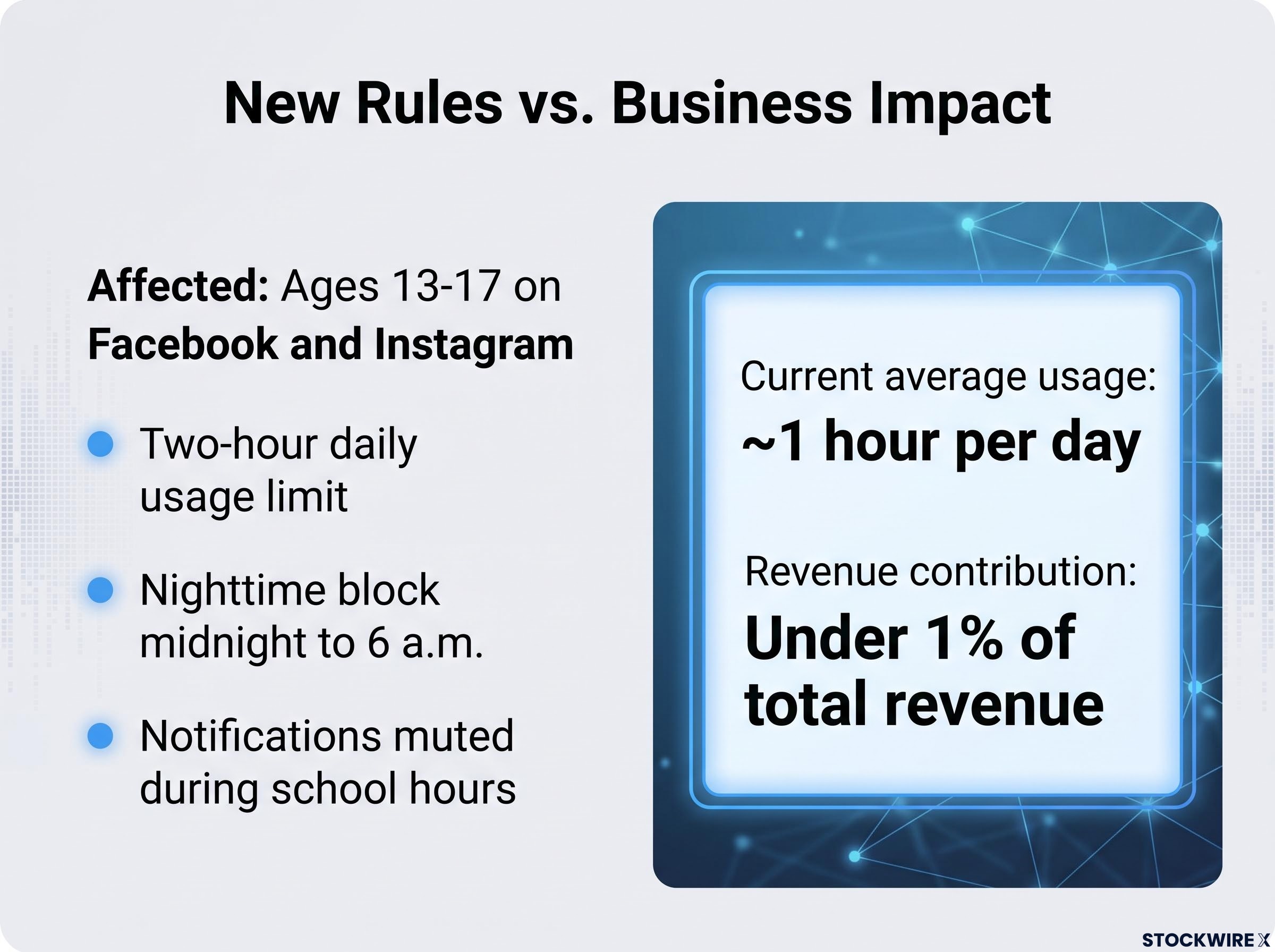
The restrictions target specific engagement patterns associated with harm to young users. They do not touch the adult user base, the advertising systems, or the commercial infrastructure that drives Meta’s revenue. That distinction is what separates a compliance event from a business model event for investors.
When big ASX news breaks, our subscribers know first
How $18 billion actually breaks down, and when Meta pays it
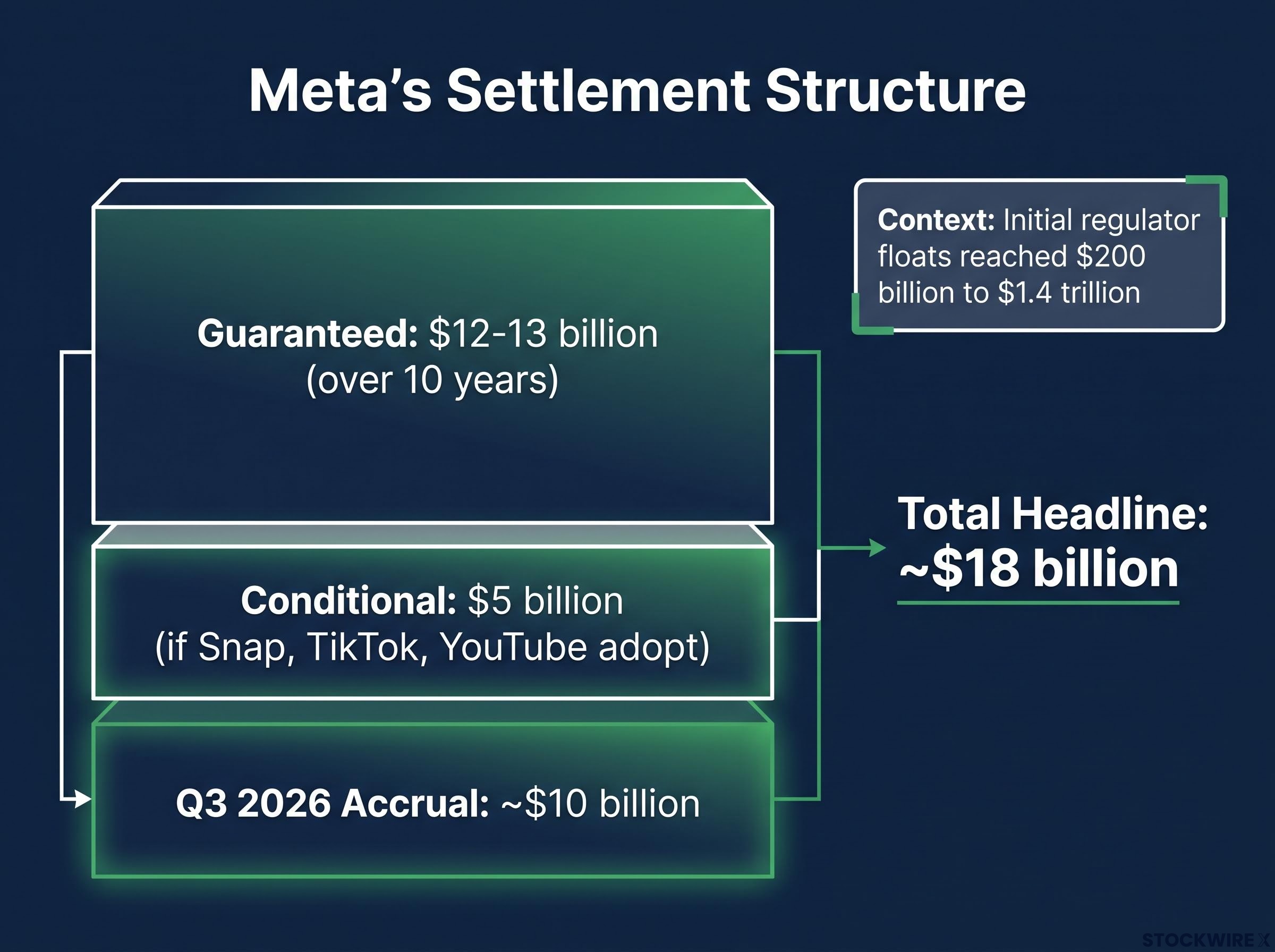
The headline figure is an upper bound, not a cheque Meta writes tomorrow. The financial architecture has three distinct components, and each carries different conditions.
| Component | Amount | Condition |
|---|---|---|
| Guaranteed base commitment | $12-13 billion | Paid over approximately 10 years |
| Conditional top-up | $5 billion | Triggered only if Snap, TikTok, and YouTube adopt comparable measures |
| Q3 2026 legal expense accrual | ~$10 billion | Accounting front-load of multi-year obligation |
| Total headline figure | ~$18 billion | Combined, including a separate Texas deal |
The guaranteed portion, roughly $12-13 billion, is the amount Meta will pay regardless. Spread over a decade, that is a low-single-digit-billions annual outflow for a company generating cash at Meta’s scale.
The conditional $5 billion only materialises if rival platforms agree to comparable teen safety frameworks. That tranche is designed to prevent the settlement from functioning as a Meta-specific competitive penalty, a point that carries strategic weight beyond the dollar amount.
The accounting wrinkle investors need to prepare for: Meta is expected to record approximately $10 billion as a legal expense accrual in Q3 2026. That will concentrate the accounting recognition into a single quarter, inflating reported expense growth and full-year guidance. But the actual cash leaves Meta’s balance sheet over a decade, not in one period.
When Q3 2026 earnings show a roughly $10 billion legal charge, the correct read is accounting front-loading of a multi-year obligation, not a single-quarter cash event that pressures liquidity or capital allocation capacity.
The figures that state regulators originally floated reached as high as $200 billion and $1.4 trillion before the current framework took shape. Against those initial ceilings, the settled amount, though substantial in absolute terms, marks a considerable reduction.
The figures that state regulators originally floated reached as high as $200 billion and $1.4 trillion before the current framework took shape, and those initial penalty demands were grounded in statutory per-violation multipliers across four states rather than projected jury awards, a distinction courts consistently use to reduce grossly disproportionate figures on due process grounds.
Why analysts see this as a de-risking event despite the cost
The logic runs in a direction that initially seems counterintuitive: Meta just agreed to pay up to $18 billion, and the analyst response is that this is good for the stock.
The mechanism is risk conversion. Before today, Meta carried an open-ended, theoretically enormous tail risk. State regulators had floated exposure figures in the hundreds of billions to trillions. That kind of undefined liability weighs on equity multiples because the market cannot price what it cannot quantify. The settlement replaces that uncertainty with a known, capped number. The cheque is large. The clarity is worth more.
The conditional tranche reinforces the strategic position. By tying $5 billion to rival adoption of comparable frameworks, the settlement incentivises an industry-wide baseline rather than a Meta-specific penalty. If TikTok, Snap, and YouTube converge on similar teen safety regimes, Meta’s competitive position is not uniquely damaged.
The conditional $5 billion tranche reflects a broader dynamic in sector-wide litigation exposure: when Meta, Snap, Alphabet, and TikTok face structurally identical legal theories across 29 states, a settlement that binds only one platform functions as a competitive penalty rather than an industry resolution.
Citi analyst Ronald Josey kept his Buy rating and $800 price target on META as of 27 August 2026, noting that the deal removes a substantial cloud over the shares at a moment when Meta’s AI product direction is gaining momentum. The underlying investment case, built on advertising strength, AI build-out, and platform scale, was characterised as remaining fully intact.
For an investor in META, Josey’s position is essentially this: the market has been discounting an undefined, potentially enormous legal risk. Replacing that uncertainty with a finite, quantified number is structurally positive for the stock’s multiple, even though a very large cheque is now being written.
Meta Connect 2026 as a near-term catalyst
Citi flagged Meta Connect 2026 as the next event capable of shifting market attention from legal headlines to growth vectors. The event is scheduled for 23-24 September at Meta’s Menlo Park campus, with a global livestream.
Connect typically showcases Quest headsets, smart glasses, and mixed reality hardware, but the event has increasingly become a platform for AI assistant and infrastructure updates. A strong showing could refocus the narrative on Meta’s AI trajectory at precisely the moment the legal overhang lifts.
Citi’s framing of Meta Connect 2026 as a catalyst for refocusing attention on AI product trajectory reflects a broader analyst consensus: the investment case for META is increasingly built on AI assistant monetisation, business agents, and subscription revenue rather than on advertising growth alone, a set of vectors that the settlement leaves entirely untouched.
What this settlement does not resolve, and what investors should monitor
The consent order covers the 52-state attorneys general coalition. It does not cover everything.
Two categories of litigation remain active:
- Approximately 1,200 school district lawsuits against Meta, pending and not addressed by the multistate settlement
- New Mexico’s separate appeal, an active state-level outlier that exists outside the settled framework
These are real. They are also structurally different from what just settled. The attorneys general case carried systemic weight because it represented a nationally coordinated legal action with enormous theoretical exposure. The school district cases are large in number but diffuse, lacking that same coordinating structure. Unless one of them coalesces into a new nationally coordinated escalation comparable in scope, they function as background litigation noise rather than a central valuation driver.
Teen users in the 13-17 age group generate under 1% of Meta’s total revenue. The typical adolescent spends around one hour per day on Instagram, a figure that falls comfortably beneath the new two-hour daily cap. The restriction largely codifies a safety standard rather than forcing a major aggregate behavioural shift.
The 1,200 school district cases are the number to keep on the radar. The absence of a new coordinating mechanism comparable to the 52-state coalition is why they do not yet constitute a parallel systemic threat.
What the settlement changes for META, and what it does not
The financial obligation is large but finite: roughly $12-13 billion guaranteed over a decade, with a conditional top-up that depends on industry behaviour. A Q3 2026 accounting charge of approximately $10 billion will inflate reported expenses without representing an equivalent immediate cash drain.
Q3 2026 guidance of $61-64 billion in revenue, set before the settlement was announced, already reflected a midpoint below analyst consensus, meaning the $10 billion accounting charge now arriving in the same quarter lands on top of an earnings print where the positive surprise cycle was already showing signs of pausing.
The core revenue engine is unaffected. Meta’s business generates overwhelmingly from adult users and commercial advertisers operating entirely outside the scope of the consent order. The affected user segment contributes under 1% of total revenue.
The forward picture sharpens from here:
- What the settlement resolves: A defined financial liability replacing undefined regulatory risk, and regulatory certainty on teen safety standards across Meta’s platforms
- What it does not resolve: Approximately 1,200 school district cases and New Mexico’s separate appeal, both active but lacking the systemic coordination of the settled case
- Where attention turns next: Meta Connect 2026 on 23-24 September for AI and hardware product visibility, followed by Q3 2026 earnings where the accounting charge will appear
Citi’s Buy rating at $800 reflects a view that the settlement is a net positive for the equity when measured against what it removes. The practical read for an investor evaluating META today is straightforward: a large but finite liability has replaced an undefined and potentially much larger one, the affected user segment does not drive revenue, and the next inflection point for the stock narrative is a product event in late September rather than a legal one.
This article is for informational purposes only and should not be considered financial advice. Investors should conduct their own research and consult with financial professionals before making investment decisions.