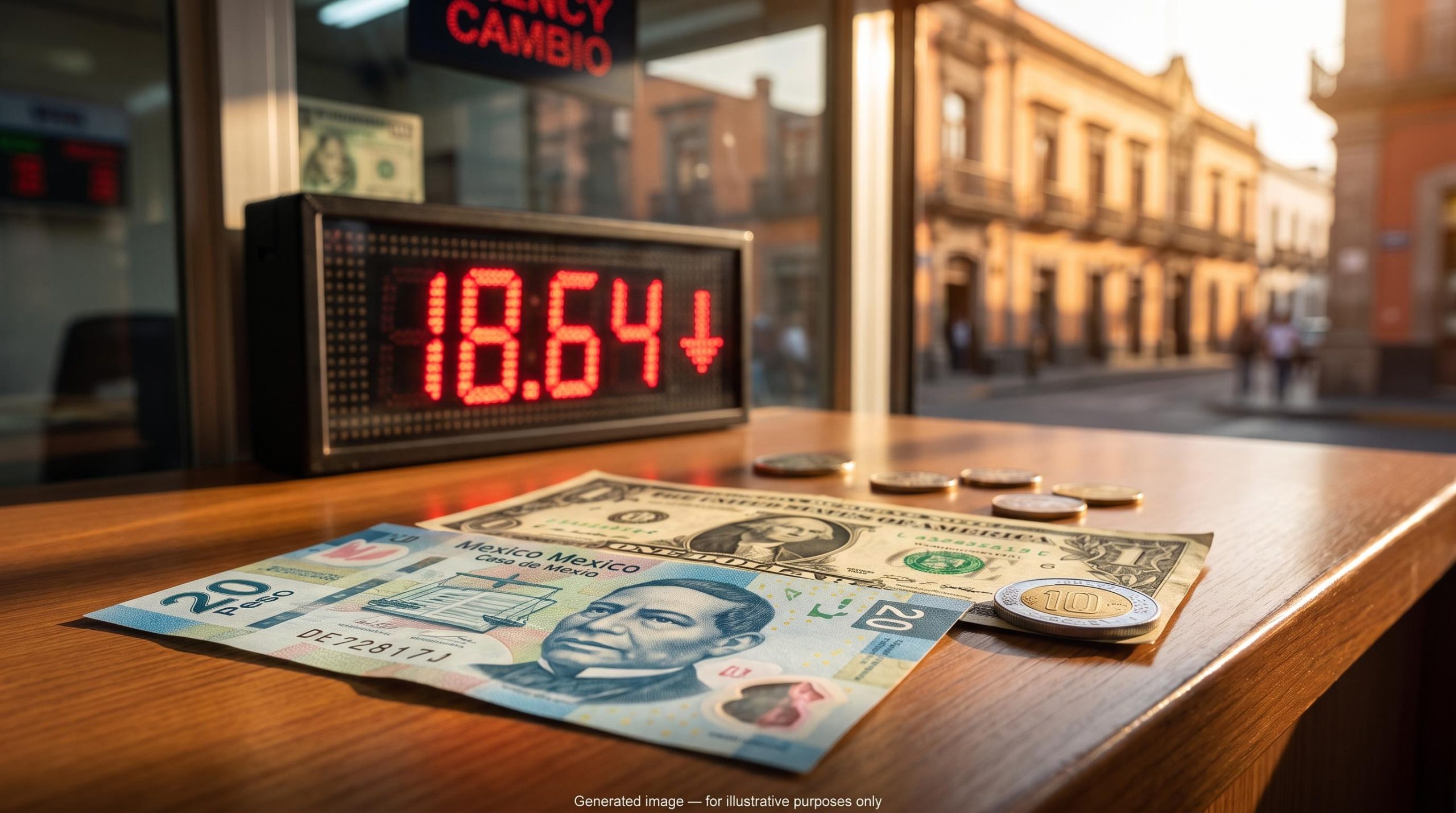
Citi’s latest survey of Mexican economists, published on 20 October 2026, nudged its end-2026 forecast for the dollar-peso exchange rate to 18.20 from 18.00. The peso already trades near 18.64 per dollar, so even the revised Mexican peso forecast sits below where the currency is today. Economists expect the Bank of Mexico (Banxico) to hold its benchmark rate at 6.50% through the end of 2027.
The revision follows a rough stretch. The peso lost 6.32% in September, and FXStreet described the latest price action as evidence that the carry trade continues to fade.
A carry trade means borrowing in a low-yielding currency to hold a higher-yielding one, pocketing the interest gap. For anyone holding Mexican bonds, equities or peso cash, that trade has long been a quiet source of support.
This piece covers what the survey implies for the peso, which forces will test that view, and where the major forecasters part ways.
Why is spot USD/MXN trading above the Citi forecast?
The survey’s median calls for the peso to finish 2026 stronger than it trades now. That is an awkward position for a forecast that was just revised weaker.
Forecast versus market Citi survey end-2026 median: 18.20 per dollar. Spot on 21 October: around 18.64.
The peso was the only meaningful revision. Rate, inflation and growth calls barely moved from the 6 October survey.
| Indicator | Latest survey | Prior survey (6 Oct) | Change |
|---|---|---|---|
| USD/MXN, end-2026 | 18.20 | 18.00 | Peso weaker by 0.20 |
| USD/MXN, end-2027 | 18.60 (range 17.00-19.80) | 18.50 | Peso weaker by 0.10 |
| Banxico rate, end-2027 | 6.50% (range 6.00%-7.25%) | Broadly unchanged | Few expect a move |
| Headline inflation, end-2026 / 2027 | 3.90% / 3.86% | 3.90% / 3.83% | 2027 up 0.03 pp |
| Core inflation, end-2026 | 3.80% | 3.88% | Down 0.08 pp |
| GDP growth, 2026 / 2027 | 1.4% / 1.8% | 1.4% / 1.8% | Unchanged |
Read against spot, the 18.20 median is a call for modest peso recovery, not further weakening. Economists conceded ground on the level but still expect the currency to claw some of September’s losses back before year-end.
If you are positioned for further peso weakness, the median does not back you. If you are positioned for strength, the 17.00-19.80 range for end-2027 tells you conviction is thin.
What is driving the peso, and why is the carry trade fading?
That expected recovery depends on forces the survey cannot control. Any peso forecast rests on a handful of them.
Core drivers in brief
- Banxico policy: higher rates attract yield-seeking capital; cuts tend to weaken the peso.
- Nearshoring: Mexico’s role as a manufacturing hub for the Americas is seen as structurally supportive, though no current 2026 investment figure was available.
- Remittances: money sent home by Mexicans abroad, mostly from the US, adds steady dollar inflows.
- Oil: as an exporter, Mexico earns foreign currency when crude sales and prices hold up.
- Risk sentiment: as an emerging-market currency, the peso gains when investors feel confident and slides in turbulence.
Why the carry cushion is thinner
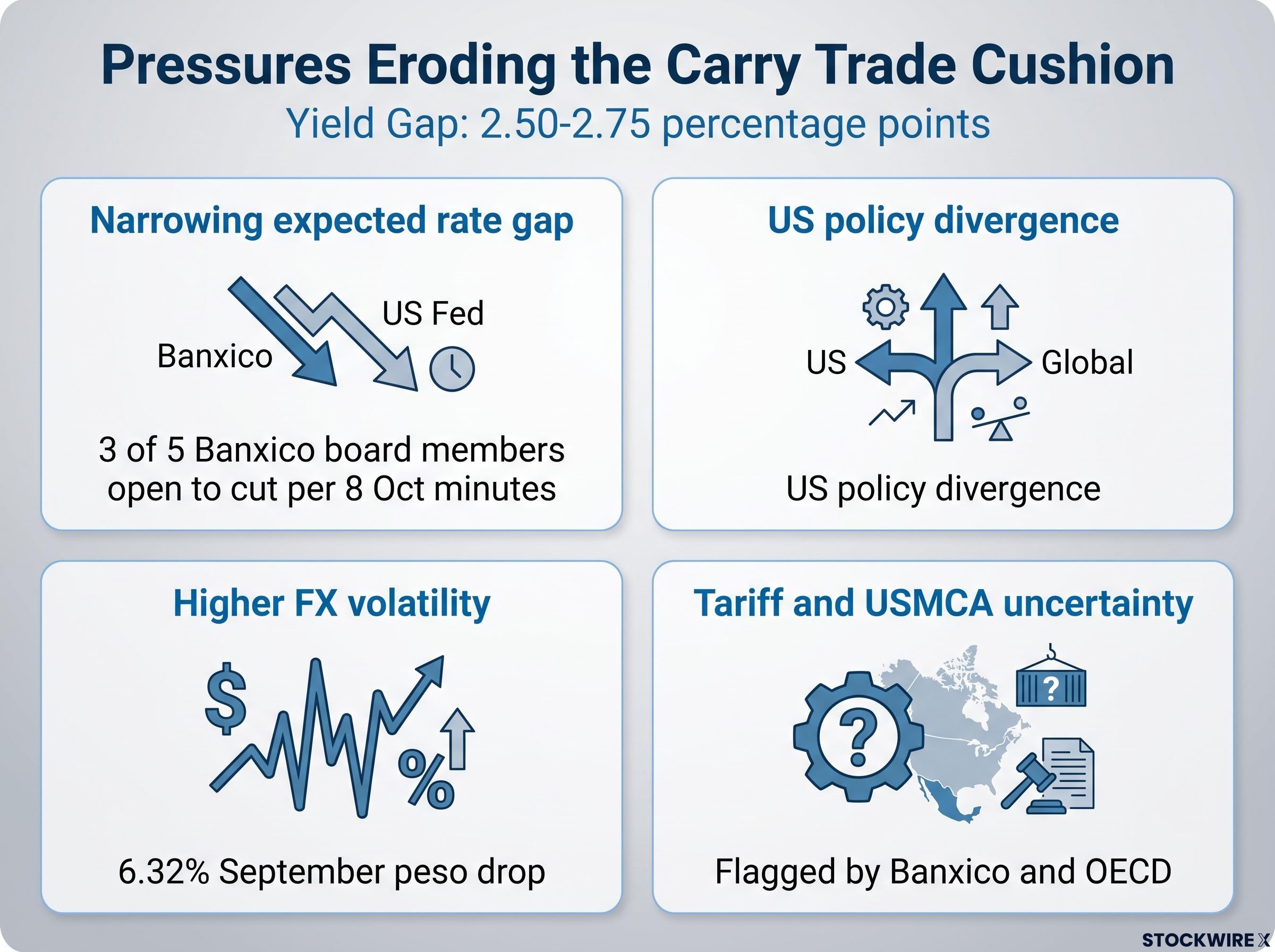
The gap between Mexican and US policy rates is roughly 2.50-2.75 percentage points. That is still wide, but the interest is only earned if the peso holds its value. A slide from about 18.00 to 18.64 can wipe out months of income.
A carry trade unwind typically begins with reduced inflows as the yield premium shrinks, and the peso’s September slide fits the early stage of that pattern seen in earlier emerging-market reversals.
Four pressures are eroding that cushion:
- Narrowing expected rate gap. Banxico’s 24 September hold was unanimous, its third in a row, yet minutes published on 8 October showed three of five board members open to another cut.
- US policy divergence. If US rates stay relatively high while Banxico eases, the differential shrinks before any cut arrives.
- Higher FX volatility. September’s 6.32% drop showed how quickly currency losses can swamp yield.
- Tariff and USMCA uncertainty. Banxico and the OECD both flagged the risk that US tariffs or a difficult review of the United States-Mexico-Canada Agreement could hit exports and investment.
External income is softening too. August remittances fell 3.6% year on year to US$5.452 billion, breaking a six-month run of gains, although January-August inflows were still up 2.2% at US$41.802 billion. BBVA Research expects weak September-November figures, while Pemex crude exports dropped 45% to 275,737 barrels per day in August, worth about US$627 million.
A high headline yield no longer guarantees a good return. Judge Mexican exposure on the yield minus the depreciation you could absorb.
Where do forecasters disagree on growth, inflation and Banxico’s next move?
The survey’s tidy medians hide genuine splits, and growth is where they are widest.
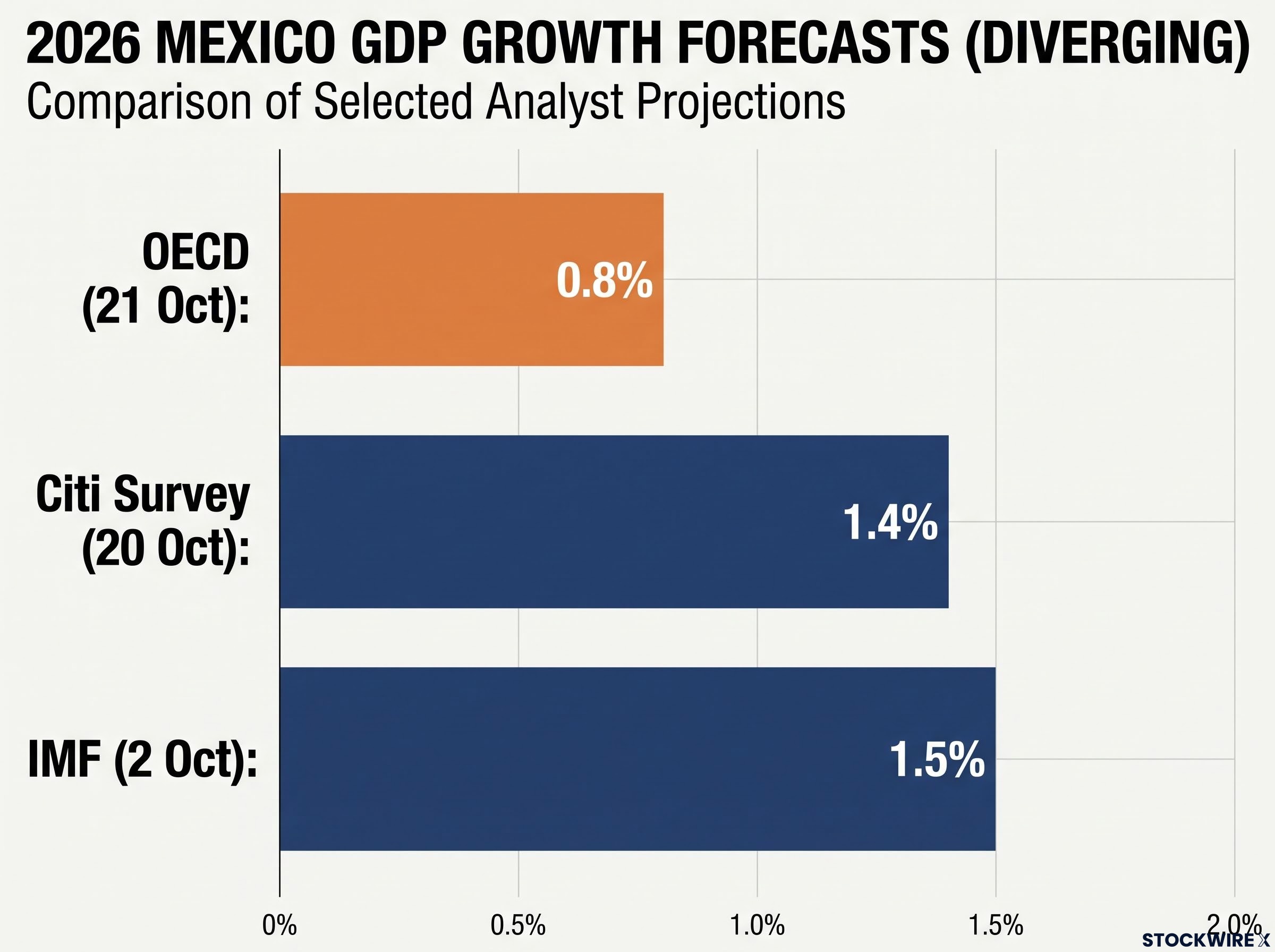
| Institution | 2026 growth | 2027 growth | Key caveat |
|---|---|---|---|
| Citi survey (20 Oct) | 1.4% | 1.8% | Range of 1.0%-2.1% for 2027 |
| IMF (2 Oct) | 1.5% | 1.8% | Return to 3% inflation could slip to early 2028 |
| OECD (21 Oct) | 0.8% | 1.8% | US tariffs and weak global demand |
Inflation sends mixed signals. Headline rose to 3.45% in September while core eased to 3.75%, and Banxico still sees risks tilted to the upside, with convergence to its 3% target (tolerance band 2%-4%) expected in Q4 2027.
Scotiabank Economics read the minutes as dovish on 9 October, expecting a hold for the rest of 2026 and a possible later cut if inflation stays within the band. No accessible October commentary from other major banks was located.
Any USD/MXN forecast has to weigh the Federal Reserve path, oil prices and the USMCA review at once, and these forces can pull the peso in opposite directions within the same month.
The peso’s risks run both ways:
- Strength case: lower US rates, improving risk appetite and continued disinflation could revive demand for peso yield.
- Weakness case: a sharper selloff would lift imported inflation and delay cuts, while weaker remittances and oil receipts drain support.
The 0.8% to 1.5% spread on 2026 growth tells you Citi’s 1.4% is not safe ground. Treat the 5 November Banxico meeting and tariff headlines as the events most likely to shift the peso call.
What the survey settles, and what the next Banxico meeting could change
The survey settles a base case: a flat 6.50% rate, inflation near 3.9%, modest growth and a peso slightly firmer than spot. It does not settle the path to get there.
Three checkpoints will decide whether that base case holds:
- The 5 November Banxico decision and its tone on further cuts.
- US tariff and USMCA review headlines.
- The next remittance and Pemex export releases.
If those land softly, the 18.20 call looks reasonable. If they disappoint, the market’s 18.64 may prove the better guide.
This article is for informational purposes only and should not be considered financial advice. Investors should conduct their own research and consult with financial professionals before making investment decisions. Past performance does not guarantee future results. Financial projections are subject to market conditions and various risk factors.