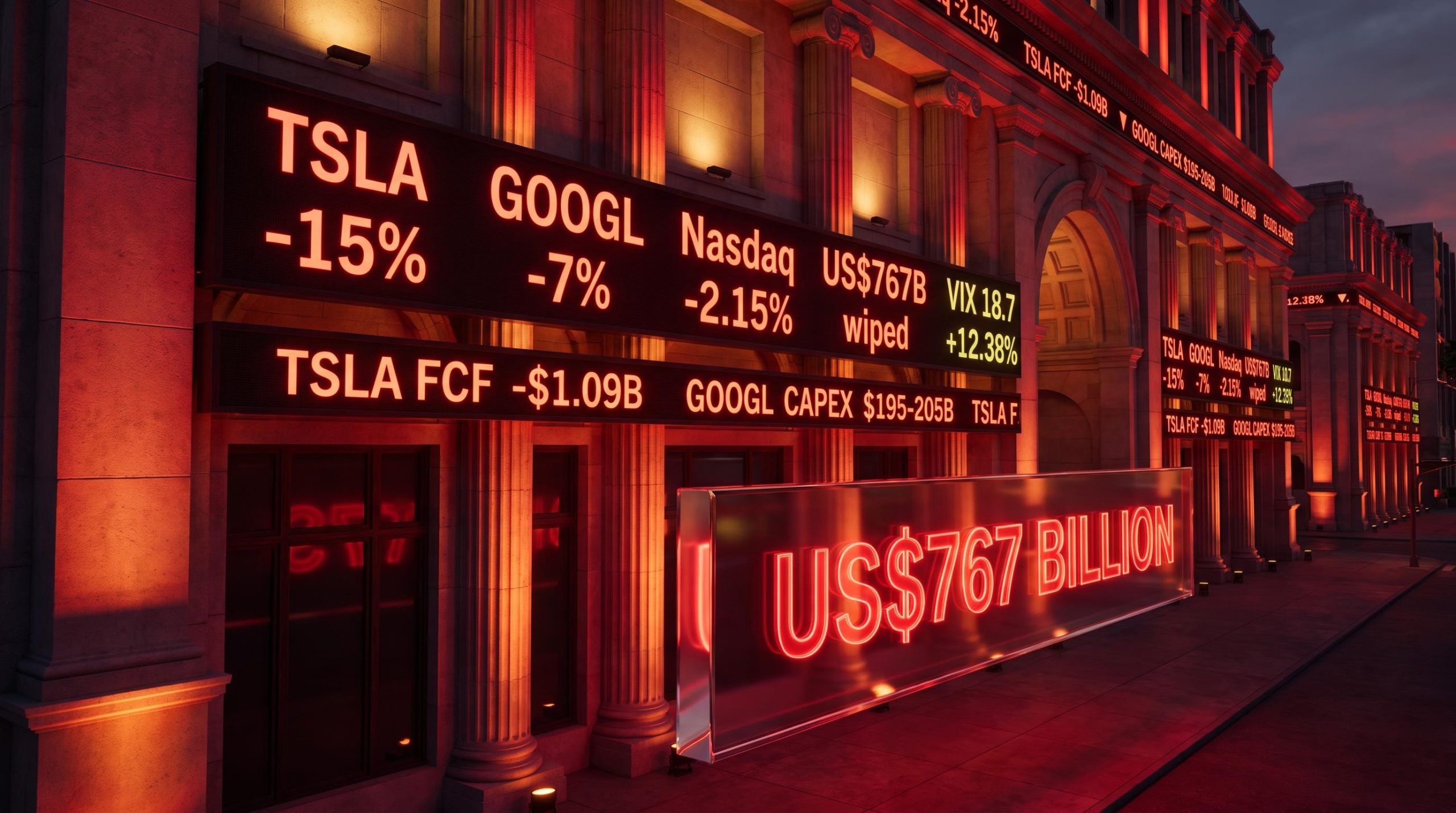
The Magnificent 7’s collective market capitalisation shrank by US$767 billion in a single trading session, a one-day decline not seen since the tariff shock of April 2025, with Tesla and Alphabet at the centre of the damage.
This was not a macro shock, a rate decision, or a geopolitical event. It was two quarterly earnings reports. Two of the most widely held names in technology, priced as near-certainties in the AI trade, delivered results that broke the market’s assumptions about what “safe” means in this part of the index.
Here is what actually happened inside each company’s numbers, what the market’s reaction reveals about where investor tolerance now sits, and what this session changes about the terms of the Magnificent 7 trade going forward.
A US$767 billion wipeout: what the session looked like
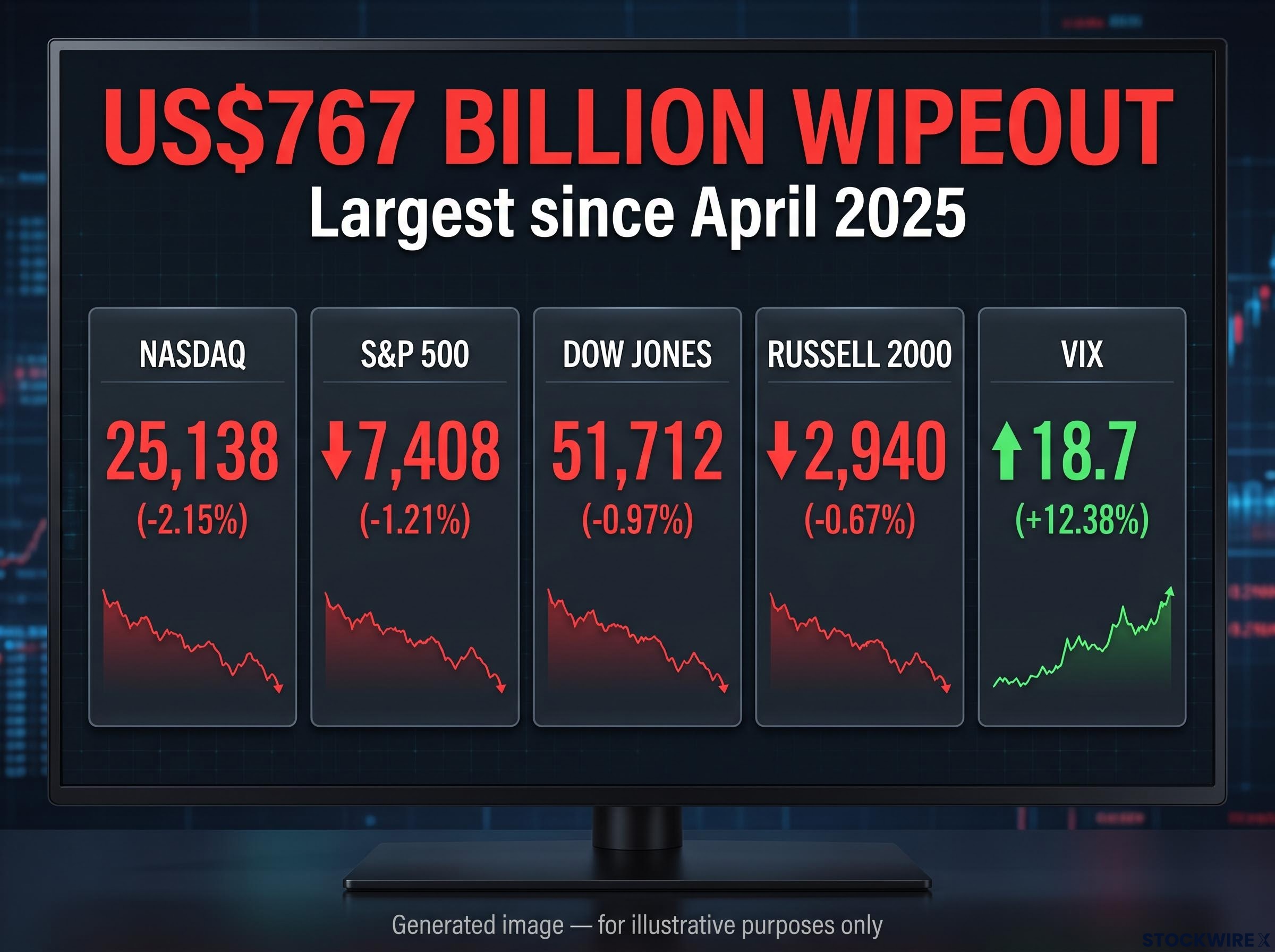
The Nasdaq Composite closed at 25,138, down 2.15%, its worst single session in approximately one month. The S&P 500 fell 1.21% to 7,408. The Dow Jones shed 0.97% to close at 51,712. Even the small-cap Russell 2000, which has limited direct exposure to megacap tech, slipped 0.67% to 2,940.
| Index | Closing level | Session change |
|---|---|---|
| S&P 500 | 7,408 | -1.21% |
| Nasdaq Composite | 25,138 | -2.15% |
| Dow Jones | 51,712 | -0.97% |
| Russell 2000 | 2,940 | -0.67% |
| VIX | 18.7 | +12.38% |
The VIX climbed to 18.7, up 12.38% on the session, pushing back toward the 20 level. That is not orderly profit-taking after a strong run. When fear re-enters the market this sharply on an earnings night, it signals that the repricing extended well beyond the two names that caused it.
US$767 billion: The single-session loss in market value recorded across the Magnificent 7 group, a drawdown on a scale not seen since the tariff-driven turbulence of April 2025.
Tesla and Alphabet were the primary contributors to the damage, but sympathy selling and risk-off repricing across the remaining megacap names compounded the aggregate figure rapidly.
When big ASX news breaks, our subscribers know first
Tesla’s Q2 results: revenue beat, profit miss, cash burn
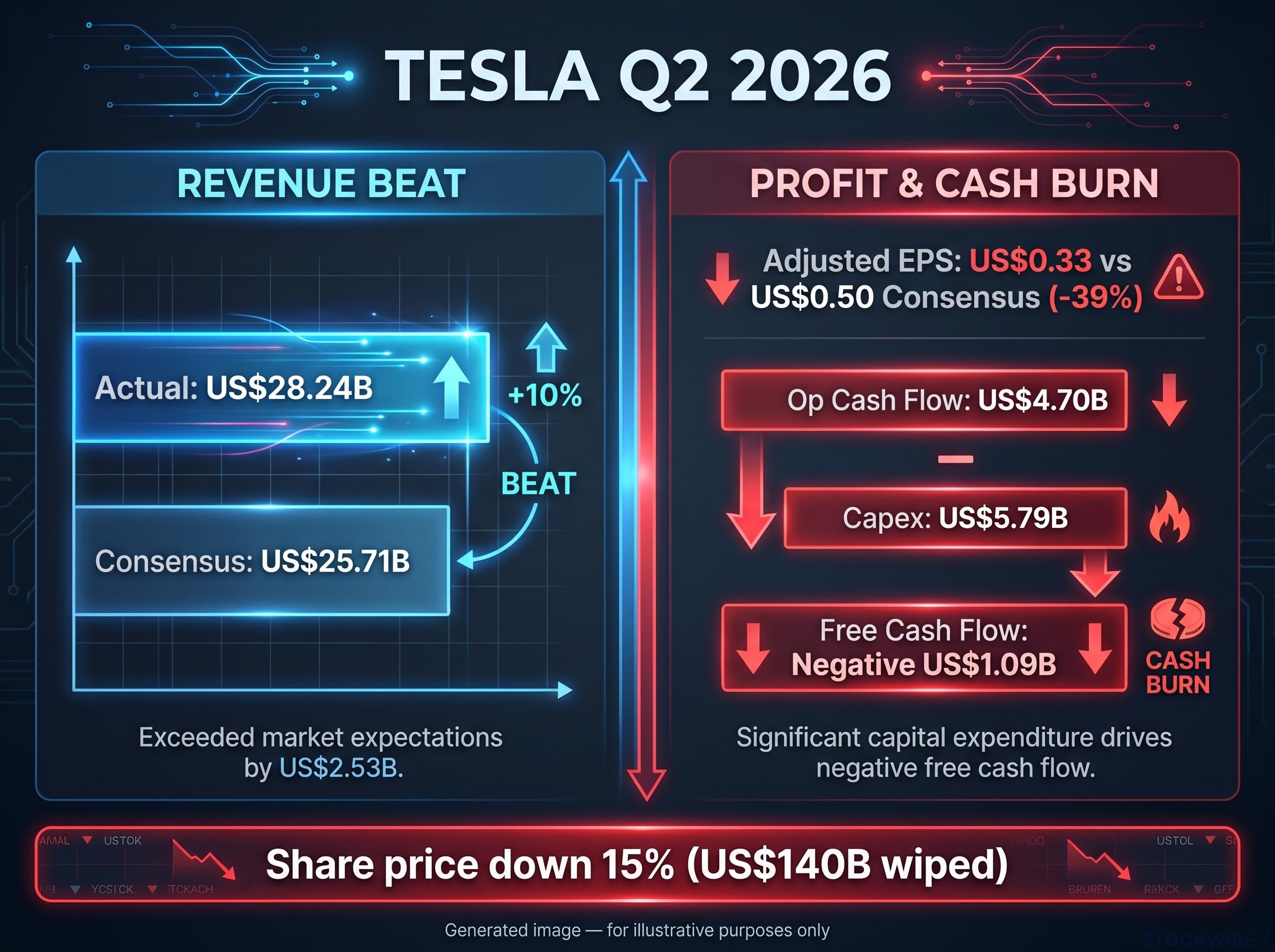
The top line looked strong. Tesla reported Q2 2026 revenue of US$28.24 billion, up 26% year-over-year and roughly 6% above consensus estimates of approximately US$25.71 billion. On a revenue basis, this was a beat.
Then the profitability numbers crossed the wire.
- Revenue: US$28.24 billion (26% year-over-year growth; consensus approximately US$25.71 billion)
- Adjusted EPS: US$0.33 (consensus approximately US$0.50; approximately 39% miss)
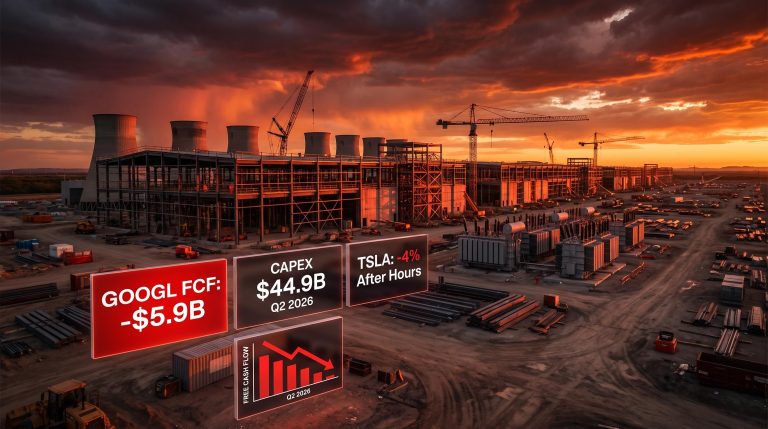
- Free cash flow: negative US$1.09 billion (operating cash flow US$4.70 billion, capex US$5.79 billion)
- Share price reaction: down approximately 15%, wiping over US$140 billion in market value
An adjusted EPS of US$0.33 against consensus of roughly US$0.50 is not a marginal miss. It is a 39% shortfall. The market could have absorbed that alone, perhaps, if cash generation had held up. It did not.
Tesla’s Q2 2026 earnings show operating margin collapsing to just 1.4% against an expected 5.4%, with capex running at roughly 14 times operating income for the quarter, figures that extend well beyond the headline EPS miss the market initially reacted to.
Where the cash went
Free cash flow came in at negative US$1.09 billion for the quarter, the result of US$5.79 billion in capital expenditure running well ahead of US$4.70 billion in operating cash flow. That negative figure made the EPS miss impossible to explain away. It told investors that Tesla’s AI, robotaxi, and robotics ambitions are being funded by eroding the profitability of the core automotive business, and the market signalled clearly that it is no longer willing to defer that reckoning indefinitely.
For anyone holding Tesla as an AI or autonomy play, this quarter draws a line: the story must eventually converge on a credible profit path. This session suggests the market’s patience for that convergence is shortening.
Why Alphabet’s record quarter still sent shares down 7%
Alphabet delivered the kind of top line that should have made this a strong quarter.
- Total Q2 2026 revenue: US$119.8 billion (24% year-over-year growth)
- Google Cloud revenue: US$24.8 billion (82% year-over-year growth)
- Full-year 2026 capex guidance: US$195-205 billion
Revenue of US$119.8 billion, representing 24% year-over-year growth, beat expectations. Google Cloud’s 82% expansion to US$24.8 billion was the strongest AI-demand signal in the company’s history. On any other night, those numbers might have sent shares higher.
US$195-205 billion: Alphabet’s revised full-year 2026 capital expenditure guidance, the figure that overrode a record revenue quarter.
That capex number changed the story. When Alphabet raised its full-year 2026 spending forecast to US$195-205 billion, the market stopped celebrating the revenue beat and started pricing a different question: when does this investment produce commensurate returns?
Shares fell approximately 7%. The reaction tells you that markets are now applying a penalty to companies that raise capital spending to unprecedented levels without providing clear monetisation timelines. Strong top-line growth is necessary but no longer sufficient. If you hold Alphabet or any large-cap AI name, this session illustrates a tension you will encounter repeatedly: strong AI revenue growth and collapsing free cash flow guidance can coexist in the same quarter, and the market will price the latter.
How two earnings misses became a market-wide event
Two companies reported disappointing results. The entire Nasdaq fell 2.15%. That gap between two names and the broader index reaction is the concentration story that defines this market.
Magnificent Seven underperformance against the broader S&P 500 had already been building before this session, with Deutsche Bank identifying crowded positioning, a capex credibility test, a more hawkish Fed, and rising chip costs as four converging headwinds that the AI growth narrative alone could not offset.
The Magnificent 7’s collective weighting in the S&P 500 and Nasdaq means a double-digit percentage decline in one or two constituents, plus mid-single-digit sympathy declines in others via risk-off repricing, compounds rapidly into hundreds of billions in aggregate losses. A company-specific shock becomes an index-wide event for anyone holding broad market exposure.
The sector data shows exactly where the damage landed, and where capital rotated to.
| Sector | Direction | Change |
|---|---|---|
| Communication Services | Down | -5.20% |
| Consumer Discretionary | Down | -5.12% |
| Information Technology | Down | -1.12% |
| Industrials | Up | +1.77% |
| Healthcare | Up | +1.29% |
Communication Services fell 5.20% (that is Alphabet’s home sector). Consumer Discretionary fell 5.12% (that is Tesla’s). Meanwhile, Industrials gained 1.77% and Healthcare added 1.29% as investors sought more predictable cash flows.
The April 2025 tariff selloff was macro-driven. This session was earnings-driven. The distinction matters: concentrated index leadership creates vulnerability to both policy shocks and company-specific fundamental failures. If you hold broad index funds, two individual companies’ quarterly results just moved your net worth in a measurable way.
Magnificent 7 index concentration risk has been quantified at roughly 33.8% of the S&P 500 as of June 2026, a weighting that means company-specific earnings failures in one or two constituents translate directly into broad index drawdowns for passive investors holding the market through funds.
What the AI spending debate actually means for megacap valuations
When a growth company raises capital expenditure sharply without commensurate near-term earnings visibility, markets apply a higher discount rate to future cash flows. A discount rate is the interest rate used to calculate the present value of money a company is expected to generate in the future; the higher that rate, the less those future earnings are worth today. The result is a compressed valuation multiple, even when revenue is growing strongly.
The AI investment cycle now sits at a scale that has no modern precedent, with US IT spending reaching 4.9% of GDP in Q1 2026 and hyperscaler capex commitments for the year ranging from $600 billion to $805 billion, a context that explains why individual capex guidance revisions carry macro-level weight.
That is the mechanic at work in both Alphabet and Tesla this quarter. Both are funding large AI bets that currently weigh on profitability and free cash flow. The market is no longer willing to ignore that cost in an AI-optimistic environment.
Alphabet: when Cloud growth is not enough
- Bull case: Google Cloud’s 82% year-over-year revenue growth validates that AI demand is real and accelerating. Enterprise adoption is translating directly into revenue, not just pilot programmes.
- Bear case: Raising full-year capex guidance to US$195-205 billion introduces material free cash flow risk. Until investors see commensurate returns on that capital, the market will price in structurally compressed margins.
Tesla: vision versus profit discipline
- Bull case: Revenue growth of 26% year-over-year to US$28.24 billion confirms that demand exists. The top line is not the problem.
- Bear case: A 39% EPS miss paired with negative US$1.09 billion in free cash flow signals that the gap between capital deployment and profitability is widening, not narrowing. The market is pricing a company that is spending faster than it is earning.
The lesson for you as an investor is that AI optimism and earnings discipline are not mutually exclusive demands. Markets can believe in the AI opportunity and still punish companies that cannot show a credible path to profitability alongside the spending.
What this session changes, and what it does not
The session makes one thing clear: markets will no longer treat AI spending as a free pass on near-term profitability. For the Magnificent 7, earnings discipline is now as important a driver of valuation as the growth narrative. That is new. For much of 2025 and early 2026, the market rewarded capital deployment on the assumption returns would follow. Today it demanded evidence.
What has not changed is equally important. AI demand is real. Alphabet’s Cloud growth and Tesla’s revenue expansion confirm that. The Magnificent 7 remain the dominant weight in US equity indices, a structural feature that is not unwinding after one session. None of these companies have signalled a retreat from their investment plans.
S&P 500 concentration had already reached levels with no historical precedent before this session, with five companies controlling roughly 30% of total US equity market capitalisation, a structural condition that converts any large-cap earnings shock into an index-wide repricing event regardless of whether the broader economy is deteriorating.
Two forward-looking variables now carry outsized importance:
- Tesla’s trajectory toward free cash flow breakeven: the negative US$1.09 billion this quarter is the number to watch for improvement.
- Alphabet’s AI monetisation metrics: US$195-205 billion in capex needs return-on-investment evidence, not just revenue growth.
The AI trade has not ended, but its terms have shifted. Proof of monetisation now carries as much weight as proof of adoption.
For anyone holding Magnificent 7 names directly or through index funds, this session is a practical reminder that position sizing and diversification assumptions made during the AI bull run may need revisiting. The US$767 billion lost today did not require a recession, a rate shock, or a geopolitical crisis. It required two quarterly earnings reports.
This article is for informational purposes only and should not be considered financial advice. Investors should conduct their own research and consult with financial professionals before making investment decisions. Past performance does not guarantee future results.