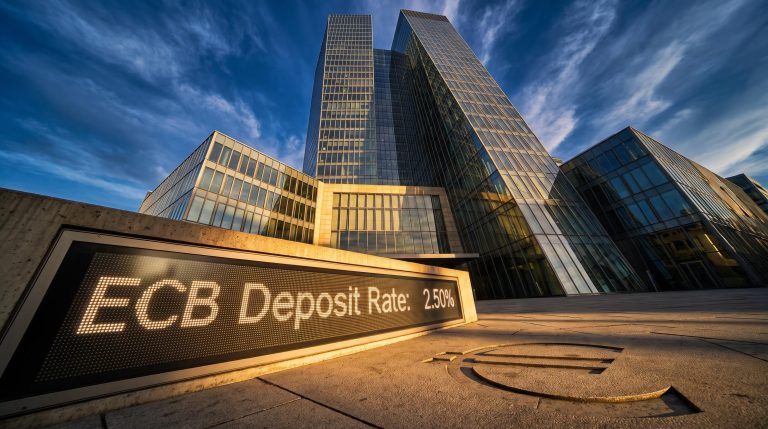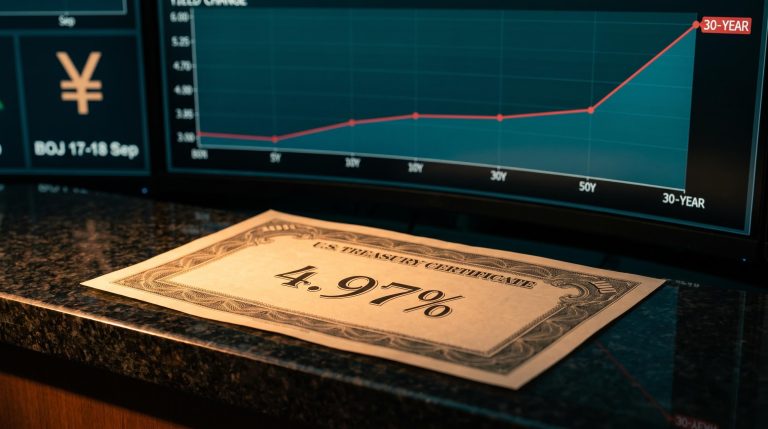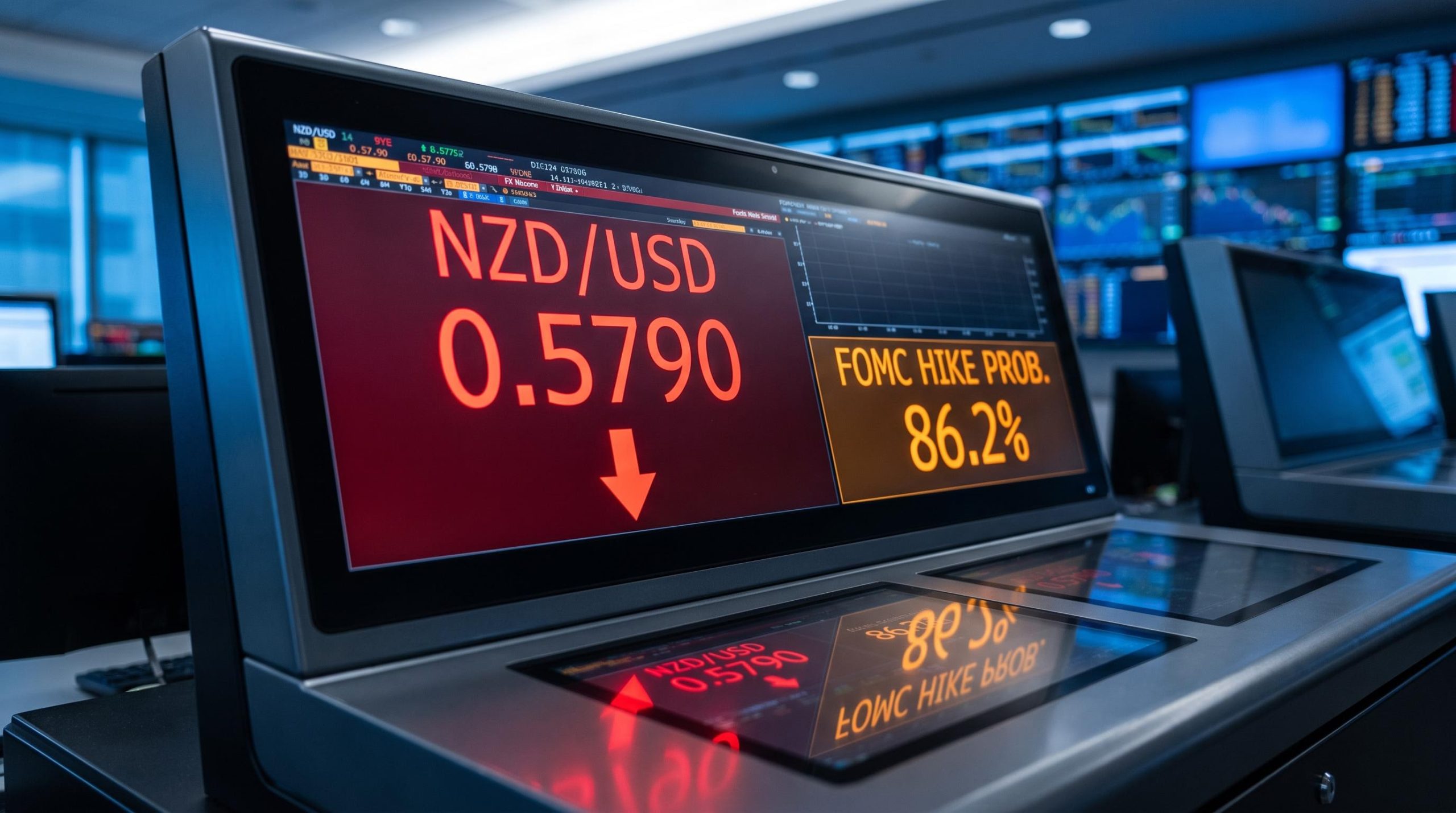
The New Zealand Dollar has slipped into the 0.5790 to 0.5820 band against the US Dollar as global markets aggressively price in a hawkish Federal Reserve, drowning out the noise from New Zealand’s own recent interest rate rise.
The problem for the Kiwi is one of comparison. Fed Chair Kevin Warsh is steering markets toward a tightening trajectory, while the Reserve Bank of New Zealand (RBNZ) has settled into a cautious, data-dependent posture that offers no matching firepower.
That gap has quietly stripped the currency of its traditional yield advantage, and it arrives at the worst possible moment: two days before Wednesday’s Federal Open Market Committee (FOMC) decision. The coverage below maps the specific monetary crosscurrents dragging the pair lower and defines the binary risks in play for that meeting.
Rate divergence drags the Kiwi below the 0.5820 threshold
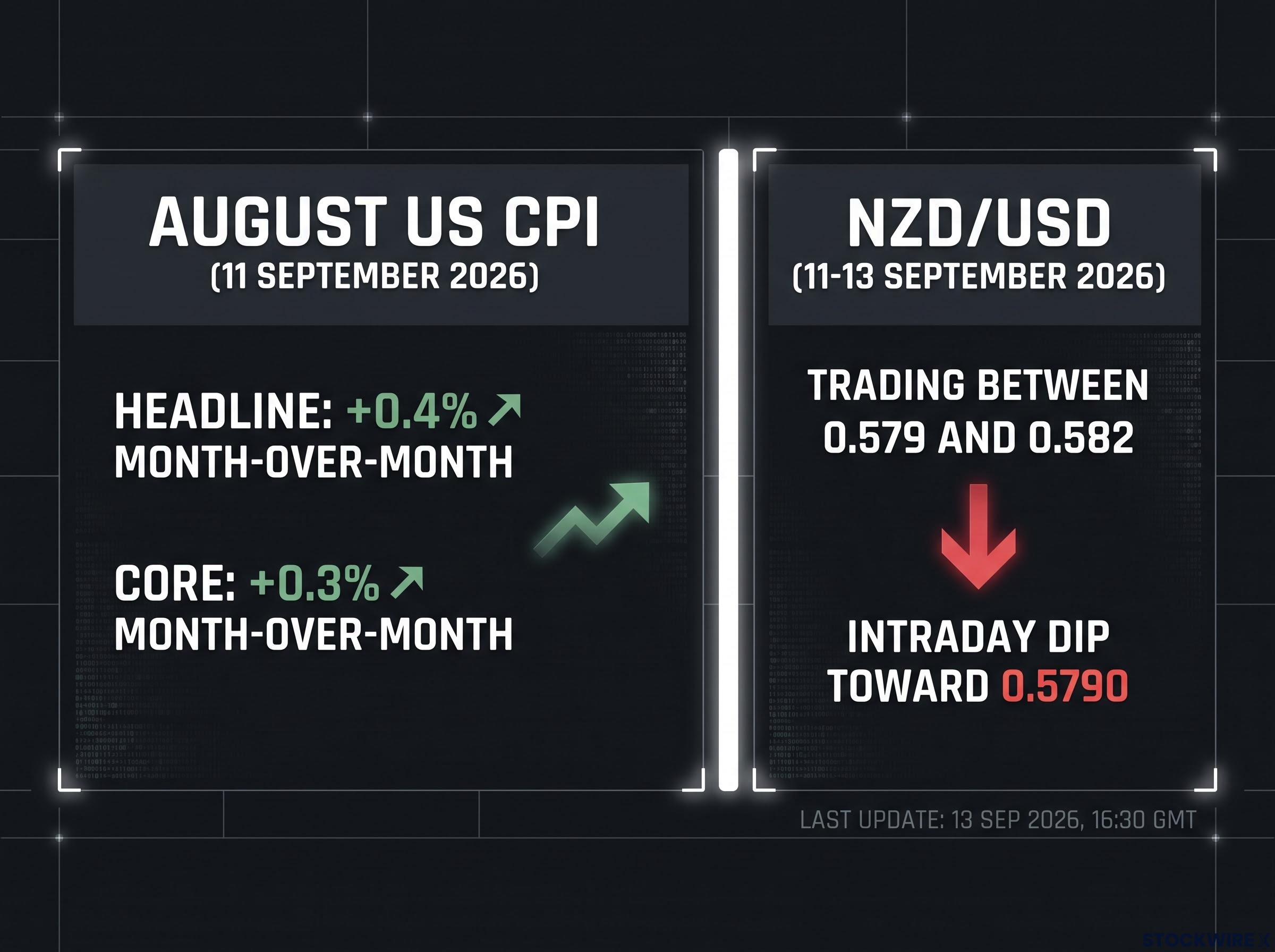
The pair has spent mid-September pinned in a tight range, trading between 0.579 and 0.582 across 11-13 September 2026, with an intraday dip toward 0.5790 during the early Monday Asian session. The move looks less like a random wobble and more like the market doing exactly what the yield mathematics demands.
Here is the mechanism. The appeal of holding the New Zealand Dollar rests heavily on the carry trade, where investors borrow in a low-yielding currency to hold a higher-yielding one and pocket the interest difference.
The yield differential is one of four NZD/USD drivers that compete for dominance across the pair’s price action, with Chinese PMI data, fortnightly dairy auction results, and global risk sentiment each capable of overriding the rate differential on any given session.
When the expected rate gap between the US and New Zealand narrows in the Dollar’s favour, that trade loses its shine, and the Kiwi loses a key buyer base.
The trigger for the latest repricing was hard data. August US Consumer Price Index (CPI) figures, released on 11 September 2026, came in hotter than markets had braced for:
- Headline CPI rose 0.4% month-over-month
- Core CPI rose 0.3% month-over-month
That print sent capital scrambling back into the US Dollar ahead of the FOMC meeting, pressing the Kiwi lower in the process.
The read you should take from this is important. The Kiwi’s weakness is not a verdict on New Zealand’s economy. It is the US rate premium expanding fast enough to crush the currency’s structural carry advantage, which means current levels are anchored to yield arithmetic rather than fleeting sentiment.
The Warsh factor and Wednesday’s 86 percent FOMC probability
The mechanical part of Wednesday’s decision is close to settled. The real event is the press conference.
Market pricing for a 25 basis point hike at the 16 September 2026 meeting has escalated sharply over recent weeks. CME FedWatch probabilities climbed from roughly 35% before Jackson Hole to 65.9% in the days after Warsh’s late-August speech, then jumped again to approximately 86.2% once the August CPI data landed.
| Date | Event | Implied Probability |
|---|---|---|
| Pre-Jackson Hole | Baseline market pricing | ~35% |
| 31 August 2026 | Warsh Jackson Hole speech repricing | 65.9% |
| 11 September 2026 | August US CPI release | ~86.2% |
Kevin Warsh, who took over the Fed Chair role in May 2026, has quickly built a reputation as a hawkish communicator. His Jackson Hole remarks alone moved hike odds by around 30 percentage points, which tells you his framing can swing currency markets far more than any single scheduled decision.
Warsh’s Jackson Hole address on 27 August 2026 moved September hike probabilities by roughly 21 percentage points in a single session, a magnitude that reflects how much weight markets are assigning to his forward guidance relative to any single data release.
That is why traders are watching the tone, not the number. A hawkish delivery on Wednesday could extend the pair’s slide below 0.579, while unexpectedly accommodative remarks could spark a US Dollar pullback and hand the Kiwi some breathing room.
For your positioning, the takeaway is direct. The 25 basis point hike is already baked into the price. The genuine volatility risk sits entirely in how Warsh frames the policy path for the rest of 2026, and that guidance is what will move your exposure the moment it crosses the wire.
Why the RBNZ’s official cash rate trajectory offers no immediate floor
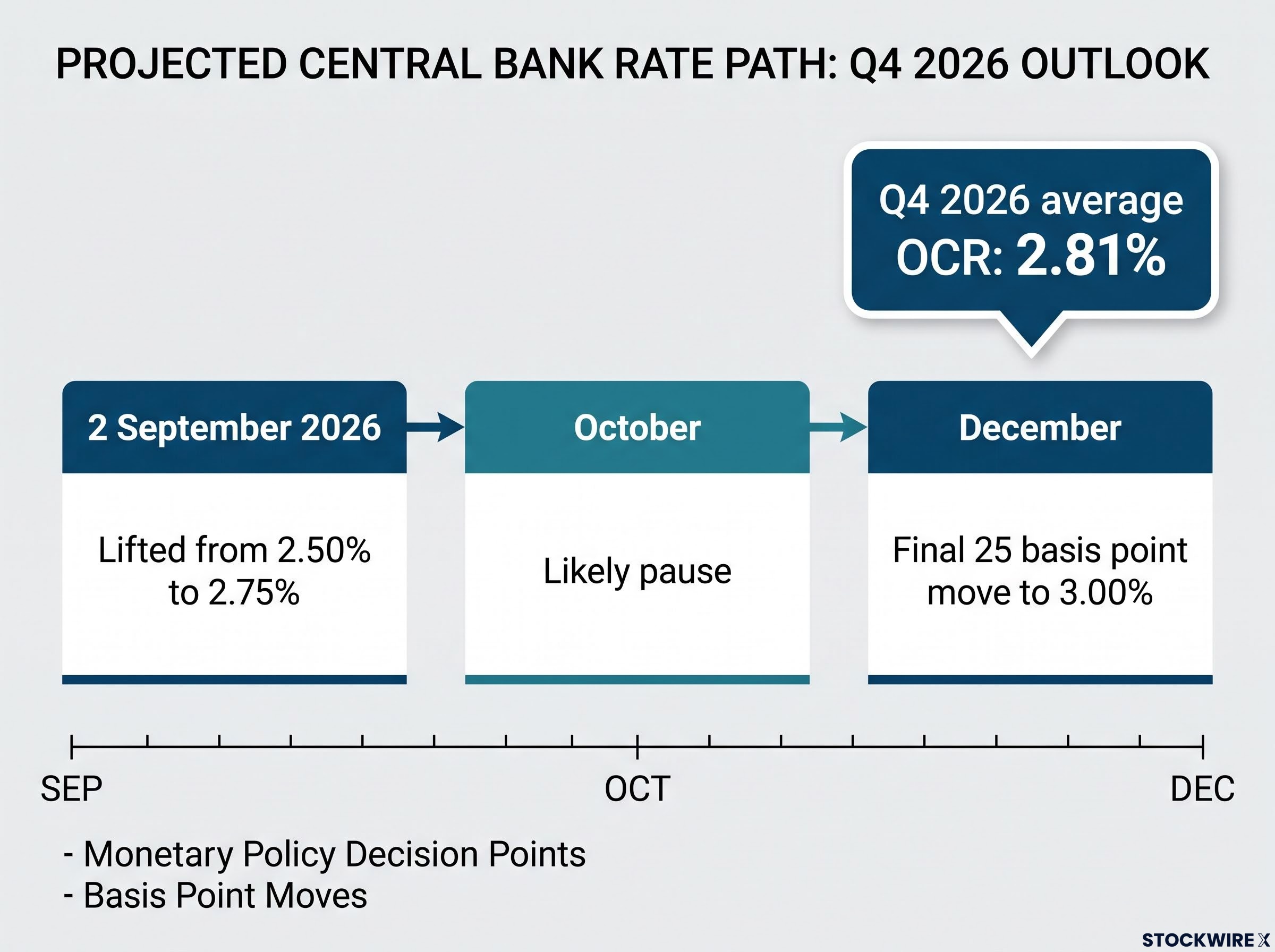
If the Fed is the accelerant, the RBNZ is the brake that cannot help the Kiwi here. On 2 September 2026, the central bank lifted the Official Cash Rate from 2.50% to 2.75%, a consensus move that all five major New Zealand bank economics teams had forecast and that markets had fully priced.
A fully anticipated hike does little for a currency. What matters is the forward path, and the RBNZ has signalled patience rather than urgency.
The September Monetary Policy Statement points to a likely pause in October, followed by one final 25 basis point move to 3.00% in December, with a projected Q4 2026 average OCR of 2.81%. The market read the tone as softer than expected, and the reaction was immediate: the 2-year swap rate fell 8 basis points and the Kiwi drifted toward 58.42 US cents.
Governor Breman was explicit about the lack of a fixed plan.
The central bank is “not on a preset course,” and the timing of future moves remains “highly uncertain.”
That dovish constraint matters for anyone eyeing the Kiwi. It confirms that with the RBNZ actively flagging a pause and a capped ceiling, any near-term relief for the pair has to come from US Dollar weakness, not domestic strength.
The lesson for your thesis is clear. Buying the Kiwi on the strength of recent domestic rate hikes ignores the RBNZ’s own explicitly limited trajectory, and that makes it a flawed entry logic in the current environment.
For investors wanting to map the full sequence of projected moves and the inflation conditions that could push the terminal rate above 3.30%, our full explainer on the RBNZ’s terminal rate outlook details the specific December 2026 and February 2027 variables that would rewrite the current path.
Positioning for the Wednesday volatility window
The pair is caught on a collision course: the RBNZ’s gradualist ceiling on one side and the Fed’s imminent decision on the other. With domestic policy offering no organic lift, the Kiwi’s direction now rests almost entirely on Warsh.
Traders appear largely sidelined, treating the 0.579 support level as fragile should the Fed Chair carry his hawkish Jackson Hole tone into Wednesday’s press conference. A balanced or dovish framing is the only scenario that credibly reopens the door to a rebound.
The monetary policy divergence trade is not isolated to the Kiwi; GBP/USD is running a parallel September setup where the Fed’s hawkish framing has similarly compressed the yield premium that had previously supported sterling against the Dollar.
Everything funnels toward that one appearance. The press conference, not the rate number, is the definitive directional trigger for the remainder of September trading.
This article is for informational purposes only and should not be considered financial advice. Investors should conduct their own research and consult with financial professionals before making investment decisions.
Past performance does not guarantee future results. Financial projections are subject to market conditions and various risk factors. These statements are speculative and subject to change based on market developments and central bank policy decisions.