Overnight on Monday 14 September, Sterling is already on the move. Traders are positioning ahead of two days of data that will, in large part, decide whether the Bank of England hikes, holds, or signals something markets have not yet priced when the Monetary Policy Committee (MPC) delivers its verdict on Thursday.
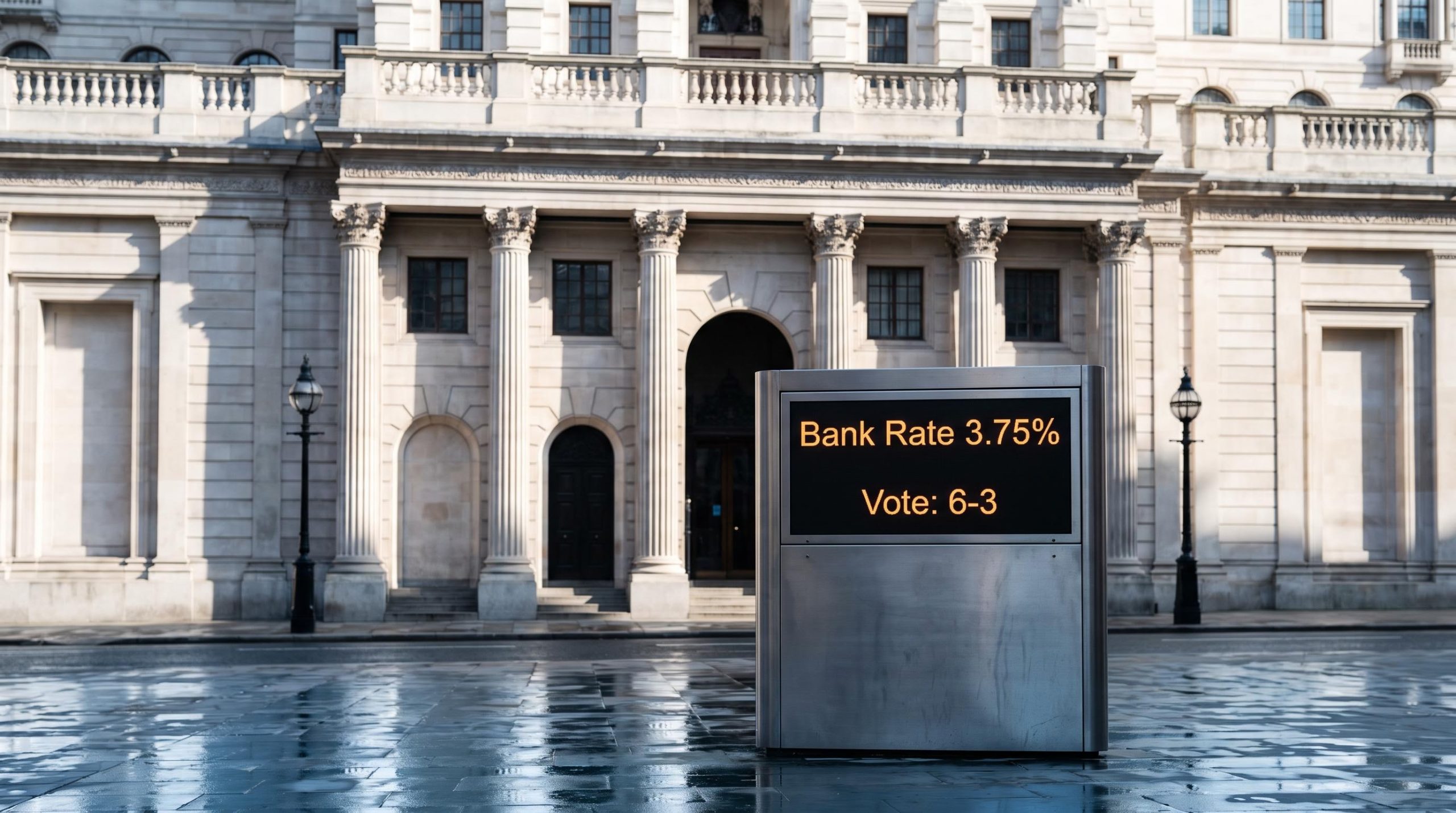
The committee left Bank Rate at 3.75% in July, but the vote was 6-3, with three members already pushing for a rise to 4.00%. That margin is close enough that Tuesday’s labour market release and Wednesday’s inflation print are not background noise. They are the deciding inputs. Headline inflation climbed back to 2.9% in July, core held at 2.6%, wages are still running ahead of the pace the Bank considers consistent with its target, and yet unemployment is drifting toward 5.0%. The committee is genuinely split, and this week’s numbers will tip it.
Here is what the data actually maps to: the specific figures to watch, the logic connecting each reading to the Bank’s behaviour, and what each plausible Thursday outcome means for the Pound. Whether you hold GBP-denominated assets or simply want to see how a central bank decision gets made in real time, this is the framework that makes the week legible.
The data the MPC will be reading before Thursday
Think of this week as a countdown clock. Two releases arrive before Thursday, each one a fresh piece of evidence the committee will weigh, and by the time the MPC sits down the balance of that evidence will already be leaning one way.
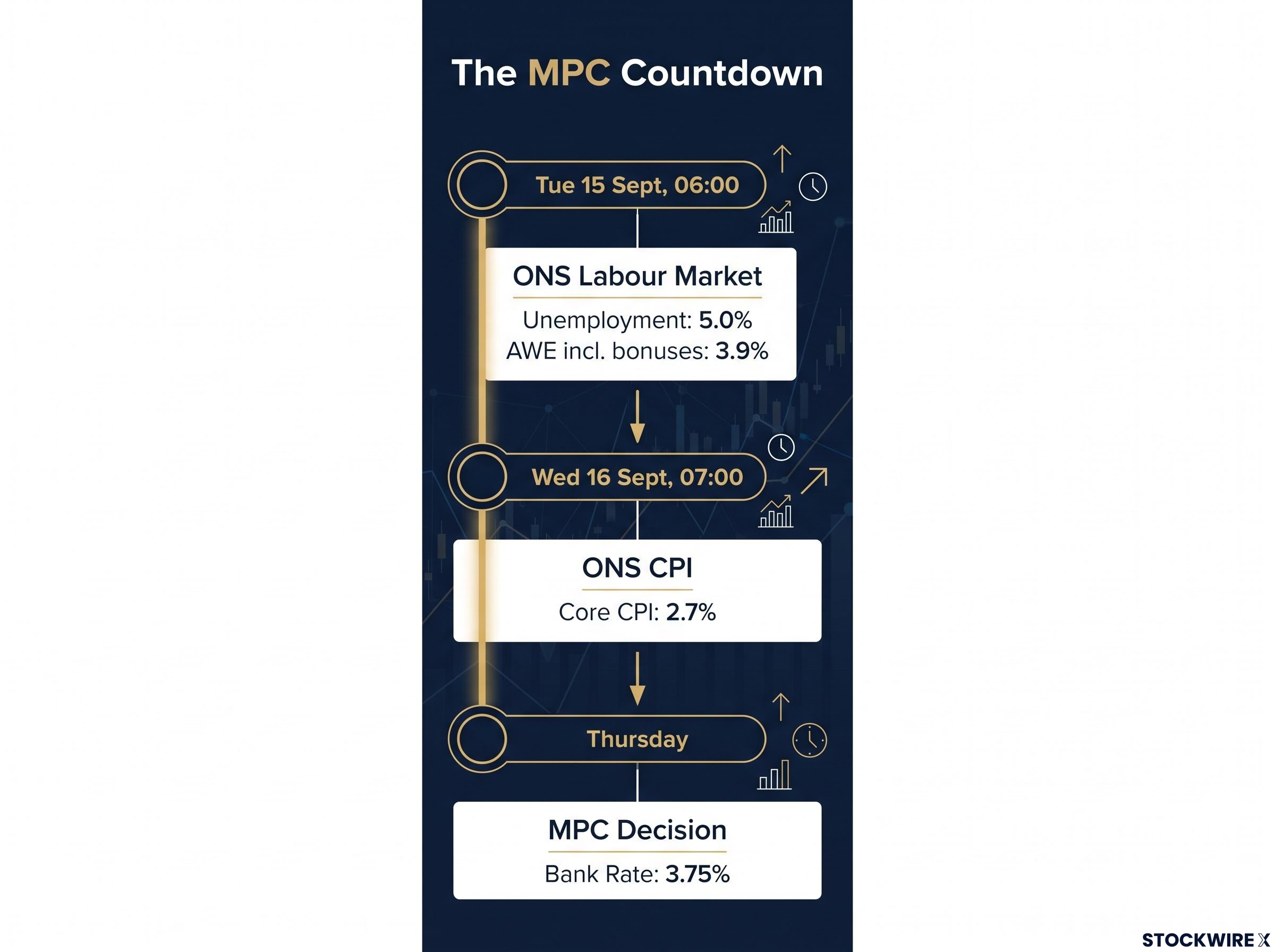
The first bundle lands on Tuesday 15 September at 06:00: the ONS labour market release. It carries three distinct signals the MPC will pull apart. The ILO unemployment rate for the three months to July is forecast to rise to 5.0%, up from 4.9%. Average weekly earnings including bonuses are expected to slow to 3.9% year-on-year from 4.1%, while earnings excluding bonuses are seen holding at 3.5%.
The single most-watched wage figure this cycle Average weekly earnings including bonuses, forecast at 3.9% YoY against a prior 4.1%. A slowdown supports the doves. A surprise to the upside hands the hawks their threshold.
The second release arrives on Wednesday 16 September at 07:00: August CPI. This print carries a specific legacy. July’s jump to 2.9% from 2.6% in June was driven largely by higher household energy bills after Ofgem raised its price cap, according to reporting from Reuters and the BBC. The committee will interrogate whether August tells the same energy-driven story or whether price pressure has spread into core categories. Core CPI sat at 2.6% in July, with an early figure of 2.7% noted for August.
| Release | Metric | Prior | Consensus | Date & Time |
|---|---|---|---|---|
| ONS Labour Market | ILO unemployment (3m to July) | 4.9% | 5.0% | Tue 15 Sept, 06:00 |
| ONS Labour Market | AWE incl. bonuses YoY | 4.1% | 3.9% | Tue 15 Sept, 06:00 |
| ONS Labour Market | AWE excl. bonuses YoY | 3.5% | 3.5% | Tue 15 Sept, 06:00 |
| ONS CPI | Headline CPI YoY (August) | 2.9% | TBC | Wed 16 Sept, 07:00 |
| ONS CPI | Core CPI YoY (August) | 2.6% | 2.7% (early) | Wed 16 Sept, 07:00 |
Each of these is not just a data point. It is effectively a vote the MPC has not yet cast. A meaningful surprise on Tuesday morning can shift the Wednesday narrative before CPI is even published, which is why those two timestamps, not the publication dates in the abstract, are what will move the market.
When big ASX news breaks, our subscribers know first
How the MPC reads labour and inflation data: the transmission logic
Understanding why these numbers matter means tracing the chain from Tuesday’s 06:00 release to Thursday’s decision room. The mechanism is standard, and once you can follow it, you can predict directionally what any surprise would do.
Analysts describe a three-step transmission path:
- A UK data surprise. CPI or labour figures land above or below what the market expected.
- A revision of Bank of England rate expectations. Money markets ask a single question: does this change what the committee is likely to do next?
- A change in the relative attractiveness of GBP-denominated assets. Higher expected UK rates make Sterling assets more appealing to foreign buyers, supporting the currency. Lower expected rates do the reverse.
The subtle point, and the one Lamera Capital stresses, is that Sterling reacts to changes in expected rates, not to the nominal Bank Rate itself. The market moves on the gap between expectation and reality. When July’s CPI came in at 2.9%, exactly in line, Sterling “held firm,” Reuters reported, precisely because no expectation revision occurred.
Sterling’s muted reaction to the July data sweep, a barely visible 0.03% move despite beats across GDP, manufacturing, and services, confirms that the currency is pricing inflation and rate expectations rather than growth surprises, which is precisely why Tuesday’s wage figure and Wednesday’s CPI print carry more weight than any GDP release this week.
Now hold that against the current pricing. As of 27 August, LSEG data showed traders pricing roughly 24.7 basis points of hikes by December 2026, which means markets are not even fully pricing a single 25bp hike this year. Yet the July vote was 6-3, more hawkish than the 7-2 economists had expected. That gap tells you markets and the committee are not aligned. If this week’s data confirms the hawks’ concerns, the repricing toward the committee’s actual position could move Sterling more sharply than the underlying rate change alone would suggest.
Why the committee looks through energy and not through wages
The Bank draws a firm line between two kinds of inflation. Energy-driven headline CPI is treated as temporary and external: a rise in the Ofgem cap does not signal domestic demand pressure, so the committee can look through it. Wage-driven services inflation is a different problem. It is persistent and home-grown, and it feeds directly into the 2% target.
That distinction is why wages sit at the centre of MPC deliberation. The February 2026 Monetary Policy Report warned that structural changes in the labour market could keep wage growth above target-consistent rates, sustaining elevated services inflation even as headline CPI falls. Energy the Bank can wait out. Embedded pay pressure it cannot, without risking second-round effects taking hold.
The competing arguments inside the MPC and where each data surprise lands
The MPC’s split is not an academic debate. It is two competing predictive models, each with a falsifiable claim about what this week’s data will show. Here is what each camp believes and the numbers that would prove it right.
The hawkish bloc’s growth from a single dissenter in April 2026 to three by July, with five-year swap rates already above 4.52%, has already translated into higher mortgage costs for the roughly 750,000 households rolling off sub-3% fixed deals this year, adding a real-economy dimension to what is otherwise a rates debate.
- The hawkish case (the three July dissenters, echoed by ICAEW’s Suren Thiru): headline inflation at 2.9% sits above target, the 6-3 vote kept a September hike live, and any upside surprise in wages or core CPI this week gives the hawks the evidence they need to pull one or two colleagues across. Thiru argues that rising inflation alongside a weakening labour market means the economy’s recent resilience is unlikely to last, and that a September rise remains “on the table.”
- The dovish case (ING’s James Smith): unemployment is already climbing toward 5.0%, earnings including bonuses are slowing from 4.1% toward a forecast 3.9%, and a cooling labour market strips away the justification for further tightening.
“A cooling labour market means there is no need for the Bank of England to raise interest rates, unless there is a severe and prolonged spike in energy prices,” said James Smith of ING.
Connect each position to a specific outcome and the week becomes a live scorecard. If earnings including bonuses print at 4.2% or above on Tuesday, the hawkish model is validated and Thursday looks tighter. If unemployment hits 5.0% alongside a wage figure of 3.7% or lower, the doves gain ground and the three dissenters lose leverage.
The wider institutional debate frames the same tension. The Resolution Foundation warns that a timid response risks letting inflation become entrenched, noting the UK has managed only one month of below-target inflation in almost five years. Societe Generale and RSM UK expect Bank Rate to stay at 3.75% through 2026, arguing the Bank will hesitate to cut until inflation is clearly falling, while KPMG’s roughly 0.7% growth projection for 2026 describes a weak labour market and sluggish GDP that argue against hiking. The Bank’s own July report frames the choice as balancing the cost of leaning too little against inflation against the cost of responding too much.
What this tells you is that three members have already declared themselves. The data needs to move only one or two of the remaining six to produce a different result than July. That asymmetry is what makes this week genuinely consequential, because Tuesday’s wage number is not just a statistic. It is a vote-counter.
Three scenarios for Thursday and what each means for the Pound
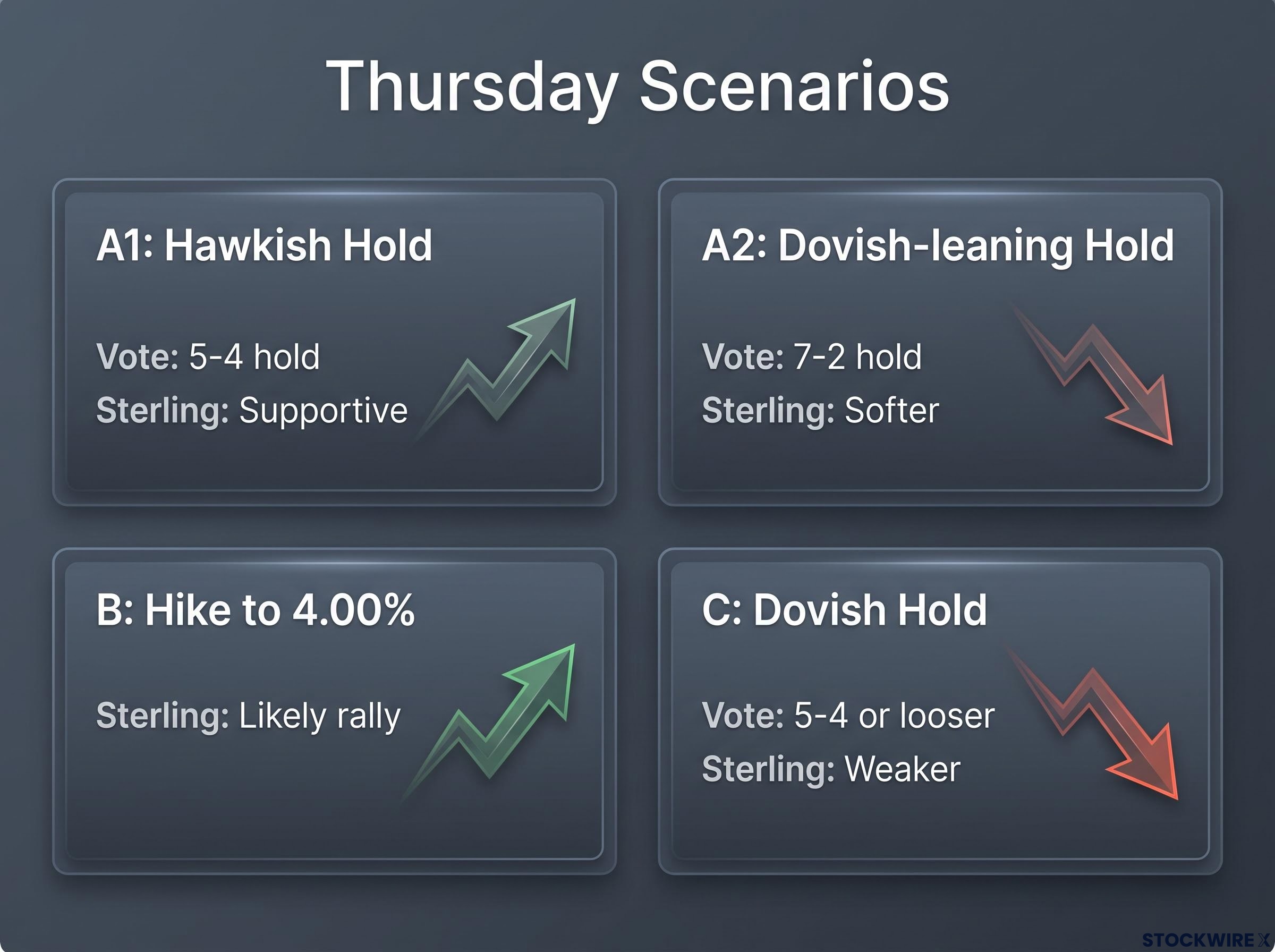
You now have enough context to evaluate Thursday yourself. What follows is not a forecast of which outcome is most likely, but a map of the conditions that would trigger each and the directional consequence for Sterling.
| Scenario | Data conditions required | Likely vote split | Sterling implication |
|---|---|---|---|
| A1: Hawkish hold | Firm wages, sticky core CPI | 5-4 hold | Supportive; a hike looks imminent |
| A2: Dovish-leaning hold | Slowing wages, in-line CPI | 7-2 hold | Softer; hawkish minority fading |
| B: Hike to 4.00% | Upside CPI and wage surprise | Majority for hike | Likely rally on announcement |
| C: Dovish hold with cut guidance | Meaningful CPI undershoot | 5-4 or looser, dovish tilt | Weaker; rate path repriced down |
Scenario A is a hold at 3.75%, and the vote split is everything. A 5-4 hold implies a hike is one meeting away and would tend to support Sterling. A 7-2 hold implies the hawkish minority is losing ground and would read as softer. Same headline rate, opposite currency signals.
Scenario B is a hike to 4.00%. This is not the baseline. Societe Generale and RSM UK both expect a hold through end-2026. But it is credible given the 6-3 July split. The February 2023 precedent, when an unexpected inflation rise pushed markets to fully price a 25bp hike and Sterling rallied in anticipation, suggests the Pound would climb on the announcement before traders judge whether the Bank is signalling the end of the cycle or more to come.
Scenario C is a hold with explicitly dovish guidance. This requires CPI to undershoot meaningfully on Wednesday. The template is recent and specific.
In February 2026, a 5-4 hold with a dovish vote composition sent Sterling down roughly 0.6% against the dollar as markets repriced the rate path lower. Vote composition alone moved the currency as much as a rate change would have.
The July 2026 meeting reinforced the lesson from the other direction: rates held, but Sterling dipped and gilt yields fell as traders trimmed hike bets after the Bank played down spillovers from an Iran-related oil shock. The takeaway is that the vote split will often tell you more about the next move than the rate decision itself, and traders have shown they can price it within minutes.
What changes after Thursday, and what stays the same regardless of the outcome
Thursday will not resolve the one fact that shapes everything: UK inflation has run above target for almost five years, with only a single month below it, according to the Resolution Foundation. That record carries a credibility cost, and it means the committee will stay in a data-dependent, meeting-by-meeting posture whether it holds or hikes this week.
Two variables will dominate the cycle from November onward. The first is the path of services inflation relative to the wage trend. The second is whether rising unemployment produces genuine wage disinflation or merely slower nominal pay growth that still outpaces productivity.
The economy is not making the decision simpler. July GDP rose 0.4% month-on-month, above forecasts, which keeps the outright-weakness argument for a hold at bay, while KPMG’s roughly 0.7% growth projection for 2026 describes an economy that is sluggish rather than shrinking. The OBR, meanwhile, flags that tighter policy could bite demand harder than expected, meaning the cost of an error runs in both directions.
The July GDP beat of 0.4% month-on-month, which prompted Deutsche Bank to quadruple its Q3 forecast, also pushed 10-year gilt yields to approximately 5.4%, creating a bifurcated outlook where the same growth number that supports Sterling simultaneously complicates the case for cutting rates later.
For the medium term, three things will govern where Sterling heads next:
- The trajectory of services inflation against the earnings trend.
- The pace at which a softer labour market converts into real wage disinflation.
- The MPC vote composition at the November meeting.
So reframe this week as the opening chapter, not the conclusion. Tuesday and Wednesday set the direction of travel. Thursday reveals how willing the committee is to act on it. The months ahead decide whether that judgment holds. The Bank is nowhere near a clean pivot, and the conditions that made this week matter, above-target inflation, a cooling but intact labour market, and a divided committee, will still be sitting on the table in November. Understanding that continuity is worth more than correctly calling a single result.
For investors wanting to extend their analysis beyond the MPC cycle into the fiscal pressures that shape the medium-term rate path, our deep-dive into sterling’s fiscal risk signals examines how the UK-Germany gilt spread separates domestic credibility risk from the global yield moves that have driven UK and US 10-year yields on an almost identical arc through 2026.
This article is for informational purposes only and should not be considered financial advice. Investors should conduct their own research and consult with financial professionals before making investment decisions. Past performance does not guarantee future results, and financial projections are subject to market conditions and various risk factors. Forward-looking statements about central bank decisions are speculative and subject to change based on incoming data and policy developments.