Two Vanguard ETFs sit side by side on the ASX. One costs almost four times more than the other, and the cheaper one is not automatically the smarter choice.
That gap is the productive discomfort worth sitting with, because it is the whole story. VDHG has been a go-to single-fund solution for Australian investors building long-term wealth for years. V500 is a recent arrival, listed in March 2026, offering something very different at a fraction of the cost. If you are weighing up where to put a starting sum of around $3,000, the fee difference is the first thing you notice and the least useful thing to decide on.
What follows gives you a clear framework for making that call based on your own goals, not just the fee comparison. By the time you finish, you will know which fund fits your situation, and why the answer is genuinely different depending on what you already hold.
What you are actually buying with each fund
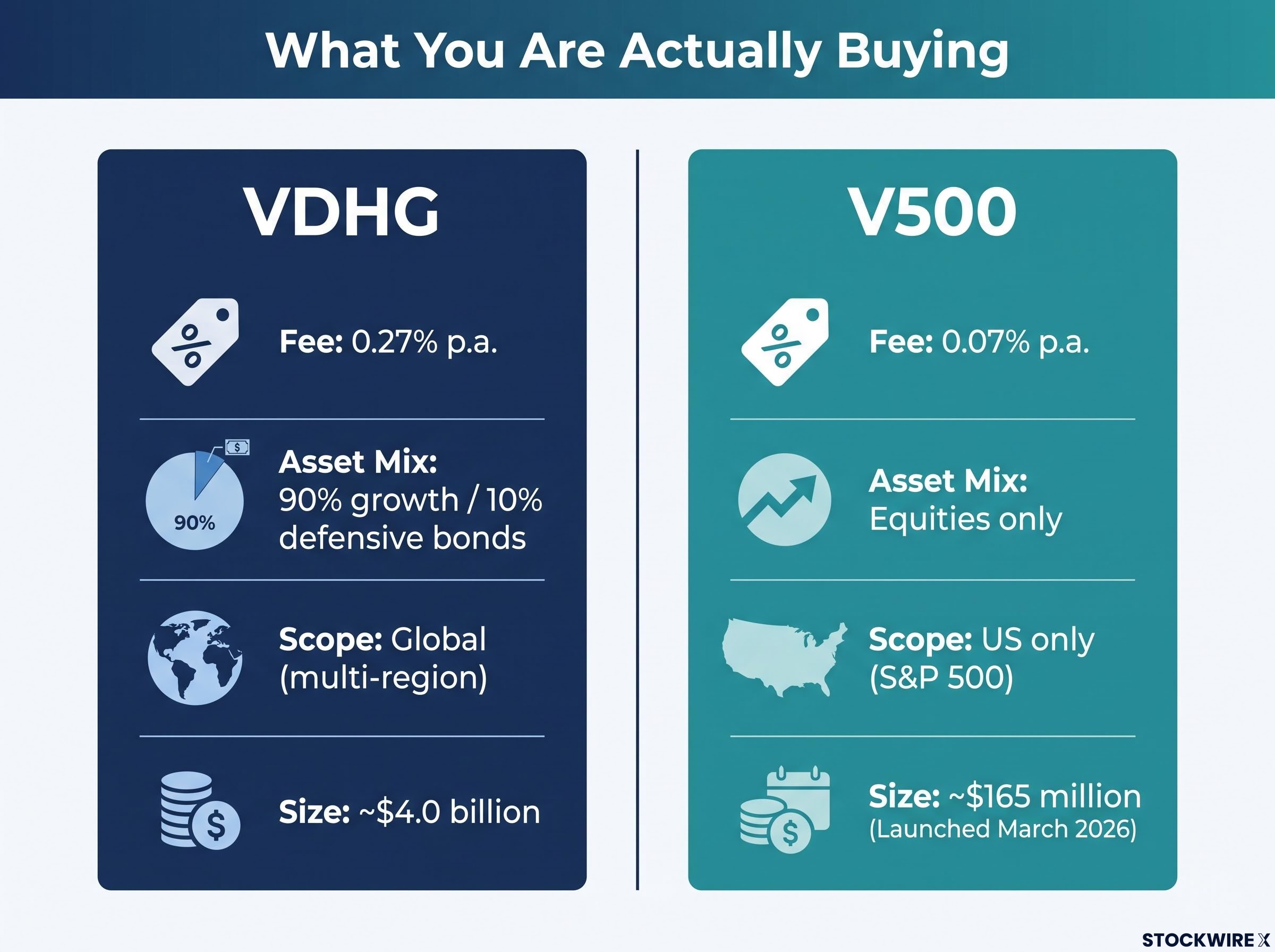
Before you compare a single number, you need to understand that these two funds are not doing the same job. The cost difference between them is not arbitrary. It is a direct consequence of how much work each fund does on your behalf, and once you see that, every other comparison in this guide makes sense.
| Fund | Index Tracked | Asset Classes | Geographic Exposure | MER |
|---|---|---|---|---|
| VDHG | Multiple (fund-of-funds) | Equities, property, bonds | Global (multi-region) | 0.27% p.a. |
| V500 | S&P 500 | Equities only | US only | 0.07% p.a. |
VDHG: the pre-built portfolio
VDHG is a fund-of-funds, which means it holds a collection of other Vanguard index funds rather than shares directly. That structure gives you exposure to thousands of securities across:
VDHG’s fund-of-funds structure holds units in several underlying Vanguard index funds simultaneously, which is why its internal rebalancing works automatically and why the 0.27% fee covers considerably more than simple index tracking.
- Australian equities
- International equities (developed markets)
- Emerging markets equities
- Listed property
- Australian and international bonds
The split is roughly 90% growth assets and 10% defensive assets (the bonds). Vanguard maintains that allocation for you, rebalancing automatically over time so you never have to decide how much to hold in each asset class. This is a long-established product, with an ETF class of approximately $4.0 billion in funds under management.
V500: the single-market tracker
V500 does one job: it tracks the S&P 500 Index, giving you exposure to roughly 500 of the largest US-listed companies at a very low fee. There is no bond component, no rebalancing service, and no diversification beyond US equities.
It is worth knowing that the modern S&P 500 leans heavily on a small cluster of technology and communications-services giants, including Apple, Microsoft, NVIDIA, Alphabet and Meta. Launched in March 2026, V500 currently sits at around $165 million in size. That is small only because it is new, not because anything is wrong with it.
So the 0.20 percentage point fee gap is not a signal of which fund is better value. It is a signal of how much portfolio management you are outsourcing. VDHG charges more because it is doing more.
When big ASX news breaks, our subscribers know first
How the numbers actually compare (and where the gaps are)
Now the return data. Read it carefully, because the interesting part is not which number is bigger. It is what the missing numbers tell you.
VDHG has a genuine track record. According to the Vanguard fact sheet dated 31 July 2026 (with distributions reinvested), it delivered 10.42% over one year, 12.95% per year over three years, and 8.72% per year over five years. You will see different figures on third-party sites, and that is expected: they use different cut-off dates and methods. Treat the Vanguard fact sheet as your standard reference.
V500 has almost no history to show. Because it launched in March 2026, there is no one-year, three-year or five-year figure to compare. Its only available number is an inception-to-date return of roughly 10.03% per year, a window far too short to mean anything.
| Metric | VDHG | V500 |
|---|---|---|
| 1-year return | 10.42% | N/A (launched March 2026) |
| 3-year return | 12.95% p.a. | N/A (launched March 2026) |
| 5-year return | 8.72% p.a. | N/A (launched March 2026) |
| Inception-to-date | N/A | ~10.03% p.a. |
| Distribution frequency | Quarterly | Quarterly |
| Trailing yield | ~3.37% (5-yr income) | ~0.26% |
On income, the two funds tell different stories. VDHG’s income return has run at 0.35% over one year and 3.08% per year over three years (InvestSmart, 31 August 2026), reflecting its multi-asset mix of shares, property and bonds. V500’s trailing yield of around 0.26% reflects the modest dividends US large-cap companies tend to pay.
Here is what that empty V500 column actually means for you. The absence of a track record is not something to gloss over. Choosing V500 is a forward-looking bet on the S&P 500, not a decision anchored in this fund’s proven performance on the ASX. That is a different kind of decision, and you should make it knowingly.
Past performance is not indicative of future results. All performance figures assume reinvestment of distributions and are subject to change with market conditions.
The risks hiding in V500’s simplicity
It is tempting to look at V500’s rock-bottom fee and the S&P 500’s strong recent run and conclude it is the smarter long-term pick. If V500 is the only thing you hold, that conclusion deserves real scrutiny, because simplicity is not the same as diversification.
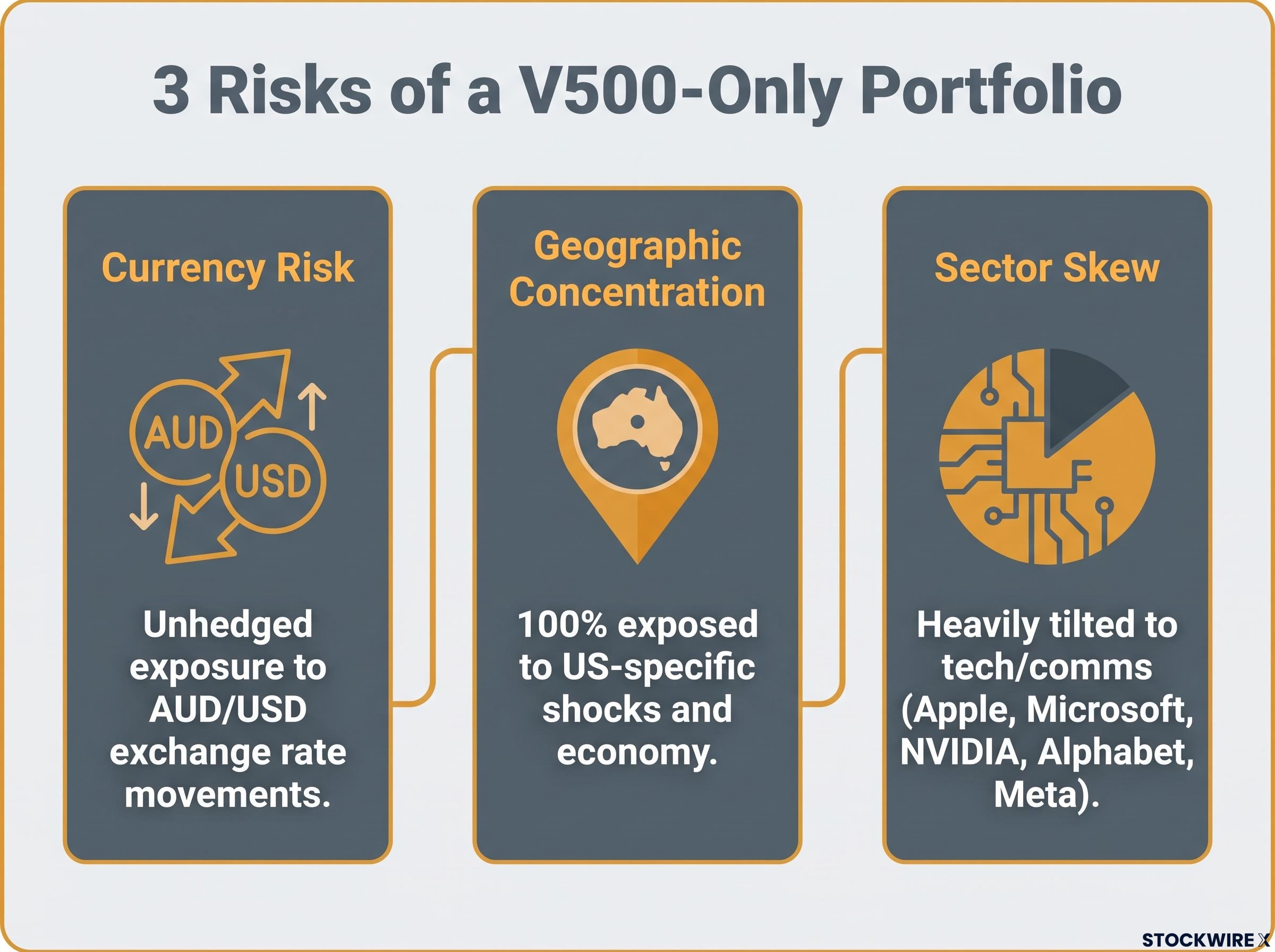
Three risks sit underneath a V500-only position:
- Currency risk: V500 is unhedged, so your returns move with the AUD/USD exchange rate as well as US share prices.
- Geographic concentration: you are exposed entirely to US-specific risks, from regulation to politics, with no cushion from other economies.
- Sector skew: the S&P 500’s tilt toward a handful of tech and communications giants amplifies your sensitivity to tech cycles and interest-rate moves.
ASIC MoneySmart warns that currency fluctuations can significantly amplify gains or losses on unhedged foreign shares, adding short-term volatility even when the underlying market is relatively calm.
ASIC MoneySmart’s guidance on diversification explains that spreading your investments across asset classes, sectors and countries reduces the impact of any single market falling, and specifically flags that currency fluctuations can amplify losses on unhedged foreign holdings.
Passive Investing Australia and Stockspot make a similar point on concentration: leaning heavily on one market, even the US, leaves you exposed to that country’s specific shocks while underexposed to other developed and emerging markets. Stockspot and various advisers add that market leadership rotates, and concentrated bets can underperform for entire decades. VDHG’s global spread means no single country or sector runs the show.
Currency risk and mega-cap concentration are the two dimensions most commonly underestimated in a V500-only position; the AUD/USD rate can move independently of US equity performance and amplify or compress returns regardless of what the underlying index does.
If V500 is the only ETF in a $3,000 portfolio, you are not buying broad market exposure. You are making a concentrated directional bet on the US economy and on where the Australian dollar sits against the US dollar. That may be a bet you want to make. It should not be one you make by accident.
The counterargument worth taking seriously
None of this makes V500 a poor fund. The US has been one of the strongest-performing markets over recent decades, and low-cost S&P 500 access has rewarded patient investors, thanks to deep liquidity and high corporate quality. Educators including Aussie Firebug acknowledge that overweighting US equities has boosted historical returns.
The same voices caution against extrapolating that outperformance forever. Leadership rotates, and today’s winning market is not guaranteed to lead the next decade. Treat this as context to weigh, not a reason to dismiss V500.
Building your portfolio around a $3,000 starting point
Enough theory. Picture yourself with $3,000 to invest and a long horizon. Which scenario is yours?
When VDHG makes the most sense
At this level, splitting money across several ETFs means paying brokerage multiple times, which eats disproportionately into a small balance. VDHG sidesteps that. One purchase gives you global diversification, automatic rebalancing, and a set-and-forget structure, all for the 0.27% fee.
This fits you if you want a hands-off, single-fund solution, value smoother volatility from the roughly 10% bond allocation, and would rather stay invested through a downturn than tinker. You are comfortable paying for the services that fee covers.
When V500 earns its place
Building your own portfolio around V500 is possible, but it is real work. To match what VDHG delivers automatically, you would pair V500 with:
- An Australian equities ETF (useful for franking credits and home-market familiarity)
- V500 for US large-cap exposure
- A global ex-US equities ETF for the rest of the developed and emerging world
- A bond ETF, added over time as your horizon shortens
This is the framework Passive Investing Australia and others describe. At $3,000, the brokerage and rebalancing effort usually make it less efficient than a single fund. V500 earns its place when you already hold Australian and global equities and want to add cheap US exposure without overlap.
There is also the bond debate to settle for yourself. VDHG’s 10% defensive slice is a stabiliser that helps you ride out crashes, but it has lagged pure-equity funds in growth-focused backtests. ReviewETF and ETFLens note VDHG underperformed the 100% equity Betashares DHHF over five years, attributing the gap to that bond allocation dragging during the 2022 bond sell-off. Whether that is a feature or a flaw depends on your horizon and how you handle drawdowns.
Before you decide, run through these questions:
- Do you want a single-fund solution, or are you genuinely comfortable managing and rebalancing multiple ETFs?
- Do you already hold assets that provide Australian and global ex-US exposure?
- How do you actually react when your portfolio drops sharply in the short term?
For most beginners starting at $3,000, V500’s fee saving is outweighed by what VDHG delivers automatically. For an investor with existing diversified holdings, V500 can add targeted US exposure at very low cost. The MER saving only justifies the DIY complexity once it clearly exceeds the added brokerage, rebalancing effort and behavioural risk.
Which fund actually fits your next decade?
The core distinction is now clear. VDHG is a complete, managed portfolio whose higher 0.27% fee is justified by the diversification, rebalancing and defensive allocation it handles for you. V500 is a low-cost 0.07% component that leaves the rest of the portfolio for you to build.
| Factor | VDHG | V500 |
|---|---|---|
| MER | 0.27% p.a. | 0.07% p.a. |
| Diversification scope | Global, multi-asset | US equities only |
| Rebalancing | Automatic | Manual (DIY) |
| Suitable as sole holding | Yes | Only as a component |
| ETF size / track record | ~$4.0B / long-established | ~$165M / since Mar 2026 |
Remember that V500’s ASX history is still being established, so its track record on this exchange is short by design. VDHG’s 8.72% per year over five years (to 31 July 2026) shows what a diversified high-growth allocation has delivered, though that does not predict what comes next.
ETF due diligence extends well beyond the MER comparison: tracking difference versus the benchmark, bid-ask spread costs, and distribution composition each affect the total return a holder actually receives, and both VDHG and V500 reward the same structured review before capital is committed.
At a $3,000 starting point, VDHG’s simplicity advantage is at its strongest. As your portfolio grows and your goals shift, the right answer can change, so reviewing the fit every few years is part of sensible long-term investing. You now have the framework to avoid the two common errors: picking V500 just because it is cheaper, or defaulting to VDHG without understanding the concentration you are sidestepping.
This article is for informational purposes only and should not be considered financial advice. Investors should conduct their own research and consult with a licensed financial professional before making investment decisions. Past performance does not guarantee future results.