Japan’s Finance Minister Satsuki Katayama announced on 10 July 2026 that the government intends to redirect the country’s pension funds toward domestic assets. Within the same session, USD/JPY fell approximately 0.4%, the Nikkei 225 pushed higher, and Japanese government bonds strengthened. Markets did not wait for a policy document to decide this matters.
Standing at the heart of this story is the Government Pension Investment Fund (GPIF), the world’s single largest pension fund, with assets approaching $2 trillion and an overseas allocation that accounts for around half of its total portfolio. Even a modest reweighting at that scale carries structural consequences for the yen, Japanese asset prices, and global capital flows, including demand for U.S. Treasuries. The government’s “Honebuto” Basic Policy framework, scheduled for release on 21 July 2026, represents the next concrete milestone markets are watching.
Here is what the mechanics actually look like, what is already in motion, and which signals will confirm whether this is a structural shift or a policy trial balloon.
Why July 10 matters: the policy signal behind the market reaction
Finance Minister Satsuki Katayama did not float the idea through a parliamentary committee or a background briefing. The announcement came directly, and currency, equity, and bond markets responded in unison within the same session.
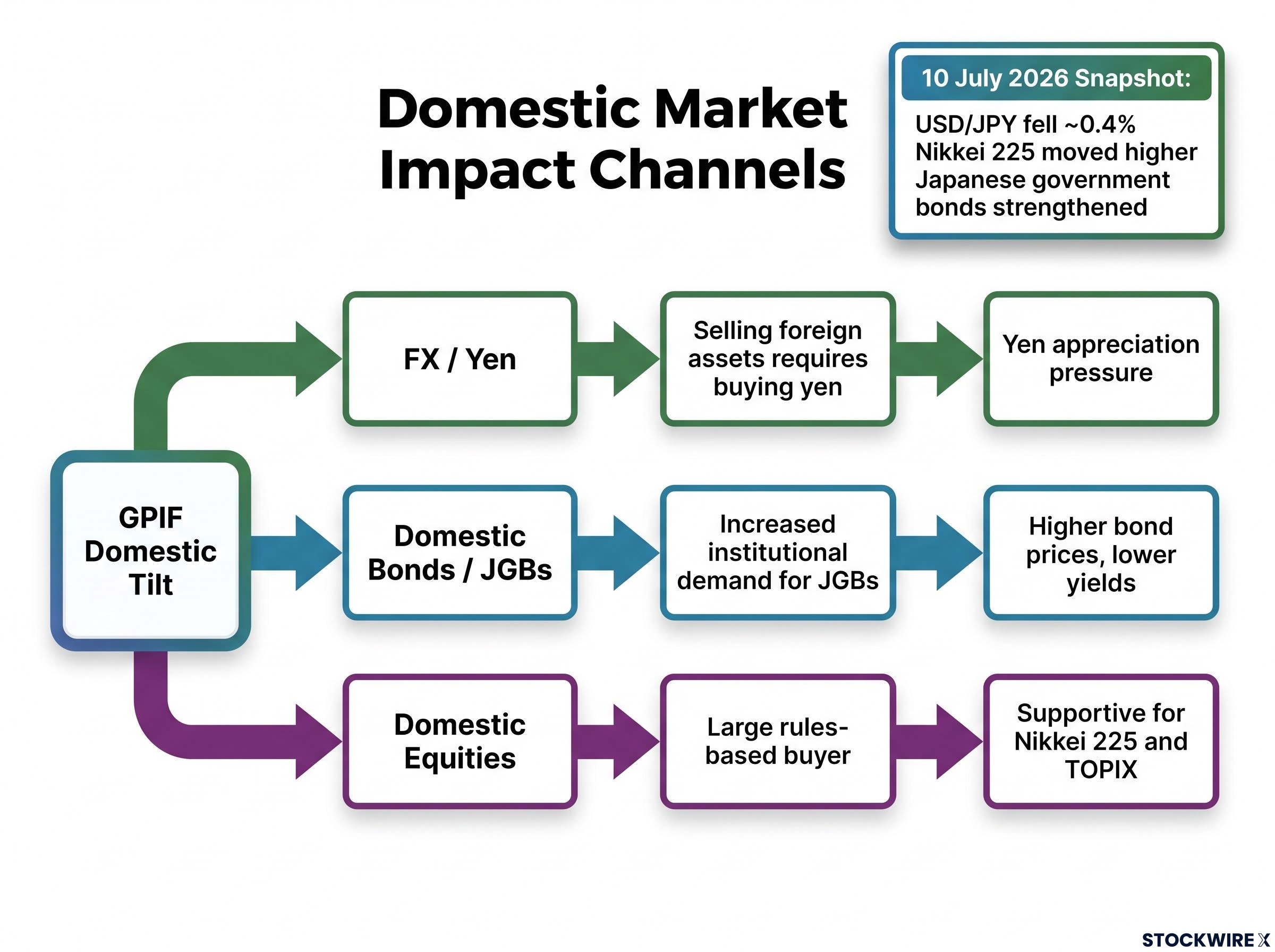
Same-session market snapshot, 10 July 2026: USD/JPY fell approximately 0.4%. The Nikkei 225 moved higher. Japanese government bonds strengthened.
That triple reaction is the credibility signal. Traders read this as a near-term policy direction rather than aspirational commentary, and the speed of the response is what separates a ministerial signal from a think-tank white paper.
The announcement did not arrive in a vacuum. Ruling-party lawmakers had already been urging GPIF to increase domestic private equity and venture capital exposure as part of a broader push to turn Japan into an “asset management nation.” Katayama’s statement converts a background discussion into a named policy priority, and the market treated it accordingly.
When big ASX news breaks, our subscribers know first
What GPIF actually is, and why its size changes everything
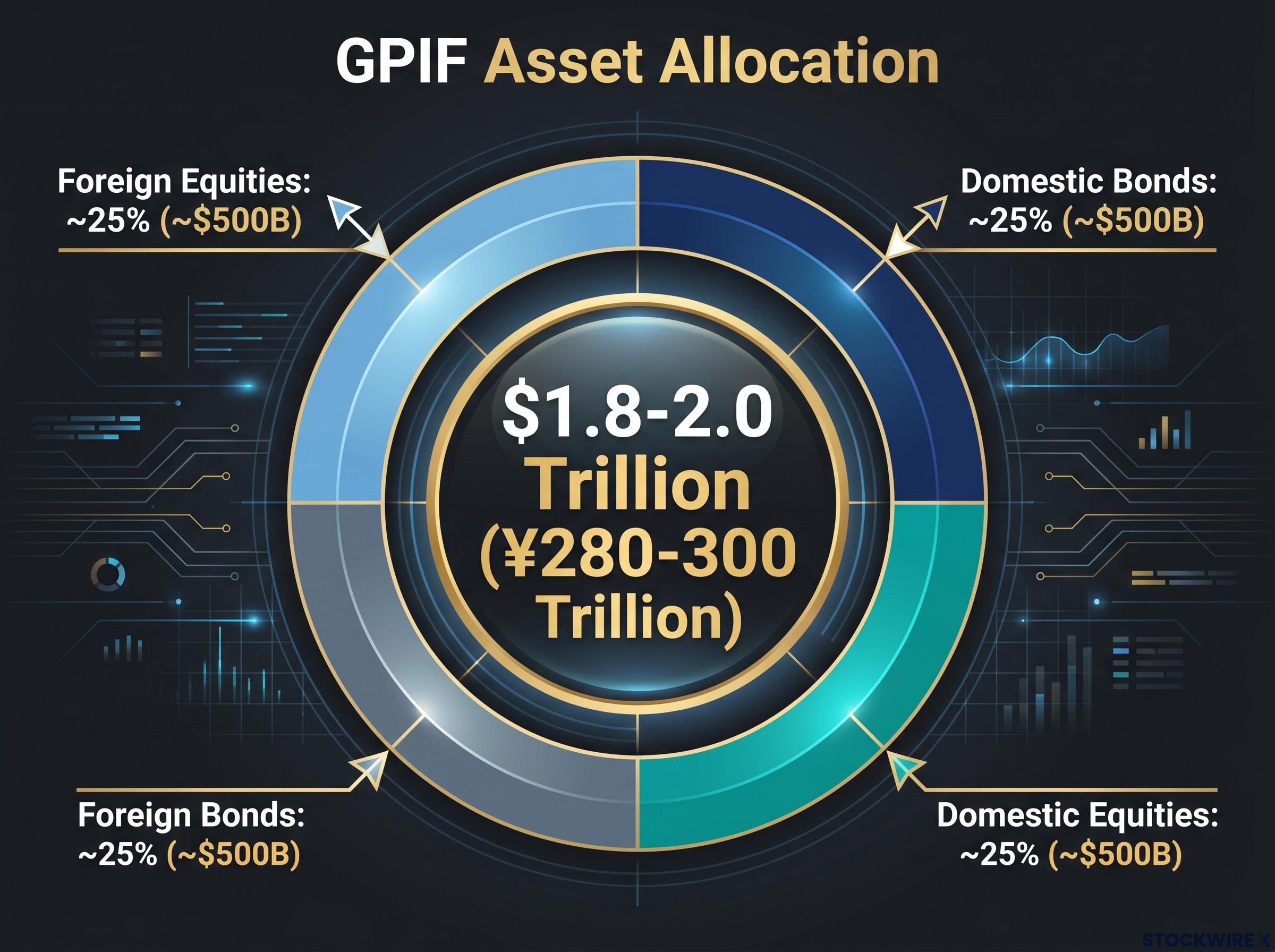
GPIF is not one of the largest pension funds in the world. It is the largest, with assets close to ¥280-300 trillion (approximately $1.8-2.0 trillion depending on the exchange rate). Its portfolio decisions carry systemic weight across both domestic and global markets.
The fund’s structure is straightforward: four asset buckets, each holding roughly 25% of total assets.
GPIF’s latest portfolio results for fiscal 2025 confirm the fund’s four-bucket structure, with each asset class holding approximately 25% of total assets and the overall portfolio sitting close to ¥290 trillion, the baseline from which any policy-driven reweighting would be measured.
| Asset Class | Current Weight | Approximate Value |
|---|---|---|
| Domestic Bonds | ~25% | ~$500B |
| Domestic Equities | ~25% | ~$500B |
| Foreign Bonds | ~25% | ~$500B |
| Foreign Equities | ~25% | ~$500B |
That produces a roughly 50/50 domestic-to-foreign split. The policy portfolio, the formal document that sets these target weights, is approved by the Ministry of Health, Labour and Welfare and revised infrequently. Changes are incremental rather than tactical.
That governance structure is the point. Any approved shift will not be reversed next quarter, which is precisely why even a 5-10 percentage-point reweighting carries multi-year market relevance.
Three channels: how a domestic tilt moves the yen, bonds, and stocks
A GPIF-led shift from overseas to domestic assets transmits through three channels, and they connect as a single repatriation story.
| Channel | Mechanism | Directional Impact |
|---|---|---|
| FX / Yen | Selling foreign assets requires buying yen | Yen appreciation pressure |
| Domestic Bonds / JGBs | Increased institutional demand for JGBs | Higher bond prices, lower yields |
| Domestic Equities | Large rules-based buyer enters concentrated market | Supportive for Nikkei 225 and TOPIX |
The FX channel is the most direct. When GPIF sells foreign securities and converts the proceeds into yen, it generates persistent demand for the currency. The yen’s structural weakness over recent years has been driven largely by interest rate differentials and yen-funded carry trades. A sustained repatriation flow can offset those carry-trade outflows over time, and it showed up in the same session as the announcement because currency markets price expectations fastest.
BOJ rate normalisation has progressively eroded the interest rate differential that made yen-funded carry trades structurally attractive, with the overnight call rate reaching 1.0% in June 2026 and a structured JGB tapering schedule running through March 2027 signalling that the tightening cycle is not yet complete.
A 5-10 percentage-point shift from foreign to domestic assets would imply tens of billions to low hundreds of billions of dollars in FX flows over a multi-year horizon.
The bond channel is less straightforward. GPIF’s domestic bond allocation declined significantly in the 2010s and 2020s as the fund diversified internationally, and its own recent results show domestic bonds have been a drag in a higher-rate environment. That makes a simple bond-heavy tilt less likely. Any reallocation may favour domestic equities and alternative assets instead.
The equities channel is where the directional support is clearest. GPIF entering as a large incremental buyer is supportive for the Nikkei 225 and TOPIX, though crowding risk exists in policy-favoured sectors if multiple institutions chase the same names.
The global side of the ledger: what shrinks when Japan reinvests at home
What Japan’s domestic markets gain, the rest of the world loses at the margin. The mirror image of a domestic tilt has three spillover channels:
- U.S. Treasury yields: Japan is historically among the largest single foreign holders of U.S. government bonds. A strategic reduction, even if gradual, removes a price-insensitive, long-term buyer and adds modest upward pressure to yields.
- Global equity flows: With roughly $500 billion in foreign equities, even a small cut in that allocation equates to tens of billions less in global equity demand over time, amplified if other Japanese pensions and life insurers move in parallel.
- Carry-trade currencies: Yen appreciation tightens funding conditions for yen-funded carry positions. Currencies that have historically served as carry-trade targets, such as select high-yielding emerging market currencies and at times AUD/NZD, face volatility and drawdown risk when those trades unwind alongside a stronger yen.
Treasury yield implications of reduced Japanese demand extend beyond bond pricing: with the 10-year yield at 4.66-4.67% and functioning as a direct pressure point on mortgage rates, corporate borrowing costs, and federal debt servicing simultaneously, even a gradual reduction in Japan’s price-insensitive long-term buying removes a structural stabiliser from the market.
If you hold global bond or equity index exposure, the Japan repatriation story is not just a yen-watcher’s concern. It is a marginal-demand story with real yield and pricing consequences for assets you may already own.
Why this will not happen overnight: the structural limits on GPIF’s speed
Two sections of directional analysis deserve a counterweight. Three structural constraints define the timeline of any reallocation:
- Governance: GPIF’s policy portfolio is approved in multi-year documents by the Ministry of Health, Labour and Welfare. Revisions are infrequent and incremental. No abrupt liquidation of foreign holdings is structurally possible under the current framework.
- Fiduciary mandate: GPIF’s primary obligation is to fund pension liabilities, not to execute industrial policy. Any domestic bias must still pass risk-return tests against global alternatives, and domestic bonds currently offer limited real-yield appeal.
- Implementation: As the largest single pool of retirement savings globally, GPIF cannot aggressively buy or sell without moving the very prices it is transacting at. This argues for phased, rules-based execution over years rather than quarters.
The constraints do not invalidate the thesis. They define its timeline. A reader positioning around this story needs to think in years, not quarters.
What to watch before and after July 21: the signals that confirm the shift
Everything the reader has absorbed converts into four concrete forward-looking signals:
- Honebuto language on 21 July 2026: The Basic Policy framework is anticipated to address how Japan will direct capital toward AI, semiconductors, and the energy sector. The specific language around pension capital allocation will tell you whether the Finance Minister’s signal was policy commitment or positioning.
- GPIF policy portfolio revision: Any formal change to target weights and tolerance bands is the clearest structural confirmation. Day-to-day trading data is noise; the policy document is the signal.
- Market-price signals: Sustained yen strength beyond what rate differentials explain, TOPIX outperformance in policy-favoured sectors, and quarterly changes in Japanese holdings of U.S. Treasuries all corroborate or contradict the reallocation thesis without waiting for official documents.
- Quarterly GPIF portfolio disclosures: A trend of the domestic share rising from approximately 50% toward 55-60% would confirm that reallocation is actually occurring, not just being discussed.
The Honebuto document on 21 July is the first hard test. Eleven days from today, the language around pension capital will confirm or qualify what the market priced in this morning.
A structural shift in motion, with the confirmation still ahead
The 10 July announcement is a credible policy catalyst backed by an immediate and coherent market reaction across three asset classes. Formal confirmation via the Honebuto framework and an eventual GPIF policy portfolio revision will determine how large and durable the reallocation actually is.
This is a multi-year structural story, not a one-session trade. The constraints on GPIF’s speed are as important to understand as the directional thesis itself.
For readers wanting to place Japan’s repatriation within the broader global reserve shift, our deep-dive into central bank reserve diversification examines the OMFIF survey finding that net dollar-reduction intent now outnumbers net dollar-increase intent for the first time on record, with central bank gold accumulation running at approximately 1,000 tonnes per year.
What the reader does with this information depends on existing exposure to yen-denominated assets, Japanese equities, or global bond markets. The next eleven days before the Honebuto release are a reasonable window to assess that exposure.
This article is for informational purposes only and should not be considered financial advice. Investors should conduct their own research and consult with financial professionals before making investment decisions. Forward-looking statements regarding policy changes and market impacts are speculative and subject to change based on government decisions and market developments.