Harvey Norman and Latitude Finance have exhausted every legal avenue available to them in a case that exposed how a national “interest-free” advertising campaign quietly signed Australian shoppers up for credit cards carrying fees that could add more than $500 to a single purchase.
The litigation trail is now fully mapped. ASIC commenced proceedings in October 2022. By late 2024, a Federal Court judge had found both companies liable for misleading conduct. By September 2025, the Full Federal Court had dismissed their appeals as “barely arguable.” As of July 2026, a penalty judgment remains reserved following a hearing where ASIC argued for combined penalties of up to $85 million.
Here is what the advertising concealed, what the court found, and what the eventual penalty decision is likely to mean for any retailer or lender that markets financial products to Australian consumers.
What the “interest-free” ads actually cost consumers
The promise was simple. Harvey Norman ran a national campaign, aired and printed across television, radio, and newspapers, promoting “no deposit, 60 months interest free” on in-store purchases. Over the course of roughly 19 months from January 2020 to August 2021, those advertisements appeared thousands of times. A consumer watching the ad would reasonably conclude that spreading payments over five years would cost nothing beyond the purchase price.
That consumer would be wrong.
The advertising did not make clear that the interest-free offer was only accessible through a Latitude GO Mastercard, a credit product that came with ongoing costs that received no mention in the promotional material itself. Hidden behind the headline terms were several obligations consumers were not warned about:
- A requirement to obtain a Latitude GO Mastercard to access the offer
- Monthly account service fees payable for the life of the credit arrangement
- Establishment fees for cards issued before 16 March 2021, on top of the ongoing monthly charges
ASIC’s illustration of the real cost is the sharpest number in this case:
ASIC identified that a consumer who used the 60-month interest-free promotion to buy a $1,000 item, took out a Latitude GO Mastercard between 16 March 2021 and 11 August 2021, and settled the balance over the full 60-month term, would face a minimum total outlay of $1,537, with $537 of that amount attributable solely to monthly account service fees on top of the original purchase price.
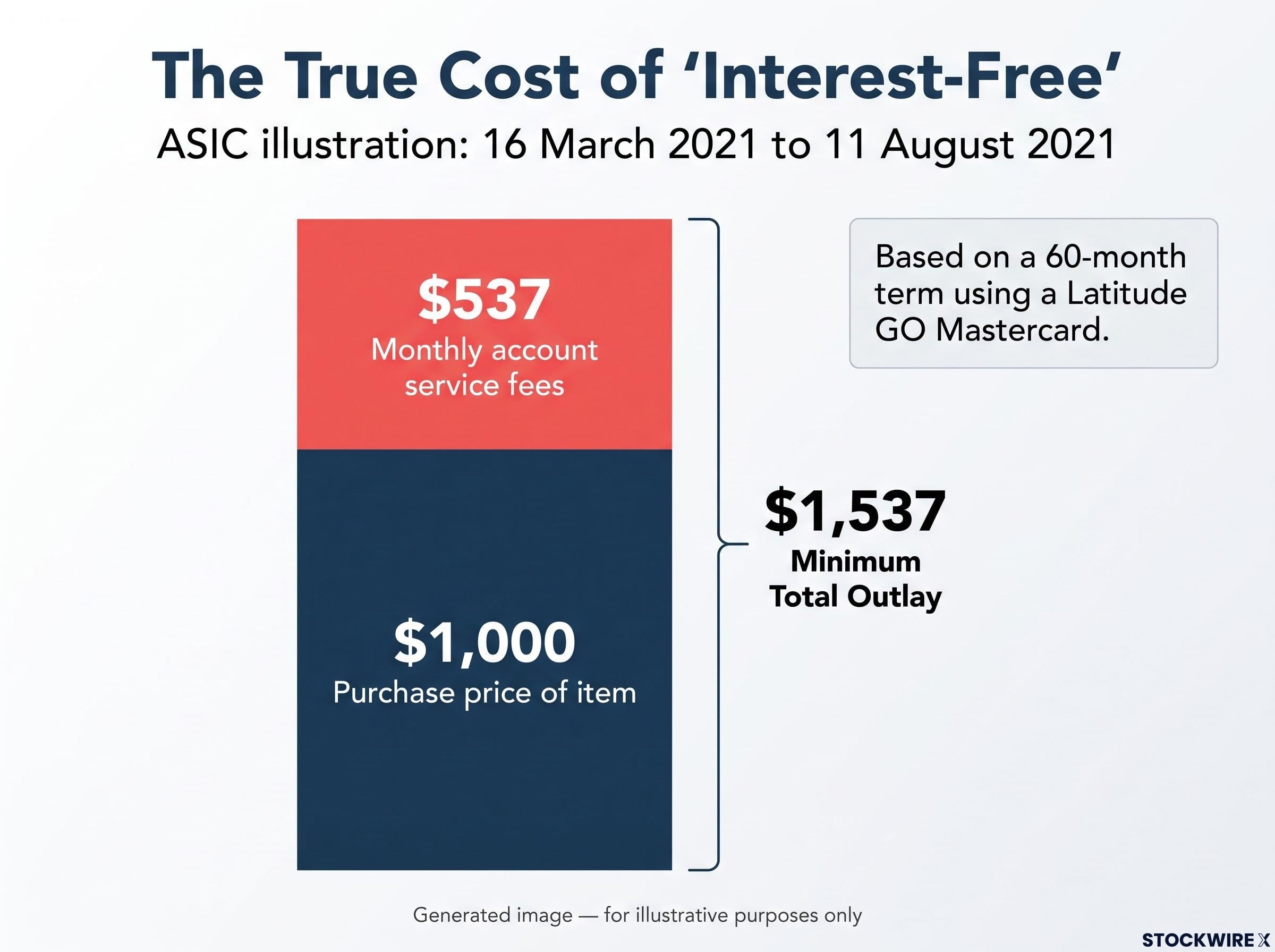
That $537 figure is the gap between what the advertising promised and what consumers actually paid. “Interest-free” was not cost-free.
When big ASX news breaks, our subscribers know first
How the Federal Court established liability
ASIC filed proceedings on 4 October 2022, and from that point, every legal door available to Harvey Norman and Latitude Finance closed in sequence.
- 4 October 2022: ASIC lodged Federal Court proceedings against both Harvey Norman and Latitude Finance, alleging breaches of consumer protection laws governing financial product advertising.
- 18 October 2024: Justice Yates delivered findings that both companies had engaged in misleading conduct and made false or misleading representations.
- 5 November 2024: Formal declarations of liability were issued against both defendants.
- 19 November 2024: Both companies filed applications seeking leave to appeal the declarations.
- 3 September 2025: The Full Federal Court rejected both companies’ appeals in their entirety.
- November 2025: A penalty hearing was held; judgment was reserved.
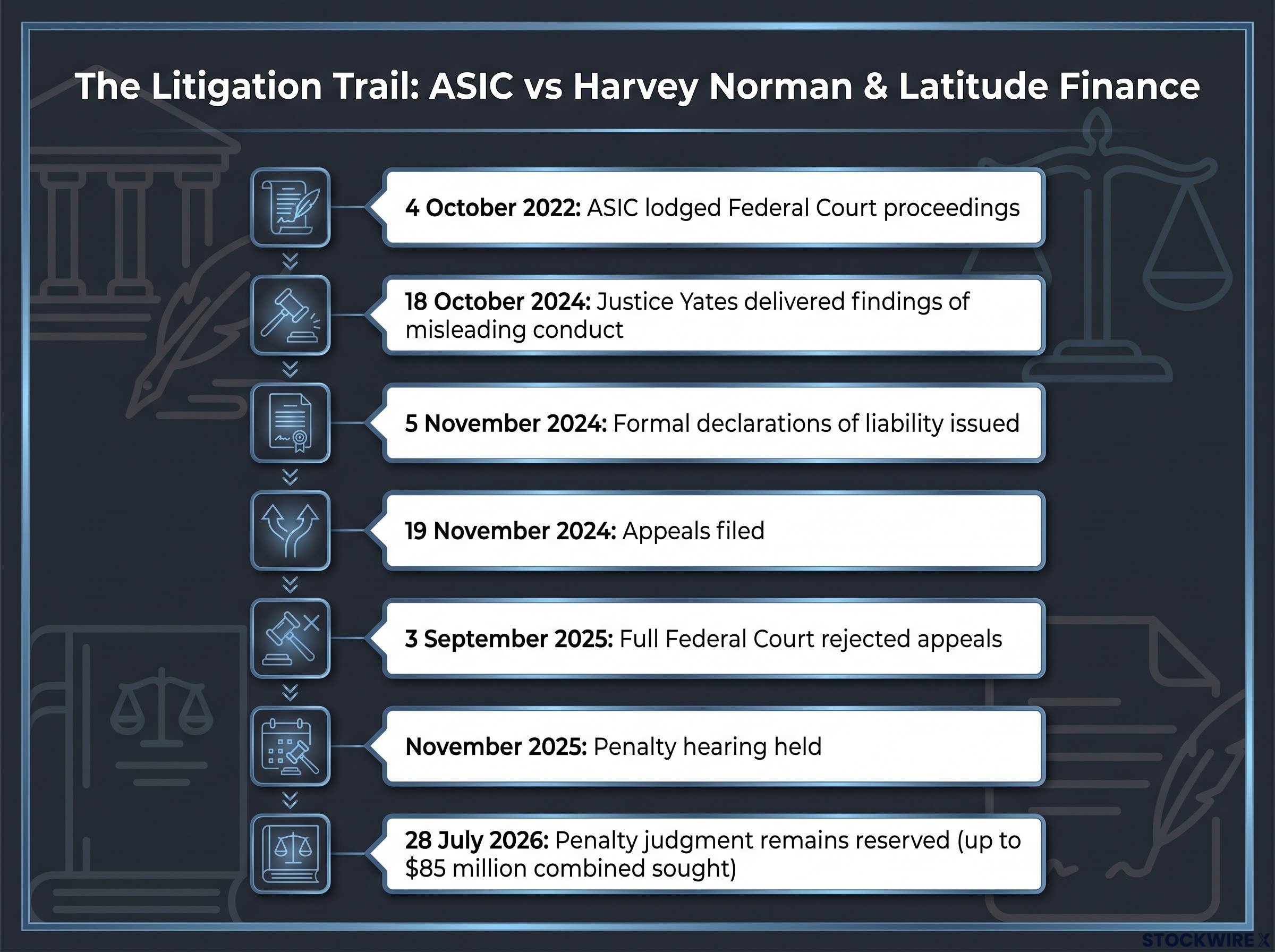
The Full Federal Court’s characterisation of the appeals as “barely arguable” is not a routine dismissal phrase. It signals the appellate bench regarded the original liability finding as so clear that the challenge was weak from the outset. That language leaves the penalty proceedings resting on a foundation neither defendant can disturb.
ASIC’s September 2025 media release confirmed the Full Federal Court’s dismissal of both appeals, with the regulator describing the outcome as reinforcing that financial product advertising must give consumers a complete and accurate picture of associated costs before they act on a promotion.
The three laws the advertising broke
The Federal Court found breaches of three provisions under the Australian Securities and Investments Commission Act 2001 (Cth), the legislation governing conduct in relation to financial services and products:
- Section 12DA prohibits misleading or deceptive conduct in financial services. The campaign created a materially false impression of what the interest-free offer would cost.
- Section 12DB prohibits false or misleading representations about the characteristics of financial products. The advertising misrepresented the nature of the arrangement consumers were entering.
- Section 12DF prohibits false or misleading representations about cost. The fees attached to the Latitude GO Mastercard were not disclosed in the advertising itself.
All three provisions were breached because the advertising told consumers one thing while the credit product behind it did another.
What “interest-free” really means under the law
The phrase “interest-free” carries a specific consumer expectation: you pay the purchase price, spread across instalments, and nothing more. Under Australian consumer protection law, that expectation is exactly what advertisers are held accountable for.
The standard is not whether the fine print eventually disclosed the fees. The standard is whether the advertising itself gave consumers the full picture before they acted on it. ASIC’s public position on the case centred on this concern:
ASIC’s core concern was that the campaign left consumers without the information they needed to make an informed decision, specifically that taking up the offer meant applying for a credit card product with substantial ongoing fees, which carried the potential for additional debt and consequences for credit standing.
The court’s findings reinforced a principle that applies well beyond this case. Consumers responding to retail promotions are in a purchase mindset, not a credit-product mindset. They are thinking about a refrigerator, not about the terms and conditions of a credit card. Advertisers are expected to account for that context, which means material obligations must be communicated in the advertising itself, not buried downstream in product disclosure statements.
That “full picture” standard gives you a practical test for evaluating any retail finance promotion: does the ad itself tell you about the credit product and its costs, or does that information only surface after you have already engaged?
The pattern of hidden costs in financial products marketed with headline-rate simplicity extends well beyond retail credit: zero-fee brokerage platforms in Australia generate revenue through cash interest retention, proprietary ETF fees, and FX margins that never appear in the advertised fee schedule.
Penalties pending: what ASIC is seeking and why the split matters
A penalty hearing was held in November 2025. As of 28 July 2026, judgment remains reserved.
ASIC has publicly argued for combined penalties of up to $85 million across both defendants.
| Defendant | ASIC’s penalty position | Status |
|---|---|---|
| Harvey Norman | Portion of up to $85 million combined | Judgment reserved |
| Latitude Finance | Portion of up to $85 million combined | Judgment reserved |
ASIC’s submissions to the court emphasised the seriousness of the conduct, the need for strong general deterrence, and differential treatment between the two defendants. That last point matters. In civil penalty proceedings under the ASIC Act, remorse and post-breach conduct are standard considerations the court weighs when setting penalties. ASIC argued that the two companies should not be treated identically.
Even if the court ultimately awards less than $85 million, the figure ASIC has argued for signals something to every retailer and lender marketing financial products in Australia: the regulator’s appetite for large civil penalties in consumer finance cases has escalated substantially.
The Harvey Norman and Latitude Finance case sits within a year of record ASIC enforcement penalties, with Australian courts ordering $830 million in civil penalties connected to ASIC’s work in FY2025-26 across banks, superannuation trustees, CFD providers, and consumer credit operators.
This article is for informational purposes only and should not be considered financial advice. Investors should conduct their own research and consult with financial professionals before making investment decisions.
What the case signals for retail finance marketing in Australia
This case sits within a broader regulatory concern about credit products sold through retail environments, where the consumer’s mindset is focused on a purchase rather than on the terms of a financial product. The category includes embedded finance arrangements, buy-now-pay-later products, and retailer-linked credit. All are subject to the same disclosure requirements the court applied here.
Retail pricing and misleading promotions have become a sustained regulatory focus beyond just credit products, with the Federal Court’s May 2026 ruling on Coles Group’s Down Down program finding that promotional timing itself can constitute a misleading representation even when underlying price changes are commercially justified.
Related class action activity has been reported in connection with the Harvey Norman and Latitude campaign, reflecting the scale of potential consumer harm.
ASIC’s enforcement position, as it emerges from this case, establishes three compliance requirements that apply across the category:
- Headline advertising must disclose when accessing a promotion requires obtaining a credit product
- Fees must be disclosed in the advertising itself, not only in downstream fine print or product disclosure statements
- The retail context in which the promotion is encountered does not reduce the advertiser’s disclosure obligations
Any Australian retailer or lender currently running promotional advertising that ties a consumer to a credit product needs to ask whether the ad itself makes the credit obligation and its costs clear. If the answer depends on fine print, this case says that is not enough.
Where the case stands now, and what to watch for
The confirmed and pending outcomes break down cleanly:
Confirmed:
- Both Harvey Norman and Latitude Finance were found to have breached the law, with courts at every level upholding those findings
- The Full Federal Court’s rejection of both appeals in September 2025 means the liability determinations are now beyond challenge
- Penalty hearing completed in November 2025
Pending:
- Final penalty judgment remains reserved as of 28 July 2026
- ASIC has sought combined penalties of up to $85 million
- Whether corrective advertising obligations will be imposed remains to be determined
When the penalty judgment lands, it will either confirm or moderate the $85 million benchmark ASIC has argued for. That figure will immediately become the compliance reference point for every other business running similar promotional campaigns in Australia.
What consumers who took up the offer can do now
ASIC’s Moneysmart platform provides independent guidance on the actual costs of interest-free retail finance arrangements, including how to assess whether fees and charges apply to a promotion. Any consumer who believes they were misled by the Harvey Norman campaign may wish to seek independent financial advice or review the class action activity associated with it.
Past performance does not guarantee future results. These statements are based on publicly available court records and ASIC media releases and are subject to the final penalty judgment.