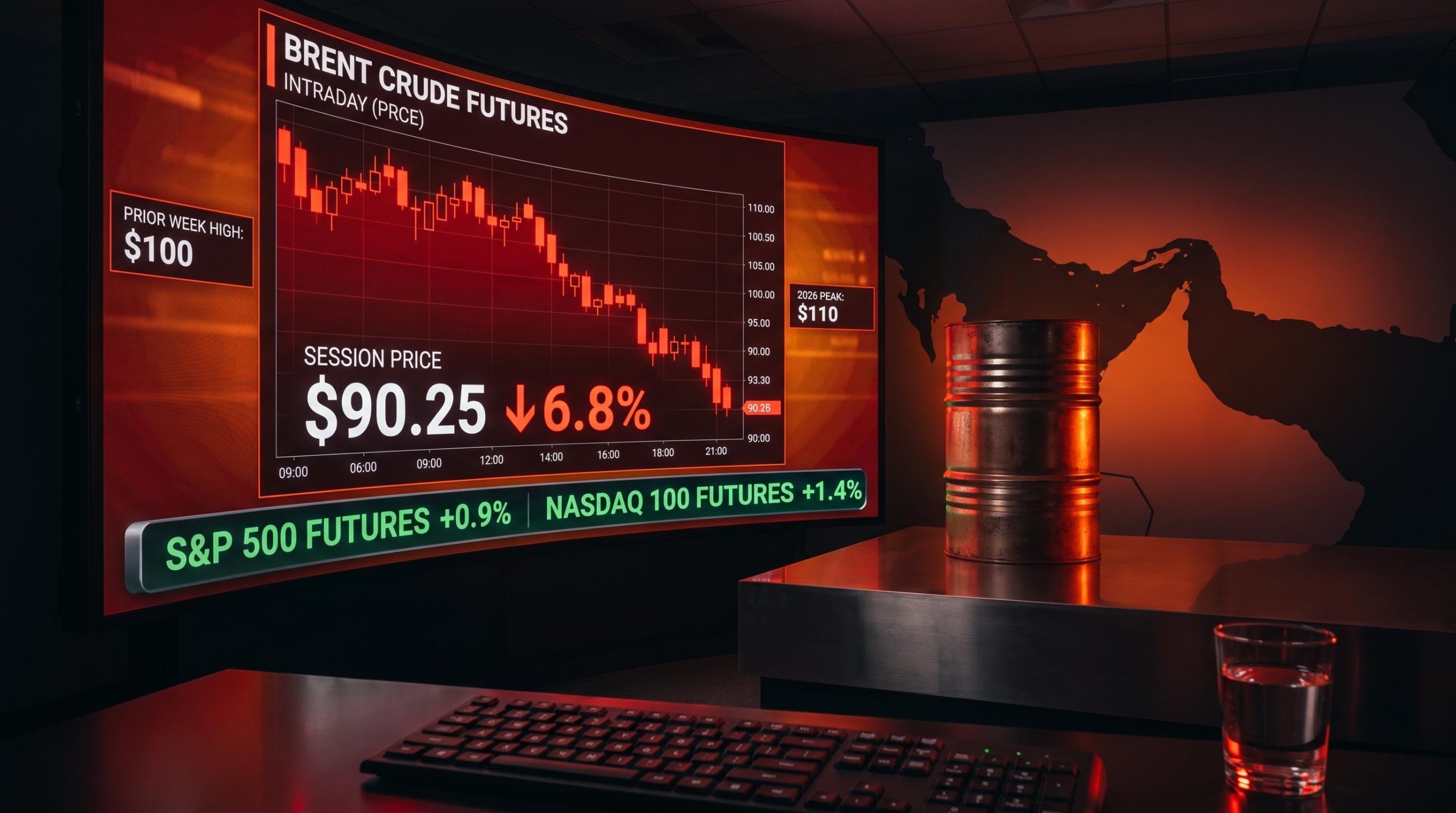
Brent crude futures dropped approximately 6.8% to $90.25 per barrel on 27 July 2026, reversing a move that had briefly pushed oil above $100 the prior week. A drop of that magnitude in crude does not stay in the energy markets. It travels into equities, bonds, inflation expectations, and the room where the Federal Reserve makes its next rate decision.
The trigger is a second consecutive day of halted U.S.-Iran military exchanges, which prompted traders to strip out a significant portion of the war-risk premium that had been embedded in crude prices since hostilities escalated earlier in 2026. The relief is real. Whether it lasts is the question every asset class is now pricing in real time.
Here is what drove the drop, what the ceasefire actually represents, and what it means for equities, bonds, and the Fed’s rate decision on Wednesday, 30 July. The answer matters for how you position over the next seventy-two hours.
Why crude oil prices fell 6.8% today
The numbers tell the story in layers. Brent crude futures settled at approximately $90.25 per barrel on 27 July 2026, shedding roughly 6.8% in a single session. The prior week, Brent had briefly crossed $100. Earlier in 2026, an Iranian closure of the Strait of Hormuz had pushed prices above $110.
When military conflict threatens supply infrastructure, traders embed a fear premium above the commodity’s fundamental value. That premium is what moved today. A second day of halted U.S.-Iran exchanges reduced the immediate probability of further supply disruptions, and traders unwound a portion of the risk they had been carrying.
Key price reference points for context:
- Brent on 27 July 2026: approximately $90.25, down 6.8%
- Prior week high: briefly above $100 per barrel
- 2026 peak: above $110 during the Strait of Hormuz closure
- Pre-war baseline: approximately $70 per barrel
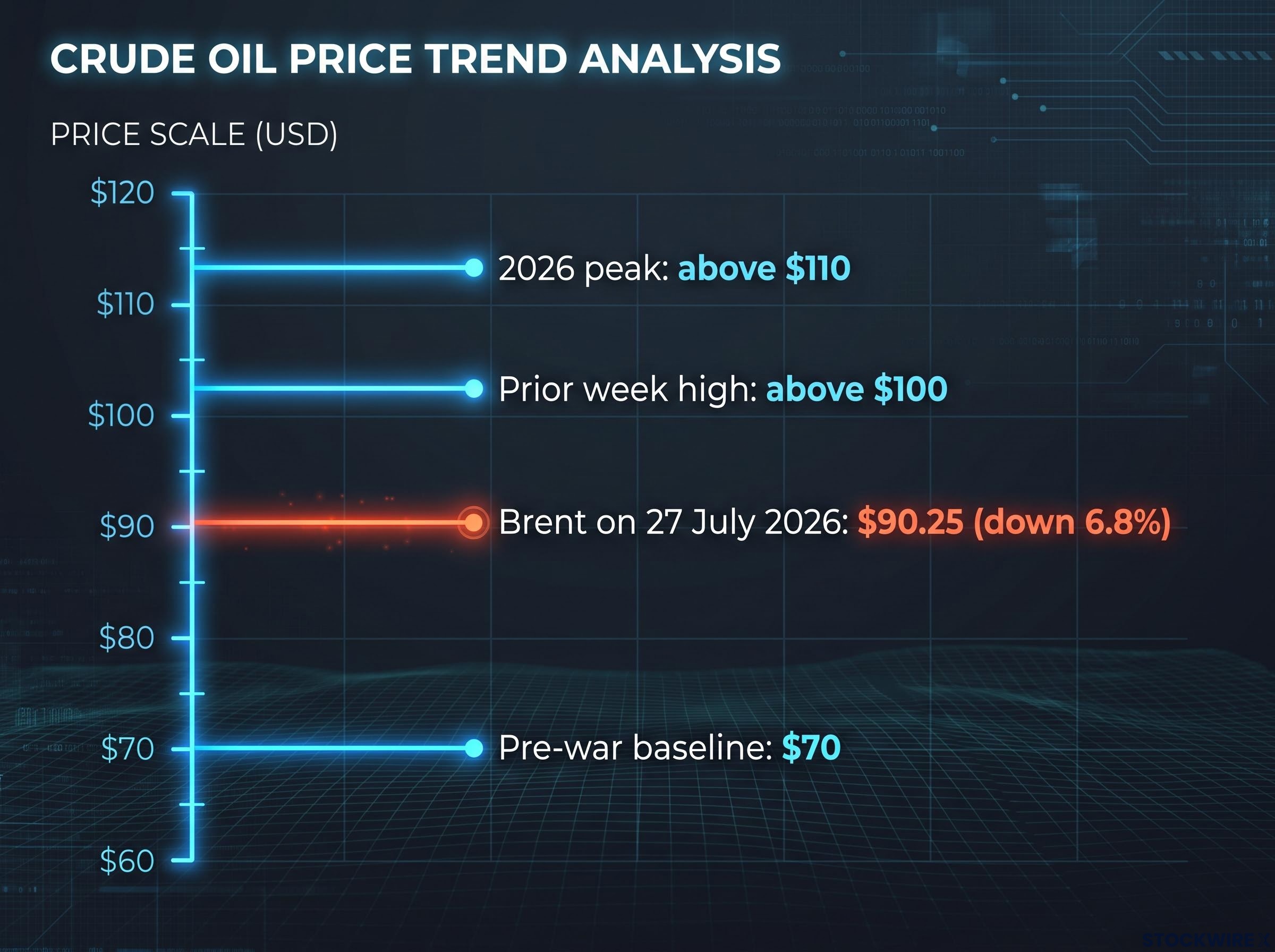
Brent at $90 remains roughly $20 above its pre-war level of approximately $70 per barrel, meaning structural supply tightness has not been resolved.
The gap between today’s $90 and the $70 pre-war baseline tells you that markets still carry a structural risk discount on supply. The inflation relief is real but partial. Treating it as resolution would be a mistake.
The Hormuz oil risk premium does not decompress uniformly with diplomatic progress; the near-total withdrawal of commercial war-risk insurance in early May 2026 effectively closed the strait to standard commercial traffic even when physical passage was technically possible, and the IEA projected a two-year supply chain recovery timeline even under a best-case resolution.
When big ASX news breaks, our subscribers know first
What the ceasefire actually is (and what it is not)
By 27 July 2026, the cessation of hostilities between the United States and Iran had stretched into its second consecutive day. Negotiations spanning multiple levels had been active, with Oman serving as an intermediary alongside Iranian and U.S. representatives, running from the most senior officials through to working-level technical staff. According to Reuters, Iran signalled it would hold off on further strikes on the condition that the U.S. brought its own bombing campaign to a halt.
That is the optimistic read. There is a competing one.
Two narratives are circulating about why the pause exists:
- Diplomatic progress framing: U.S. Ambassador to the United Nations Mike Waltz disputed reports of depleted munitions, characterising President Trump’s posture as deliberately creating space for negotiations.
- Munitions constraint reporting: The New York Times reported that Trump’s choice to hold off on additional strikes, at least for now, was shaped by concerns about dwindling stocks of Patriot antimissile interceptors and other air defence munitions held in the Middle East.
The dispute between these accounts is not a media sideshow. It signals genuine uncertainty about whether this pause is diplomatically grounded or logistically forced, and that uncertainty is exactly why markets are pricing cautious relief rather than full risk-on.
Why the ceasefire’s character matters for oil pricing
If the pause is backed by real diplomatic progress and credible steps to secure shipping lanes, markets can continue unwinding the war premium, potentially pushing Brent closer to the $80s.
If it is mainly a tactical, operational pause driven by logistics rather than a true political shift, the current oil pullback is fragile. Prior conditional ceasefires in 2026 have repeatedly collapsed, producing abrupt 3-6% single-day oil spikes and risk-off equity moves when they broke. The nature of this ceasefire, whether it is structurally grounded or operationally forced, determines how much of today’s decline is durable versus vulnerable to reversal on the next headline.
The June 2026 record shows how quickly a ceasefire collapses into a renewed oil spike: when JD Vance cancelled Geneva talks on 19 June, Brent dropped below $80 and both benchmarks were on track for approximately 10% weekly losses, a reminder that today’s $90 level sits in exactly the range where rapid reversal has already occurred once this year.
How oil and inflation feed into the Fed’s July 30 decision
Lower crude feeds into cheaper petrol and diesel within weeks, lowering headline CPI relative to what markets feared when Brent was above $100. Transportation and input costs for goods and services fall in tandem. That is the inflation transmission channel, and it is already working.
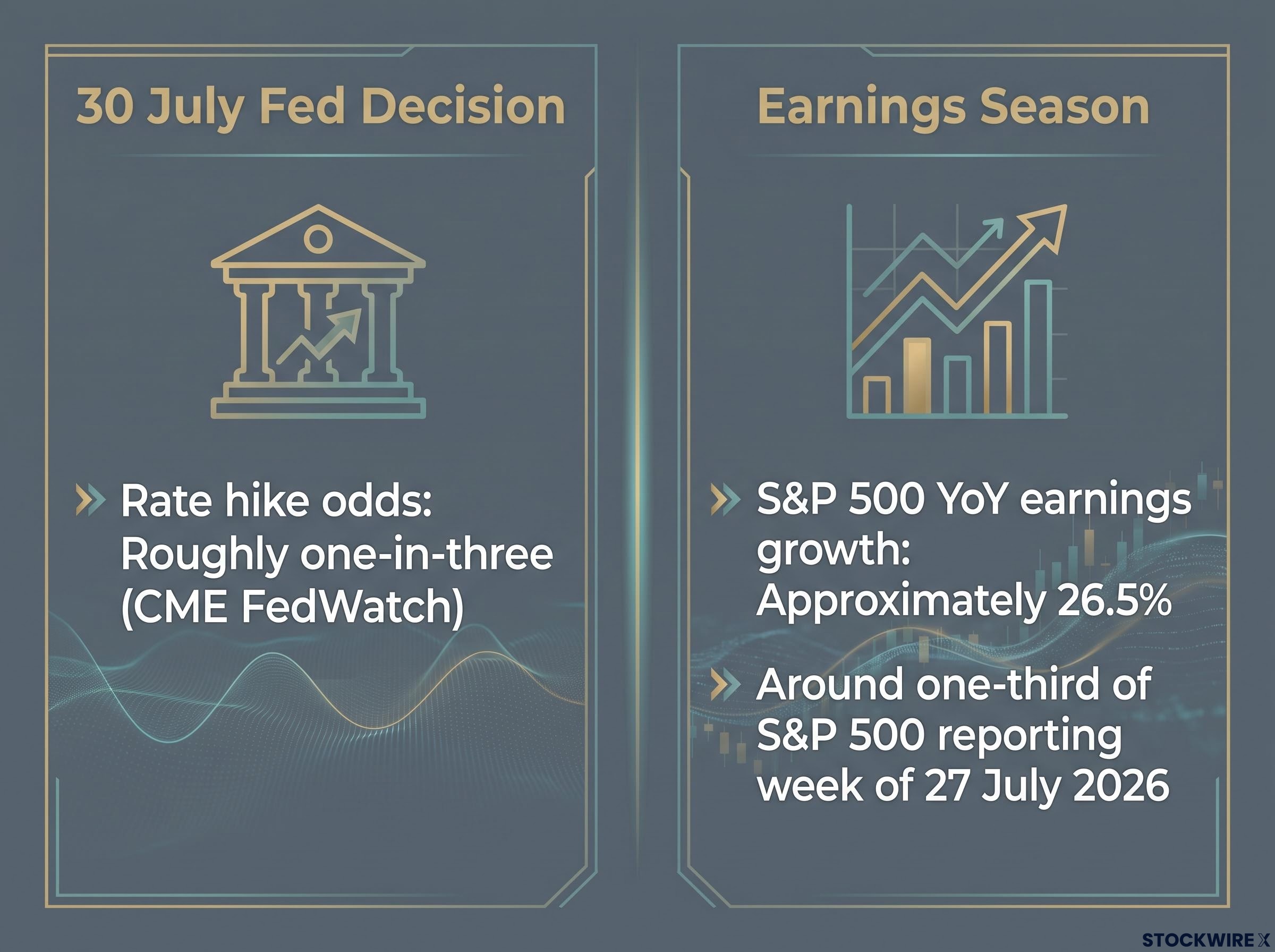
According to CME FedWatch data, roughly one-in-three odds were being placed on a rate hike at the 30 July meeting, while the bulk of market participants expected the central bank to hold borrowing costs steady.
A one-in-three hike probability means the outcome is genuinely uncertain from a market pricing perspective. Today’s oil drop shifts the balance of risks toward a hold without removing the hike scenario entirely, which means Wednesday’s press conference language carries outsized weight for rate-sensitive assets.
Fed press conference language has already demonstrated outsized market impact in 2026: at the June meeting, Kevin Warsh’s inaugural press conference carried more weight than the widely expected hold itself, with the 2-year Treasury yield moving as the most direct real-time signal of whether his framing on oil and inflation leaned dovish or hawkish.
The Fed, however, focuses on core inflation rather than short-term energy swings. Policymakers are also navigating inflationary pressures from the expansion of artificial intelligence infrastructure spending, a separate force that has nothing to do with the ceasefire. Powell is likely to acknowledge the easing in energy prices while stressing the need for durable improvement and noting that Brent at $90 remains elevated versus pre-conflict levels.
Two language signals to watch in Powell’s press conference:
- Whether the Fed frames the oil drop as transitory or as part of a broader supply normalisation
- How much explicit weight the Fed assigns to AI infrastructure spending as a competing inflation driver
The Fed’s interpretation of this oil move, whether framed as a temporary reprieve or evidence of supply stabilisation, will directly affect rate expectations and the trajectory of rate-sensitive assets including long-duration bonds and growth equities.
What lower oil means for stocks and bonds right now
Equity futures moved sharply on the news. As of 01:49 ET on 27 July 2026:
| Index | Point move | Percentage gain |
|---|---|---|
| Dow futures | +398 points | 0.8% |
| S&P 500 futures | +66 points | 0.9% |
| Nasdaq 100 futures | +406 points | 1.4% |
The major U.S. indices closed the preceding week on mixed footing, having been dragged lower by the sharp run-up in oil prices that accompanied the escalating conflict in the Middle East. Today’s futures strength mirrors prior ceasefire episodes in 2026, when stock futures jumped as oil fell and investors priced in lower inflation risk.
The Nasdaq 100’s outperformance relative to the Dow tells you the market is specifically pricing lower rate-hike odds, not just general risk appetite. Growth and tech valuations are especially sensitive to interest-rate expectations. If you hold growth or long-duration assets, today’s session is working in your favour, but the exposure is symmetric if the ceasefire breaks.
The bond market mechanism follows the same logic:
- Lower oil reduces expected inflation
- Lower inflation expectations reduce the urgency for rate hikes
- Fewer expected hikes lift bond prices and pull yields lower
Today’s crude drop supports Treasuries and other high-grade bonds, and may flatten or slightly bull-steepen the curve if markets see less near-term hiking but still expect restrictive policy for some time. The pattern from prior 2026 ceasefire episodes is consistent: growth and tech outperformed, bonds rallied, and energy names pulled back.
The earnings season complication
Around one-third of S&P 500 constituent companies are due to publish their quarterly figures during the week of 27 July 2026. Year-over-year earnings growth for the S&P 500 is running at approximately 26.5%.
S&P 500 corporate earnings are tracking at approximately 26.5% year-over-year growth, a pace that supports risk assets but complicates the Fed’s calculation.
Strong tech and AI-linked earnings can reinforce the case for risk assets and help markets look through geopolitical noise, as occurred in prior 2026 ceasefire relief rallies. Positive earnings surprises from those names in earlier episodes helped sustain gains even when headlines remained volatile.
The complication is that robust corporate profits and resilient economic activity make it harder for the Fed to argue that current policy is already sufficiently restrictive. If the earnings reports this week confirm that the economy is running hot even with elevated oil and borrowing costs, the Fed’s calculus shifts: today’s oil relief may not be enough to take a hike off the table if activity data signals continued inflationary pressure underneath.
For positioning, prior 2026 episodes suggest three dynamics to watch:
- Energy and commodities: expect volatility rather than a straight line down; ceasefire headlines have whipsawed these markets repeatedly
- Rate-sensitive growth and long-duration bonds: benefit from any sustained oil pullback and lower rate-hike odds, but are exposed to sharp reversal if the ceasefire breaks
- Defensives and quality: outperformed on days when ceasefires wobbled or broke, acting as a hedge against the risk that today’s relief proves temporary
Strong earnings and lower oil are both individually bullish signals. Their combination, however, sends a mixed message to the Fed, and anyone with rate-sensitive exposure needs to track both variables through the week rather than treating Monday’s oil drop as the only input.
Three variables that will determine whether today’s relief holds
The next seventy-two hours hinge on three factors, listed in order of immediate significance:
- Ceasefire durability and shipping lane developments. Any new threats to the Strait of Hormuz or Bab el-Mandeb could reverse today’s move overnight. What matters most is whether Oman-mediated talks produce structured commitments rather than a tactical operational pause. Daily indications that the pause is holding, or fraying, will set oil’s direction.
- Fed rate decision and Powell press conference language on 30 July. The decision itself (hold versus hike) is the headline, but the press conference language carries more weight for forward expectations. Specifically:
- Whether Powell frames the oil drop as transitory or as part of broader supply normalisation
- How much explicit weight the Fed assigns to AI infrastructure spending as a competing inflation driver
- Earnings reports from energy companies and major tech firms. Energy company guidance will signal whether the current price range looks sustainable or whether management is bracing for renewed volatility. Strong results from major tech and AI-exposed firms reinforce the growth-and-inflation narrative the Fed will factor in even if oil falls.
How these three variables interact over the next seventy-two hours will determine whether Monday’s relief rally consolidates into a durable repricing or reverts sharply. If you have active positioning decisions ahead of you, the oil drop is context, not conclusion.
Relief is real, but this is not an all-clear
Today’s 6.8% crude drop is a genuine positive for risk assets and the Fed’s near-term flexibility. Equity futures are up sharply, bonds are supported, and the probability of a rate hike on Wednesday remains a minority view. The relief is real.
But Brent at $90 remains $20 above its pre-war baseline, and the ceasefire’s durability is unconfirmed. Prior pauses in 2026 have collapsed repeatedly, producing the kind of abrupt reversals that punish anyone who sized for resolution rather than relief.
For readers wanting the complete sector-level breakdown of how markets repriced during the closest prior analogue, our full explainer on the June ceasefire market repricing covers the 14-point memorandum, the Strait of Hormuz reopening timeline, and why markets priced approximately 17 basis points of Fed cuts before the 60-day window tested those assumptions.
The market’s cautious risk-on posture is rational given what is known today. Watch the ceasefire developments, Wednesday’s Fed language, and the earnings results in combination, not in isolation. Sizing for a ceasefire that holds is different from sizing for one that breaks.
This article is for informational purposes only and should not be considered financial advice. Investors should conduct their own research and consult with financial professionals before making investment decisions. Past performance does not guarantee future results. Financial projections are subject to market conditions and various risk factors.