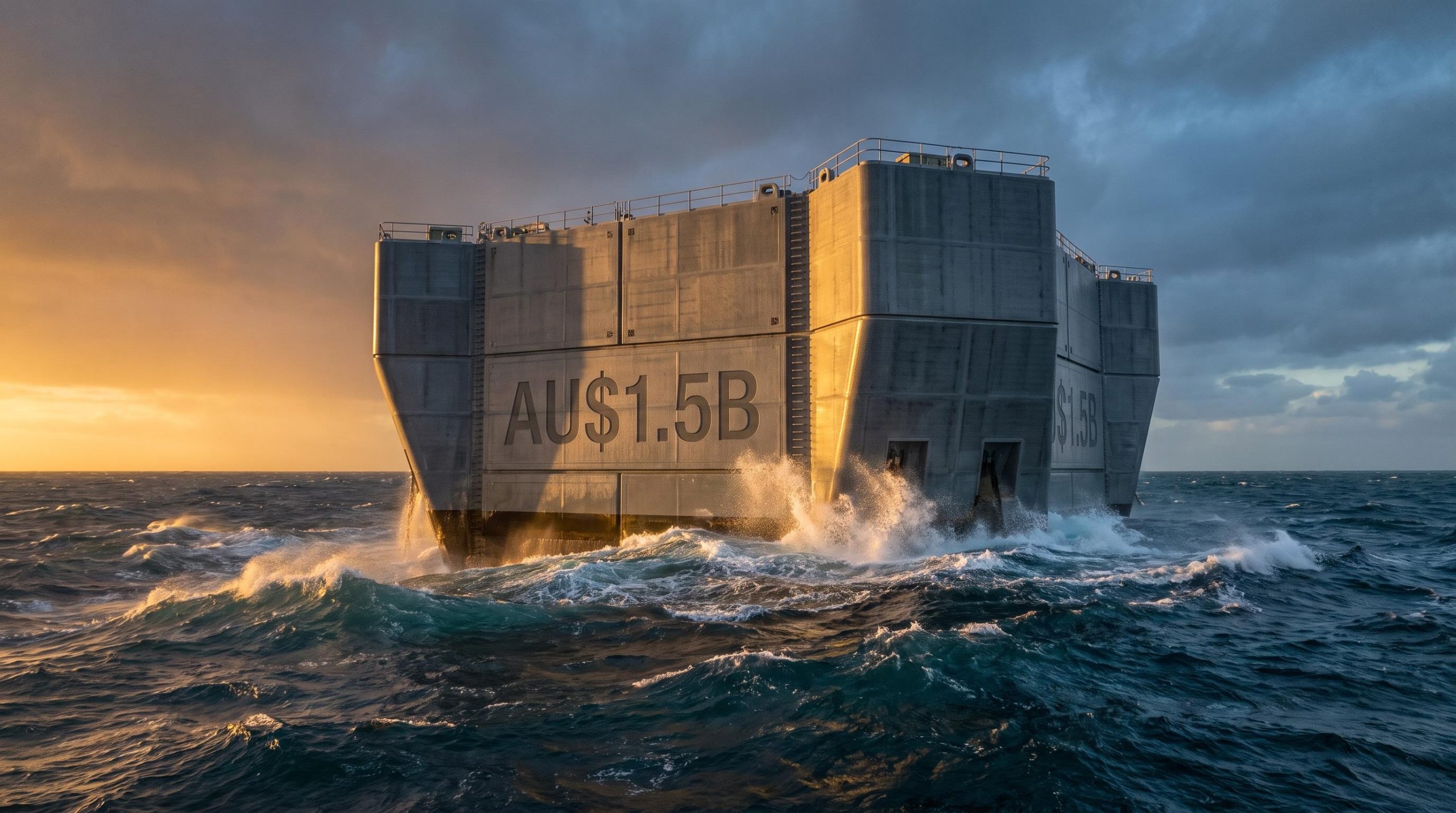
A single number is meant to carry the weight of this announcement: AU$1.5 billion in private capital, committed to a floating wind technology that has not been proven at commercial scale anywhere in the world, in a country that has yet to switch on a single offshore wind turbine.
That combination should give any commercially-minded investor pause. Australia’s offshore wind pipeline sits at roughly 86 GW of announced projects and precisely zero gigawatts operational. The regulatory system is still handing out feasibility licences only, meaning permission to study the resource, not to sell power from it.
PolarBlue’s Bell Bay hub is being positioned as a manufacturing starting point, not a project with revenue flowing. The Tasmanian government’s support is a framework agreement covering land, port access, and workforce training, with no grant cheque attached.
What follows maps the investment logic, the risk layers, and the sector-level headwinds so you can form a view on whether this is early-mover positioning or early-stage promotion.
The commercial logic behind AU$1.5 billion and no government grant
Here is the question that should structure your reading of this deal. If PolarBlue’s economics are genuinely viable, why does the project not need public co-investment? And if the economics do stack up without a grant, what does that tell you about who is carrying the risk?
The core proposition is unusual. PolarBlue intends to use industrial 3D printing (fibreglass-based) to produce modular floating platforms, which are then assembled into self-navigating units the company calls “harvesters.” These sail into high-wind Southern Ocean waters to generate electricity or to produce hydrogen, ammonia, and methanol directly from seawater.
The deal structure matters more than the technology claim at this stage, so start there.
- Capital: AU$1.5 billion in private capital across the first three years, Phase One
- Jobs: 150 permanent local positions projected in Phase One
- Timeline: First production targeted at roughly 18 months from the mid-September 2026 announcement, subject to regulatory approvals
- Investors: Backed by names including Japanese trading house Sumitomo and transformer maker NHP
- Government role: A framework agreement covering land, port access, marine access, and workforce training, with no state grant
- Assets: PolarBlue plans to relocate existing manufacturing equipment from Western Australia and recommission it at Bell Bay
The absence of a grant is the analytically interesting feature. Founder Grant Reynolds has framed it as a matter of process, not money.
PolarBlue “never asked Tasmania for a cent,” according to RenewEconomy’s coverage, with Reynolds positioning Bell Bay as the starting point for large-scale advanced manufacturing and crediting the state only for providing a transparent, accessible development process.
Read that two ways at once. It signals confidence in the company’s own economics, which is genuinely positive for taxpayers. It also transfers execution risk entirely to private capital, with no public money cushioning the downside if the technology or the timeline slips.
That distinction becomes sharper against Bell Bay’s own history. The site has already absorbed more than AU$330 million in federal and state grants under its green hydrogen hub concept, and according to RenewEconomy, none of those plans have been realised to date.
| Project | Capital Scale | Government Co-Investment | Current Status |
|---|---|---|---|
| PolarBlue Bell Bay | AU$1.5B private (Phase One) | None (framework agreement only) | Pre-approval, proposal stage |
| Bell Bay Hydrogen Hub | >AU$300M total | AU$70M federal | In development, not built out |
| Gladstone Electrolyser Facility | Not disclosed | Strong government backing | Operational manufacturing |
The capital source, the government role, and the existing investor base together tell you whether this is bankable infrastructure or a well-framed proposal. On structure alone, it currently reads as the latter, with confidence, but without a public safety net.
The structural shift in how capital is being deployed into climate tech investing, from venture-style bets toward long-duration infrastructure positions with predictable return profiles, reframes what a manufacturing-first play like Bell Bay actually is: not a growth stock, but an early-position in a capital cycle measured in decades.
When big ASX news breaks, our subscribers know first
What the 3D-printing manufacturing model actually promises, and where the proof stops
The manufacturing method is where the story gets genuinely interesting, and where the risk concentrates. Take it on its own terms first.
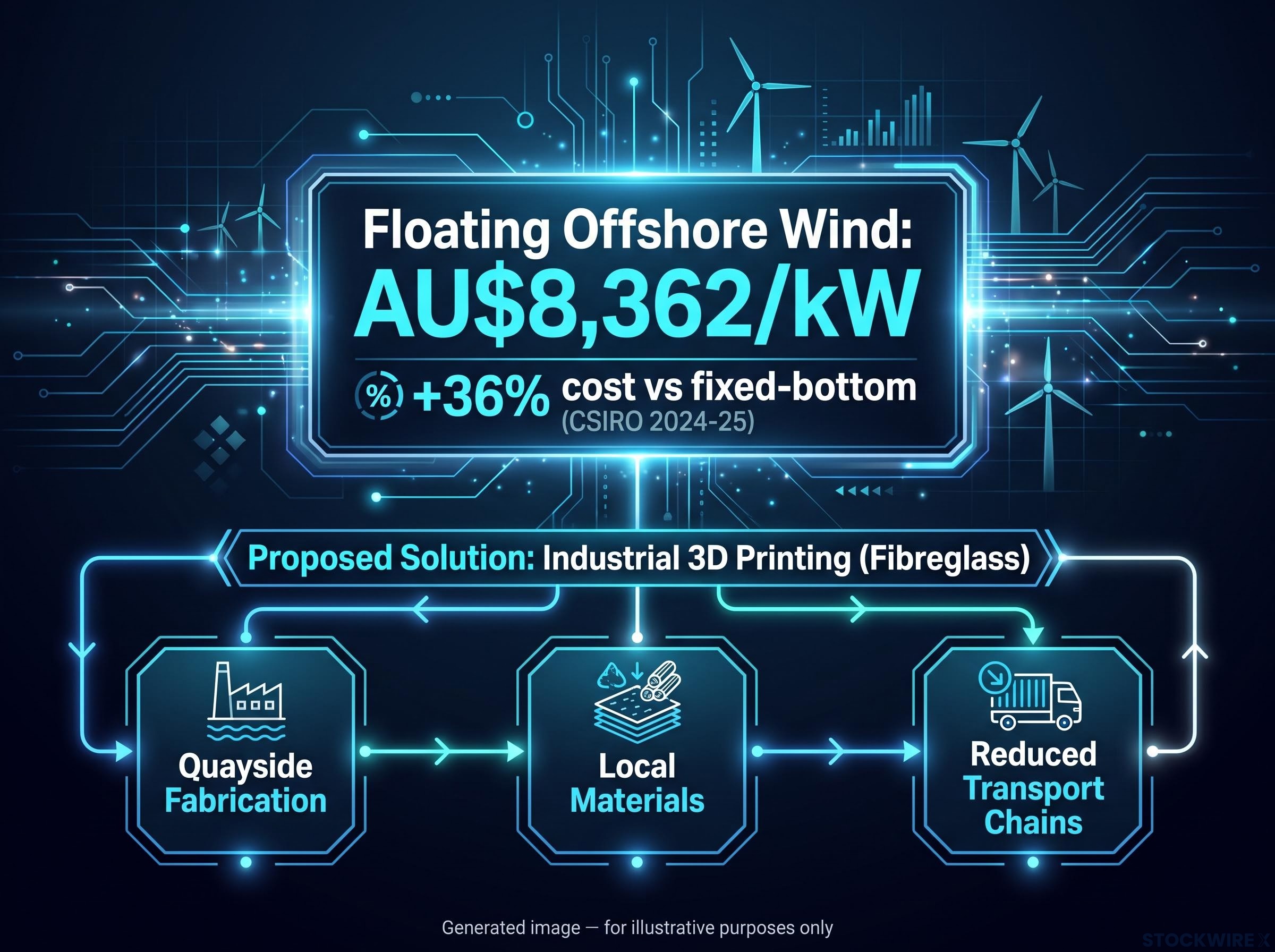
Industrial 3D printing lets PolarBlue fabricate large platform components at the quayside rather than trucking precast sections from distant yards. Academic research on 3D concrete printing (3DCP) for marine renewables backs several of the claimed advantages.
- Quayside or barge fabrication using local materials, sidestepping supply-chain bottlenecks
- Greater design flexibility than conventional precast methods
- Faster construction cycles
- Reduced dependence on large traditional precast yards and long transport chains
On paper, that is a plausible cost and logistics edge, and cost matters enormously here. CSIRO’s GenCost 2024-25 draft puts floating offshore wind at roughly AU$8,362/kW, around 36% more expensive to build than fixed-bottom offshore. Any fabrication method that meaningfully compresses that premium would be a real differentiator.
What prototype research has demonstrated
The evidence trail is solid at the small end. Researchers have used 3D-printed joints and buoys to rapidly prototype complex floating-device geometries. Work on 3DCP has produced marine anchors and platform prototypes.
These are legitimate precedents. They demonstrate that the technique works for components and for testing designs quickly.
The commercial-scale certification gap
Then the evidence stops. No commercial-scale, full-platform 3D-printed floating wind structure suitable for a harsh marine environment has been identified anywhere in the available research base.
The unresolved risks are specific, not vague.
- Printer size limits force multi-part fabrication and assembly, which complicates quality control and structural performance
- Long-term fatigue behaviour and durability certification for large printed structures in ocean conditions remain areas of active research, not settled practice
- Most existing printed floating structures are prototypes or teaching tools, not certified commercial platforms
Conventional steel and concrete fabrication in shipyards still dominates offshore wind, backed by established standards and decades of performance data. That is the benchmark PolarBlue’s method has to clear.
The debate around additive manufacturing at scale is being resolved sector by sector rather than all at once: AML3D’s ARCEMY wire-based metal printing has already accumulated more than AU$30 million in US Navy contracts for structural marine components, establishing that the certification hurdles for harsh-environment applications are passable, even if fibreglass-based large-platform printing presents its own unresolved challenges.
For you as an investor, the manufacturing technology is simultaneously the most compelling part of the value proposition and the single highest technical risk in the deal. The gap between a working prototype and a certified, commercial-scale platform in Southern Ocean conditions is exactly where most novel fabrication approaches either prove themselves or stall. PolarBlue has not yet crossed that line.
How Australia’s offshore wind sector shapes the investability question
Zoom out, because the sector context reframes the announcement entirely. Australia had no operational offshore wind capacity, fixed or floating, as of 2025-2026, against an announced pipeline of roughly 86 GW across about 43 projects, per Arup’s 2025 market study. Feasibility licences granted target 24.21 GW in total.
That is an enormous gap between ambition and delivery, and it defines the revenue environment any manufacturing hub will depend on.
| Zone | Potential Capacity (GW) | Feasibility Licences Granted | Status Note |
|---|---|---|---|
| Gippsland (VIC) | 25 | 12 | First declared zone; six projects under preliminary consideration |
| Hunter (NSW) | 5.2 | Preliminary offers only | Commercial licences not yet issued |
| Southern Ocean (VIC) | 2.9 | Applications assessed | Applications opened March-July 2024 |
| Bunbury (WA) | Up to 11.4 | 4 GW under preliminary offers | Three proposed projects |
What the OEI regime means for manufacturing-first strategies
The federal Offshore Electricity Infrastructure (OEI) regime is running, but it currently issues feasibility licences only. Each lasts up to seven years and permits resource assessment, such as installing LiDAR buoys, but not commercial electricity generation.
The OEI Act licensing regime, administered by DCCEEW, currently issues feasibility licences lasting up to seven years, permitting resource assessment but not commercial electricity generation, which is precisely the legal gap that makes a manufacturing-first strategy so exposed to timing risk.
That creates a timing problem for a manufacturing-first strategy. A hub can start producing platforms before there is a clear legal pathway for those platforms to generate billable electricity in Australian waters. As of mid-September 2026, PolarBlue itself has no publicly disclosed OEI Act application or environmental approvals.
The commercial headwinds compound the timing risk. BloombergNEF’s base case, as reported by RenewEconomy, expects Victoria to begin commissioning offshore wind only around 2033, with just 1.5 GW online by 2035. In BNEF’s low case, high costs and inadequate support could mean no offshore wind deployment at all.
BNEF’s base-case forecast of 1.5 GW of Victorian offshore wind by 2035 sits against a legislated state target of 4 GW for the same year, and 9 GW by 2040.
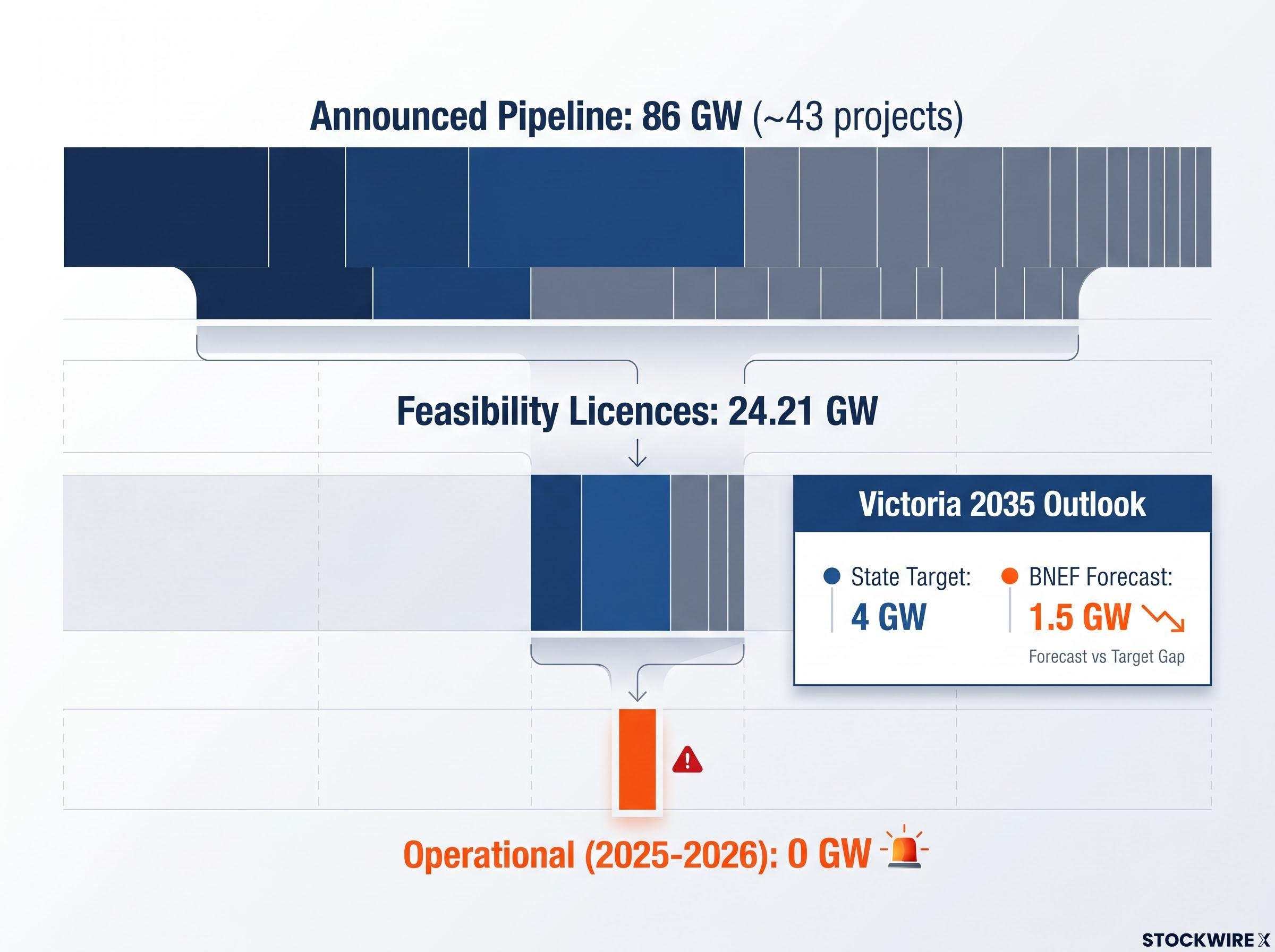
That divergence between policy ambition and commercial forecast is the single clearest signal in Australian offshore wind. It tells you the revenue environment is far softer than the headline pipeline suggests.
Headline pipeline figures in Australian infrastructure announcements have a documented tendency to conflate cumulative scenario ceilings with near-term committed investment, a gap that the data centre sector illustrated sharply when a A$60 billion market figure resolved into roughly A$10-13 billion in annual operating revenue by 2030-31; the same analytical discipline applies to reading the 86 GW offshore wind pipeline.
Two further pressures matter. BNEF analyst Kajsa Jernetz has warned of a global shortage of installation vessels, with more than 30 GW of offshore wind at risk of lacking suitable ships. And Australia lacks the UK-style contracts-for-difference offtake mechanisms that give offshore wind projects long-term price certainty, leaving developers exposed to merchant price risk.
An investor who understands where offtake, regulation, and vessel supply are failing the broader pipeline can price PolarBlue’s exposure to those same headwinds far more precisely than the announcement alone allows.
Risk-adjusted reading: what the Bell Bay announcement signals for investors
Pull the three threads together and a structured picture emerges, though not a verdict.
The strategic logic is real. A genuine Southern Ocean wind resource, a manufacturing-first position that could establish supply-chain advantage early, and no dependency on public grants all count in the project’s favour.
The risks are equally real, and they cluster.
The funding mechanics of pre-commercial marine energy projects illuminate a recurring pattern: milestone-based public programmes pay retrospectively, creating the cash flow gaps that require bridging facilities, and that timing structure is one reason private capital backing a technology ahead of regulatory approvals carries materially different risk than capital entering post-licence.
- Execution timeline risk: An 18-month first-production target against multi-year comparable cycles
- Technology certification risk: No commercial-scale 3D-printed floating platform precedent anywhere
- Offtake vacuum risk: No long-term price-support mechanism to underwrite revenue
- Sector delivery risk: A pipeline of 86 GW that has delivered zero operational capacity
The timeline deserves particular scrutiny. PolarBlue’s 18-month target is aggressive next to comparable hubs. The North Queensland Super Hub does not expect operations until 2027 at the earliest, and the Bell Bay Hydrogen Hub, despite public funding in place, remains in development rather than built out.
The floating cost premium of roughly 36% above fixed-bottom offshore, per CSIRO, is a persistent structural drag. And while Sumitomo and NHP lend some institutional credibility, the scope of their financial commitment has not been publicly disclosed.
Westwood Global Energy Group’s 2024-2025 analysis finds that floating offshore wind global targets are likely to be missed, with developer optimism declining amid cost inflation, supply-chain bottlenecks, and permitting delays.
So weight the forward indicators over the headline number. Track these, in order of materiality:
- Formal OEI Act or environmental approval filings
- A final investment decision announcement
- Named offtake agreements or power purchase agreements
- Evidence of a successful large-scale 3D printing trial at Bell Bay
The honest read is that this is a credible but early-stage strategic position in a sector where the distance between a framework agreement and first revenue is measured in years and contingencies, not months.
What Bell Bay needs to prove, and when to pay serious attention
The point of tracking this story is knowing when the investment case actually hardens, rather than filing it as confirmed opportunity or confirmed hype today.
Give the announcement its due. PolarBlue has a named investor base, a signed state framework agreement, an existing equipment base to relocate, and a founder publicly committed to a specific timeline. That is more concrete than many comparable announcements manage at this stage.
But re-rating waits on evidence. Three milestone categories will signal most clearly whether the case is strengthening or stalling.
- Regulatory: A first OEI Act or environmental approval filing, none disclosed as of mid-September 2026, would show the legal pathway to revenue is genuinely opening
- Manufacturing: A first successful large-scale 3D printing trial at Bell Bay, targeted within 18 months, would begin to close the commercial-scale certification gap
- Offtake: A first named power purchase agreement or green fuel supply contract would attach real revenue to the platforms
The Bell Bay announcement marks the moment a novel commercial model entered the public record with named capital behind it. That is worth monitoring. The decision to act, though, waits on regulatory, manufacturing, and offtake milestones that are likely at least 12-24 months from resolution. Monitoring, rather than committing or dismissing, is the position the current evidence actually supports.
This article is for informational purposes only and should not be considered financial advice. Investors should conduct their own research and consult with financial professionals before making investment decisions.
Past performance does not guarantee future results. Financial projections and forward-looking statements are speculative, subject to market conditions and various risk factors, and may change based on regulatory, technological, and market developments.