Federal Reserve Vice Chair Philip N. Jefferson told an audience at the University of Virginia’s Darden School of Business today that the central bank will not back away from its 2% inflation target, delivering a message that leaves little doubt about where monetary policy is headed into the final quarter of the year.
The Fed’s dual mandate requires it to balance two goals: stable prices and maximum employment. Jefferson’s point was that with the U.S. labour market sitting close to full employment, the institution now has room to put more weight on the price side of that equation.
The Federal Reserve dual mandate requires balancing price stability and maximum employment, and the current configuration, with inflation running at 3.4% against a 2% target while unemployment holds at 4.1%, places those two objectives in direct tension with each other.
That framing matters for anyone carrying a mortgage, a car loan, or credit card debt. This covers why your borrowing costs are staying high, the specific inflation readings keeping them there, and the economic warning signs that could still force the Fed’s hand.
Why a resilient labour market provides cover for restrictive policy
Jefferson’s confidence rests on one assessment: the U.S. economy is operating near maximum employment. That judgment is what gives the central bank licence to keep borrowing costs elevated without worrying it is starving the job market of oxygen.
Jefferson’s October 2026 speech, delivered at the University of Virginia’s Darden School of Business, makes explicit that the Fed views current labour market conditions as sufficient cover to maintain a restrictive policy stance until inflation converges on the 2% target.
The data backs him up. The national unemployment rate held at 4.1% in August 2026, unchanged from the prior month, while total nonfarm payroll employment rose by 162,000, according to the Bureau of Labor Statistics release published on 4 September 2026.
The reasoning here draws on standard Phillips-curve logic, the idea that when there is little slack left in the economy, adding more demand pushes up prices rather than creating new jobs. Federal Reserve research and Brookings Institution analyses both describe this trade-off.
In plain terms: with unemployment already low, the payoff from pushing it lower shrinks, while the cost of letting inflation drift keeps rising. Policymakers can therefore accept some risk of mild job-market cooling in exchange for defending price stability.
Jefferson described the Fed’s dual mandate as embodying significant institutional wisdom, and reaffirmed that the central bank remains strongly dedicated to its 2% objective, prepared to take whatever action is required to validate the public’s inflation expectations.
What this means for you is straightforward. Policymakers treat the current job-market strength as a cushion, which tells you they are willing to tolerate modest economic softening to bring prices down. Standard signs of mild cooling, the kind that might prompt cuts in a weaker economy, are unlikely to move them.
The sticky inflation metrics keeping borrowing costs elevated
Rhetoric only carries so far. The real driver behind Jefferson’s tone is the inflation data, and it remains stubbornly above target.
The Fed’s preferred gauge, the Personal Consumption Expenditures (PCE) price index, which measures the change in prices of goods and services bought by consumers, rose 3.4% year-over-year in August 2026, with a 0.3% monthly increase, according to the Bureau of Economic Analysis. Core PCE, which strips out volatile food and energy prices, ran at 3.0% year-over-year and 0.2% month-over-month.
The Consumer Price Index (CPI) told a similar story. Headline CPI came in at 3.4% year-over-year and 0.4% month-over-month for the same period, per the Bureau of Labor Statistics via Reuters.
The August 2026 CPI breakdown published in mid-September showed that gasoline alone accounted for more than a third of the monthly all-items increase, driven by Middle East supply disruptions rather than broad demand pressure, a distinction that matters when assessing how durable the 3.4% headline figure actually is.
| Metric | Headline YoY | Headline MoM | Core YoY | Fed Target |
|---|---|---|---|---|
| PCE (Aug 2026) | 3.4% | 0.3% | 3.0% | 2% |
| CPI (Aug 2026) | 3.4% | 0.4% | 2.4% | 2% |
The gap is the whole story. Both headline readings sit a full 1.4 percentage points above the Fed’s goal, which ties directly to Jefferson’s warning that the institution must act to keep public inflation expectations anchored.
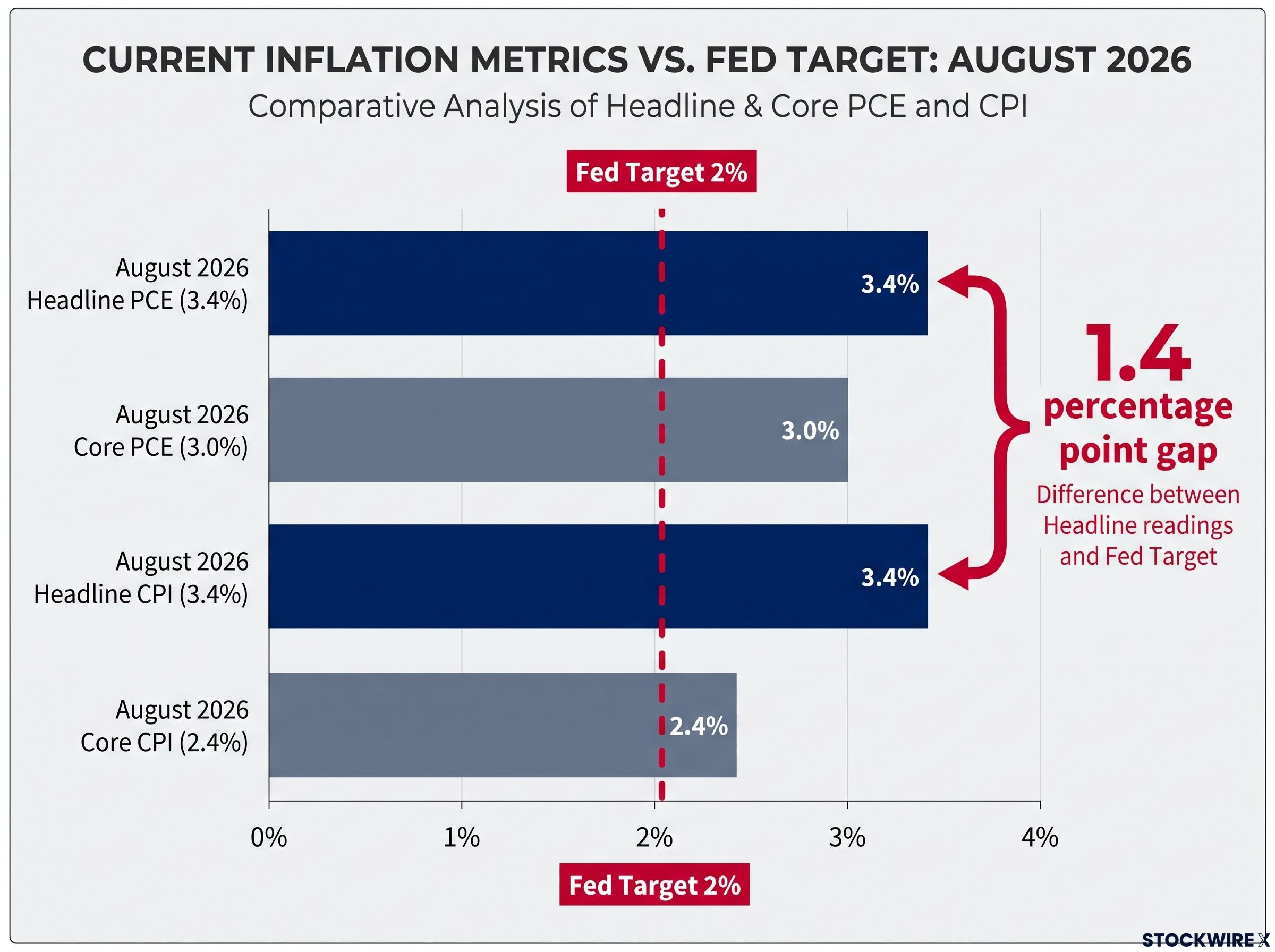
For you, this is the benchmark. Until these specific numbers move meaningfully toward 2%, your mortgage and credit card rates have little reason to fall. Watch core PCE in particular; it is the figure the Fed watches most closely when deciding whether the job is done.
Rising vulnerabilities and the threat of over-tightening
Not everyone shares the central bank’s confidence. A growing chorus of economists argues that the official narrative is glossing over cracks that could widen fast.
The first objection is about what headline numbers hide. Researchers at the Economic Policy Institute and other analysts caution that an aggregate unemployment rate of 4.1% can mask real weakness in specific regions and demographic groups, meaning “near maximum employment” is not the same as a universally healthy job market.
Labour force participation fell to 61.6% in August 2026, meaning the headline unemployment rate of 4.1% reflects a shrinking worker pool rather than genuine slack, a distinction that complicates the Fed’s standard reading of how much room remains before price pressure re-accelerates.
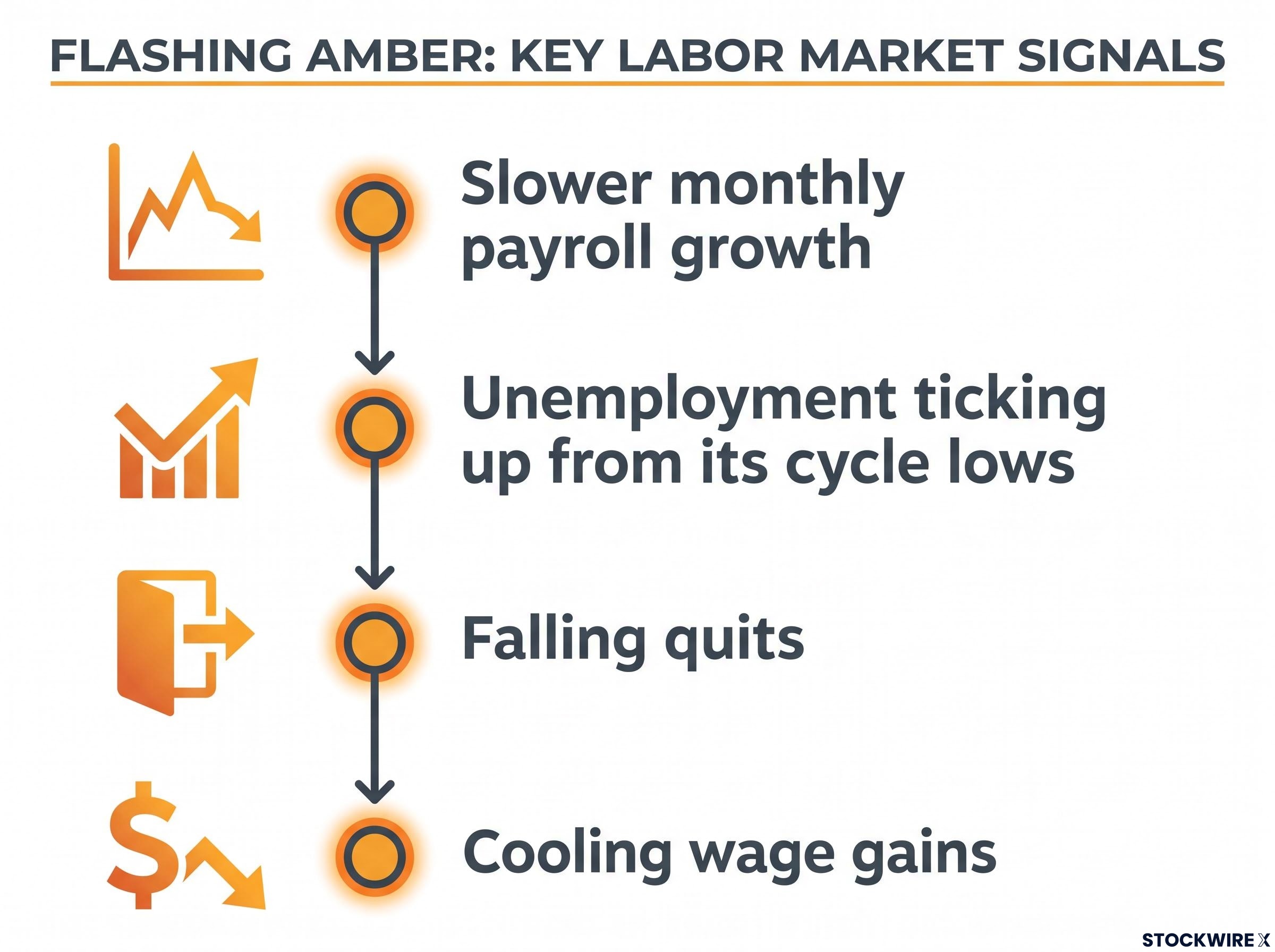
The second concern is that the slowdown may already be underway. Macroeconomist Claudia Sahm and others point to leading indicators flashing amber, with coverage in Bloomberg and the New York Times noting that job openings and quits have pulled back from their cycle peaks, a sign that workers are losing bargaining power.
The specific warning signs worth tracking include:
- Slower monthly payroll growth
- Unemployment ticking up from its cycle lows
- Falling quits, which signal workers feel less confident switching jobs
- Cooling wage gains
History sharpens the worry. Bank economists at Morgan Stanley and UBS point to past cycles where the Fed underestimated the lagged impact of tight policy, keeping real interest rates too high relative to underlying growth and tipping the economy into unnecessary recession.
Distributional impacts of a prolonged inflation fight
The cost of getting this wrong is not shared evenly. Research from the Economic Policy Institute and the Center for Economic and Policy Research stresses that higher unemployment and slower wage growth land hardest on lower-income workers, younger workers, and workers of colour, groups with the least financial buffer to absorb a layoff.
The practical takeaway for you is to watch the leading labour indicators above, not just the headline rate. A sudden drop in job openings or a jump in localised unemployment is the fastest way the current policy approach could break down, and it would show up in those figures before it reaches the monthly jobs report.
Parsing the policy trajectory for the months ahead
Jefferson’s speech sets a clear baseline heading into the Federal Open Market Committee’s remaining decisions. The FOMC, made up of 12 voting members and meeting 8 times a year, has signalled that the bar for a dovish pivot is high and the employment data is keeping it there.
For your finances, the sensible assumption is that rates stay restrictive through the close of 2026, barring a sharp and unexpected collapse in employment. Position your borrowing plans and portfolio around a higher-for-longer environment rather than betting on near-term relief.
The mortgage rate impact of holding rates restrictive through the end of 2026 is not abstract: on a $300,000 loan, the difference between a 3.9% rate and a 7.0% rate adds more than $200,000 in total interest over the loan term, a figure that dwarfs the energy cost increases that dominated financial coverage in 2022.
This article is for informational purposes only and should not be considered financial advice. Investors should conduct their own research and consult with financial professionals before making investment decisions. These statements are speculative and subject to change based on market developments and economic conditions.