Bank of America has just named five semiconductor stocks it wants to own heading into Q4 2026, and the timing is deliberate. The Philadelphia Semiconductor Index (SOX) is sitting roughly 12% below its post-ChatGPT valuation median, while the bank’s own artificial intelligence data center forecast now stands at $2.2 trillion by 2030. Discounted entry plus structural demand growth is a combination that does not line up often.
The note, authored by BofA analyst Vivek Arya and published around 1 October 2026, lands at a moment when the fourth quarter has historically delivered the sector’s strongest seasonal returns. BofA’s own data puts median outperformance versus the S&P 500 at 300 to 500 basis points across Q4 and Q1 over the 2010-2025 period.
For investors who already hold semiconductor exposure, or those weighing whether to add it, the Bank of America semiconductor picks matter for near-term positioning. Here is what each of the five names is, the specific catalyst BofA is pointing to for each, and what you need to weigh before acting, including the risks sitting alongside the opportunity.
Why Q4 2026 looks like a historically interesting entry window for semiconductors
Start with valuation, because it changes the risk profile of everything that follows. The sector has pulled back from its own highs even as the demand story underneath it has strengthened, which is a very different proposition than buying at the top of a euphoric run.
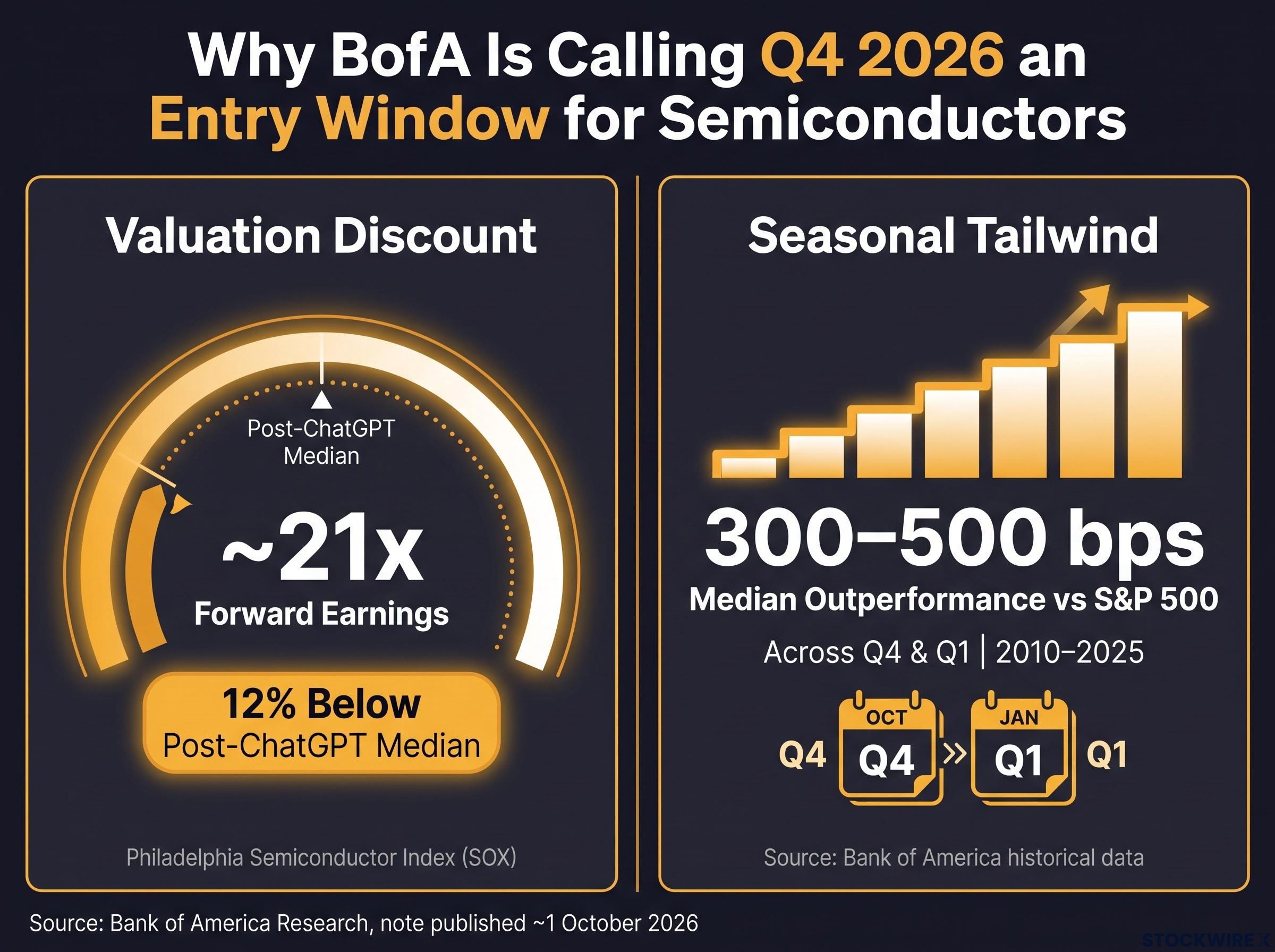
SOX valuation The SOX is trading at approximately 21 times forward earnings, roughly 12% below its median since ChatGPT launched.
That discount is the anchor for why BofA is making these calls now rather than six months ago. It is not a moment of peak excitement; it is a sector trading beneath its own recent midpoint while the forward thesis gets bigger.
The semiconductor bubble narrative has been contested at the institutional level since at least May 2026, with BofA analyst Savita Subramanian pointing to record free cash flow yields, 20%-plus earnings revisions, and active positioning at roughly half the 2017 cycle peak as evidence that the current valuation has genuine fundamental support.
The seasonal pattern reinforces the timing. BofA’s historical work shows semiconductor equities have tended to outperform the S&P 500 by a median 300 to 500 basis points across Q4 and Q1, measured from 2010 through 2025. That is a tailwind layered on top of the valuation case, not a standalone reason to buy.
Underpinning all five picks is a structural demand story BofA has upgraded sharply. In August 2026, the bank lifted its AI data center total addressable market forecast to $2.2 trillion by 2030, up from a prior estimate of $1.8 trillion. Here is how BofA breaks that figure down by segment.
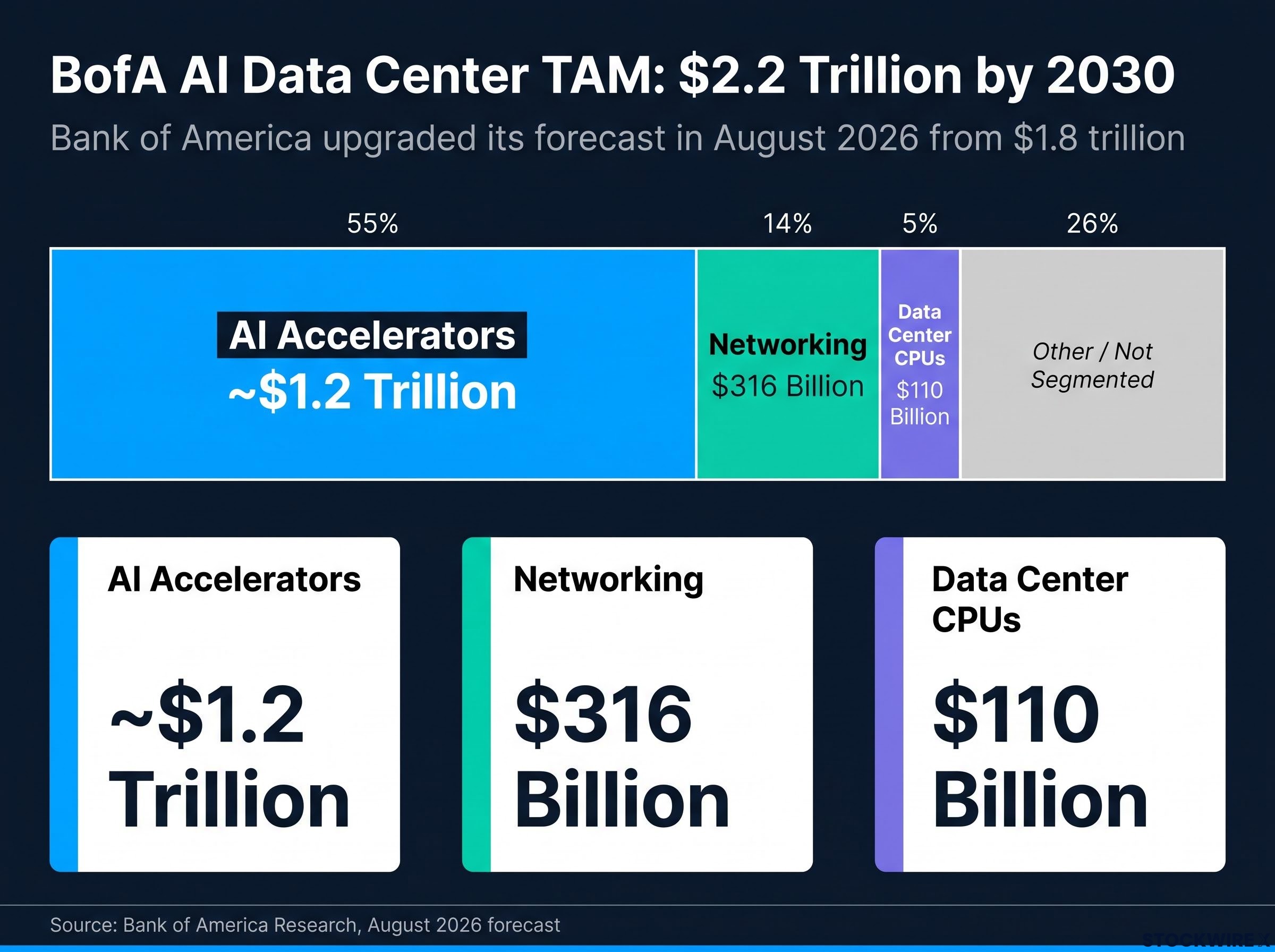
| Segment | BofA estimate by 2030 |
|---|---|
| AI accelerators | ~$1.2 trillion |
| Networking | $316 billion |
| Data center CPUs | $110 billion |
Read together, the three inputs form a single thesis: discounted valuation, a seasonal window, and a bigger addressable market than previously modelled. Each of the five picks sits somewhere inside that frame.
When big ASX news breaks, our subscribers know first
#1 Nvidia: buybacks and GTC appearances as near-term catalysts
You already know Nvidia dominates the AI graphics processing unit market. That is not why BofA is flagging it now. The bank is pointing to a dense near-term catalyst calendar, which is a different signal than general market leadership.
Specifically, BofA cites two upcoming events it expects to support the shares.
- An anticipated expansion of Nvidia’s share buyback programme
- Multiple appearances at upcoming GTC tradeshow events
BofA frames Nvidia alongside AMD as a resilient compute play in a market where AI chip supply remains structurally tight. The bank describes high-bandwidth memory supply, a key component for AI accelerators, as constrained through 2028, which keeps hyperscaler demand firmly ahead of what suppliers can deliver.
That supply backdrop feeds directly into capex. BofA estimates aggregate 2026 capital spending from major U.S. and Chinese cloud providers at roughly $1 trillion, a budget Nvidia captures a large share of.
For investors already holding the stock, the read is this: BofA is signalling the near-term catalyst calendar is unusually busy, which makes positive price events foreseeable rather than purely speculative. Knowing which events the bank is watching lets you monitor the thesis rather than simply hold and hope.
#2 Intel: agentic CPU demand and foundry wins as a turnaround inflection
Intel is the contrarian name on this list. Where the other four picks ride a continuation of existing momentum, the Intel case rests on an inflection that has not fully arrived yet.
BofA points to two catalysts it believes could drive that turn.
- Expected strength in agentic CPU demand, meaning processors suited to AI systems that act autonomously rather than simply respond to prompts
- Anticipated wins in Intel’s foundry business, where it manufactures chips for outside customers
The foundry angle is structurally distinct from the AI accelerator story powering the other picks. It is a manufacturing contract thesis, not an end-market demand thesis, which gives Intel a different driver entirely.
Intel foundry strategy received its most significant external validation in June 2026, when President Trump confirmed Apple had agreed to collaborate with Intel on domestic chip manufacturing, sending the stock to an all-time closing high of $133.99 and providing concrete commercial evidence that the 18A process node is attracting major customer interest.
Intel also appears on BofA’s broader list of names that could outperform if sector momentum improves, cited alongside Micron, Lam Research, and Applied Materials in Yahoo Finance coverage from 16 September 2026.
What this tells you is that Intel is not an equal-conviction clone of Nvidia or Marvell. It is a recovery bet on catalysts yet to materialise, so sizing a position here to reflect that asymmetry, rather than treating all five picks as interchangeable, is the sensible approach.
#3 Micron: the buyback countdown and what it signals about management confidence
Micron comes with the most precise catalyst on the entire list: a share repurchase programme scheduled to begin on 9 December 2026. A dated buyback is a rare thing to attach to a forward-looking investment thesis, and the specificity is the point.
Companies rarely initiate buybacks when they expect near-term share price weakness. A dated repurchase launch reads as a confidence signal from Micron’s own management, not just a financial engineering move.
The pick also connects back to BofA’s June 2026 upgrade note, where the bank was notably bullish on Micron.
BofA on Micron Micron was the “most notable” upgrade in BofA’s June 2026 semiconductor note, with the bank citing “robust high-bandwidth memory demand and structurally constrained supply through 2028.”
That supply constraint through 2028 is the structural backdrop. Demand for high-bandwidth memory, the specialised chips that feed data to AI accelerators, is running ahead of what the industry can produce, which supports pricing.
HBM market dynamics are central to understanding why BofA’s supply-constraint thesis holds through 2028: Micron projects the market growing from approximately $35 billion in 2025 to $100 billion by 2028 at a roughly 40% CAGR, with mid-80% gross margins and only 3-4 weeks of industry-wide inventory confirming a structural pricing shift rather than a cyclical peak.
Here is the useful part for your monitoring: the buyback date gives you a concrete thesis test. If the repurchase launches as planned in December, the bull case is intact. If it slips, that delay itself becomes a signal worth reading, which is a cleaner checkpoint than an open-ended hold.
#4 Marvell: Analyst Day and the XPU ramp as dual near-term triggers
Marvell carries an urgency the other picks do not, because one of its catalysts is just days away. BofA flags two reinforcing triggers arriving in quick succession.
- An Analyst Day scheduled for 6 October 2026, five days after the note’s publication
- An expected acceleration in its XPU custom silicon product ramp, meaning purpose-built chips designed for specific customer workloads rather than off-the-shelf parts
The proximity of that Analyst Day makes Marvell the most time-sensitive name on the list. BofA published this pick days before the event, which implies the bank views the Analyst Day as a positive catalyst rather than a sell-the-news risk.
Marvell is BofA’s primary networking beneficiary in the AI buildout, tied to the $316 billion networking slice of the $2.2 trillion AI data center TAM. The bank groups it alongside Nvidia and AMD as a resilient infrastructure play in its 16 September 2026 positioning, per Yahoo Finance.
For you, the combination matters regardless of which thesis you find more convincing. An imminent named event plus a product-cycle catalyst gives you two separate reasons to be watching Marvell through October, and the clustering of both inside a single month is what distinguishes this pick.
#5 Lam Research: market share gains as a compounding equipment play
Lam Research may be the least familiar name here for some readers, but it carries arguably the most durable structural catalyst. It rewards reading through to the fifth pick with a genuinely different kind of investment case.
BofA’s catalyst for Lam is market share gains across both memory and logic chip manufacturing. This is a share-of-wallet story, not an end-market demand story, which is an important distinction.
- Memory chip manufacturing equipment
- Logic chip manufacturing equipment
The logic is upstream from the AI hype cycle. Semiconductor equipment suppliers benefit when foundries and integrated device manufacturers expand capacity, and those manufacturers expand capacity when chip supply is structurally tight. BofA projects AI chip availability staying constrained, which keeps capex flowing to the producers Lam sells to.
Like Intel, Lam Research also features on BofA’s broader list of potential outperformers if sector momentum improves, named alongside Applied Materials, Micron, and Intel in the 16 September 2026 Yahoo Finance coverage.
Here is the read for your portfolio: Lam’s catalyst sits one layer removed from Nvidia’s direct demand cycle. The thesis holds even if end-user AI demand proves lumpy, because manufacturers keep spending on equipment as long as supply stays tight, which makes it a useful way to hold semiconductor exposure without concentrating entirely in accelerator plays.
What could undercut the thesis: risks every investor should price in
The opportunity case deserves a risk case of equal weight, because the debate below is already live among institutional investors right now, not a set of distant tail risks.
Start with spending sustainability. The entire BofA bull case rests on hyperscaler capex continuing at an accelerating pace, and that assumption is contested.
The core debate Investors are actively weighing “whether the current AI spending cycle can maintain its breakneck pace,” per Yahoo Finance, 16 September 2026.
The three primary risk vectors worth pricing in:
- Spending sustainability. CNBC reported on 28 July 2026 that large capex commitments from Alphabet and Amazon have drawn Wall Street scrutiny over returns on investment. Any deceleration hits semiconductor suppliers directly.
- Concentration risk. All five picks tie back to a relatively small cluster of AI infrastructure beneficiaries. That amplifies downside if AI sentiment turns, because the names tend to move together.
- Inventory cycle risk. Futunn noted on 25 September 2026 that supply-chain-based AI forecasts are exposed to cyclicality if customers over-order and later work through excess capacity, a pattern that has hurt semiconductors in prior cycles.
There is also a cost dimension. Ground News reported on 1 October 2026 that hyperscalers are acknowledging “persistent capacity constraints and rising component costs” that challenge their build-out plans, raising the risk of margin pressure or re-phased orders.
What this means for you is straightforward: ignoring these vectors means building a position on a one-sided thesis. Understanding the specific points of failure BofA’s call depends on lets you monitor the thesis in real time rather than being blindsided if conditions shift.
Building a position with both the opportunity and the risk on the table
So where does this leave you? Not at a blanket buy or sell, but at a decision-point with a clear evaluative frame.
On the opportunity side: valuation roughly 12% below the post-ChatGPT median, a seasonal tailwind of 300 to 500 basis points, and a structurally upgraded demand forecast anchored by capex that BofA projects rising from roughly $1 trillion in 2026 to $1.4 trillion in 2027 across major U.S. and Chinese cloud providers. On the risk side: spending sustainability, concentration, and inventory cyclicality.
The five picks are a differentiated menu, not a uniform recommendation. Nvidia and Marvell are catalyst-dense event plays, Micron carries a dated thesis-check, Intel is a recovery bet, and Lam Research is an upstream equipment play.
| Stock | BofA catalyst | Thesis type |
|---|---|---|
| Nvidia | Buyback expansion, GTC appearances | Event-driven |
| Intel | Agentic CPU demand, foundry wins | Recovery turnaround |
| Micron | Buyback starting 9 December 2026 | Buyback initiation |
| Marvell | Analyst Day, XPU ramp | Product cycle / event |
| Lam Research | Memory and logic share gains | Upstream equipment |
What to watch in October and December 2026
Treat the named events as concrete checkpoints rather than static buy-and-hold triggers: Marvell’s Analyst Day on 6 October 2026, Nvidia’s GTC appearances through the quarter, and Micron’s buyback launch on 9 December 2026. A positioning decision made against that calendar and an honest risk inventory is more defensible than one made on sector momentum alone.
This article is for informational purposes only and should not be considered financial advice. Investors should conduct their own research and consult with financial professionals before making investment decisions. Past performance does not guarantee future results, and financial projections are subject to market conditions and various risk factors. Forward-looking statements regarding catalysts and forecasts are speculative and subject to change based on market developments and company performance.