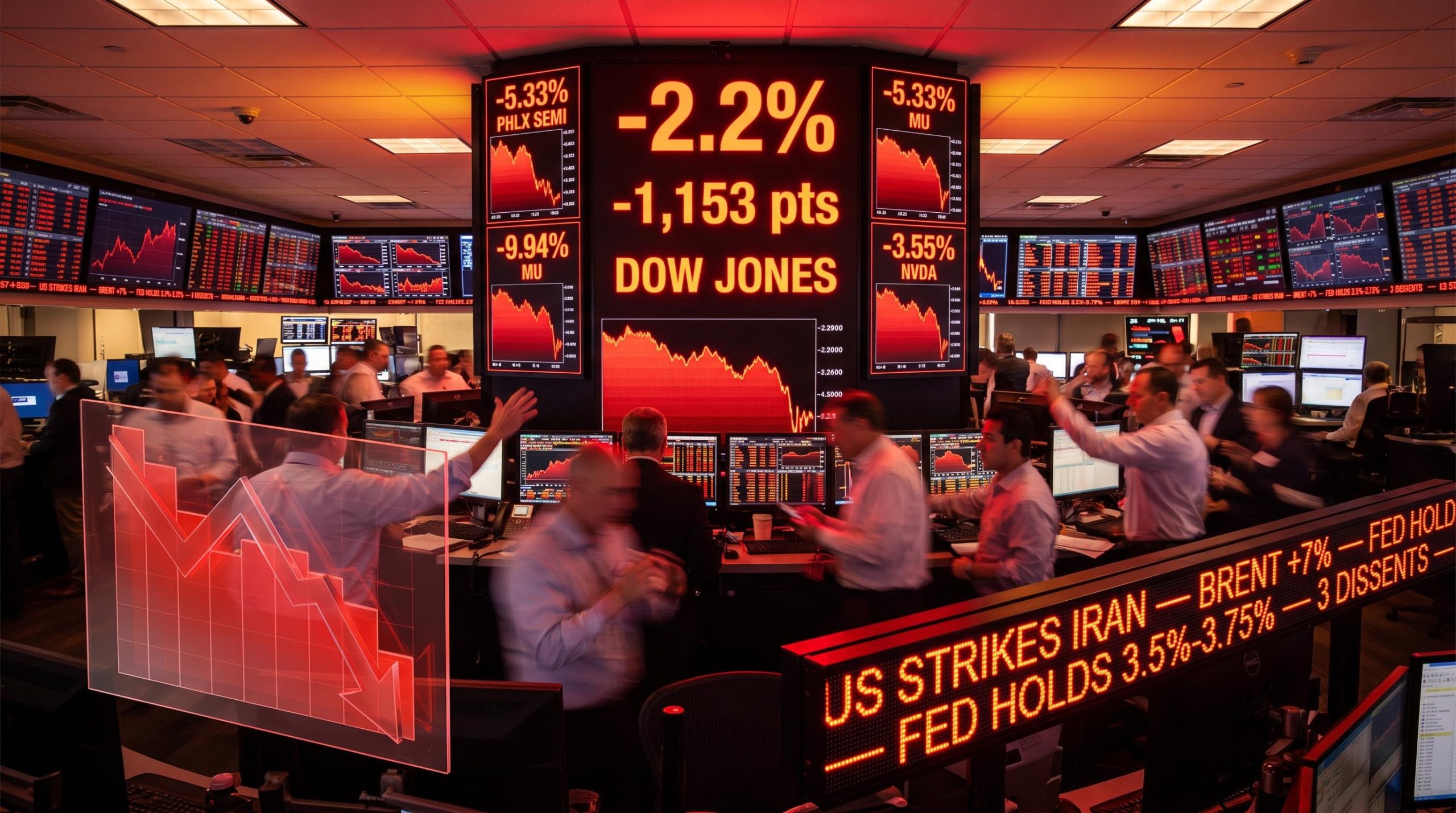
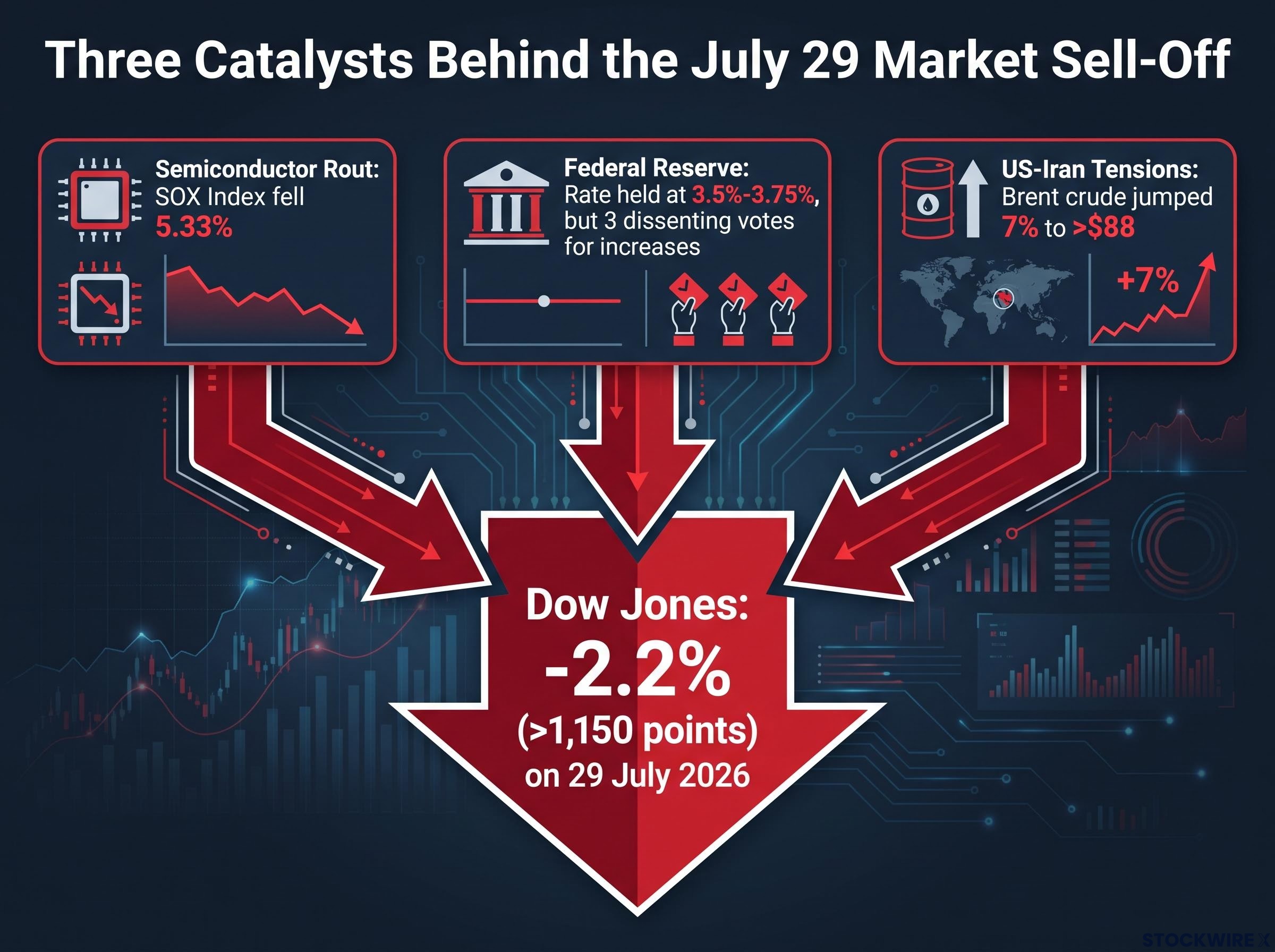
The Dow Jones Industrial Average lost more than 1,150 points on Wednesday, but the number alone understates what happened. Three separate forces struck simultaneously, each one amplifying the others, and by the close the damage had spread well beyond the tech stocks where the selling started.
Wednesday’s session on 29 July was not a single-catalyst event. A semiconductor rout, a Federal Reserve meeting that raised more questions than it answered, and fresh US military strikes against Iran all landed inside the same trading window. In isolation, any one of these could have produced a manageable reaction. Together, they fed a generalised risk-off move that broadened from chips to the wider market as the session progressed.
Here is what each pressure actually did, how the three interacted, and what you need to watch to judge whether Wednesday marked a temporary reset or the start of something more sustained.
Three catalysts, one ugly session: how the numbers broke down
All three major indices fell together, and the breadth of the losses tells the story more clearly than any single number.
| Index | Decline | Context |
|---|---|---|
| Dow Jones Industrial Average | -2.2% (~1,153 points) | Worst single-day drop since 2025 |
| S&P 500 | -1.5% | Broad selling across sectors |
| Nasdaq Composite | -1.7% | Now more than 10% below recent intraday record |
The Dow’s 2.2% decline was its heaviest since 2025. The Nasdaq’s 1.7% fall pushed it past the 10% threshold below its recent intraday record, a level market technicians treat as a formal correction. Institutional desks characterised the session as a “risk-off rotation” away from crowded technology and semiconductor trades.
Selling started in chipmakers but broadened into the session’s second half. When three major indices fall in unison and selling widens rather than narrows, it signals that investors are pulling back across positions rather than adjusting a single thesis. That distinction matters for how long the pressure tends to last.
When big ASX news breaks, our subscribers know first
What happened to chip stocks, and why the losses were this severe
The Philadelphia Semiconductor Index, known as the SOX, fell approximately 5.33% on Wednesday. All 30 of its constituents finished in the red. There was nowhere to hide inside the sector.
The global semiconductor selloff that preceded Wednesday’s session had already forced South Korea’s Kospi circuit breaker for the eighth time this year, with Samsung down roughly 13% and SK Hynix down roughly 15%, illustrating how the same AI valuation compression hitting US chipmakers was simultaneously unwinding across Asian markets.
| Company | Ticker | Decline | Closing Price |
|---|---|---|---|
| Micron Technology | MU | -9.94% | $739.00 |
| Western Digital | WDC | -7.32% | $1,015.89 |
| Advanced Micro Devices | AMD | -5.51% | $429.56 |
| NVIDIA | NVDA | -3.55% | $190.01 |
Micron led the damage with a near-10% decline on roughly 69.85 million shares traded. NVIDIA saw approximately 147.68 million shares change hands. Intel, Arm, and Qualcomm each fell in the 4-8% range.
Analysts at Morningstar and Forrester characterised the move as “a repricing of expectations, not a collapse in underlying demand.”
That framing is important, but it does not soften the mechanics. The fact that every SOX constituent fell tells you this was not a single earnings disappointment or company-specific problem. Investors are reconsidering the entire AI-driven semiconductor thesis simultaneously, which carries different implications for how long pressure on the sector may persist than an isolated miss from one chipmaker.
Semiconductors carry outsized weight in the Nasdaq and in widely held tech ETFs. When the whole group sells off together, the drag on index-level returns is magnified. If you hold broad tech exposure, you felt this whether or not you owned a single chipmaker directly.
What the AI chip rally was built on, and why the reset arrived now
To understand why Wednesday’s semiconductor rout was so violent, you need to understand what the trade was built on.
Chipmakers became the primary proxy trade for AI infrastructure investment. The thesis was straightforward: any AI growth scenario required more chips, making semiconductor companies the picks-and-shovels beneficiaries of the entire boom. That narrative attracted concentrated positioning and pushed valuations higher through the first half of 2026, with the SOX entering territory that some analysts described as “parabolic.”
The problem with a crowded consensus trade is that it needs continuous confirmation to hold. When guidance softens, or when spending signals stop accelerating, the unwind arrives fast because too many investors are positioned for the same outcome.
Three structural conditions made chip stocks vulnerable to exactly this kind of repricing:
- Concentrated positioning: Large numbers of institutional and retail investors held overlapping long positions in the same names, meaning any de-risking impulse triggered correlated selling.
- Valuation reliance on continued AI capex growth: Prices required not just continued AI spending, but accelerating AI spending. Anything less than the best-case scenario left multiples exposed.
- Insufficient near-term earnings catalysts: With chip stocks having already priced in aggressive forward earnings, there was little room for execution missteps or even modest guidance.
Commentary circulating among strategists noted that “chip stocks are down three of the last four weeks” as positions that “got way ahead of themselves” began unwinding. Prime brokerage data pointed to large-scale long liquidations in tech and memory stocks, suggesting forced deleveraging rather than ordinary profit-taking (this figure is sourced from secondary commentary and has not been independently verified at the primary source level).
Wednesday’s rout was not the first time the sector repriced sharply in 2026; the semiconductor sector crash in early June erased more than $1 trillion in a single session after Broadcom’s AI outlook disappointed, establishing the pattern of violent mean-reversion that has characterised crowded chip positioning throughout the year.
For anyone with exposure to broad tech funds, Wednesday’s decline was not random volatility. It was the resolution of a structural tension that had been building for weeks, and the same dynamics could persist if AI capex guidance from major hyperscalers continues to soften.
The Fed held rates, but three dissenting votes changed the read
The Federal Reserve held its policy rate unchanged at 3.5%-3.75%. Markets had fully expected that outcome. Under normal conditions, it would have been absorbed without a ripple.
The dissents changed the read entirely.
The Federal Reserve FOMC statement confirmed the 9-3 vote to hold rates at 3.5%-3.75%, naming the three dissenters who each preferred an immediate quarter-point increase, a level of visible internal division that markets had not fully priced into positioning ahead of the meeting.
Three Federal Reserve officials voted in favour of rate increases, a scale of visible hawkish dissent that is uncommon and signals the tightening debate is actively live, not a background possibility.
Fed Chair Jerome Powell provided no meaningful forward guidance on the rate path, stating only that the central bank would work to bring inflation down while leaving the mechanics of future policy adjustments entirely open. On a calm day, that ambiguity would have been tolerable. On a day when semiconductors were in free fall and geopolitical risk was escalating, it removed any potential policy floor for equities.
Growth and tech stocks are particularly sensitive to rate expectations. Their valuations rely on future cash flows discounted at current rates; any upward revision to expected rates compresses those valuations mechanically. Three dissenting votes in favour of hikes tells you the Fed is not a unified body moving calmly toward easing. For rate-sensitive positions, that internal fracture means the policy risk premium has risen even without any actual rate increase.
The Fed meeting could have functioned as a stabiliser on a stressful day. Instead, it became an amplifier.
How US-Iran military strikes added an oil and inflation layer
The United States conducted military strikes against Iran on the evening of 29 July 2026, with leadership statements referencing a strong counterattack. This was not background geopolitical noise. It was a third weight added to a market already struggling to stay upright.
US-Iran tensions had already forced a same-session repricing of crude futures, Treasury yields, and volatility gauges earlier in July, when Trump voided the interim peace arrangement and triggered formal Iranian retaliation warnings, establishing the geopolitical risk premium that amplified Wednesday’s oil spike.
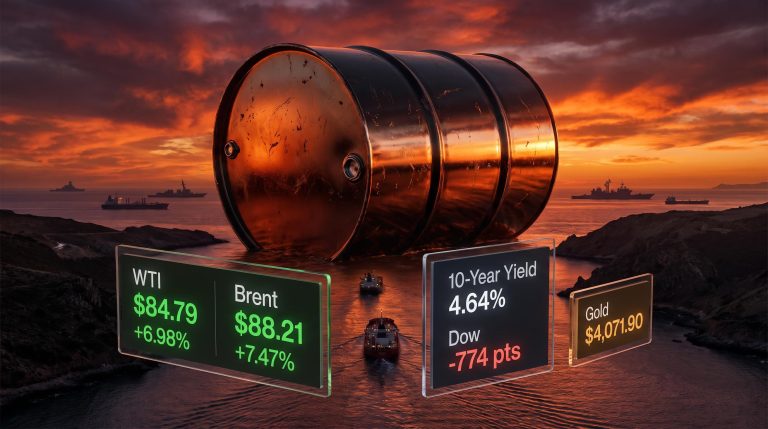
Brent crude jumped approximately 7% to above $88 on the session, according to market commentary (this figure has not been independently verified at the primary source level). The oil-inflation transmission is direct: persistent Gulf tensions support a sustained risk premium in energy prices, which raises input costs and muddies the inflation picture at exactly the moment the Fed is divided over whether to tighten further.
Three channels connected the Iran situation to Wednesday’s broader sell-off:
- Oil price risk premium: Higher energy prices act as a tax on growth-sensitive businesses and household spending, compounding the inflation signal the Fed is already monitoring.
- Inflation complication for the Fed: Rising oil prices make it harder for the three hawkish dissenters to be overruled, increasing the probability that the next data print could tip the internal balance toward a hike.
- Non-linear tail risk prompting generalised de-risking: Military developments are non-schedulable and difficult to hedge, pushing investors toward lower leverage and higher cash balances as a precaution, reinforcing de-risking already underway in semiconductor positions.
The Iran situation was not a standalone geopolitical story that happened to land on a bad day. It actively worsened the inflation outlook the Fed was already divided over and added a hard-to-model tail risk that deepened the defensive posture already forming across markets.
What Wednesday actually reset, and what remains unresolved
The core question is whether Wednesday was a contained correction or the beginning of a more sustained risk-off regime. The answer depends on how each of the three catalysts evolves, not on any single headline.
Three variables will determine what comes next:
- AI capex guidance from major hyperscalers. If spending forecasts stabilise at realistic levels, chip valuations can find a floor. If guidance continues to be revised downward, the repricing has further to run. Morningstar and Forrester analysts frame the current moment as a repricing of expectations rather than a structural collapse in demand, but that distinction only holds if the next round of earnings calls confirms it.
- Incoming inflation data and the Fed’s internal balance. Three dissents means any upside inflation surprise could shift the committee’s balance toward a hike. If inflation prints come in softer, the hawkish minority stays a minority. If they do not, the rate picture tightens.
- The trajectory of US-Iran tensions. Whether the conflict de-escalates, stabilises, or intensifies will have direct consequences for oil prices, inflation expectations, and global risk appetite.
The convergence of all three on one session is what made 29 July unusually sharp. If any single variable resolves positively, the pressure could moderate quickly. If none do, the conditions that produced Wednesday’s market sell-off remain intact.
Sector rotation away from AI and mega-cap technology had already been underway before Wednesday, with energy gaining more than 22% year-to-date and industrials more than 16% against a broad market index return of under 1%, a divergence that institutional desks had been flagging for weeks as a structural rather than tactical shift.
This article is for informational purposes only and should not be considered financial advice. Investors should conduct their own research and consult with financial professionals before making investment decisions. These statements are speculative and subject to change based on market developments and company performance.