
Global investors treat the Swiss Franc as a shelter. When markets panic, capital floods into Switzerland, and the Franc climbs. That refuge for the world becomes a wrecking ball for the country that issues it.
A rising currency crushes exporters, drags down import prices, and threatens to tip the economy into deflation. This is the paradox that defines Switzerland’s central bank.
Most macroeconomic attention lands on the Federal Reserve and the European Central Bank. Yet the Swiss National Bank operates under structural constraints those giants never face, because Switzerland is a small, hyper-open, export-driven economy carrying a globally coveted safe-haven currency.
After reading this, you will have a clear framework for how unconventional foreign exchange interventions actually work, what triggers them, and why standard interest rate moves are not enough for an economy shaped like this one.
Understanding the institutional mandate and the safe-haven dilemma
The core statutory job is straightforward on paper. The central bank exists to keep prices stable over the medium to long term while allowing the Swiss economy to develop appropriately.
Price stability has a precise definition here: annual growth in the Swiss Consumer Price Index (CPI) of between 0% and 2%. The CPI is the standard measure of how much the cost of a typical basket of goods and services rises over a year.
The Governing Board reviews policy on a fixed quarterly schedule, in March, June, September, and December. As of August 2026, headline inflation sat at 0.8% year-on-year, comfortably inside the target band and low by international standards.
So far this reads like any other central bank. The complication is the currency.
Switzerland’s openness and the Franc’s safe-haven status create a distinct set of vulnerabilities:
- The mandate demands medium-term price stability, but persistent Franc appreciation risks pulling inflation below zero.
- A large export sector means a strong currency directly erodes competitiveness and margins.
- Global stress events trigger sudden capital inflows the domestic economy has no natural way to absorb.
- Imported deflation becomes a live threat, not a theoretical one, when the Franc surges.
Here is the point you need to sit with. The global popularity of the Franc is not a source of national pride to be enjoyed. It is a structural threat to Swiss jobs and price stability, and it frames every defensive decision the central bank makes.
The limits of domestic policy rates
The primary domestic tool is the policy rate applied to sight deposits, which are the reserves commercial banks hold at the central bank. Adjusting that rate is the conventional lever, and higher rates generally attract capital and support the Franc, while lower rates weaken it.
The trouble is scale and speed. When a global crisis sends billions rushing into Francs in a matter of days, a rate tweak cannot offset that flood.
That mismatch is exactly why interest rate policy alone falls short for Switzerland, and why the toolkit had to evolve into something far more unusual than its peers rely on.
When big ASX news breaks, our subscribers know first
How quantitative easing operates through the foreign exchange channel
When you watch the Federal Reserve or the ECB expand their balance sheets, they are buying domestic bonds to manage liquidity at home. Switzerland’s central bank does something structurally different: it buys foreign currency.
By purchasing US Dollars and Euros to hold down the Franc, it accumulates a vast pile of foreign exchange reserves. Analysts describe this as quantitative easing through the FX channel, and it expands the balance sheet just as domestic bond-buying does, only the assets sit in another currency entirely.
Quantitative easing through the FX channel expands the central bank’s balance sheet by the same mechanical logic that domestic bond programmes do, but the downstream effects on asset prices and capital allocation are structurally different when the purchased assets sit in foreign currency rather than domestic sovereign debt.
The numbers are substantial. As of the September 2026 assessment, the policy rate stood at 0.00%, and foreign exchange reserves reached roughly CHF 770 billion in August 2026, according to market data, the highest level since January 2023. A mid-2026 currency allocation breakdown indicated those reserves were held around 39% in Euros, 37% in US Dollars, and 7% in Japanese Yen.
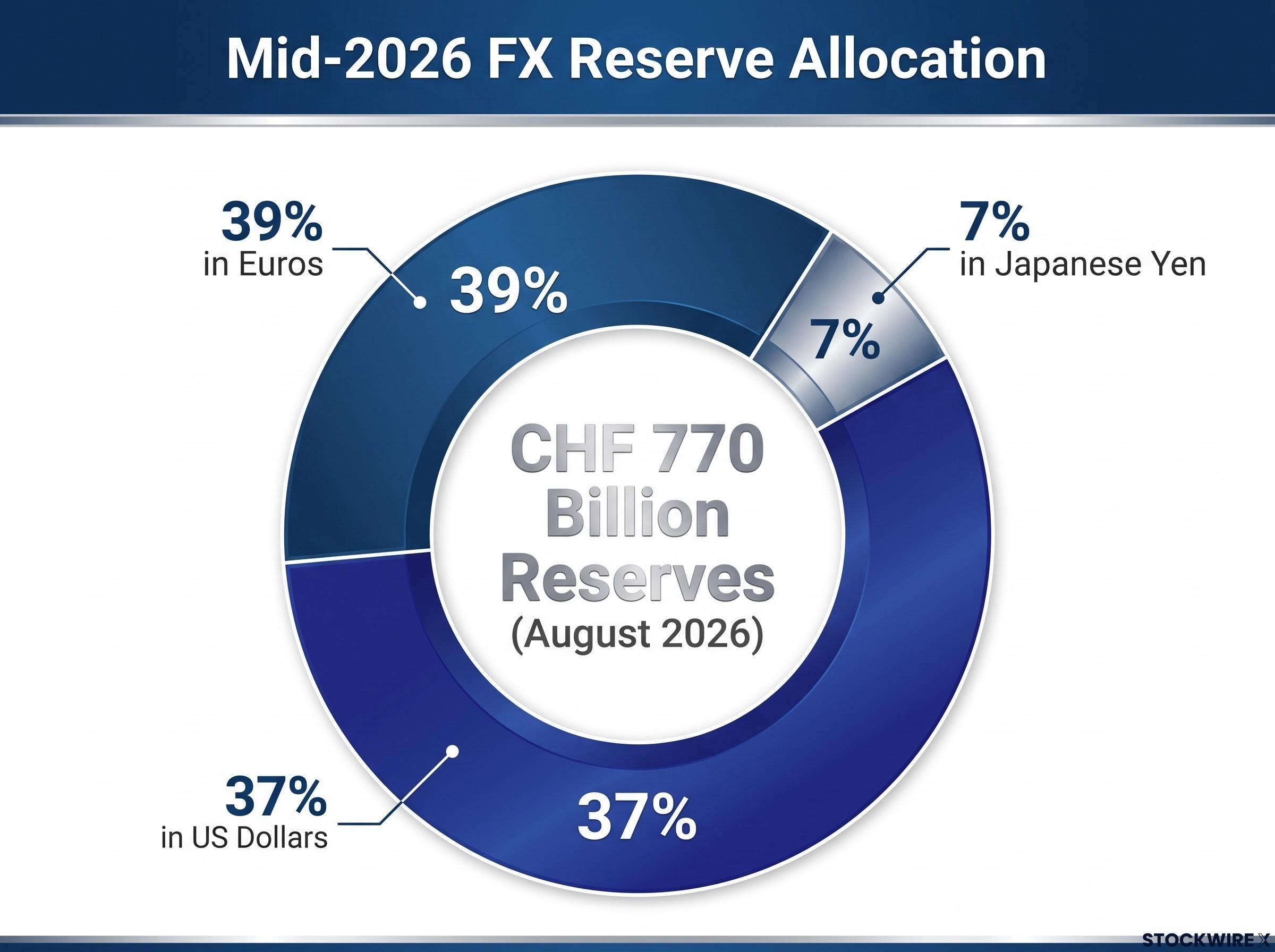
The distinction matters for how you read these interventions. A traditional central bank expanding its balance sheet is managing domestic liquidity; this institution is actively defending its exporters in what critics have called a currency war.
| Central Bank | Primary QE Mechanism | Balance Sheet Composition |
|---|---|---|
| Swiss National Bank | Foreign currency purchases (FX channel) | Heavily weighted to foreign assets (EUR, USD, JPY) |
| US Federal Reserve | Domestic Treasury and mortgage bond buying | Domestic government and agency securities |
| European Central Bank | Eurozone sovereign and corporate bond buying | Domestic eurozone debt instruments |
This approach carries diplomatic baggage that domestic QE avoids. Extensive intervention has previously led the US Treasury to flag Switzerland for meeting criteria associated with currency manipulation, a reminder that holding down your own currency draws direct scrutiny from foreign governments watching their own trade balances.
Switzerland’s ongoing placement on the US Treasury monitoring list for currency practices confirms that the diplomatic friction generated by large-scale foreign exchange intervention extends well beyond academic debate, carrying formal bilateral consequences that constrain future policy choices.
The 2015 market shock and the abandonment of the Euro peg
In September 2011, with the eurozone sovereign debt crisis driving frightened money into Francs, the central bank drew a line in the sand. It set a fixed minimum exchange rate of 1.20 EUR/CHF and pledged to buy foreign currency in unlimited amounts to defend it.
For over three years the floor held. Then the ground shifted underneath it.
By early 2015, the ECB was preparing a massive quantitative easing programme of its own. Defending 1.20 against a flood of newly created Euros would have forced the Swiss central bank to print Francs and buy foreign assets without limit, ballooning its balance sheet to a size that was politically and mathematically untenable.
On 15 January 2015, the floor was scrapped without warning. The Franc rocketed upward in an event that became known as the “Frankenshock,” instantly squeezing exporters and the tourism sector.
The policy then flipped hard, moving into deeply negative interest rates to discourage the inflows the peg had absorbed.
The Frankenshock was more than a currency spike. It delivered a lasting credibility shock, teaching the market that this central bank will deploy aggressive tools and may also pull them away suddenly. The institutional response was to abandon fixed floors entirely and pivot to opaque, unannounced interventions, denying speculators a fixed target to attack.
Coordinated currency intervention, as illustrated by the US-Japan operation in August 2026, carries significant diplomatic costs and cross-asset spillovers that unilateral central bank action avoids, which is part of why Switzerland has historically preferred to operate alone and without pre-announced targets.
Treat 2015 not as a historical footnote but as the defining trauma that explains the modern playbook. It is precisely why policymakers now refuse to broadcast their moves in advance.
Navigating zero rates and a bloated balance sheet into 2027
History sets up the present dilemma. Under Chairman Martin Schlegel, the Governing Board held the policy rate at 0.00% at its September 2026 assessment, extending a zero-rate stance that markets expect to persist through 2027.
This is a normalisation phase, a deliberate move away from the negative rate era that ran from 2015 into the early 2020s. The conditional inflation forecast from the June assessment projected average annual CPI of 0.6% for 2026, low enough to justify patience but not so low as to demand fresh action.
The harder question is what happens next, and three forward-looking risks deserve your attention:
- Balance sheet unwind: There is no clean exit from the reserve stock. Selling assets quickly could strengthen the Franc and hurt exporters, while a slow run-off keeps the central bank exposed to years of global market volatility and mark-to-market losses.
- Global spillovers: Any international slowdown will send safe-haven money surging into Francs, forcing renewed intervention and reviving the currency manipulation friction with foreign treasuries.
- Rate differentials: Normalising faster than the ECB or Fed could push the Franc sharply higher and import deflation, while cutting back below zero to deter inflows brings its own market-distortion costs.
As you position a portfolio or a business for 2027, watch global growth closely. Any fresh panic abroad will drag these policymakers straight back into the very interventions they are currently trying to pause.
Institutional forecasts have mapped the EUR/CHF corridor into a tight 0.91-0.95 range over the next 12-18 months, a consensus that reflects both the structural safe-haven bid and the SNB’s active resistance to sustained appreciation beyond that band.
This article is for informational purposes only and should not be considered financial advice. Investors should conduct their own research and consult with financial professionals before making investment decisions.
Past performance does not guarantee future results, and financial projections are subject to market conditions and various risk factors.
Evaluating the limits of unconventional monetary defense
The through-line is a single, unresolved friction. An economy this open cannot comfortably host a currency the whole world runs to in a crisis, and every tool in the kit exists to manage that contradiction.
The most important takeaway is structural. The enormous foreign-currency balance sheet built up over the past decade is not a temporary crisis measure waiting to be reversed. It is a permanent feature of how this central bank now operates, and unwinding it carries as much risk as building it did.
That leaves the reader with a clear lens for the years ahead. Swiss policy will remain unusually dependent on what larger central banks do, because Franc strength is imported from abroad rather than generated at home.
Fed policy expectations shape Franc dynamics more directly than domestic Swiss conditions do, because the yield gap between the two central banks sets the cost of holding Francs and determines the intensity of safe-haven inflows during global stress periods.
Watch the Fed and the ECB, not just Bern. When global conditions turn, the decisions made here will follow the panic, not lead it.