
Bendigo and Adelaide Bank has signed a seven-year deal with Infosys and a six-year deal with Genpact, targeting $65 million to $75 million in annualised expense savings by FY2028. For a regional lender built on community banking principles, the decision to offshore significant technology and operations work to two global outsourcing partners marks a sharp directional shift. Disclosed on 9 April 2026 alongside a Q3 FY2026 trading update that showed cash earnings of $137.9 million (up 7.6% on the first-half quarterly average), the partnerships form the backbone of the bank’s Productivity Programme. BEN shares rose approximately 6-7% on the day. What follows is an analysis of the financial mechanics, the strategic logic, the workforce fallout, and the execution risks that will determine whether the programme delivers on its promises.
The numbers behind the deals: what Bendigo is betting on
The Productivity Programme’s financial architecture is built around a single headline commitment.
The bank targets $65 million to $75 million in annualised expense benefits, fully realised by FY2028, against upfront transition costs of $85 million to $95 million, with the bulk of those costs falling in FY2027.
The timing asymmetry is where the tension sits. Transition costs are front-loaded; benefits are back-loaded. For investors tracking the bank’s near-term earnings trajectory, that gap creates a period in which reported costs rise before savings materialise.
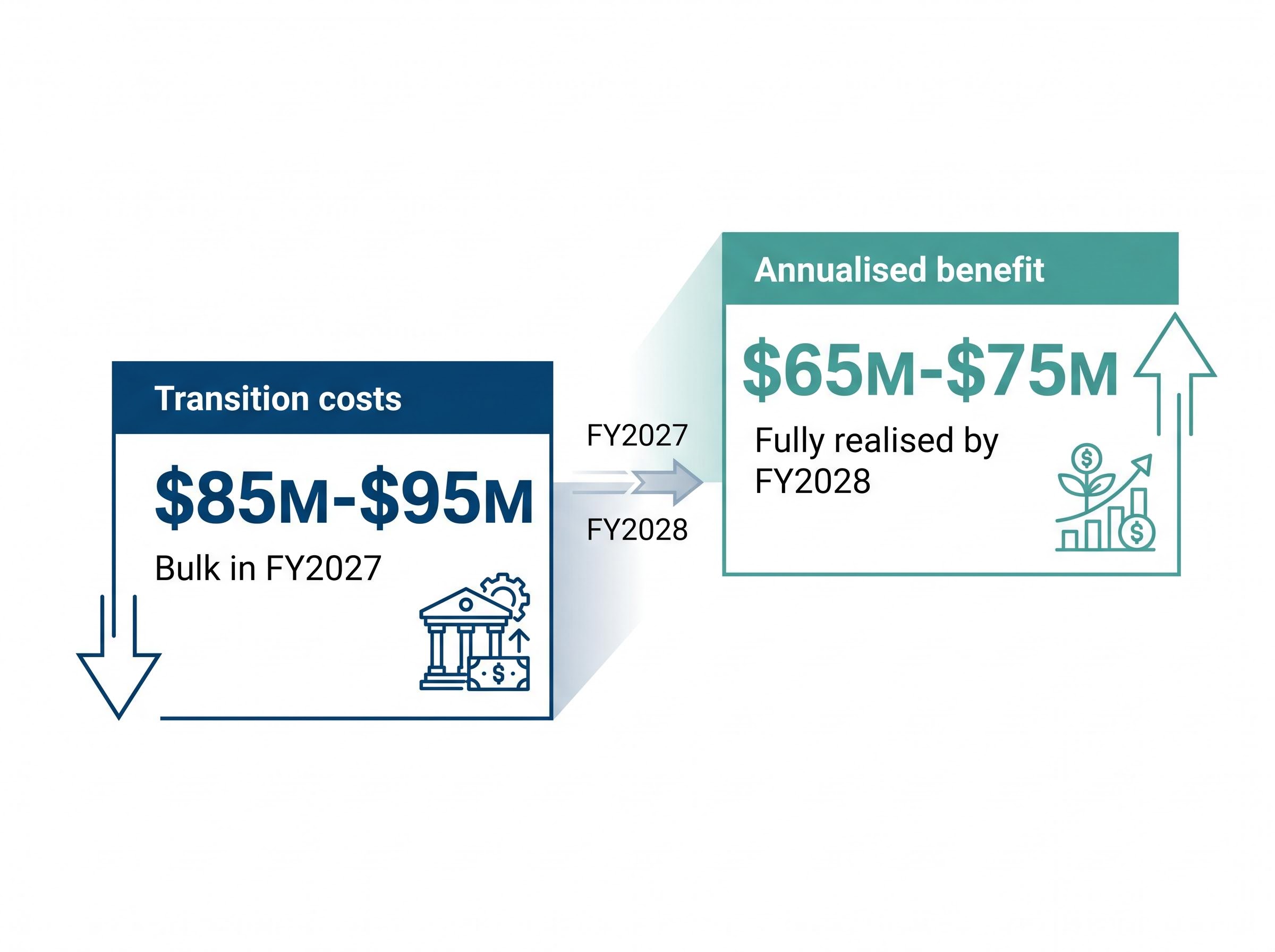
| Item | Quantum | Timing | Full realisation |
|---|---|---|---|
| Transition costs | $85M-$95M | Bulk in FY2027 | N/A |
| Annualised benefit | $65M-$75M | Phased from FY2027 | FY2028 |
The Q3 trading update provided some supporting context. Operating expenses came in at $305.1 million, down 4.1%, and net interest margin expanded 6 basis points to 1.98%. The expense savings are tied to a public commitment that business-as-usual costs will grow no faster than inflation across the economic cycle. The programme is the mechanism intended to keep that promise.
When big ASX news breaks, our subscribers know first
What Infosys and Genpact actually bring to the table
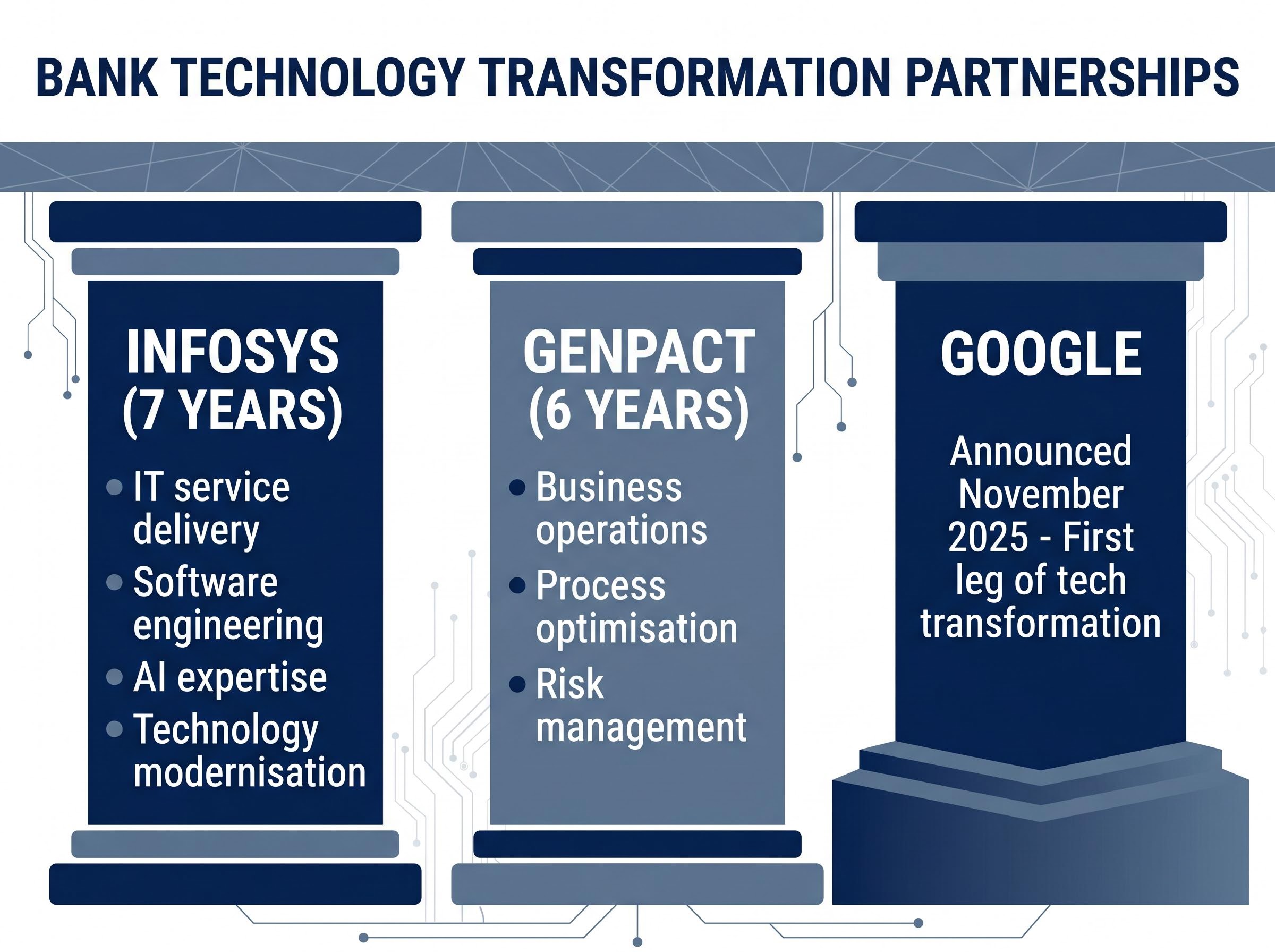
The bank selected two partners with distinct mandates rather than consolidating under a single provider. The division of responsibilities is deliberate.
Infosys: building AI and engineering capacity
Infosys holds the seven-year contract covering IT service delivery, software engineering, and AI capability. The arrangement is designed to give BEN access to global-scale technology talent it determined it could not maintain internally at comparable cost.
The relationship has a track record. In 2023, Infosys and the bank collaborated on a document management consolidation project, migrating approximately 15 million documents to Microsoft SharePoint Online. That project streamlined lending processes and retired legacy systems, providing a demonstrated execution foundation for the broader partnership now in place.
- Infosys scope: IT service delivery, software engineering, AI expertise, technology modernisation
- Contract duration: 7 years
Genpact: process discipline and risk management
Genpact holds the six-year contract focused on business process optimisation and risk management. Where Infosys addresses the technology layer, Genpact addresses the operational layer, covering the workflows and processes that sit underneath the technology stack.
- Genpact scope: Business operations, process optimisation, risk management
- Contract duration: 6 years
The two mandates complement rather than duplicate. The Google partnership disclosed in November 2025 formed the first leg of the bank’s technology transformation; Infosys and Genpact extend it into execution and operations.
Why regional banks cannot afford to build this capability themselves
The outsourcing decision reflects a structural calculation, not simply a cost-cutting exercise. Three factors make internal capability maintenance difficult at BEN’s scale:
- Talent cost: Regional banks compete for AI and software engineering talent against Australia’s Big Four banks and global technology firms, without the compensation packages or career infrastructure those institutions offer.
- Pace of AI change: The speed at which artificial intelligence capabilities evolve means internal teams require continuous reinvestment in skills and tooling, a capital-intensive cycle for a bank of this size.
- Capital requirements: Building and maintaining technology infrastructure at global competitive standards absorbs capital that a regional lender could otherwise deploy into lending growth or shareholder returns.
The bank’s own framing is direct: the partnerships provide access to global scale in AI and software engineering not achievable internally at comparable cost. A prior signal came in 2025, when a technology division restructure affected fewer than 100 roles in a smaller, earlier wave of the same directional shift.
Lending volume growth of 5.6% in Q3 provides context. This is a bank still growing its loan book while restructuring its cost base, a simultaneous operation that makes the outsourcing model’s capacity to absorb operational complexity more relevant.
Understanding outsourcing in Australian banking: what the regulatory framework allows
The Australian Prudential Regulation Authority (APRA) oversees outsourcing arrangements for authorised deposit-taking institutions (ADIs), which are institutions such as banks that are licensed to accept customer deposits. APRA’s framework requires that boards remain accountable for outsourced functions regardless of where or by whom those functions are performed.
APRA’s CPS 230 operational risk standard, which commenced in July 2025, formalises the board accountability obligations that apply to outsourcing and service provider arrangements for all authorised deposit-taking institutions, requiring banks to maintain oversight of material service providers regardless of whether those providers operate onshore or offshore.
Under APRA’s outsourcing framework, board accountability for outsourced functions is non-delegable, meaning the bank’s directors retain responsibility for outcomes even when third-party providers perform the work.
In 2025, APRA rescinded its 2018 cloud computing guidance paper as part of broader updates to its outsourcing-related frameworks, signalling an evolving regulatory posture toward technology arrangements in the banking sector. As of 30 April 2026, APRA has made no public statement specifically addressing BEN’s Infosys and Genpact arrangements. The absence of targeted regulatory commentary does not constitute endorsement, but it is itself informative for investors assessing whether the deals have attracted prudential attention.
APRA’s regulatory posture toward financial sector technology and structural arrangements has been shifting, as evidenced by the regulator’s 2025 decision to rescind its 2018 cloud computing guidance paper and its concurrent overhaul of capital framework rules for longevity product providers, both signals that APRA is updating its supervisory lens to match a sector undergoing rapid operational change.
This article is for informational purposes only and should not be considered financial advice. Investors should conduct their own research and consult with financial professionals before making investment decisions.
Jobs, union opposition, and the human cost of the transformation
The Finance Sector Union (FSU) responded within a day.
The FSU’s public statement on the Bendigo partnerships used language that frames the outsourcing decision as part of a wider pattern of AI-driven displacement across Australian banking, a characterisation that signals the union intends to contest these arrangements publicly rather than limit its response to enterprise-level consultation.
On 10 April 2026, the FSU condemned the partnerships as “appalling offshoring” and described the programme as a “dramatic escalation” of AI-driven disruption and offshoring in Australian banking.
The confirmed and projected workforce impacts require careful distinction:
- Confirmed: 188 positions affected in the first wave of changes
- Projected: FSU warning of potential total losses of up to 1,000 jobs
- Programme status: Detailed design unfinished at the time of announcement; employee consultations described as pending
The FSU cited inadequate consultation as a specific grievance and held a technology union meeting on 23 April 2026 to address member concerns. CEO Richard Fennell acknowledged that “decisions affecting staff are difficult.”
The workforce dimension carries investment relevance beyond sentiment. Implementation risk rises when staff transitions are contested, and reputational complexity is heightened for a bank whose brand identity is anchored in community values. Whether the consultation process proceeds smoothly or escalates into a protracted dispute is a variable that affects the programme’s execution timeline.
What the 2030 strategy requires, and whether this programme can deliver it
The Productivity Programme exists to serve a specific commitment within the bank’s 2030 strategy: keeping business-as-usual expense growth no higher than inflation across the economic cycle. The Infosys and Genpact deals are the mechanism designed to make that commitment viable.
The market’s initial reading was positive. BEN shares rose approximately 6-7% on 9 April, reaching a close of $11.34. By 29 April, the price had settled to approximately $10.61, roughly 1.5% above pre-announcement levels but well below the announcement-day peak. That stabilisation suggests investors have partially priced in execution risk after the initial enthusiasm.
Australian bank valuations entering mid-2026 carry a notable tension: Morningstar has flagged the Big Four as overvalued at current multiples, yet regional lenders like Bendigo are undertaking exactly the kind of cost-structure transformation that analysts typically reward with multiple expansion when execution risk proves manageable.
Statutory net profit after tax for Q3 was $109.4 million, and lending growth came in at 5.6% in the quarter. The financial base is sound. The question is whether the benefit realisation timeline holds.
Three primary execution risks stand between the programme and its FY2028 target:
- Knowledge transfer and staff transition: Retaining institutional knowledge as roles move to offshore partners, particularly while union opposition remains active.
- Programme design completion and consultation timeline: The detailed design was unfinished at announcement, meaning implementation milestones remain unconfirmed.
- Partner operationalisation at scale: Both Infosys and Genpact must build functional capacity within the bank’s operating environment before savings can begin flowing.
Past performance does not guarantee future results. Financial projections are subject to market conditions and various risk factors.
The regional banking sector is watching
BEN’s decision sends a signal that extends beyond one institution. The partnerships, with their seven-year and six-year durations, represent structural commitments that reach well past any single strategic planning cycle. They reflect a judgement that a minimum technology capability threshold now exists for competing in Australian retail banking, and that institutions below a certain scale cannot cross that threshold alone.
The bank has stated that the partnerships provide capabilities “not achievable internally at comparable cost,” the clearest articulation of why a community lender concluded it needed global partners to remain competitive.
The Google partnership announced in November 2025 laid the first technology pillar. Infosys and Genpact extend that foundation into engineering, operations, and process management. Together, the three arrangements constitute a wholesale restructuring of how the bank sources its non-lending capabilities.
Regional bank digital transformation carries measurable leadership consequences: Bank of Queensland’s decision to promote its Chief Transformation and Operations Officer to CEO in March 2026 reflects how central technology execution capability has become to the succession calculus at institutions competing in the same market segment as Bendigo.
Whether the model succeeds or encounters friction, it establishes a reference point for how Australia’s regional banks approach the AI and outsourcing question in the years ahead. The tension at its centre, a community banking identity and a decision to offshore significant work to global providers, is one the entire sector will be forced to confront.