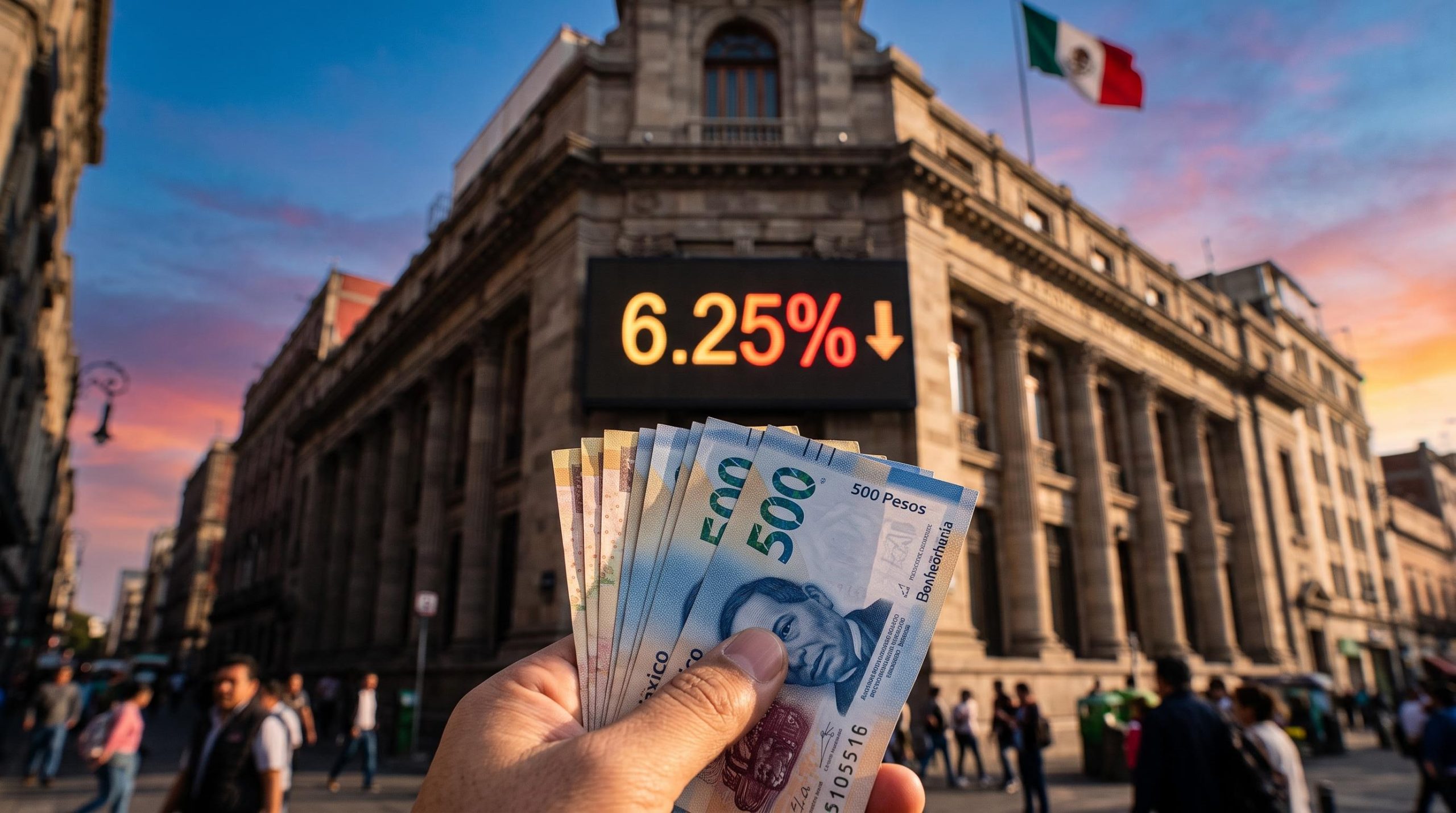
Banco de México (Banxico) cut its benchmark interest rate by 25 basis points to 6.25% on Thursday, 5 November 2026. Most economists had expected a hold, and the board raised its own inflation forecasts in the same statement.
That combination sends mixed signals. A central bank that eases while it lifts its inflation projections is betting that weak growth matters more than rising prices. The Mexican peso is where that bet will be tested first, because currencies tend to react quickly when a rate decision surprises the market.
This Banxico rate cut matters well beyond Mexico. Here is why the board moved, how divided it was, and how a rate decision like this one feeds through to the peso, so you can read the next central bank surprise with the same framework.
Why did Banxico cut when almost nobody expected it?
The board lowered the overnight interbank target rate from 6.50% to 6.25%, effective 6 November 2026. That rate is what banks pay to borrow from each other overnight, and it anchors borrowing costs across the Mexican economy. Bloomberg reported the move as unexpected, and the pre-meeting surveys show how few forecasters had called it:
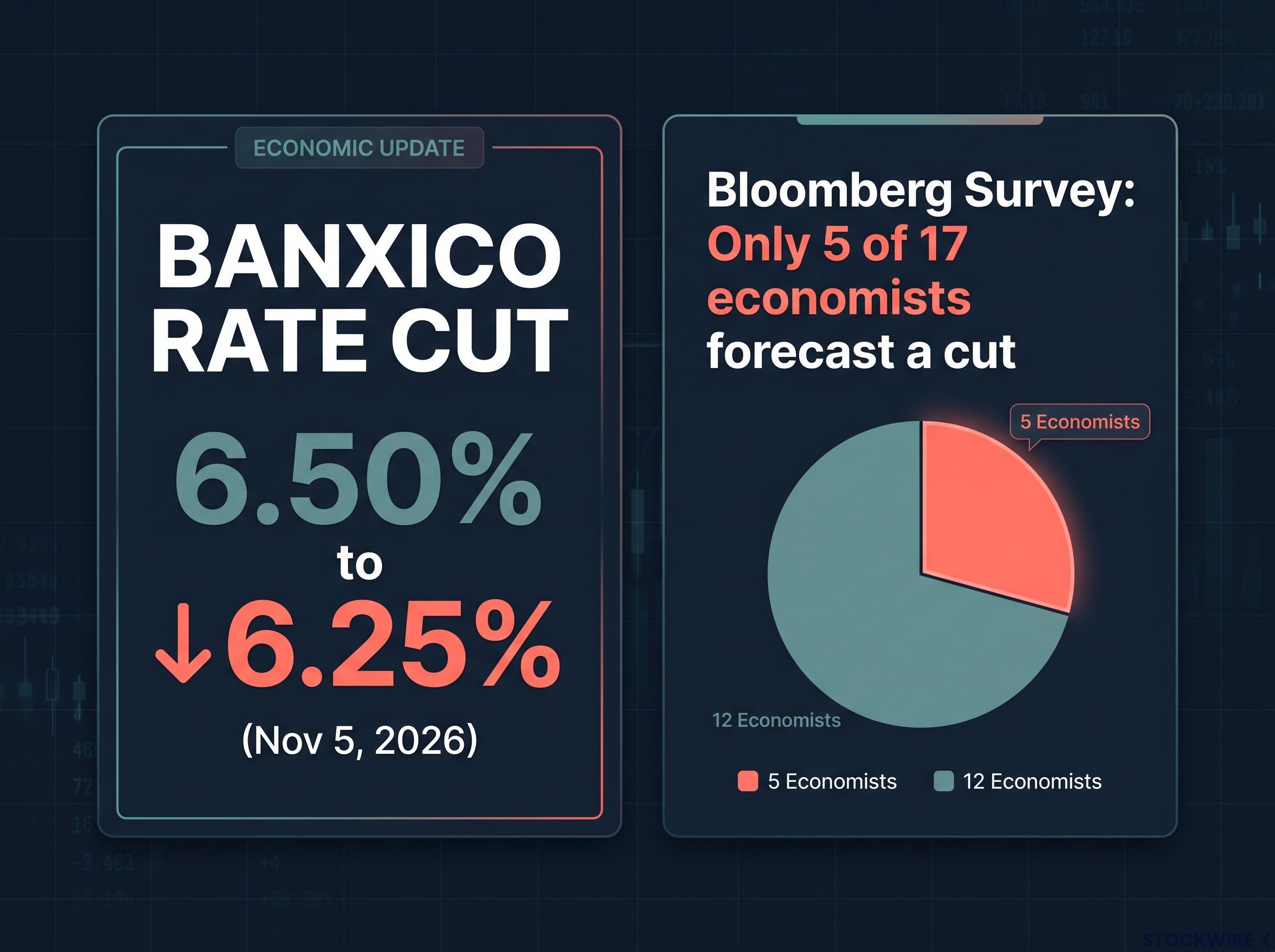
- Bloomberg survey: only 5 of 17 economists forecast a cut.
- Citi survey (published 4 November): 20 of 36 analysts expected no change. Six expected a 25 basis point cut: Bankaool, Barclays, Bradesco BBI, Finamex, Itaú BBA and UBS. Another 10 expected the next move to come in 2027.
- Banxico’s own analyst survey (3 November): respondents saw the rate staying at 6.50% through the end of 2027.
Commerzbank’s Norman Liebke was among those expecting a hold. He pointed to inflation still running slightly above target and to earlier cuts that had not yet fully worked through the economy.
The earlier Citi economist survey had also flagged softer external dollar inflows, including weaker remittances and falling Pemex crude exports, which thin the cushion supporting the peso when rate differentials narrow.
So why cut while raising inflation forecasts?
The board’s answer centred on “condiciones de holgura”, or slack. Slack means the economy has spare capacity: idle workers and unused production that can absorb demand without pushing prices higher. The majority judged domestic demand to be soft and policy to be restrictive already. Bloomberg described the decision as a resumption of easing made possible by that slack.
The board’s framing Banxico called the cut an “ajuste puntual”, a one-time adjustment, rather than the start of a new easing cycle.
When a central bank goes against near-consensus, the decision shows you what the board cares about most. Here it chose to address growth slack over the near-term inflation path.
When big ASX news breaks, our subscribers know first
What does the 3-2 split and the “one-time adjustment” language tell you?
The vote was 3-2, and the names show where the division sits.
| Board member | Role | Vote |
|---|---|---|
| Victoria Rodríguez Ceja | Governor | Cut to 6.25% |
| José Gabriel Cuadra García | Deputy Governor | Cut to 6.25% |
| Omar Mejía Castelazo | Deputy Governor | Cut to 6.25% |
| Galia Borja Gómez | Deputy Governor | Hold at 6.50% |
| Jonathan Heath | Deputy Governor | Hold at 6.50% |
The governor sided with the majority. The available sources do not set out Borja’s or Heath’s individual reasons for dissenting.
The wording around the cut matters more than the vote count. The board said it intends to keep the rate at 6.25% for an extended period and judged that risks to inflation remain skewed to the upside. It also said future decisions will weigh observed and expected inflation, exchange-rate pass-through, slack and inflation expectations. Taken together, the statement delivers a dovish action wrapped in a hawkish message. The language is designed to stop markets pricing in a string of further cuts.
The 2026 record supports that reading. According to reports that have not been independently confirmed, Banxico cut to 6.75% in March and 6.50% in May, then held at that level, with the cycle described as finished. November reopens a door the board had signalled was closed.
The cut reverses a pause that had run since May, and the September decision, a unanimous third straight hold, followed a cumulative 475 basis-point easing cycle that began in March 2024.
With a 3-2 vote and guidance this firm, the easing door is barely open. You should not read this as the start of a new cutting cycle.
Higher inflation forecasts, same 3% target: what the new numbers say
Set the revisions side by side and the tension is plain.
| Measure | Previous | New | Note |
|---|---|---|---|
| Q4 2026 headline | 3.5% | 3.7% | Revised up |
| Q4 2026 core | 3.6% | 3.7% | Revised up |
| Q4 2027 headline | 3.0% | 3.0% | Unchanged |
| Q4 2027 core | 3.0% | 3.0% | Unchanged |
Headline inflation covers every item in the consumer basket. Core inflation strips out volatile items such as energy and some food. In the first half of October, headline inflation climbed to 3.62% from 3.42%, while core edged down to 3.78% from 3.79%.
The board attributed its 2026 upgrade mainly to non-core components and treats that pressure as temporary. It still expects both measures to return to its 3% target, the midpoint of a 2%-4% tolerance band, by Q4 2027. That 2027 convergence is how the majority justifies a cut alongside higher near-term forecasts.
Where private forecasters differ
Private-sector economists are less optimistic. Banxico’s analyst survey put headline inflation at 3.88% for 2026 and 3.85% for 2027, with core at 3.82% in both years. These are private forecasts, not the central bank’s.
Some critics argue that cutting while raising forecasts could weaken Banxico’s commitment to 3%. Banamex reportedly warned of credibility damage, although that report has not been independently confirmed.
The private forecasts sit above the board’s own path, so the market is less convinced than Banxico that inflation will return to 3%. That gap is the one to watch.
Market-based inflation expectations offer a cross-check on whether investors share the board’s view, since adjusted market rates tend to converge with professional forecasts and a widening gap signals shifting risk appetite.
How do rate cuts move the peso, and what is still unknown?
The mechanics apply to almost any central bank decision. Many investors run carry trades, which means borrowing in a low-yielding currency and investing in a higher-yielding one to earn the difference. A rate cut shrinks that difference and sets off a chain:
- Carry trades lose appeal as the yield advantage over US dollar assets narrows.
- Capital inflows can slow as fewer investors chase peso returns.
- Depreciation pressure builds on the currency.
- Pass-through risk rises, because a weaker peso lifts the cost of imported goods and feeds back into inflation.
For Mexico, the key measure is the gap between Banxico’s rate and the upper bound of the US Federal Reserve’s target range. Before the decision, that differential was reportedly about 250 basis points, with scenarios of about 225 and 200 if it narrowed further. Banxico has at times moved ahead of the Fed, as it did after Covid-19, to limit depreciation and capital outflows.
Hawkish guidance can soften the currency hit. If markets believe no more cuts are coming, the expected yield gap holds steadier than the single cut alone would suggest.
Episodes of central bank divergence show that currencies respond more to the expected path of the rate gap than to any single decision, which is why the direction of the Banxico-Fed spread may matter more than its current size.
What we do not yet know
The research does not confirm the Fed’s current target range, so the exact post-cut gap cannot be calculated. It also contains no confirmed USD/MXN level after the decision. Before the meeting, the peso had reportedly weakened from about MXN 16.90 per dollar in September to around 18.80, and some analysts flagged a possible move above 18.85-19.00 on a surprise cut. Those figures are unverified.
If you hold peso exposure, or travel and trade in Mexico, the Fed’s next move may now matter more than Banxico’s. With Mexico signalling a long pause, the rate gap has become the main swing factor.
What to watch after Banxico’s cut: the Fed gap, the next inflation print and the peso
A surprise cut, a divided board and firm guidance add up to a one-off adjustment, not a new cycle. Three things will show whether the board’s bet holds:
- The Fed’s next decision, and the Banxico-Fed gap that results from it.
- The next biweekly inflation print, measured against the board’s 3.7% Q4 2026 forecast.
- USD/MXN in the coming sessions, for signs of carry outflows or pass-through.
The pre-meeting surveys point to a prolonged pause as the base case. If you are positioned for further Mexican easing, the board’s own words argue for patience.
This article is for informational purposes only and should not be considered financial advice. Investors should conduct their own research and consult with financial professionals before making investment decisions.
Past performance does not guarantee future results. Financial projections are subject to market conditions and various risk factors.