
The Federal Reserve just moved its policy rate to a target range of 3.75%-4.00%, markets are pricing another 25 basis point hike for October, and yet the US Dollar Index is sitting at just 101.0960 as of 28 September 2026, barely above a technical floor rather than punching toward multi-year highs.
That gap between aggressive policy and a restrained dollar is the tension worth resolving this week, because it converges with elevated Treasury yields and a packed data calendar all landing at once. EUR/USD near 1.1350, GBP/USD around 1.3280, and AUD/USD challenging the 0.7000 floor each tell a different part of the same story: the relative tightening premium baked into dollar-denominated assets.
This covers three things that matter for anyone tracking those pairs. Why Treasury yields transmit into currency markets the way they do, which pairs are most exposed over the next five trading days and why, and what the data releases and Fed speakers could actually change before the week is out.
Why Treasury yields move currency markets (and when they stop working)
Look at any rates screen and the correlation seems obvious: US yields climb, the dollar firms. What is less obvious is the mechanism underneath, and understanding it tells you whether the current dollar support is something to position around or a peak approaching its own reversal.
The 2022 episode is the most instructive historical anchor here: central bank divergence drove EUR/USD below parity for the first time in twenty years, and the mechanics that produced that move, forward rate path pricing, carry rebalancing, and energy shock compounding, are structurally similar to what is operating now.
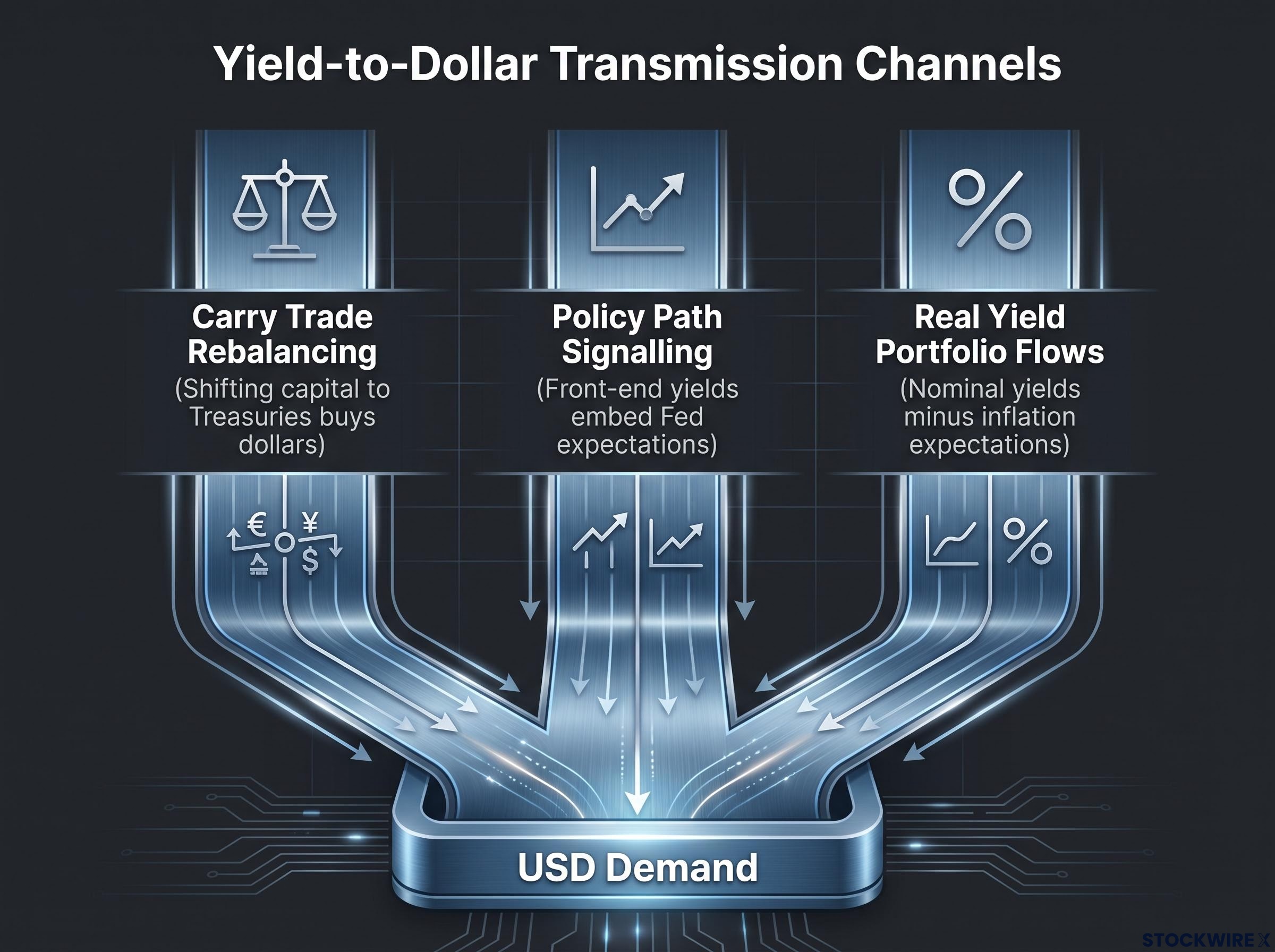
Elevated US Treasury yields feed into dollar demand through three linked channels.
- Carry trade rebalancing. Higher US yields relative to German, UK, and Australian sovereign debt raise the return on dollar fixed income. Investors shifting capital into Treasuries have to buy dollars to do it, lifting demand for USD against EUR, GBP, and AUD.
- Policy path signalling. Front-end yields, particularly the 2-year, embed what the market expects the Fed to do next. When those yields rise because traders price in more hikes or a longer restrictive hold, the perceived policy gap strengthens the dollar against currencies whose central banks are nearer a pause.
- Real yield portfolio flows. Rising US real yields, meaning nominal yields minus inflation expectations, attract global capital chasing inflation-adjusted returns that the euro area and UK cannot currently match.
The market-observable measure analysts lean on is the front-end yield spread: the gap between the US 2-year and the German 2-year Bund. Wider spreads in the dollar’s favour line up with a weaker euro.
Here is the qualification that matters most before you position around any of this.
Good yield versus bad yield When yields rise because US growth is strong and the Fed is determined, that is “good yield” and it tends to support the dollar durably. When yields rise mainly because of fiscal sustainability worries or a swelling term premium, that is “bad yield,” and it can erode confidence in US assets even as the nominal number climbs.
The distinction is not academic. It decides whether the present dollar support is structural or fragile, and the honest read is that the current move sits closer to the growth-and-policy end of the spectrum for now, which is why it holds. Watch for that to shift.
When the relationship inverts
The yield-dollar relationship is not permanent. It flips the moment markets stop pricing hikes and start pricing cuts.
Once traders become convinced the Fed has reached its terminal rate, elevated yields stop doing positive work for the dollar. Attention rotates toward relative growth and valuation instead, which opens the door for EUR, GBP, and AUD to recover.
Historically, this peak-hikes pivot has preceded sharp dollar reversals even when the underlying case for the currency still looked intact on paper. That is the trap. The fundamentals can read bullish right up until the positioning unwinds.
When big ASX news breaks, our subscribers know first
EUR/USD, GBP/USD, and AUD/USD: three pairs, three versions of the same pressure
Dollar strength is not a single uniform force pressing equally on every counterpart. It is calibrated differently against each one, and mistaking the three for the same trade is the most common analytical error this week.
EUR/USD is the cleanest expression of the policy divergence story. The primary quantitative driver is the front-end spread between US and German yields, with the Fed either further ahead in the cycle or more committed to holding restrictive rates than an ECB balancing inflation against fragile Eurozone growth. The ECB reference rate sat at 1.1378 on 28 September, and the pair approached 1.1350 intraday on 29 September, multi-week lows. The spread does not capture everything, though: Eurozone energy dynamics and political risk add a layer the yield gap alone misses, and with Cipollone, Lane, Lagarde, and Vujcic all scheduled to speak, the communication tone could move the pair independently.
The ECB’s September 2026 rate decision and accompanying statement set the baseline policy posture that EUR/USD traders are currently pricing against the Fed’s more aggressive path, with the ECB’s own inflation and growth assessment shaping how much further the front-end spread can widen.
GBP/USD carries its own idiosyncratic wrinkle. The pair reached its highest level in three days near 1.3280 on 29 September, but that reads as momentary relief rather than a trend reversal. UK housing market sensitivity to higher rates, plus a slate of Bank of England mortgage and lending data due this week, means sterling faces domestic pressures beyond what rate differentials imply. The Bank of England’s room to hike is more constrained than the Fed’s, which caps how far any relief rally can run.
AUD/USD is the acute pressure point. It printed 0.7023 at the RBA 4pm reference on 28 September and was challenging 0.7000 intraday on 29 September, near its lowest since 4 August. What makes it different is that the Aussie faces two forces on the same day.
- A US macro headwind from broad dollar strength and rising odds of an October Fed hike.
- A domestic rate decision, with the RBA Monetary Policy Board meeting on 28-29 September and consensus expecting a 25 basis point rise to 4.60%, which would be the highest cash rate since early November 2011.
For anyone with AUD exposure, that pairing is the whole story. Depending on the RBA’s accompanying guidance, the two forces could partly offset each other or compound, and the guidance matters as much as the decision itself.
The AUD/USD yield spread framework matters here because the RBA at 4.35% and the Fed at 3.50%-3.75% had been providing a structural carry tailwind for the Australian dollar in the weeks before this meeting, making the RBA’s guidance on whether that spread widens or stabilises as consequential as the rate decision itself.
| Currency Pair | Current Level (29 Sep) | Key Driver This Week | Central Bank Wild Card |
|---|---|---|---|
| EUR/USD | ~1.1350 | US-German 2-year yield spread; policy divergence | ECB speakers (Cipollone, Lane, Lagarde, Vujcic) |
| GBP/USD | ~1.3280 | UK lending and mortgage data; housing sensitivity | Constrained BoE path relative to the Fed |
| AUD/USD | ~0.7000 | USD strength plus October Fed hike odds | RBA decision (25 bp hike to 4.60% expected) |
The entry point and risk profile for a EUR/USD position differs meaningfully from an AUD/USD one this week. That is why the pairs need to be read separately, not lumped into one dollar-strength thesis.
This week’s data calendar and what each release could change
A data calendar is only useful if you know in advance what each number means for your positioning. So treat the week ahead not as a schedule but as a decision tree, where every release carries a specific directional implication for the dollar.
Start with the US releases landing on 29 September: the FHFA House Price Index, JOLTS Job Openings, Conference Board Consumer Confidence, and the API crude oil inventory report. The two that matter most for dollar direction are JOLTS and Consumer Confidence.
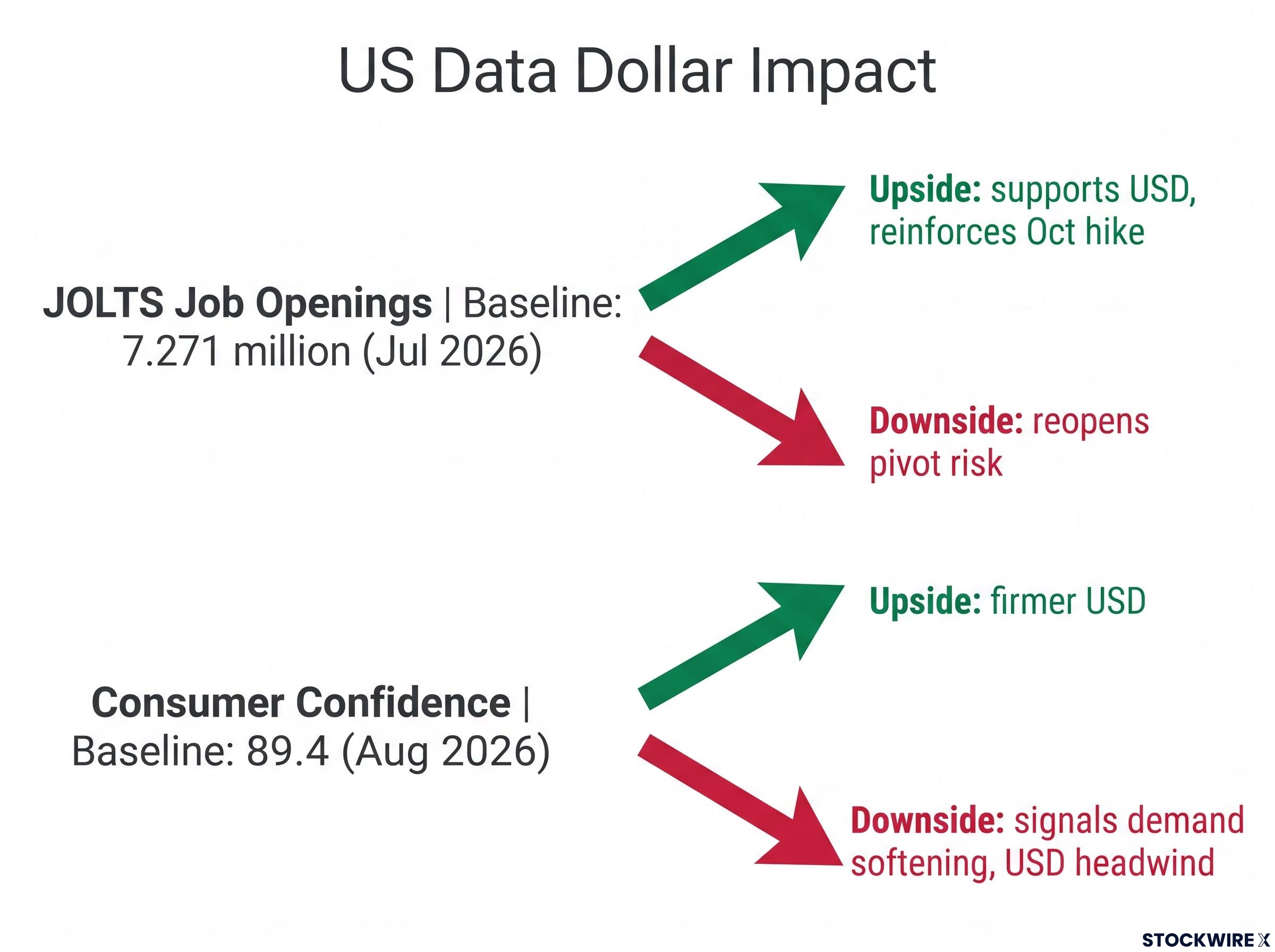
JOLTS came in at 7.271 million openings in the July 2026 print released 1 September, and August data is due now. A strong number reinforces the October hike probability and supports the dollar; a weak one reopens the pivot narrative and creates downside risk for the DXY. Consumer Confidence had an August baseline of 89.4, and a further decline would signal demand softening that sits awkwardly against another aggressive hike.
| Release | Baseline / Prior Reading | Dollar Impact if Surprise |
|---|---|---|
| JOLTS Job Openings (Aug) | 7.271 million (Jul 2026) | Upside: supports USD, reinforces Oct hike. Downside: reopens pivot risk |
| Consumer Confidence | 89.4 (Aug 2026) | Upside: firmer USD. Downside: signals demand softening, USD headwind |
| RBA Decision | 4.35% (consensus 4.60%) | Hawkish guidance supports AUD. Dovish tone deepens AUD/USD pressure |
The UK slate adds a sterling-specific catalyst: BRC Shop Price Inflation, BoE Mortgage Approvals, M4 Money Supply, Consumer Credit, and Net Lending to Individuals. Soft lending data would reinforce the view that the Bank of England has less room to hike than the Fed, weighing on GBP. Australia releases Household Spending data alongside the RBA decision at 2:30 pm AEST.
Then there is the layer that can override the hard data entirely.
Watch the Fed speakers Goolsbee, Musalem, and Williams are all scheduled this week. Verbal guidance can shift market pricing independently of the data, particularly if any of them characterise the October meeting as effectively decided or leaves it genuinely open.
No single strong US print mechanically triggers an October hike. What it does is shift the probability distribution, which Fed speakers then either reinforce or push back against. Track the sequence, not each event in isolation.
The structural limits of dollar strength: what history says about this phase of the cycle
The same conditions that build the strongest dollar bull cycles also plant the seeds of their own reversals. That is the uncomfortable read from history, and it should leave you genuinely uncertain about how much further this move has left rather than convinced of its momentum.
Three episodes are instructive in sequence. The early 1980s Volcker tightening drove real yields sharply higher and produced a powerful dollar bull run, but excessive appreciation eventually invited policy responses abroad and a sharp correction once the Fed eased. The 2014-2016 Fed-versus-ECB divergence is the closest parallel to now, and it deserves its own callout.
The 2014-2016 warning As the Fed ended quantitative easing and moved toward hikes while the ECB and Bank of Japan expanded asset purchases and pushed yields lower, the dollar rallied hard and stayed strong. The divergence trade only unwound once foreign central banks began normalising. The setup then looks a lot like the setup now.
The post-GFC cycles of the 2010s reinforce the same lesson: FX markets overshoot on policy expectations, and sentiment can turn quickly near a tightening peak.
Four structural risks weigh against sustained dollar strength in this episode.
The fiscal risk premium argument deserves weight here because analysts at Convera, Nomura, Lloyds Bank, and Bank of America have each characterised rising US 10-year yields as a credit concern rather than an investment opportunity, which would invert the normal yield-to-dollar relationship and is one of the structural risks the current dollar bull run cannot easily absorb.
- Crowded positioning. When long-USD becomes the consensus trade, any positive non-US surprise or dovish Fed line can spark a short squeeze and a rapid decline.
- Valuation overshoot. Purchasing power parity metrics frequently flag the dollar as expensive against EUR, GBP, and AUD after extended bull runs.
- US fiscal concerns. Large deficits and a rising debt trajectory act as a longer-run constraint on confidence in dollar assets.
- Policy convergence. A hawkish shift from the ECB or BoE, or stronger non-US data, narrows rate differentials from the other side.
If this cycle is following the 2014-2016 template, the reversal when it arrives will likely be faster than the build-up. That is the part worth internalising if you are holding dollar-correlated positions.
Two triggers worth watching for a reversal
Two conditions are the most likely to catalyse a meaningful dollar reversal from here, and both are things you can monitor actively given the calendar already covered.
The first is a dovish pivot signal from the Fed, whether it shows up in softening data such as a weak JOLTS print or in the tone of Goolsbee, Musalem, or Williams this week. The second is a positive growth or policy surprise from the Eurozone or UK that narrows yield differentials from the non-US side.
Neither has arrived yet. But both are live over the next five sessions, which is precisely why the week matters.
What this rate environment actually requires from you as a market participant
You now have the mechanism, the pair-by-pair picture, and the historical context. What that leaves is a practical disposition, and it differs depending on where you already stand.
If you hold existing FX exposure, whether direct currency positions, international equities with currency sensitivity, or AUD commodity exposure, what you need is a monitoring framework. If you are evaluating new positions, what you need is a conditions-based checklist before you act rather than after the move has started.
Either way, this week’s releases and Fed speakers are not background reading. They are the actual inputs that will resolve the current pricing uncertainty, which makes real-time engagement a practical necessity.
- Track JOLTS and Consumer Confidence against their prior baselines for October hike probability signals.
- Monitor Fed speaker tone for whether October reads as a live meeting or an effectively decided one.
- Watch AUD/USD at 0.7000 as a technical level carrying heightened significance around the RBA decision.
- Track the US-German and US-UK 2-year yield spreads as the primary quantitative measure of divergence direction.
The RBA decision at 2:30 pm AEST on 29 September is the most immediate resolved uncertainty for AUD-exposed readers. Beyond it, the October FOMC is the next structural decision point, and it is close enough that this week’s data and speakers are the inputs from which the next FX move will be built. Treating them as noise rather than primary signals is a positioning error.
This article is for informational purposes only and should not be considered financial advice. Investors should conduct their own research and consult with financial professionals before making investment decisions. Past performance does not guarantee future results, and financial projections are subject to market conditions and various risk factors.
When the dollar’s advantage starts to fade
The central thread across all of this is straightforward. The dollar’s current support rests on a specific bundle of conditions: the Fed still tightening, US real yields elevated, no credible pivot signal, and peer central banks constrained. Each of those is individually testable against this week’s and next month’s data.
The risk runs genuinely two ways. The October hike could materialise and extend dollar strength, or the data could soften and tilt the probability toward a pause that revalues EUR, GBP, and AUD upward. Peak-hike periods, as history shows, are often when FX moves are most acute in both directions.
For investors wanting to map the full cross-regional policy picture behind the EUR, GBP, and AUD dynamics covered here, our dedicated guide to global central bank divergence sets out how the Fed, ECB, and BOJ divergence paths in mid-2026 are reshaping cross-regional bond and equity allocations alongside the FX moves.
Watch for these conditions to signal the advantage is fading:
- Pivot language from Goolsbee, Musalem, or Williams this week.
- A softening JOLTS print against the 7.271 million baseline.
- A hawkish surprise from the ECB or Bank of England.
- A DXY break below 101.
The question is not whether the dollar eventually reverses. It is whether your current positioning is sized for the possibility that it reverses from this level, near 101 on the DXY and 0.7000 on AUD/USD, rather than after one more leg up.