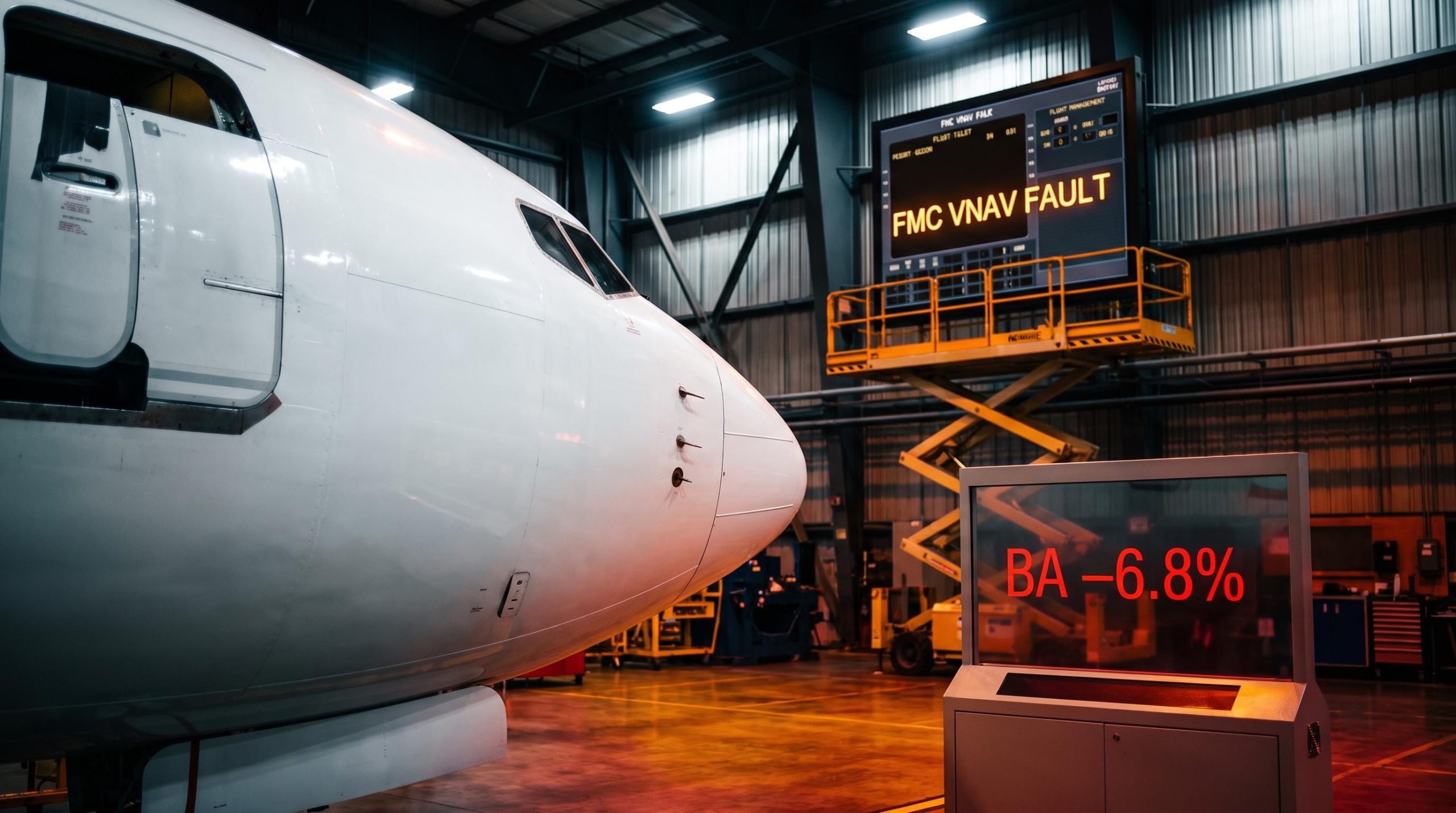
Boeing shares closed at their lowest level of 2026 on Monday, down nearly 7% in a single session, after the Federal Aviation Administration (FAA) froze certification of the 737 Max 10 over a software defect the company first learned about nearly two years ago and initially decided did not warrant a formal safety review.
The timing could hardly be worse. Just twelve days earlier, Boeing chief executive Kelly Ortberg told investors that Max 10 approval was arriving “very soon,” with only three deliverables left to clear. That expectation now hangs on the outcome of a Corrective Action Review Board the FAA convened on 28 September 2026, with no public deadline attached.
The defect sits in flight-management software supplied by GE Aerospace, and it affects vertical navigation during a specific, safety-critical moment of flight.
What follows here is straightforward: this piece explains what actually triggered the FAA’s move, what it means for Boeing’s delivery pipeline, and how to weigh the stock from here given the gap between what management promised and where the certification timeline now stands.
How a software glitch grounded Boeing’s certification process
The strange part is how close this was to being finished. Boeing was not weeks into a multi-year certification slog; it was, by its own account, weeks away from the finish line. Then a software problem the company had known about since November 2024 put the whole process on hold.
The fault lives in GE Aerospace flight-management computer (FMC) software, specifically versions 14 and 14.1. Under certain conditions, the vertical navigation function (VNAV), which handles the aircraft’s automated climb and descent profile, can disengage during a go-around after a missed approach, precisely when pilots change the planned flight path.
That matters because a go-around happens at low altitude. Autopilot itself stays available, but crews lose some automated navigation assistance at the exact moment it is most useful, during a phase of flight where workload is already high. This is not a cosmetic bug. It is the kind of low-altitude limitation the FAA cannot simply wave through.
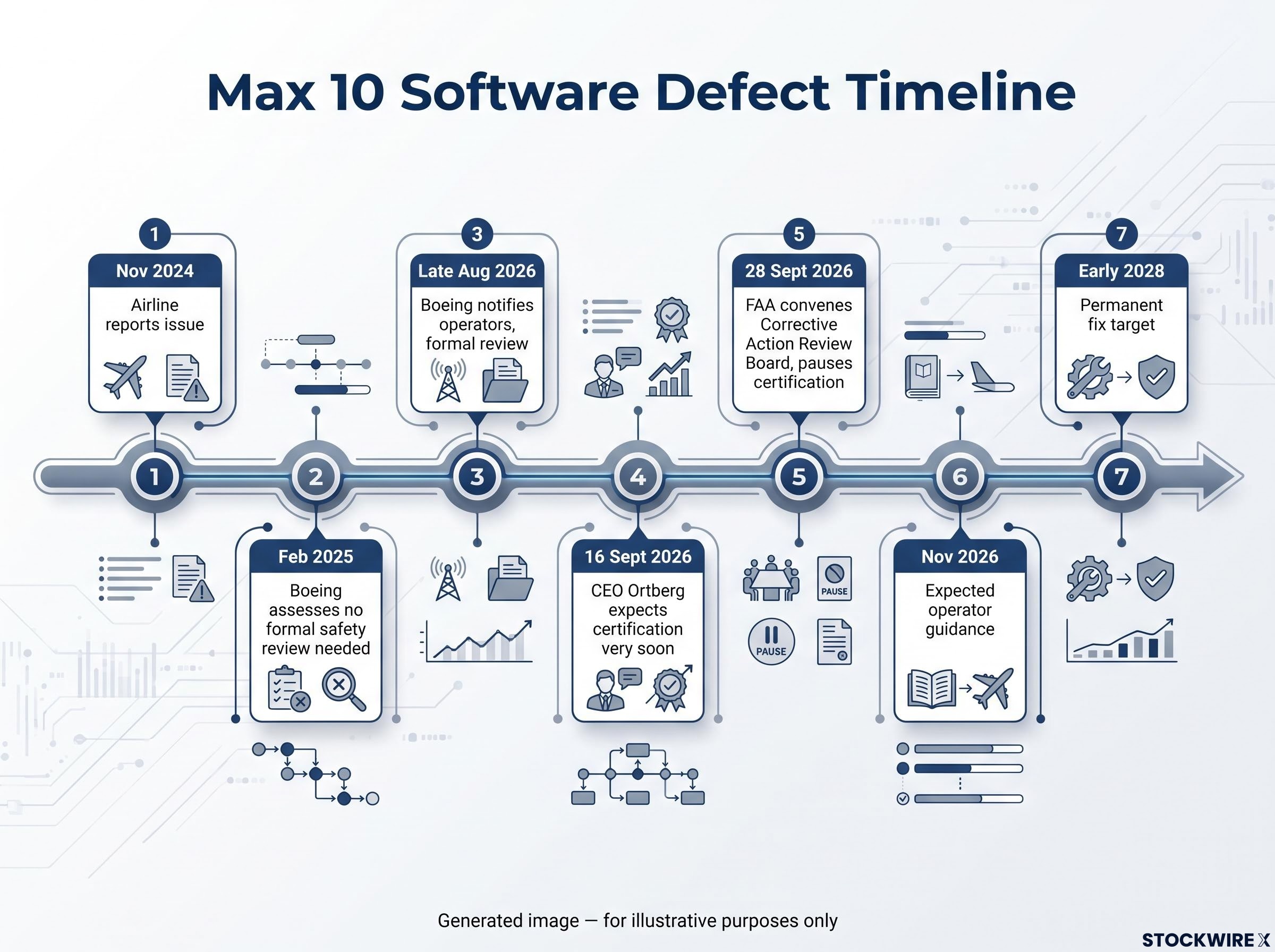
The escalation timeline is where the discomfort sits:
- November 2024: An airline reports the issue to Boeing on aircraft that had received recent cockpit software upgrades.
- February 2025: Boeing assesses the defect as not requiring a formal safety review.
- Late August 2026: Boeing notifies operators and opens a formal review after additional operator input.
- 28 September 2026: The FAA convenes a Corrective Action Review Board and pauses Max 10 certification.
- November 2026: Boeing expects to issue further operator guidance.
- Early 2028: Original target for a permanent software fix, now being accelerated under regulatory and customer pressure.
The FAA has kept its language measured but firm.
The agency stated it “will take immediate action if it identifies a safety concern.”
The two-year gap between Boeing first hearing about the defect and a formal board being convened is the detail worth sitting with. It tells you something uncomfortable about how Boeing’s internal safety judgment intersects with its regulatory credibility, and that distinction, contained bug versus recurring blind spot, is what determines how long this pause is likely to last.
When big ASX news breaks, our subscribers know first
What the FAA’s certification freeze actually means for deliveries
Not every 737 Max is affected the same way, and the difference is where the real financial picture lives. There are two populations of aircraft here, and only one of them is a near-term problem.
Planes already flying keep flying. US carriers can revert to earlier software versions or operate under procedural mitigations, so the in-service fleet is not grounded. The freeze applies to new Max 10 deliveries, which are formally on hold pending the review.
Before the pause, expectations were concrete. Alaska Air said on 24 September 2026 that it anticipated certification by the end of the month, with its first aircraft arriving in spring 2027. Ortberg had confirmed at the Morgan Stanley Laguna Conference on 16 September 2026 that all flight testing was complete and only three deliverables remained.
Here is how the pre-pause messaging compares with where each party now stands.
| Voice | Pre-Pause Statement | Date | Current Status |
|---|---|---|---|
| Boeing CEO Kelly Ortberg | Certification “very soon,” three deliverables remaining | 16 September 2026 | Now contingent on CARB outcome |
| Alaska Air | Certification by end of September, first delivery spring 2027 | 24 September 2026 | Timeline uncertain |
| FAA senior official | Expected to certify “soon” after intensive review | July 2026 | CARB process initiated |
The Max 10 accounts for roughly 30-31% of Boeing’s undelivered 737 orders, and both Southwest and United have said they will not accept new Max aircraft carrying the affected software. That combination is the point for investors: even a 60-90 day slip pushes meaningful cash flows out of the near term and onto a schedule that is no longer Boeing’s to set.
Could the Max 7 be caught in the same net?
The Max 7 was certified in August 2026 using the same software family that introduced this defect. That is the awkward part.
Depending on what the review board concludes, its findings could require software adjustments on already-certified Max 7 aircraft or affect near-term Max 7 deliveries. For now this is a watch item, not a confirmed problem, but it is the reason the delivery-schedule risk here is larger than a single-variant pause first suggests.
A 7% drop and a Dow drag: reading the market’s reaction
The market did not treat this as a footnote. Boeing shares fell nearly 7% on 28 September 2026, a per-share loss exceeding $12, closing at their weakest level of the year. Source figures for the intraday move ranged from 6.1% to nearly 7%, with the higher figure confirmed by the primary source.
Context sharpens the read. Boeing was already down roughly 15% year-to-date heading into the session, which tells you investors had been pricing in chronic execution risk long before this particular defect became public.
Boeing’s delivery recovery was already under scrutiny before this session: the Q2 2026 output of 171 aircraft, the strongest quarterly figure in roughly eight years, still fell 15% short of the 2018 benchmark, and analyst consensus required six to eight more quarters of evidence before production controls could be considered validated.
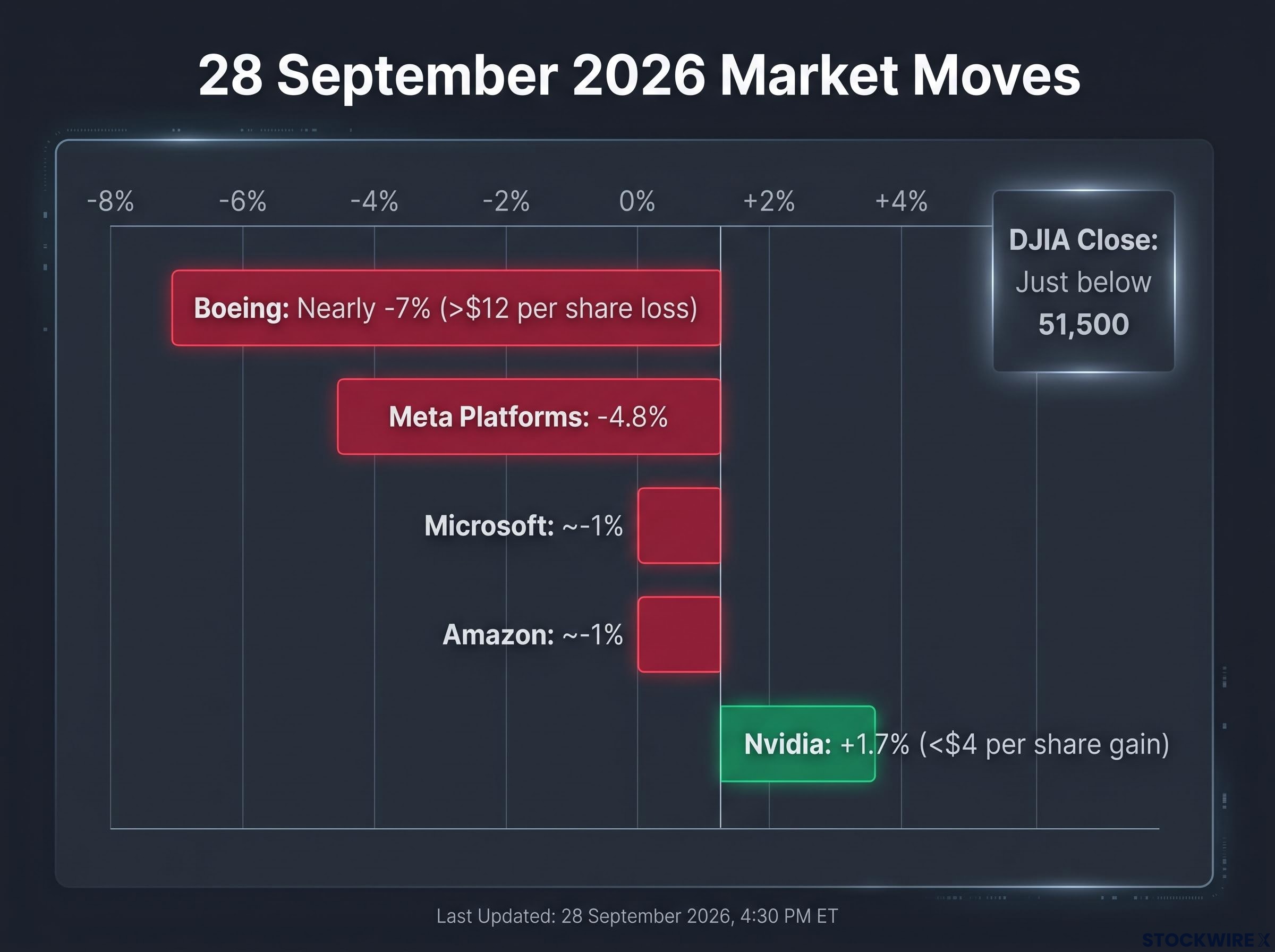
Then there is the odd way it hit the Dow. Because the Dow Jones Industrial Average (DJIA) assigns index weight according to each member’s share price rather than its overall market value, any given dollar move per share shifts the index by an identical number of points, no matter how large or small the underlying company is. On Monday, that mechanic worked squarely against Boeing.
- Boeing’s per-share loss exceeded $12.
- Nvidia rose 1.7%, a per-share gain of under $4, on a $150 billion buyback authorisation.
- In index-point terms, the drag from Boeing’s share-price fall was more than three times larger than the lift from Nvidia’s gain.
- The DJIA surrendered roughly two-thirds of the prior session’s gains, closing just below 51,500.
The scale of the contrast is worth pausing on.
Nvidia’s newly approved $150 billion buyback authorisation is roughly equivalent to Boeing’s entire market capitalisation at Monday’s closing price.
That is the counterintuitive lesson for anyone tracking the Dow: a single-stock software defect moved the index more than one of the largest buyback announcements in corporate history. Among the other Dow members, Microsoft and Amazon each edged lower by roughly 1%, keeping their contribution to the day’s losses modest. GE Aerospace, the FMC supplier whose software sits at the centre of the defect, has no presence in the index at all, nor does Meta Platforms, which dropped 4.8% on the session. So while the S&P 500 and Nasdaq took heavier hits from concentrated AI-sector selling, the Dow’s story on Monday was Boeing, and the price-weighting quirk is why institutional investors benchmarked to it felt this more sharply than the broad market decline would suggest.
What analysts say, and where the real risk sits for investors
The bull and bear cases here do not resolve cleanly, and it is more honest to lay them side by side than to force a verdict.
Bull case
Bank of America maintained a buy stance, framing the pause as a near-term timing issue rather than a structural threat. The bank pointed to Boeing’s large commercial backlog and to Ortberg’s own messaging: completed flight testing and only three deliverables remaining, which suggests the airframe has substantially cleared its regulatory hurdles.
The base case across most analyst commentary is delay, not programme cancellation. That is the anchor for anyone holding the stock through this.
Boeing’s cash flow position complicates the bull case further: full-year free cash flow was -$1.9 billion in FY 2025 even after stripping out a $9.6 billion one-time divestiture gain, and Q1 2026 reversed to -$1.5 billion, meaning any delay to Max 10 deliveries lands on a balance sheet with limited buffer to absorb slippage.
Bear case
The bears point to the pattern. The roughly 15% year-to-date decline before this session tells you the market was already discounting Boeing for serial operational setbacks, not pricing a clean recovery. The Air Current has emphasised that the review is landing after years of delays and intensive scrutiny, evidence of a still-strained FAA relationship with little tolerance for further software surprises.
Boeing’s intrinsic value was already a contested figure before this pause: a conservative DCF framework placed fair value in the low-to-mid $200s per share, with a genuinely compelling entry only below $150, leaving the stock little margin of safety against an event that pushes meaningful cash flows further out.
Regulatory posture reinforces the point.
A US Department of Transportation Inspector General report warned that extended timelines for safety-critical software updates could pose public-safety risks.
That warning matters because it suggests regulators may insist on conservative schedules rather than the compressed one Boeing wants.
The structural risk both camps must price
Here is where the two views converge. The permanent software fix is not expected until early 2028, even with acceleration underway. Both camps agree the immediate risk is delayed Max 10 cash flows and incremental engineering costs; where they part is whether Boeing’s backlog and management credibility can absorb another unexpected delay.
The fix timeline is the detail that separates this from a simple near-term delay story. Even if Boeing and the FAA agree interim mitigations quickly, you are holding a stock where the underlying software risk is not fully resolved for at least 12-18 months, and that is the starting point for any informed call on it right now.
What changes if the CARB finds a safety-of-flight issue, and what does not
The forward picture is contingent, so the honest framing is a fork rather than a forecast.
Down one path, the review board concludes the defect is not a safety-of-flight issue. Boeing and GE Aerospace pursue interim mitigations while building the permanent fix, and Max 10 certification could resume on a compressed timeline. Down the other, the board finds a genuine safety issue, certification is paused indefinitely, and the odds of cross-programme effects on the Max 7 rise.
Some variables do not shift regardless of which path the review takes:
- The permanent fix remains targeted for early 2028, now being accelerated.
- The in-service fleet keeps operating under software rollback or procedural mitigations.
- The FAA relationship stays the gating constraint on any delivery recovery.
For investors, the useful move is to watch the right signals rather than react to daily price swings driven by speculation about a process with no public deadline.
- The review board’s findings and timeline. No firm public date has been given as of 28 September 2026.
- Boeing’s November 2026 operator guidance. This is the first tangible read on the interim mitigation path.
- Southwest and United delivery acceptance. Both currently decline new Max aircraft with the affected software; any revision signals confidence returning.
In the related Leap-1B engine software context, GE Aerospace’s VP of product safety confirmed that a software update is undergoing certification with the FAA, Boeing, and EASA, and is expected to enter service within the year. Alaska Air’s first Max 10 delivery, once planned for spring 2027, is now uncertain.
The review board’s conclusion is the single variable Boeing cannot control and investors cannot forecast. The clear-eyed position is to size Boeing exposure to that uncertainty rather than assume the optimistic timeline holds.
This article is for informational purposes only and should not be considered financial advice. Investors should conduct their own research and consult with financial professionals before making investment decisions. Financial projections are subject to market conditions and various risk factors, and forward-looking statements are speculative and subject to change based on market and company developments.
Boeing’s certification credibility is the longer story behind the software defect
Step back from the mechanics and a pattern comes into focus. The Max family has now accumulated several software-linked episodes across its certification history, from the MCAS-related grounding of March 2019 to November 2020, nearly two years, to this FMC defect surfacing in the final weeks before Max 10 approval. Each episode has stretched Boeing’s recovery timeline and forced another round of regulatory relationship repair.
What has genuinely changed as of 28 September 2026 is narrower than the headlines imply. Max 10 certification is not cancelled; it is subject to a formal safety review with no public deadline. Near-term cash flow from Max 10 deliveries is delayed by an indeterminate period. And the stock has hit its lowest close of the year, on top of a roughly 15% year-to-date decline.
The Max 10 still represents around 30-31% of undelivered 737 orders. The backlog is real, narrow-body demand is real, and GE Aerospace is collaborating on a fix.
The investor tension sits between two arguments: the backlog says the value is intact and the delay is temporary; the pattern of late-cycle software surprises says the discount is warranted until Boeing proves it can deliver cleanly certified aircraft.
The most important question is not whether this specific defect is fixable, because it likely is. It is whether Boeing has closed the internal process gap that let a known software issue sit for more than a year without a formal review before regulators stepped in.
That gap, not the software itself, is what determines whether the stock recovers when Max 10 approval finally arrives or keeps trading at a discount to its backlog value.
—