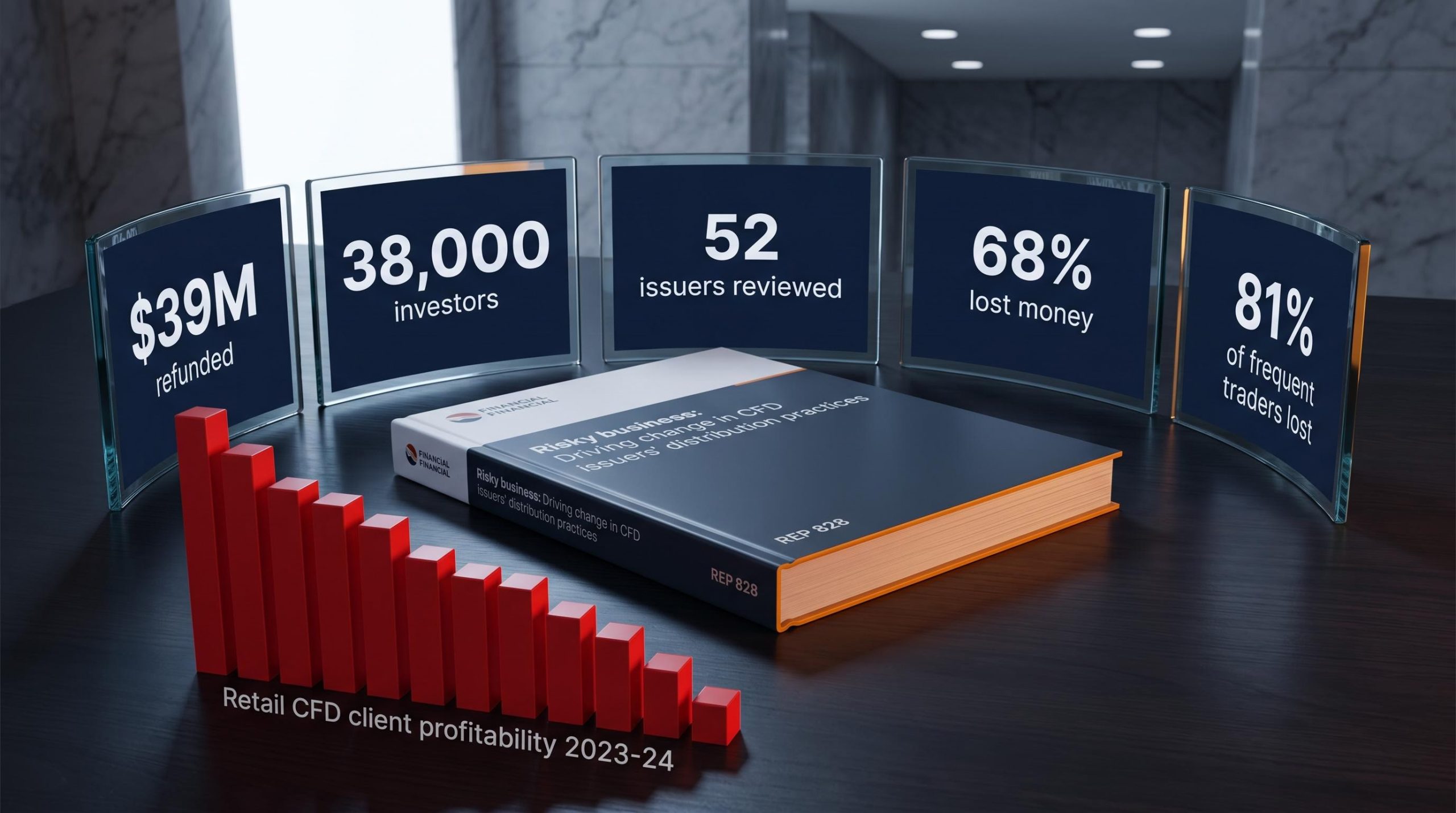
A refund pool exceeding $39 million was distributed across more than 38,000 retail investors as ASIC’s sector-wide review swept through all 52 licensed CFD issuers. That is not an enforcement action against a rogue operator. It is a whole-of-sector indictment, and ASIC delivered it in a single report.
ASIC released REP 828, titled Risky business: Driving change in CFD issuers’ distribution practices, on 20 January 2026 following a 14-month sector-wide review. The findings go beyond historical cleanup. They reveal that contract-for-difference (CFD) distribution in Australia was structurally failing retail clients at the product design, onboarding, and monitoring levels simultaneously, and that a consultation on the future of the Product Intervention Order (PIO) is already underway in 2026.
Here is what the review actually found, why the margin discount issue drove the majority of refunds, and what the new compliance standard means for anyone who trades, or is considering trading, leveraged products in Australia.
A 14-month review that found systemic failure, not isolated misconduct
Between October 2024 and December 2025, ASIC assessed every one of Australia’s 52 licensed CFD issuers. This was not a targeted probe triggered by a whistleblower or a single firm’s collapse. It was a deliberate, whole-of-sector test of whether compliance with the Design and Distribution Obligations (DDO), the framework requiring issuers to define who a product is suitable for and distribute accordingly, and the PIO had actually taken hold since both came into force in 2021.
The answer was clear: almost every issuer required remediation in at least one area. The headline figure tells you the scale.
Across the review, refunds totalling over A$39 million were returned to more than 38,000 retail investors who had been affected by non-compliant practices.
- Report: REP 828, released 20 January 2026 (ASIC media release 26-004MR)
- Review period: October 2024 to December 2025
- Issuers reviewed: 52 licensed CFD issuers
- Total refunds: Nearly A$40 million
- Investors refunded: More than 38,000
- Status: CFDs listed as a 2025-26 supervisory priority for market intermediaries
The fact that remediation was required across virtually the entire sector tells you these were not outlier failures. Any retail investor who held CFDs during this period had material exposure to practices that ASIC has now confirmed were harmful.
When big ASX news breaks, our subscribers know first
Why CFDs attract regulatory scrutiny: the loss data behind the rules
CFDs are complex, leveraged, over-the-counter (OTC) derivatives. As instruments, they let retail clients take positions on the price movements of shares, currencies, and commodities without taking ownership of those assets. The leverage means a small move in the underlying price can produce a large percentage gain or loss on your position. Financing costs and fees can erode or eliminate profits even on trades that are directionally correct.
That structure alone creates elevated risk. The profitability data confirms it.
Financial leverage for Australian investors spans a range of instruments beyond CFDs, from margin lending on ASX equities to exchange-traded options and MINI Warrants, each carrying cost structures and stop-loss mechanisms that produce different loss profiles but share the same amplification dynamic that drove the sector-wide retail losses ASIC documented in REP 828.
What the profitability numbers actually show
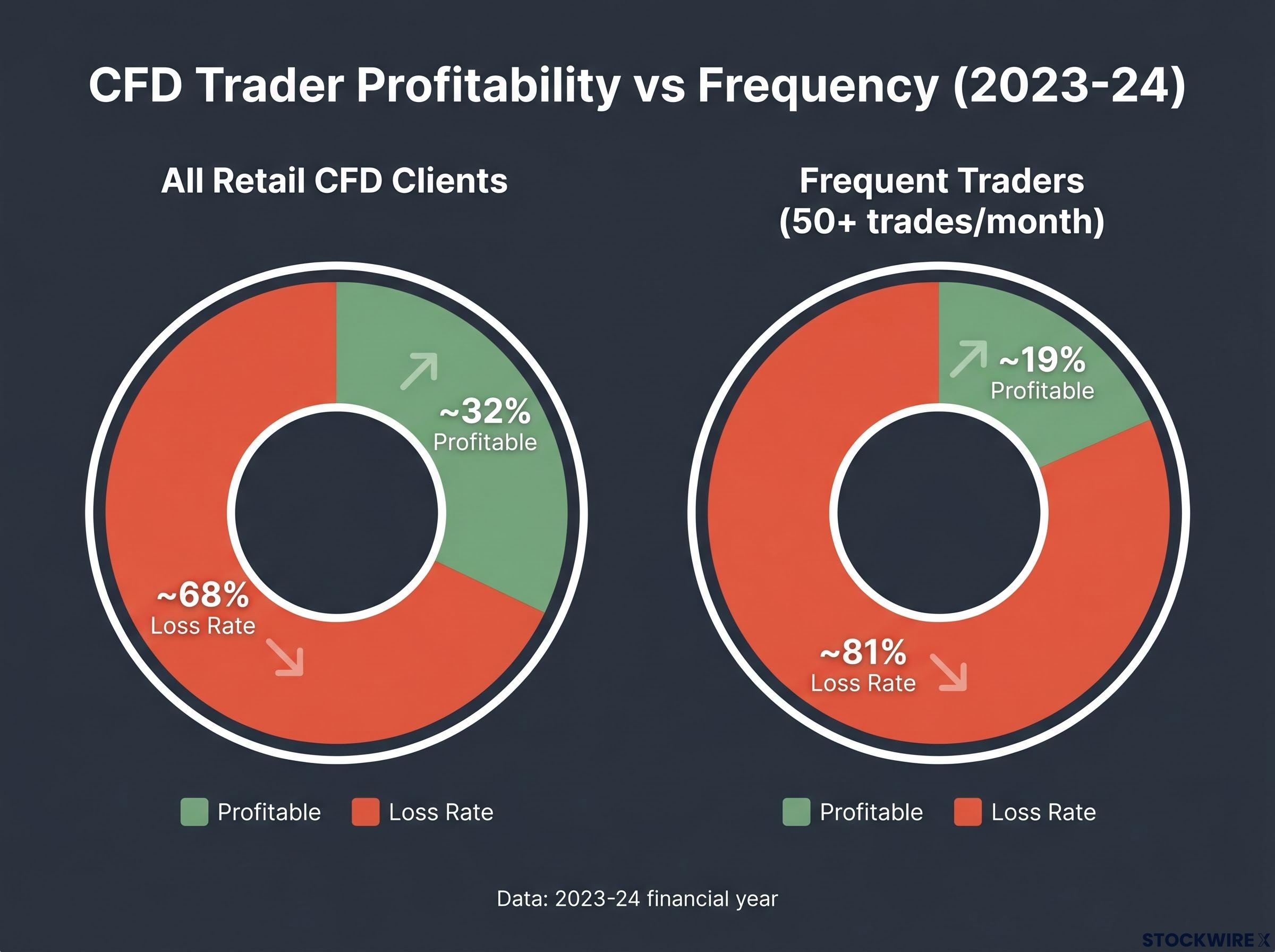
In the 2023-24 financial year, approximately 68% of retail CFD clients lost money, with aggregate net losses of approximately A$458 million, including A$73 million in fees. Only 32% of retail clients were profitable after fees.
The counterintuitive finding sits with the most active traders. Among frequent traders, those placing 50 or more trades per month, profitability fell to approximately 19%. Roughly four in five of the most engaged retail CFD traders were losing money.
| Investor Cohort | Profitable Clients (%) | Loss Rate (%) |
|---|---|---|
| All retail CFD clients (2023-24) | ~32% | ~68% |
| All retail clients after fees | ~32% | ~68% |
| Frequent traders (50+ trades/month) | ~19% | ~81% |
That frequency-profitability inversion matters. Increased engagement with CFDs does not improve outcomes the way it might with other investment products. It is precisely this dynamic that makes regulatory gatekeeping at the onboarding stage so consequential: if the product’s economics work against most participants regardless of activity, then who gets in the door is the variable regulators can actually influence.
Four compliance failures ASIC found across the sector
REP 828 identifies widespread weaknesses in four areas, and the failures reinforce each other. A too-broad target market makes onboarding screening weaker. Weak onboarding feeds a client base whose outcomes are never monitored. And corrupted transaction data means ASIC’s own surveillance cannot catch the patterns that would trigger intervention.
| Compliance Area | Core Deficiency Found | Issuers That Made Changes |
|---|---|---|
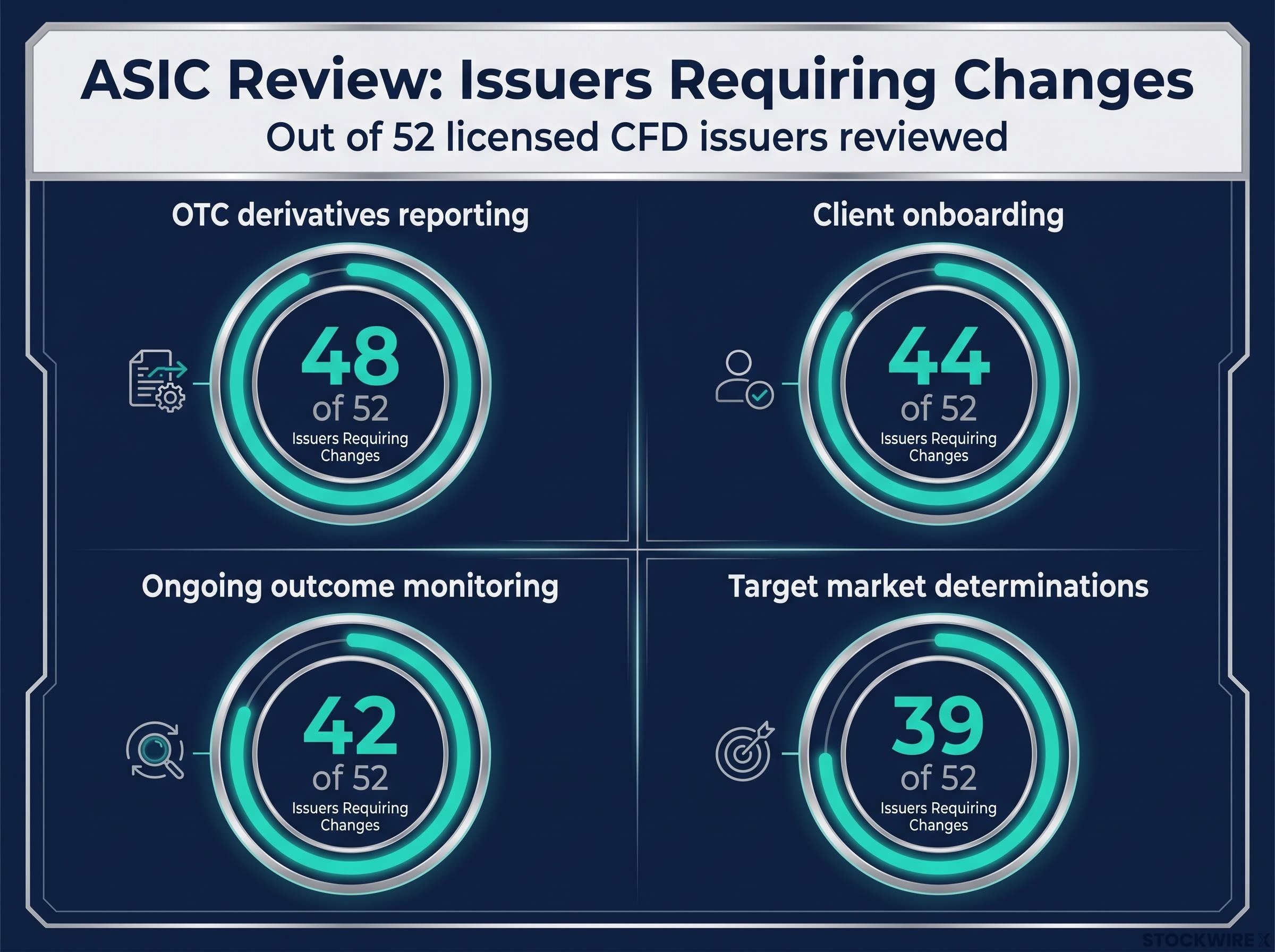
| Target market determinations | Markets defined too broadly; omitted criteria on financial objectives, circumstances, or trading experience | 39 of 52 |
| Client onboarding | Knowledge questionnaires did not reliably test understanding of leverage, margin calls, and loss scenarios | 44 of 52 |
| OTC derivatives reporting | Over 70 million erroneous reports, including missing fields and incorrect counterparty data | 48 of 52 |
| Ongoing outcome monitoring | Most issuers did little to no tracking of persistent loss patterns or consumer harm indicators | 42 of 52 |
DDO commenced in October 2021. Five years later, 39 issuers still needed to tighten their target market determinations. 44 had to improve their onboarding questionnaires. The gap between the regulation’s intent and its implementation was sector-wide.
Retail client misclassification, where issuers incorrectly designate retail investors as wholesale clients to remove DDO and PIO protections, represents a parallel enforcement track to the distribution failures REP 828 identified: the Federal Court’s $10 million penalty against Binance Australia Derivatives in March 2026 confirmed that classification errors carry the same enforcement weight as onboarding and target market failures.
Why transaction reporting failures matter beyond paperwork
The 70 million erroneous OTC derivatives reports are not an administrative footnote. ASIC uses this data as a frontline surveillance tool to detect risk concentrations and misconduct patterns across the sector. Corrupted data limits that capability directly.
Following the review, 48 issuers implemented changes to their reporting processes and systems. Reportable situations lodged by issuers rose 127% year-on-year. That increase signals something more durable than a process fix: it suggests the review shifted issuer willingness to surface problems, not just their systems for catching them.
The margin discount practice that drove most of the $40 million in refunds
The single practice that caused the most financial harm was also the most structurally revealing. Here is how it worked:
- A retail client holds opposing long and short CFD positions on the same underlying asset.
- The issuer offers a reduced margin requirement on the hedged position, making it appear risk-reducing.
- The client incurs higher funding costs on both legs of the position.
- Because the positions offset each other, the client cannot generate a profit from the hedged structure.
- The issuer earns fees and financing charges throughout.
The result: a product feature marketed as a benefit was systematically extracting costs from clients who had no path to profitability on those positions. More than half the sector, over 26 of 52 issuers, contravened the PIO through this practice. ASIC classified it as a breach, not merely a poor practice.
28 issuers refunded over $36 million specifically related to margin discount practices, representing the majority of the total nearly $40 million refunded across the review.
The margin discount finding illustrates why ASIC moved to outcome-based supervision. A practice can involve no explicit deception, appear risk-reducing on its face, and still systematically disadvantage retail clients at scale. Disclosure alone would never surface this kind of structural harm. Outcome data did.
This article is for informational purposes only and should not be considered financial advice. Investors should conduct their own research and consult with financial professionals before making investment decisions. CFDs and other leveraged derivatives are complex instruments that carry a high risk of rapid loss.
What the new compliance floor means for issuers and retail investors
ASIC has signalled four post-review compliance expectations that collectively reset the operating environment for CFD distribution:
- Tighter target market determinations: TMDs must be specific, conservative, regularly reviewed, and genuinely reflect who can bear CFD risks.
- Onboarding as a genuine gatekeeper: Knowledge tests must be robust enough that unsuitable clients are actually declined, not waved through.
- Accurate and timely OTC derivatives reporting: Data quality is now a core compliance obligation, with governance including controls, reconciliations, and board-level oversight.
- Ongoing monitoring of client outcomes: Issuers are expected to track loss rates, fee erosion, and persistent loss cohorts, and to use this data to revise distribution practices.
The PIO is due to expire on 23 May 2027. ASIC’s consultation on its future, planned for 2026, is ongoing as of mid-2026. Given the findings in REP 828, ASIC has left the door open to remaking or tightening conditions.
For you as a retail investor, the practical takeaway is that these improvements raise the floor on product design and distribution, but they do not alter the fundamental loss statistics. 68% of retail clients still lost money in 2023-24, and that number reflects the product’s structure, not just its distribution.
What the CFD sector review signals for other high-risk trading products
REP 828 explicitly frames its findings as relevant beyond CFDs. The regulatory logic ASIC demonstrated, DDO with genuine enforcement, outcome-based monitoring, and onboarding that functions as a real gatekeeper, applies to any complex, leveraged retail product.
The product categories facing analogous scrutiny include:
- Retail OTC derivatives (including FX): Similar leverage structures, similar retail loss profiles, and the same DDO obligations.
- Highly leveraged crypto derivatives: Increasingly offered to retail clients, often with marketing that emphasises the underlying asset rather than the derivative structure and its risks.
- Certain structured products: Where fee structures and payoff profiles may be opaque to the target audience.
Outcome-based supervision as the new regulatory standard
ASIC’s stated position in REP 828 is that products must be assessed on actual consumer outcomes, not compliance paperwork. Marketing scrutiny is increasing, particularly where product benefits are emphasised over risks, or where the underlying asset is promoted more prominently than the derivative itself.
The B-book dealing model, in which the issuer takes the opposite side of every retail trade and profits directly from client losses, represents the most extreme version of the structural misalignment REP 828 identified across the sector; the Federal Court’s record $300.2 million penalty against Union Standard International Group and its authorised representatives confirmed that a business model built on retail losses is not merely harmful practice but legally actionable misconduct.
The review’s scope, 52 issuers over 14 months, demonstrates ASIC’s capacity and willingness to run whole-of-sector assessments. For anyone invested in or distributing complex leveraged products beyond CFDs, outcome data (who is consistently losing, at what rate, and whether the issuer is responding) is now an enforceable compliance obligation, not an optional governance enhancement.
For investors exploring how DDO and wholesale client classification rules apply to leveraged crypto products, our full explainer on crypto derivatives regulation in Australia covers the Binance and Kraken enforcement outcomes and the 2026 Digital Assets Framework Act, showing how the same regulatory logic ASIC applied to CFDs is being extended across the broader derivatives sector.
What the review changes for retail investors, and what it does not
The review produced concrete results. Refunds totalling close to $40 million reached more than 38,000 real people. Compliance standards across all four failure areas have been raised. The regulatory floor is measurably higher than it was before October 2024.
What changed:
- Remediation payments to tens of thousands of affected investors
- Tighter target market definitions across 39 issuers
- Upgraded onboarding at 44 issuers
- Monitoring frameworks introduced or materially improved at 42 issuers
What did not change:
- 68% of retail CFD clients lost money in 2023-24
- Aggregate net retail losses reached approximately A$458 million, including A$73 million in fees
- Among the most active traders (50+ trades per month), approximately 81% lost money
- Leverage, fees, and complexity remain structural headwinds to long-term profitability
The 2023-24 loss data was gathered during a period when the PIO was already in force. That tells you regulatory protections constrain how harmful distribution can be, but they cannot fundamentally alter the economics of a leveraged derivative product for most retail participants. The PIO consultation is ongoing in 2026, and ASIC has left the door open to tightening conditions further. Regulation is a backstop against harmful product features and distribution, not a guarantee against loss. The distinction matters.
Past performance does not guarantee future results. These statements are based on regulatory findings and historical data, and are subject to change based on market developments and regulatory outcomes.