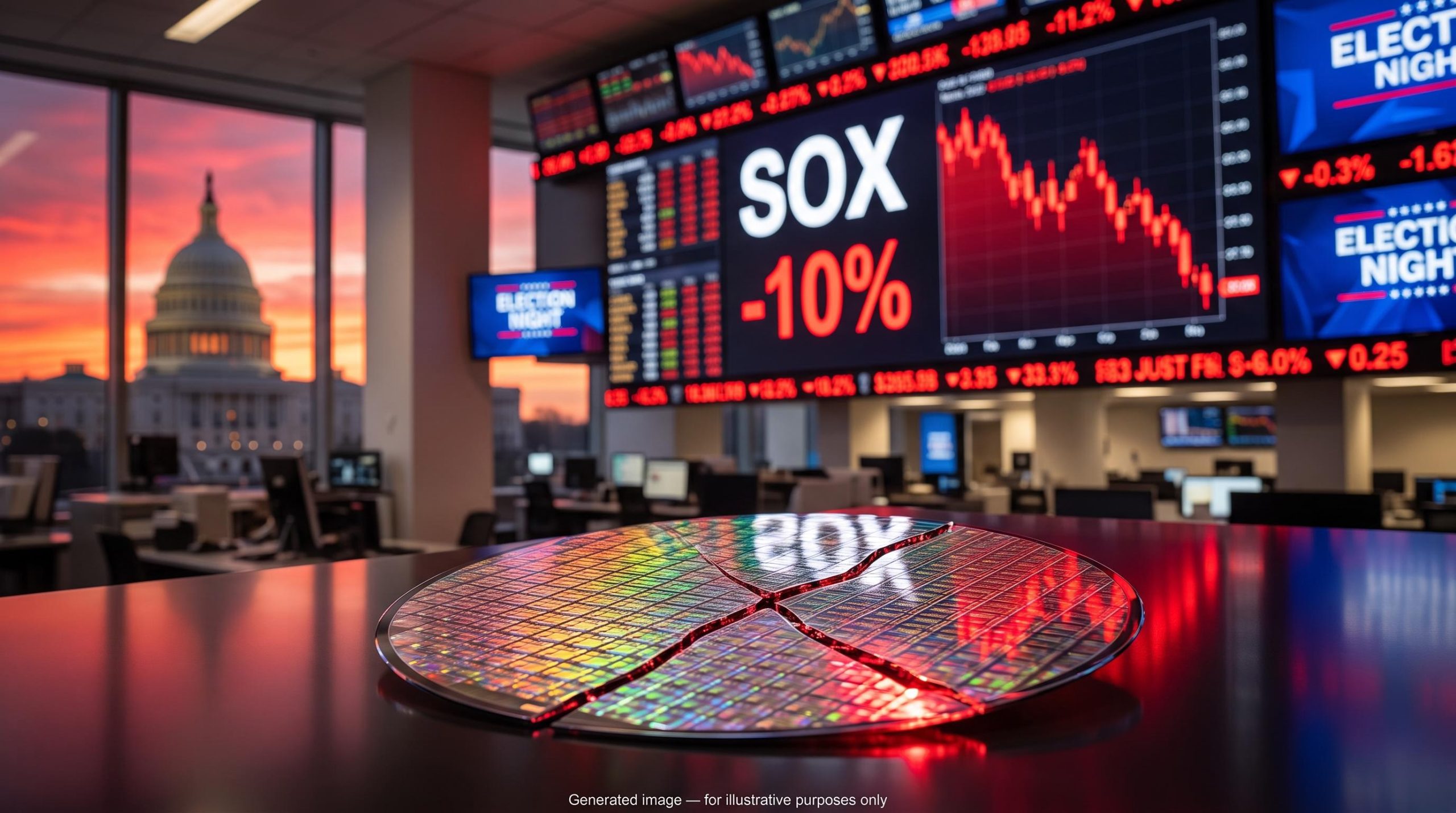
A political result, not a profit warning, wiped about US$1.9 trillion off the Nasdaq 100 on Thursday, 5 November 2026. The Nasdaq Composite fell 5.52% and entered correction territory, while the Philadelphia Semiconductor Index (SOX) closed down about 10%, its worst session since March 2020. The AI chip selloff was triggered by the ballot box.
The Democratic midterm sweep put the AI buildout under political scrutiny just as hedge funds were carrying heavy leverage. The S&P 500 and Dow both posted their worst sessions since April 2025.
This report covers what drove the selling, which companies took the largest hits and why, and what the move does and does not say about demand for AI.
How bad was Wall Street’s worst session since April 2025?
Every major benchmark closed sharply lower. Some figures in circulation were intraday readings, so the table below uses closing data where it is available.
| Index or measure | Close | Move |
|---|---|---|
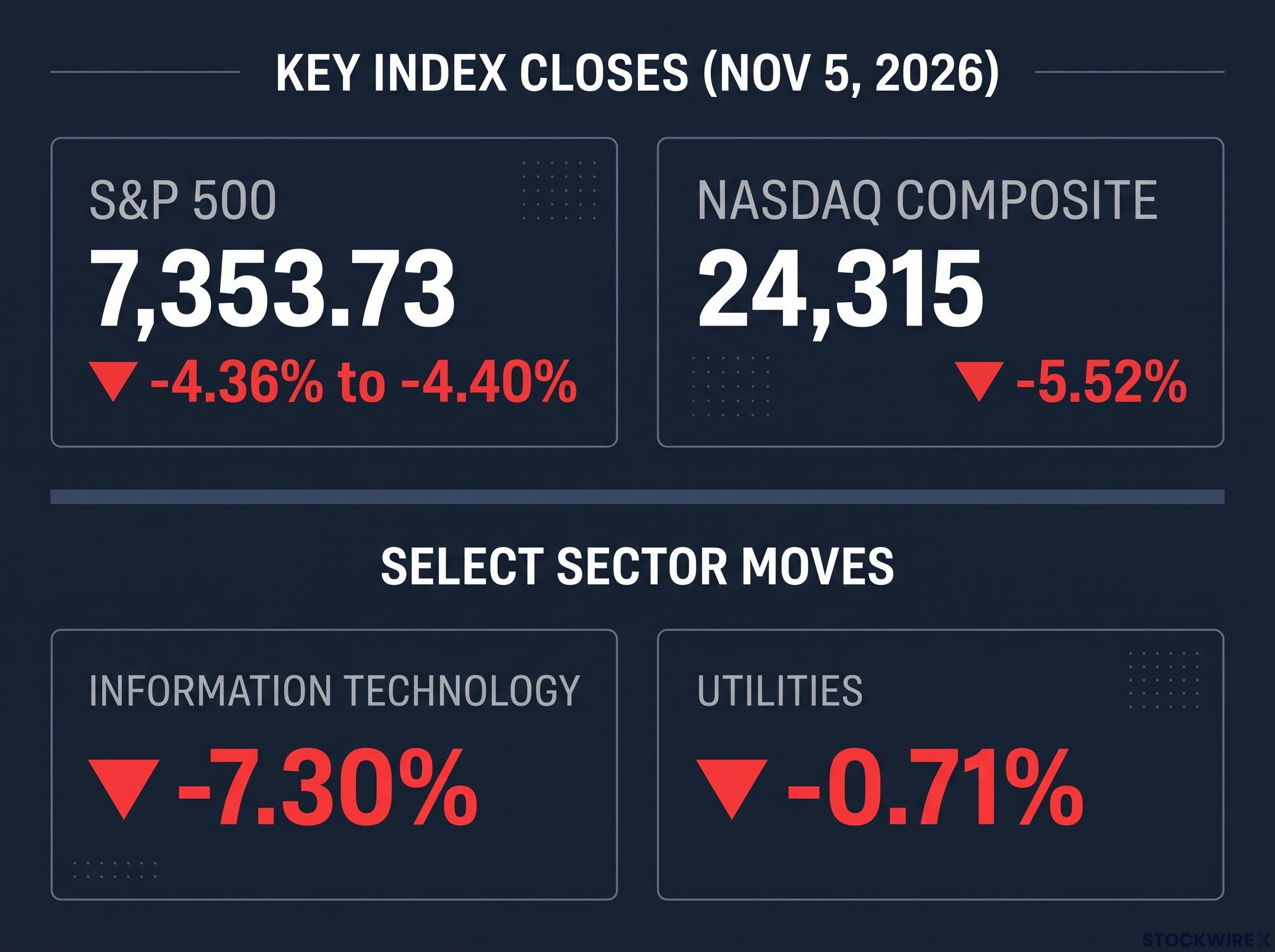
| S&P 500 | 7,353.73 | -4.36% to -4.4% |
| Dow Jones Industrial Average | 51,523.06 | -3.44% |
| Nasdaq Composite | 24,315 | -5.52% |
| Russell 2000 | 2,732 | -4.39% |
| Cboe Volatility Index (VIX) | 28.09 | Up 11.5 points |
The VIX tracks expected swings in the S&P 500 and is often called Wall Street’s fear gauge. An earlier report had it up 61.5% to 26.93. Both versions agree it was the largest jump since roughly April 2025.
All 11 S&P 500 sectors finished lower, and the gap between the weakest and strongest was wide:
- Information technology: -7.30%
- Industrials: -4.12%
- Utilities: -0.71%
- Consumer staples: -0.67%
A semiconductor exchange-traded fund fell 12.15%. The SOX swung between -7.1% and -11% during the session and was on course for a fifth straight weekly decline.
A record for the history books The Dow was heading for its worst second session after a midterm election in records going back to 1896, according to Yahoo Finance.
The losses were concentrated in technology, which points to a targeted repricing of AI exposure. If your portfolio leans towards chips or mega-cap tech, your losses were likely much larger than the headline S&P 500 figure suggests.
When big ASX news breaks, our subscribers know first
Why did a midterm sweep hit AI and chip stocks so hard?
AI demand depends on physical infrastructure: data centres, power plants, grid connections, cooling systems and chips. Local and state politics can slow every one of those.
The political risk
Candidates opposed to rapid data-centre expansion won important races in Texas and Georgia, two major data-centre markets. Voters also approved dozens of ballot initiatives that could restrict construction in the coming months and years. The concerns include tougher permitting, rules making operators pay more of their power and grid costs, and construction delays. A Senate proposal to push more power costs onto data centres was one reported example.
Polling shows opposition to a new data centre near home running between 63% and 72%, and the data centre backlash has already coincided with cancelled projects worth at least US$260 billion in 2026.
Melissa Brown, global head of investment decision research at SimCorp, said some newly elected officials want to slow AI infrastructure. She saw a complete halt as unlikely, but noted that even a slowdown matters when the growth story depends on building fast. Goldman Sachs said the size of the Democratic result has significant consequences for how AI and data-centre projects will be regulated.
The pressure then fed on itself:
- Hyperscalers borrow heavily to fund their buildouts.
- Heavy issuance can push tech debt yields higher.
- Higher yields raise financing costs and lower growth stock valuations.
- Political scrutiny may delay or shrink projects.
- Chip suppliers lose value as expected orders fall.
- Falling chip stocks inflict losses on leveraged funds.
- Those funds sell other tech holdings to cut exposure.
The leverage accelerant
Positioning made the fall faster than politics alone would have. Reuters described the trading this way:
“very aggressive institutional selling and de-leveraging by hedge funds”
Goldman’s trading desk said the prior day’s rebound had been fully erased. Its prime brokerage data put clients’ gross exposure, meaning the combined size of their long and short bets, at the 97th percentile over five years.
That matters for how you read the drop. The selling reflected a fight over how fast the buildout happens and how it gets paid for, not evidence that AI demand has collapsed.
Which stocks took the biggest hits, and what did Qualcomm and Arm add?
The losses spread well beyond a few names. SK Hynix and Samsung also fell in Asia.
| Company | Reported move |
|---|---|
| Nvidia | -6% to -9% (about US$450B erased) |
| AMD | -13% to -15% |
| Micron | -12% to -15% |
| Marvell | -10% to -15% |
| Arm | about -11% |
| Qualcomm | -9% to -11% |
| Tesla | -9.5% to -11% |
| Broadcom | -7% to -9.4% |
| SpaceX | -6.7% to -9% |
Nvidia was the single largest drag on the S&P 500, closing down about 9%.
Qualcomm and Arm: earnings into the selloff
Qualcomm reported fiscal Q4 adjusted revenue of about $10.32-$10.4 billion and adjusted earnings per share (EPS) of $2.17. Its chip division brought in about $9 billion and licensing about $1.3 billion, but handset chip revenue came in under forecasts as demand softened and income linked to Apple shrank. Guidance of $10.4-$11.2 billion in revenue and EPS of $2.15-$2.35 for fiscal Q1 was seen as weak.
Arm beat expectations. Revenue rose 27% to about $1.44 billion, licensing jumped 50% to $773 million, royalties rose 8% to $670 million and data-centre royalties reportedly doubled. Its fiscal Q3 guidance of about $1.54 billion, plus or minus $50 million, was only in line with estimates.
Arm’s strong quarter was sold anyway. On a day like this, valuation and outlook outweighed a beat.
Tesla and SpaceX: Texas exposure
Tesla and SpaceX together lost about US$130 billion. Stronger Democratic results in Texas heightened the political and regulatory threat facing Elon Musk’s companies, given how closely they are tied to the state.
Why did Apple’s bond sale draw so much demand?
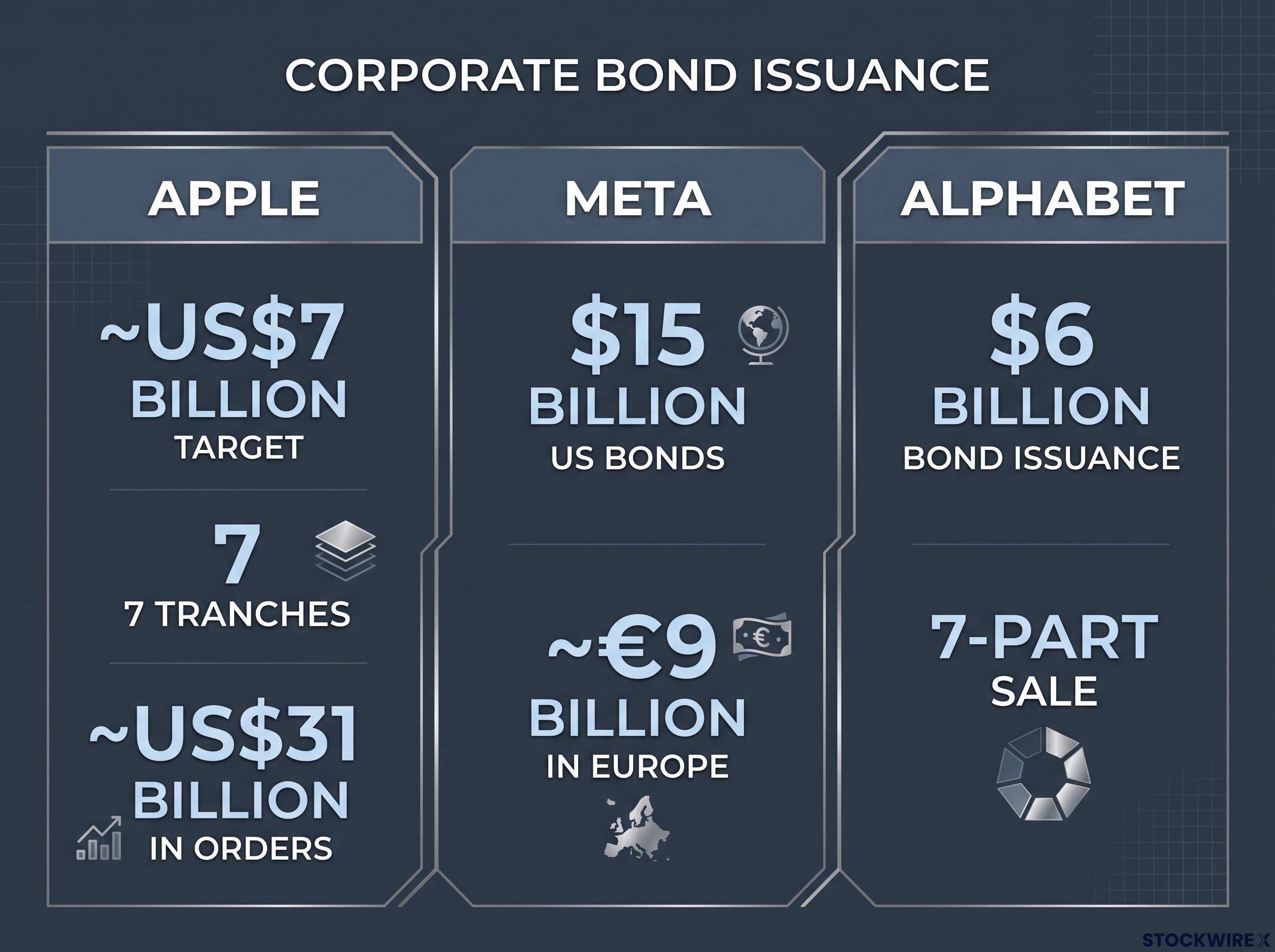
While AI-linked shares were falling, lenders still lined up to finance a cash-rich tech giant. Apple sold a seven-part high-grade bond and drew about US$31 billion in orders, roughly four times its target. The best-supported deal size is about US$7 billion, although an earlier report cited US$7.5 billion.
Investors reportedly saw the deal as relief from AI-related debt. Goldman Sachs, Bank of America Securities, Deutsche Bank Securities and JPMorgan ran the books.
The rest of the week’s issuance shows how much borrowing the AI buildout already involves:
- Apple: about US$7 billion, seven tranches, about US$31 billion in orders
- Alphabet: $6 billion, seven-part sale
- Meta: $15 billion in US bonds plus about €9 billion in Europe
Oracle also issued debt this week.
Capex intensity at the largest hyperscalers has reached about 34% of revenue, which turns the buildout into a bond market problem as well as an equity story.
The contrast suggests credit investors are separating heavy AI spenders from lower-risk borrowers. If you hold companies that rely on funding the buildout, watch the bond market as closely as the share price.
What the selloff changes for AI investors, and what to watch next
The evidence points to a shock driven mainly by positioning that exposed real risks in power, permitting and debt. It does not prove AI demand has vanished, and SimCorp’s Brown saw a full halt as unlikely.
The SOX had already fallen about 29% between 22 June and 29 July 2026 while industry revenue forecasts kept rising, a split Truist reads as a valuation correction in chip stocks rather than a fundamental peak.
Three variables matter from here:
- Permitting and ballot measures in Texas and Georgia
- Hyperscaler bond issuance and the yields lenders demand
- Hedge fund leverage, following Goldman’s 97th percentile reading
Some investors may see delays rather than cancellations as a buying opportunity, but that is an inference, not a reported forecast. No source has documented how markets recovered from April 2025 or earlier AI drawdowns. Check how much of your portfolio depends on each of these three variables before you draw conclusions from a single session.
This article is for informational purposes only and should not be considered financial advice. Investors should conduct their own research and consult with financial professionals before making investment decisions.