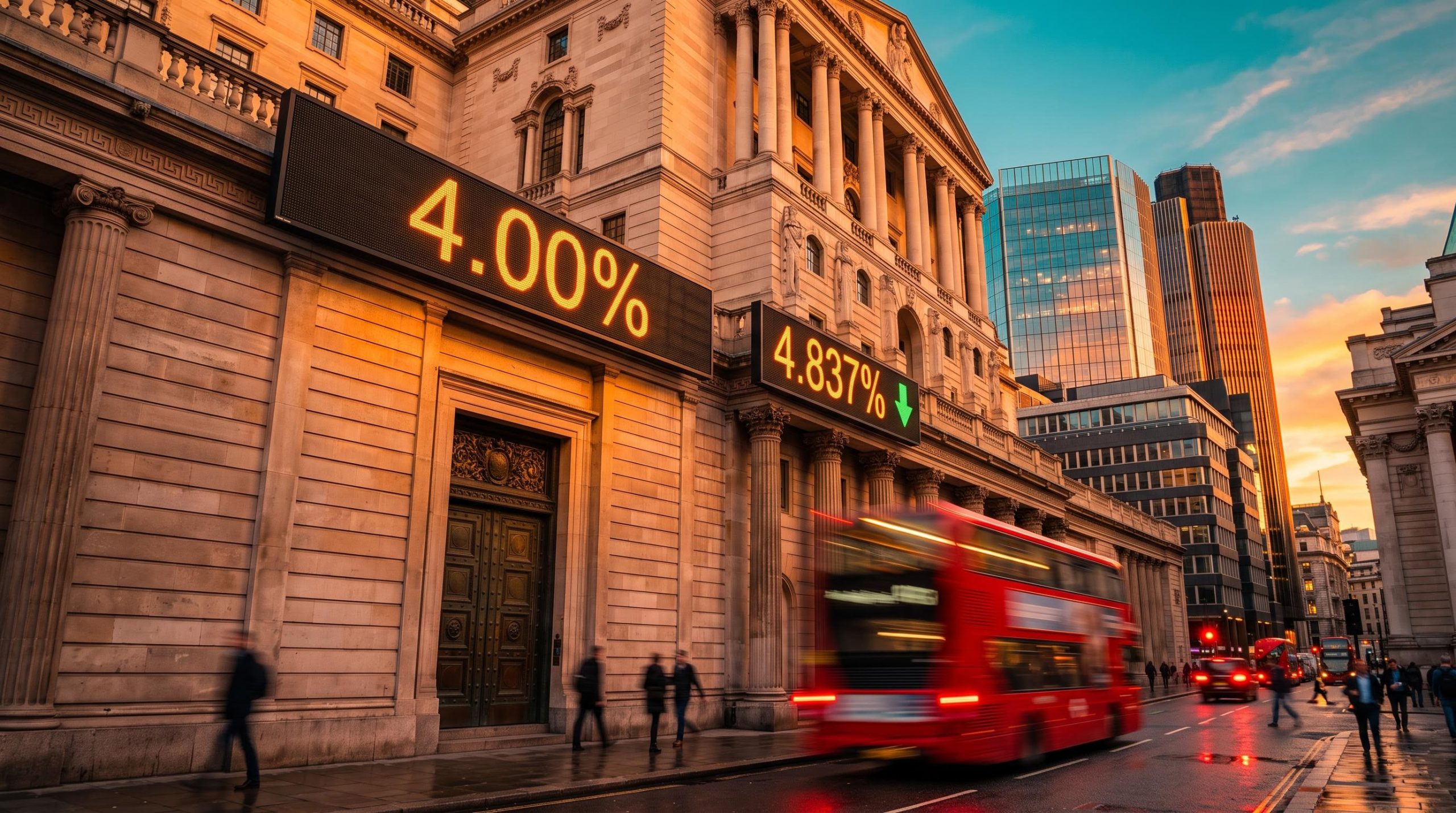
US 10-year Treasury yields fell to about 4.84% overnight, their lowest since early September, hours after the Bank of England (BoE) raised rates for the first time since August 2023. The move went against the signals from policymakers. Federal Reserve and European Central Bank (ECB) officials spent the same 48 hours leaning toward more tightening.
That split matters. An energy shock tied to the eight-month US-Iran conflict is forcing central banks to choose between defending their inflation-fighting credibility and protecting fragile growth.
The bond market appears to have weighed the same facts and reached a different conclusion from the policymakers.
This piece covers three things: what the Bank of England rate hike signals, why long-term yields moved the other way, and which indicators will decide whether the hawkish turn sticks. A hawkish central bank is one that leans toward higher interest rates to contain inflation.
Why did yields fall when the Bank of England and its peers turned hawkish?
Normally, tougher talk from central banks pushes bond yields up. A bond yield is the annual return an investor earns for holding the bond, and it rises when bond prices fall.
This time the long end of the curve did the opposite. On 5 November, the 10-year yield sat around 4.89%-4.93%, down from roughly 4.97%-4.98%. The overnight update showed 4.837%, with Treasury yields down as much as 9 basis points across maturities. A basis point is one hundredth of a percentage point.
| Market | 5 November | Overnight 5-6 November |
|---|---|---|
| Brent crude | US$97.10 (+2.6%, StoneX) | About US$98 (+4%) |
| WTI crude | About US$89.80 (+2%) | US$90.69 (+2.92%) |
| Gold | US$4,035-4,066/oz | US$4,090-4,120/oz |
| US 10-year yield | 4.89%-4.93% | 4.837% |
The two snapshots differ because of timing, and the overnight figures are the more recent. Three forces outweighed the hawkish message:
- Haven demand. Tanker attacks and a technology sell-off sent money into Treasuries and pushed gold above US$4,000/oz.
- Falling oil. Brent dropped 9% on Wednesday. Even after rebounding overnight, it was still down 11% on the week, which eased fears of stagflation (slow growth combined with high inflation).
- Fiscal restraint. Traders bet a Democratic Congress will rein in tax and spending plans and limit new Treasury supply.
Andrew Jackson of Vontobel said divided government could support Treasuries, but persistent deficits and heavy issuance would cap any fall in yields. Ed Yardeni warned that gridlock could turn into damaging paralysis over the debt ceiling. He also said 10-year yields near 5% offer an attractive real yield, the return left after inflation, while still expecting equities to outperform bonds over the long term.
If you hold long-dated bonds, this rally reflects demand for safety and hopes of fiscal discipline. It does not mean inflation risk has passed, so treat the gains as conditional.
What the Fed and ECB signalled
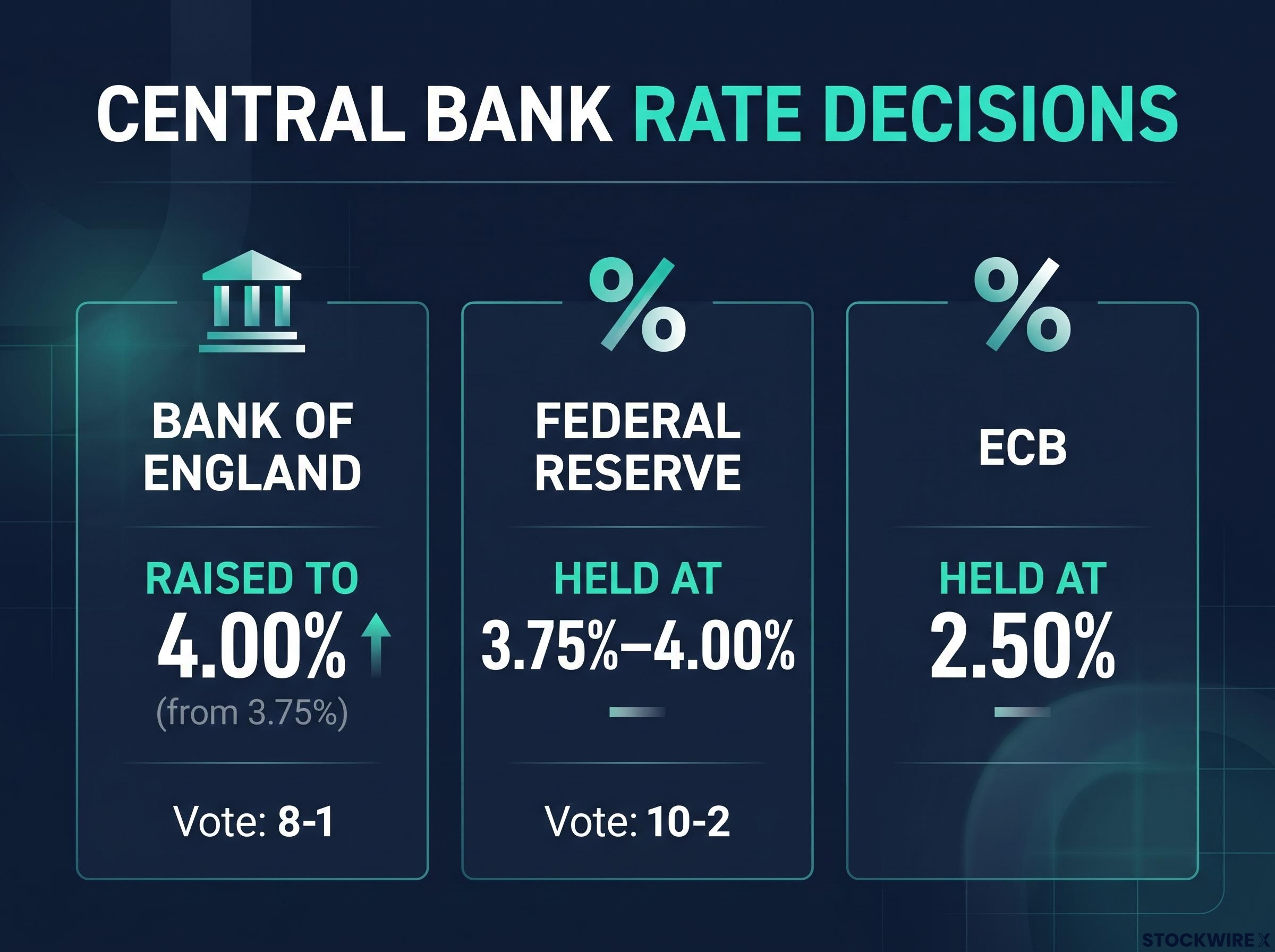
The Fed held its target range at 3.75%-4.00% in a 10-2 vote. Cleveland Fed President Beth Hammack and Governor Lisa Cook dissented in favour of a 25bp hike. Hammack and Richmond Fed President Thomas Barkin both backed a path of smaller, more gradual increases.
The Fed’s September hike, its first since 2023, rested on an inflation-first rate strategy that ranked price stability above employment risks, and Barkin described further tightening as uncertain, leaving the remaining 2026 meetings open.
The ECB held its deposit rate at 2.50%. President Christine Lagarde said incoming data will decide on a December move, and Bundesbank President Joachim Nagel is among the members who have publicly supported one. Market odds of a December Fed hike have varied by report, from about 70% to 83%.
When big ASX news breaks, our subscribers know first
Inside the Bank of England’s 25bp move to 4%
The BoE’s committee was close to unanimous. No member of the Monetary Policy Committee voted to hold rates. The meeting concluded on 4 November, and the decision was announced on 5 November.
- Bank Rate: raised from 3.75% to 4.00%
- Vote: 8-1 in favour of 25bp
- Dissent: Catherine Mann voted for 50bp, taking the rate to 4.25%
- Projections: UK CPI inflation of around 4.5% in Q1 2027 and about 5% in Q2 2027, driven largely by energy costs
The lone dissenter wanted a bigger move, not a smaller one.
Mann argued that a stronger response was needed to protect the Bank’s credibility and to head off second-round inflation risks. Her vote shows the committee is more worried about doing too little than about doing too much.
The Bank of England Monetary Policy Summary sets out the reasoning behind Mann’s preference for a larger move, framing the dissent as a judgement about second-round risks rather than disagreement over the direction of policy.
The BoE’s inflation path CPI of roughly 4.5% in Q1 2027, rising to about 5% in Q2 2027, according to the Bank’s projections.
The Bank kept the door open to further hikes if the conflict keeps energy prices high. Its next moves will depend on evidence that energy costs are feeding into wages, services inflation and wider price-setting. The pressure behind that warning is still building. According to UKMTO, 35 vessels were hit in October, the highest monthly total of the conflict, though that figure has not been independently confirmed. Iran’s Revolutionary Guard also reported tanker fires and a mine strike on 5 November.
For UK borrowers and gilt holders, a committee that agrees on direction and differs only on size means the question has shifted from whether rates rise to how fast.
Why hike into an energy-supply shock?
The answer depends on how far the oil shock spreads. Economists separate its effects into two stages.
First-round effects are the direct costs: dearer fuel, transport, electricity and business inputs. Second-round effects come later, when workers push for higher pay, firms raise prices across the board and people start to expect inflation to stay high.
Central banks have long relied on central bank inflation strategies built around benchmark rate changes, which work by suppressing demand, though the Volcker era showed how severe the economic trade-offs of aggressive tightening can become.
| Case for tightening | Case for looking through |
|---|---|
| Stop second-round effects before they set in | Rates cannot produce oil or reopen shipping lanes |
| Protect expectations through gradual hikes (Hammack) | Growth is weak and could be needlessly hurt |
| Avoid repeating the slow response of 2022 | Evidence of second-round effects is limited |
| Credibility is quickly lost and costly to rebuild (Mann) | The ECB’s 2011 hikes are widely seen as a mistake |
Both cases are backed by recent history. Reuters reporting has revisited criticism that central banks reacted too slowly after Russia invaded Ukraine in 2022, and separately cited weak growth and the 2011 ECB experience as reasons for caution. UBS economists argued that the 2022 playbook should not be applied mechanically, because central banks may diverge further this time.
The US labour market gives hawks extra cover. Initial jobless claims fell to 189,000 in the week to 31 October, below the 196,000 expected, and the four-week average of about 194,750 was reportedly the lowest since 1969.
The dividing line: persistence A short-lived oil spike argues for patience. A prolonged one that reaches wages, services and expectations argues for acting early.
If the shock fades quickly, the hawkish pivot will look premature. If it lasts and feeds into pay, it will look prescient, so persistence is the variable to track.
What the hike means for bond and macro investors
That uncertainty shows up across the yield curve. Short-dated bonds are exposed to further Fed, ECB and BoE hikes. Long-dated bonds draw support from haven demand and fiscal restraint, but an oil rebound, renewed fiscal expansion or slipping inflation expectations could hurt them.
| Scenario | Oil | Central banks | Bonds |
|---|---|---|---|
| Diplomatic de-escalation | Lower, without severe recession | Less tightening needed | Most favourable |
| Persistent Hormuz disruption | Brent US$110-125 (Eurasia Group) | Renewed tightening | Most adverse, stagflation risk |
Arab News reported an Oxford Economics warning that oil averaging about US$140 a barrel for two months could tip parts of the global economy into recession. That figure has not been independently confirmed.
Analyst estimates of oil price pass-through suggest that 40-60% of a crude increase can feed into core CPI over three to six months, which explains why the Hormuz outcome dominates the scenario analysis for central banks.
Inflation-linked bonds and commodities tend to hedge against entrenched inflation, while long-duration nominal bonds are most exposed to it. If the conflict turns recessionary, high-quality government bonds are easier to defend than lower-quality credit. The 2011 precedent suggests that tightening into weak demand can later spark a sharp rally in safe bonds, which is why credit spreads, bank lending and employment deserve attention.
Trade adds friction at the margins. US tariffs on Canadian kitchen cabinets double to 50% on 1 January, and China has tied larger farm purchases to tariff cuts.
No single position wins in both scenarios. On this analysis, the right exposure depends on how long you expect the Hormuz disruption to last.
Four indicators to watch
- Oil: whether prices stay elevated after the initial shock.
- Wages and services inflation: whether either accelerates.
- Treasury issuance: whether fiscal gridlock actually reduces supply.
- Labour markets: whether their resilience persists.
Four signals that will decide whether the hawkish turn holds
The Bank of England has moved first, the Fed and ECB are leaning the same way, and the bond market is betting on safety and fiscal restraint. Which side proves right depends on how long oil stays high and whether second-round effects appear.
The next tests are close. The December Fed and ECB decisions, Washington’s post-midterm decision on the Iran conflict and the next UK wage and services inflation figures will each move the picture.
Your decision point is the same in every case. Separate temporary headline inflation from the entrenched kind before changing your exposure.
This article is for informational purposes only and should not be considered financial advice. Investors should conduct their own research and consult with financial professionals before making investment decisions.