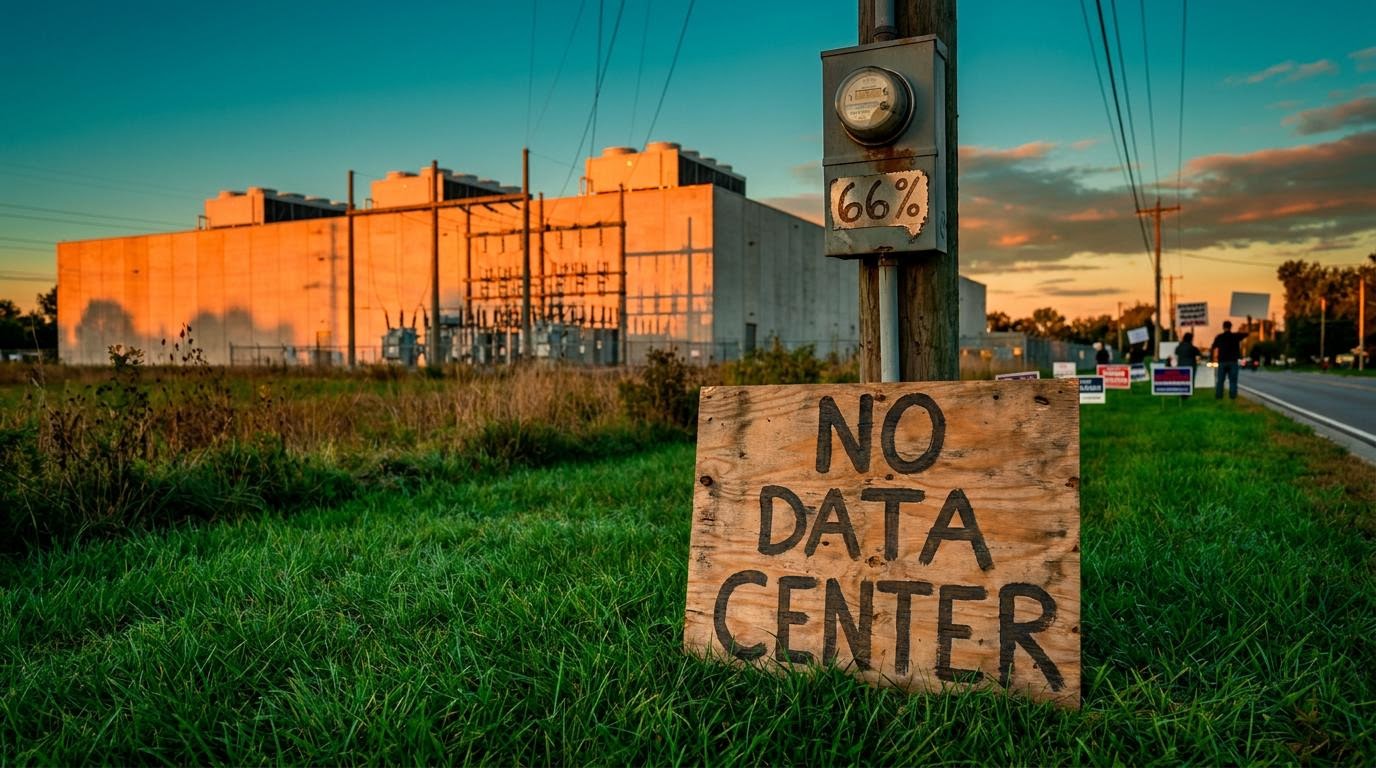
Roughly two in three Americans now oppose a new data centre near their home. Heatmap Pro counts at least US$260 billion of data centre investment cancelled in 2026, yet US hyperscalers still cite US$7-9 trillion of planned spending. That gap is the signal many AI investors are underweighting: the binding constraint on the buildout may be political and local, not financial.
The timing matters. The 3 November midterms are eight days away, and both Republicans and Democrats are attacking the industry over power bills and the cost of living.
The outcome reaches well beyond politics. It affects what AI compute costs, what households pay for electricity and where new AI capacity physically ends up.
This analysis gives you a way to judge whether the data centre backlash will slow the buildout, stall it or simply push it somewhere else. It also sets out the dated signals that will tell you which of those outcomes is unfolding.
How wide is the data centre backlash, and how much has it already cost?
What the polls say
Several pollsters, working independently, have landed in the same place. National surveys published this month and last show opposition between 63% and 72%. Most of the spread comes from wording: whether respondents were asked about data centres generally, AI data centres specifically, or one a set distance from home.
| Pollster | Published | Question | Opposed |
|---|---|---|---|
| ABC News/Washington Post/Ipsos | 21 October 2026 | New US data centres / one in own community | 66% / 72% |
| CNBC All-America Economic Survey | 24 October 2026 | AI data centre within 10 miles | 63% (13% support) |
| UMass Amherst | Updated 2 October 2026 | AI data centre in local community | 65% |
| Economist/YouGov | Updated 24 October 2026 | New data centre in community | 63% |
| Heatmap Pro/Embold Research | August 2026 | AI data centre near home | 75% |
| POLITICO/PF Global | 25 October 2026 | Data centre within three miles | 50% |
The POLITICO result is the outlier. Its narrower three-mile framing produced a much lower figure than every other survey in the set. One unnamed nonpartisan survey cited in industry commentary put opposition at about 71%, which sits inside the range but cannot be tied to a specific pollster.
The momentum figure matters more than any single level.
The four-month shift: The Annenberg Public Policy Center found 61% of Americans opposed new data centres in their area, up from 49% in its February-March survey.
The Annenberg survey release shows the 61% opposition figure comes from fieldwork run 16 June to 19 July 2026, a 12 percentage point rise from the February-March reading, which anchors the momentum trend in a dated sample.
What the cancellations say
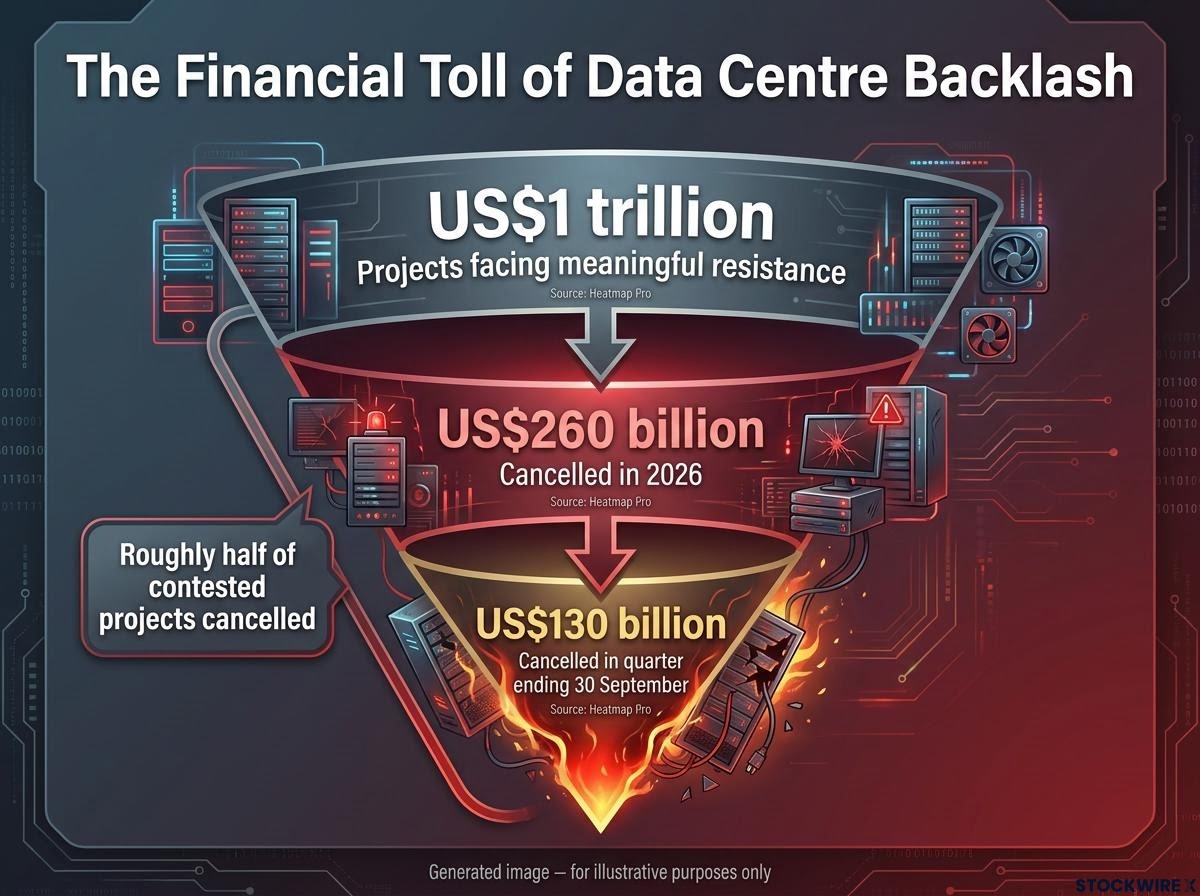
Heatmap Pro turns that mood into money. It counts at least US$260 billion cancelled in 2026 after sustained local opposition, with roughly US$130 billion of that falling in the quarter ending 30 September. A further US$1 trillion or so faced meaningful resistance, and about half of the projects that met backlash were cancelled.
A separate community-benefits analysis found 46 projects blocked, withdrawn or stalled across 20 states between 1 January 2024 and 15 May 2026, worth over US$170 billion. These measures cover different categories and time windows, so they should not be added together or compared directly.
The pace is what you should notice. Half the year’s cancellations landing in one quarter means opposition is now an input to project timelines and capital allocation, so read any company’s capacity pipeline with that discount applied.
When big ASX news breaks, our subscribers know first
Why are voters turning on data centres, and why does it cut across party lines?
The grievances are consistent across Annenberg, Gallup, Harvard Gazette experts and NBC reporting:
- Electricity bills: Harvard experts cited projections that data centres could use 10%-15% of national electricity demand within a few years.
- Water and cooling: large facilities need substantial cooling water.
- Noise and disruption: residents report noise, grid strain and lower property values.
- Subsidies: tax breaks flow to developers while infrastructure costs may land on residents.
- Few permanent jobs: construction labour is heavy, but ongoing employment is thin.
The concentration can be stark. NBC reported that data centres consume roughly 25% of Virginia’s electricity. AP reported that data centre demand has already lifted bills across the 13-state PJM grid region.
Projections for AI electricity demand vary widely, but the IEA expects data centre consumption to exceed 1,000 TWh by 2026, which explains why utilities are pushing to spread upgrade costs across the general rate base.
The politics are unusual. Democrats tend to stress ratepayer and environmental protection, while some Republicans object to subsidies and mandates. Politico counted bills in at least 28 states to roll back incentives or make data centres pay more for power.
The shared complaint: residents fear they will fund the shared grid upgrades while developers collect the tax concessions.
The picture gets messier here. NBC noted that bills also reflect fuel prices, extreme weather, inflation and grid replacement. A New York property developer’s internal survey found voters linked data centres to higher costs even where no increases had occurred, and the developer read much of it as election-season posturing.
Washington is trying to defuse it. President Donald Trump has proposed host-community dividends and said large facilities should supply their own power, and the March Ratepayer Protection Pledge saw major tech companies agree to add power and cover required upgrades. These are public statements and pledges, not a completed statute, and no verified US dividend deal exists yet, even as developers sweeten local incentives.
Because the grievance is partly perception, it can persist even if bills stay flat. You should not assume post-midterm calm will remove the political risk.
How could slowing the buildout raise costs? Fink’s inflation argument and the two cost channels
The cost question splits into two separate pathways, and confusing them is where most public arguments go wrong.
- The compute channel: if permitting, power connections or local opposition restrict new capacity, GPU-hours become scarcer. A GPU-hour is one hour of rented time on a graphics processing chip used to train or run AI. Scarcity lets providers charge more, raising the cost of AI.
- The electricity channel: data centres run continuously and add large, concentrated loads. Utilities may need new generation, transmission and substations, and if those costs are spread across the general rate base, households pay more.
BlackRock Chief Executive Officer Larry Fink argues the compute channel dominates. Speaking to Bloomberg Television at the Berlin Global Dialogue, reported 21-22 October, he said:
“If we don’t build out these data centers, it is actually more inflationary because the cost to compute is so high right now.”
Fink also warned a nationwide moratorium would risk recession. His view comes from an investor with large exposure to the buildout, which is worth keeping in mind.
The compute data supports a rising-cost story, though less dramatically than some claims. The GetDeploying tracker put the median on-demand Nvidia H100 rental at US$3.42 per GPU-hour in the week of 28 September, up 15% year on year across 40 providers. A widely repeated figure of about 30% could not be verified against the latest published tracker.
| Camp | Core claim | Main weakness |
|---|---|---|
| Buildout proponents | Delay keeps compute expensive and threatens growth | Ignores who funds grid upgrades |
| Ratepayer critics | Socialised grid costs raise household bills | Bills also reflect fuel, weather and grid replacement |
| State-policy middle | Build continues but shifts to welcoming states | Relocation may simply move the conflict |
The Congressional Research Service has described state efforts to protect ratepayers and assess grid effects before approval. No authoritative national overbuild forecast exists as of today, so neither camp can claim the numbers settle it.
That leaves a genuine tension. The same project can lower your AI costs while raising a household’s power bill, so ask who pays for the grid upgrades before judging any project or policy.
Where does political risk bite hardest: Georgia, Texas, New York and Victoria?
That cost-allocation fight is already shaping law. On 14 July 2026, New York became the first state to impose a moratorium, pausing state environmental permits for up to one year. Texas paused new grid-connection approvals while regulators audit power, water, tax and ownership details.
Beyond New York, state-level data centre moratoria have already advanced elsewhere, with Maine’s legislature passing an 18-month ban that failed to become law only because a veto survived by two votes, showing how quickly a coalition can form.
| Jurisdiction | Status | What it signals |
|---|---|---|
| New York | Statewide moratorium, up to one year | Backlash can become state law |
| Texas | Grid-connection approvals paused for audit | Scrutiny of public costs, not a ban |
| Georgia | Pause on the ballot via governor’s race | Test of whether a pause wins votes |
| Victoria, Australia | Election 28 November; cooling-water ban proposed | Opposition can hit listed earnings |
Georgia: the US test case
Georgia, Texas and Virginia together hold about a third of US development, which makes Georgia’s race the one to watch. An AJC/UGA SPIA poll of 1,000 likely voters (7-15 October) found 61% opposed more AI data centres in the state, including 79% of Democrats and 47% of Republicans.
Democrat Keisha Lance Bottoms backs a statewide pause. Republican Rick Jackson favours guardrails and local control, while outgoing Governor Brian Kemp called the pause “insane”. Polls describe a toss-up with Jackson slightly ahead, though commentary citing Polymarket gave Democrats a 63% chance.
Georgia will tell you whether a pause is a winning platform in a major data centre state. Treat the result as a leading indicator of where capital becomes harder to deploy.
Victoria: the NextDC warning
NextDC showed what that looks like on a share register. Energy network operator Jemena partially suspended power-supply work for its M3 West Footscray site amid community opposition, and the shares fell about 42% in a day as the company cut its earnings outlook.
Caretaker mode before Victoria’s election means a decision on the final M3 stages is now expected only in 2027.
What the backlash changes for the AI buildout, and what it does not
Put the evidence together and the likeliest read is relocation and repricing, not a halt. Bills in 28 states, New York’s moratorium and Texas’s audit change where, when and at what cost capacity gets built. Hyperscaler plans of US$7-9 trillion and competition with China’s expanding capacity keep demand intact, and Heatmap’s data implies roughly half of contested projects still proceed.
Physical limits sit alongside politics. NextDC’s dispute shows power delivery, not just planning permission, can decide whether an expansion goes ahead.
The grid access bottleneck is not unique to the US; roughly 300 live Australian projects are already straining connection processes, and a new federal energy obligation framework adds further cost and timeline pressure.
| Scenario | Trigger | Likely cost effect |
|---|---|---|
| Continues and clusters | Welcoming states absorb displaced projects | Compute costs ease; local grid pressure concentrates |
| Slows | More states copy New York or Texas | Compute prices stay elevated |
| Stalls | Pauses win elections and spread | Compute scarcity sharpens; Fink’s inflation case tested |
The signals to track, roughly in order of timing:
- Georgia’s result on 3 November.
- Victoria’s election on 28 November.
- Heatmap Pro’s next quarterly cancellation total.
- Cost-allocation rules utilities adopt, plus whether community-benefit deals or Trump’s dividend idea become actual agreements.
The uncertainty is real. If post-midterm politics fail to cool, the stall scenario gains weight. For now, your read should weight capacity exposure toward states with available power, faster permitting and favourable community-benefit rules, and discount pipelines concentrated where opposition is organised.
These scenarios are speculative and subject to change as markets and policy develop. Past performance does not guarantee future results.
Judging the buildout after November 3: what the backlash changes and what it leaves intact
The opposition is measurable, bipartisan and already costing billions. Even so, the evidence points to capital being redirected rather than demand disappearing.
The idea to carry forward is simple: judge any project, policy or data centre-linked holding by who pays for the power and where permitting is friendliest. Those two questions explain most of the gap between the polls and the spending plans.
Your next decision points are dated. Georgia’s vote on 3 November tests whether a pause wins in a major hub, and Victoria’s on 28 November tests whether the NextDC shock spreads. Both will sharpen the view on where capacity can still be built.
This article is for informational purposes only and should not be considered financial advice. Investors should conduct their own research and consult with financial professionals before making investment decisions.