
Roughly 44.7% of U.S. households now earn $100,000 or more, according to the Census Bureau’s 2025 income data. Two decades ago, that figure sat closer to one in six.
Crossing into six figures used to mark a household as comfortably above the crowd. It no longer signals what it once did, and part of the reason sits inside the tax code itself. Several of the most consequential income lines in that code were drawn in the 1980s and in 2013, and not one of them has moved a cent since.
The gap this creates matters because the law still assumes you stand where those thresholds put you: firmly at the top. In real terms, the income geography has shifted dramatically. The statutory lines have not. Which means you may be crossing limits designed for someone considerably wealthier than the household actually paying them today.
What follows gives you a precise picture of which thresholds have drifted furthest from their original intent, what your equivalent exposure looks like against an inflation-adjusted benchmark, and where the planning pressure points sit for households like yours.
Why the tax code’s fixed lines move against you over time
You have probably heard that U.S. federal income tax brackets adjust for inflation every year. That is true, and it protects most taxpayers from the oldest problem in the book: being pushed into a higher bracket purely because prices rose.
The trouble is that this protection does not cover everything. A separate class of tax thresholds runs on completely different logic, and it is quietly working against you in the background.
The distinction matters, so here is the mechanical difference between the two:
- Bracket creep (addressed by indexing): When tax brackets themselves are not adjusted, inflation pushes you into a higher marginal rate even if your real income never improved. The U.S. system largely solves this through annual indexing of the brackets.
- Fixed-threshold fiscal drag (not addressed): When a surtax or inclusion threshold is written as a hard dollar figure, it never moves. Nominal incomes rise year after year, the line stays put, and a larger population crosses it every year regardless of whether real purchasing power went up.
A fixed nominal threshold works as a one-way ratchet. The line does not chase inflation, so the only direction the affected population moves is toward it and then across it. The Congressional Research Service (CRS) describes this as a discrete form of fiscal drag, because the jump in your marginal rate arrives suddenly at the threshold rather than gradually.
This is not an accident of drafting. In several cases Congress left these thresholds unindexed on purpose, precisely because an expanding taxpayer base over time was part of how the provisions were meant to raise revenue.
CRS on the NIIT thresholds The net investment income tax thresholds are not indexed for inflation. As a result, more taxpayers become subject to the tax over time regardless of whether their real income has increased.
The United Kingdom offers a nearby illustration of the same mechanism, having frozen its income tax thresholds rather than the bracket-indexing route the U.S. took. The American variant is subtler because it lives in specific surtaxes rather than the headline brackets.
The takeaway you need before the numbers arrive is simple. Bracket indexing does not shield you from the taxes covered here, and the distance between your nominal income and these fixed lines narrows every year, whether or not you feel any wealthier.
When big ASX news breaks, our subscribers know first
The investment surtax and Medicare charges that more households are quietly crossing
Start with the gap itself, because the gap is the whole story. The net investment income tax (NIIT) and the Additional Medicare Tax both kick in at $200,000 for single filers, $250,000 for married couples filing jointly, and $125,000 for married filing separately. Both were set in 2013 as part of the Affordable Care Act, and neither has changed in the years since.
Now put those numbers next to what they would be if they had simply kept pace with prices. Applying consumer price inflation from 2013 forward, the single-filer line would sit near $287,600 today, and the joint line near $359,500.
That difference is the erosion you have absorbed without any statutory acknowledgment.
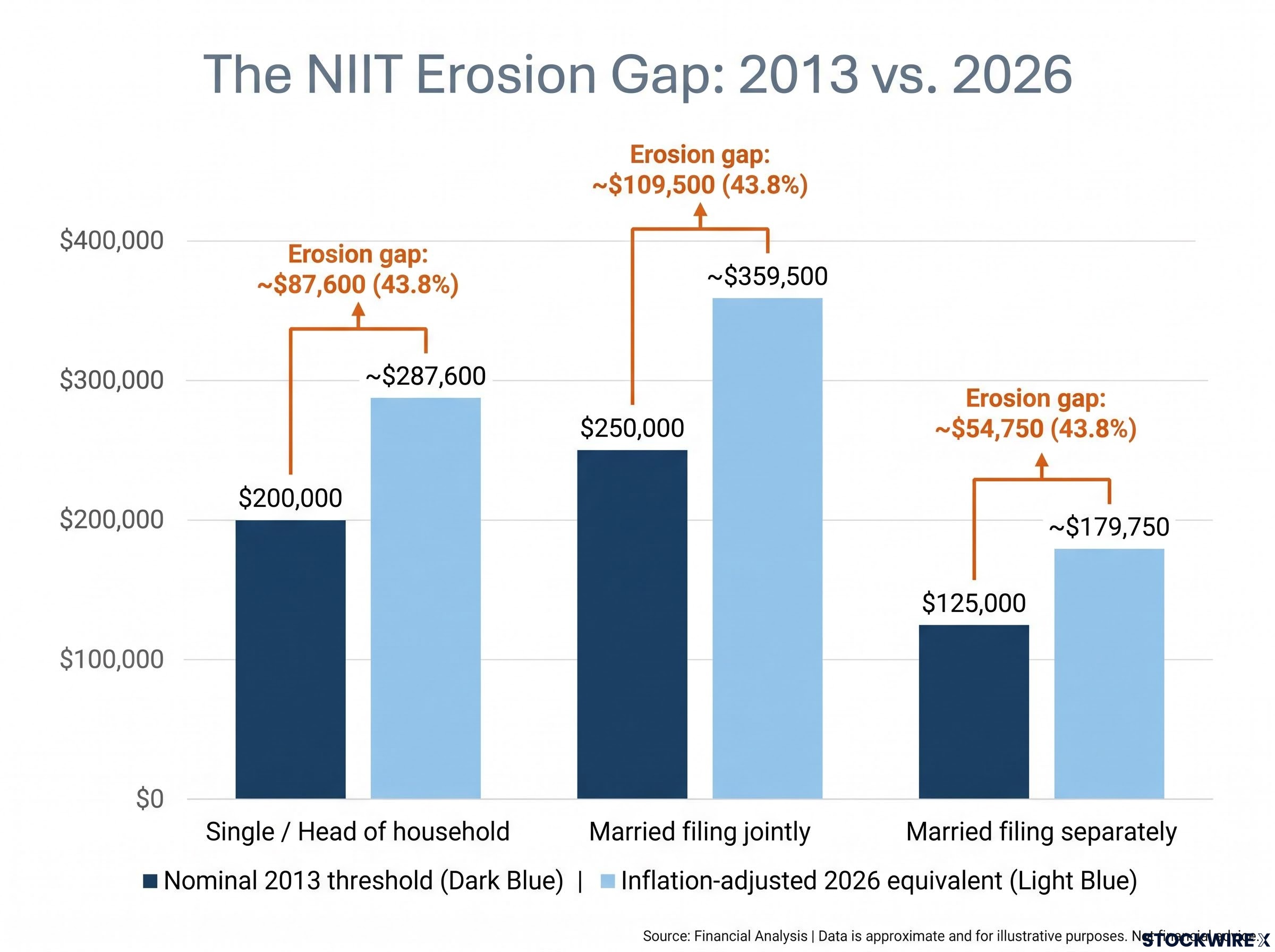
| Filing status | Nominal 2013 threshold | Inflation-adjusted 2026 equivalent | Erosion gap |
|---|---|---|---|
| Single / Head of household | $200,000 | ~$287,600 | ~$87,600 |
| Married filing jointly | $250,000 | ~$359,500 | ~$109,500 |
| Married filing separately | $125,000 | ~$179,750 | ~$54,750 |
The NIIT applies at 3.8% on net investment income (interest, dividends, capital gains and similar earnings) once your modified adjusted gross income clears the applicable threshold. It was written to reach high earners. But consider a dual-income household where each partner earns between $100,000 and $150,000. Individually, neither looks like the target. Combined, they can sit squarely inside the NIIT zone.
CRS illustrates the cliff plainly. A single filer with $210,000 in modified adjusted gross income and $40,000 of net investment income pays the surtax on $10,000 of that income, the amount above the threshold, producing $380 in additional tax. A near-identical filer at $195,000 pays nothing at all.
Read that gap carefully. Roughly $15,000 of nominal income growth, with no real gain in purchasing power, is enough to cross the line and trigger a new layer of tax. And with the threshold now more than $87,000 below its inflation-adjusted equivalent, households well beneath the original high-income target are the ones approaching it.
The 0.9% wage surtax and why it often arrives as a surprise
The Additional Medicare Tax shares the same thresholds but applies to a different kind of income: wages, at 0.9%. This is the part W-2 earners tend to miss, because you do not need a single dollar of dividends or capital gains to owe it. A large enough paycheque is sufficient.
Here is where it catches dual-income couples. Employers begin withholding the surtax once an individual’s wages pass a certain level. But the filing threshold for joint filers is $250,000. If both partners each earn below $200,000 but their combined wages exceed $250,000, no employer withholds the tax, yet the couple still owes it at filing. That is an underwithholding surprise waiting at tax time for exactly the households least likely to expect it.
Social Security benefit taxation and the thresholds set in the 1980s that never moved
If the NIIT lines feel old, the Social Security ones are older still. The taxation of benefits was introduced in 1983, allowing up to 50% of benefits to be taxed, and expanded in 1993 to allow up to 85%. The four thresholds that decide all of this have not moved since.
For single filers, the lines sit at $25,000 and $34,000. For joint filers, they sit at $32,000 and $44,000. That is over four decades of frozen figures for the first tier and over three for the second.
The mechanism that decides whether you cross them is called provisional income, and it is worth walking through because each dollar of other income carries more weight than its face value.
- Take your adjusted gross income.
- Add any tax-exempt interest (municipal bond income counts here).
- Add 50% of your Social Security benefits.
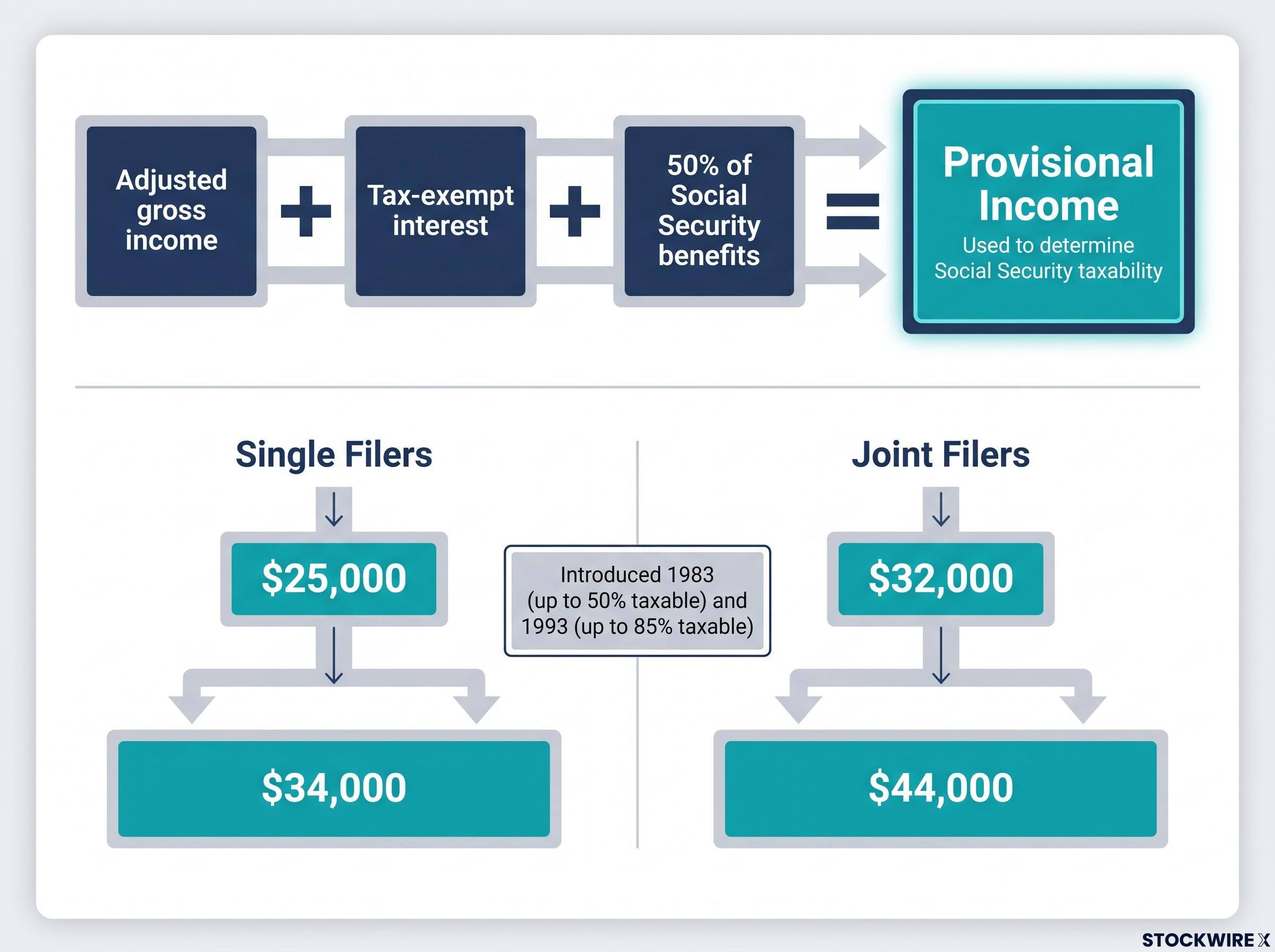
The total is your provisional income, and it is measured against those fixed thresholds. Because half your benefits feed into the very calculation that decides how much of your benefits get taxed, modest additional income can tip you across a line faster than you would expect.
CRS on the deliberate design Up to 85% of Social Security benefits can be included in taxable income for recipients whose provisional income exceeds statutory thresholds. These thresholds have not been adjusted for inflation.
That non-indexing was a legislative choice. Both CRS and the Congressional Budget Office (CBO) note that an expanding taxpayer base over time was a known and intended financing feature, not an oversight.
The consequence shows up in the numbers. The CBO projects that roughly 48% of Social Security beneficiaries will owe federal income tax on their benefits in 2026, up from under 10% when the tax began in 1984.
That figure tells you something stark. The typical Social Security recipient is now more likely than not to owe tax on benefits, a complete inversion of what the threshold was built to produce. And the shift happened entirely through nominal income growth pressing against a frozen line. In 2025, benefit taxation delivered $57.8 billion to the trust funds, about 4.0% of total Social Security income.
For a married couple, the math bites quickly. Take $40,000 in Social Security benefits and $20,000 in other income. Provisional income comes to $40,000 ($20,000 plus half of $40,000), already past the $32,000 joint first-tier line, making up to 50% of their benefits taxable.
How a small IRA withdrawal can trigger a large change in taxable benefits
Watch the same effect for a single retiree, step by step. Start with $20,000 in Social Security benefits and $10,000 in other income. Provisional income is $20,000 ($10,000 plus half of $20,000), comfortably below the $25,000 first-tier line. No tax on benefits.
Now add a $10,000 IRA withdrawal. Provisional income climbs above $25,000, and up to 50% of benefits become taxable. Add further income that pushes provisional income past $34,000, and up to 85% of benefits fall into the taxable column.
That jump from the 50% tier to the 85% tier is where the effective marginal rate hits hardest, because a single additional dollar can drag a large slice of previously untaxed benefits into your taxable income. For anyone drawing on an IRA, investment income, or even municipal bond interest through the AGI channel, these lines interact with a threshold set when far fewer retirees had meaningful non-Social-Security income.
What the behavioral evidence says about how households are already responding
The clearest sign that these thresholds matter is that sophisticated households have already restructured their finances around them. This is no longer the province of tax attorneys managing the ultra-wealthy. Vanguard and mainstream financial planners now publish plain-language guides on managing exactly these lines.
Four adaptations show up repeatedly in the research:
- Roth conversions: Roth distributions do not count toward provisional income, so converting traditional savings before retirement can keep future withdrawals out of the Social Security taxability calculation entirely.
- IRA and 401(k) withdrawal management: Planners help retirees size traditional account withdrawals to stay under the provisional income thresholds year by year.
- Municipal bond preference: Certain tax-favoured instruments are chosen to avoid piling up provisional income the way ordinary interest does, though note that tax-exempt interest still feeds the provisional income formula.
- Capital gains timing: Spreading large asset sales across multiple tax years keeps modified AGI below the NIIT threshold in any single year.
The Roth IRA wrapper removes Roth distributions from the provisional income calculation entirely, which is why converting traditional savings before retirement is one of the most structurally sound responses to fixed Social Security thresholds, not simply a tax-deferral swap.
There is a real asymmetry in who does this. Households with advisors actively manage these lines. Households without them cross the lines unknowingly and pay the surtax or the benefit tax without ever understanding why. CRS notes that the lack of indexing steadily enlarges the group for whom these strategies become relevant.
The counter-argument deserves a fair hearing, and it rests on two points:
Roth conversions, withdrawal sequencing, and capital gains timing all share the same underlying logic: a tax-efficient portfolio structure that controls which income lands in which year can keep your provisional income and modified AGI below the lines that trigger these surtaxes.
- Trust fund revenue: Indexing the NIIT and Social Security thresholds would reduce revenues credited to the Social Security and Medicare trust funds, forcing offsetting choices elsewhere.
- Income distribution: The households currently affected still tend to sit above median income, so the taxes continue to serve a progressive function even as they reach more people than originally intended.
The debate, in other words, is about targeting precision, not about whether affected households are poor. But the fact that a mainstream advisory audience now needs these strategies at all tells you how far the thresholds have drifted into ordinary financial life.
Whether these thresholds get indexed is a policy fight, not a mechanical fix
None of this is a glitch awaiting a quiet correction. The non-indexing of these thresholds is a deliberate statutory design, and only Congress can change it by acting explicitly. That framing matters, because it means the outcome depends on a genuine trade-off rather than a bureaucratic fix.
The case for indexing is straightforward. It would restore the original targeting, sparing households that were never the intended target and only crossed the line through nominal income growth. CRS IF11820 lists indexing among the plausible policy options for addressing exactly that drift.
The case against is equally real. Any indexing relief reduces revenues flowing to the Social Security and Medicare trust funds, and the affected households, more numerous than intended, still tend to earn above the median.
The legislative environment around capital gains tax proposals matters here because any rate cut or inflation-indexing of the NIIT threshold would directly change the calculus for households managing investment income near the $200,000 and $250,000 lines, but no such legislation has advanced beyond campaign-stage pledges as of mid-2026.
Set the numbers side by side and the direction becomes clear. Real median household income reached a record $87,460 in 2025, according to the Census Bureau. Place that next to a $200,000 NIIT line and Social Security thresholds of $25,000 and $32,000, and the shrinking distance between ordinary earnings and lines meant to sit well above ordinary is hard to miss.
CRS on the path forward Indexing the thresholds is identified as a plausible policy option that would address the issue of more taxpayers paying the tax solely due to inflation.
Without legislative action, the CBO expects the share of beneficiaries taxed on their benefits to keep rising. Which means the planning strategies covered here will matter to a broader, more mainstream audience each year, not a shrinking elite one.
Proposals for an unrealized capital gains tax at the federal level would add a third layer of complexity on top of the fixed NIIT thresholds and Social Security provisional income rules, though no such tax has been enacted and the constitutional questions left open by the Supreme Court in Moore v. United States remain unresolved.
This article is for informational purposes only and should not be considered financial advice. Investors should conduct their own research and consult with financial professionals before making investment decisions. Financial projections are subject to market conditions and various risk factors, and forward-looking policy scenarios are speculative and subject to change based on legislative developments.