The most important thing a professional prop desk teaches a new trader in the first six months is not how to find winning trades. It is how to stay small enough to keep making them.
That sounds backwards. You would expect a firm handing out serious capital to want its traders swinging hard, capturing every edge, sizing up fast. The opposite is true. The entire architecture of professional desk culture is built to slow new traders down before it lets them scale.
This matters now more than ever. Retail traders have more access to prop firm capital than at any point in history, yet most walk in without understanding how a professional desk actually shapes trader behaviour from the inside. The gap between what they imagine and what the job involves is large, and it costs them.
What follows gives you the inside structure of how professional firms build traders, and which parts of that structure you can borrow without ever sitting on a trading desk. You will learn which desk principles translate directly to your own development, and which psychological traps are most likely to derail you before you get there.
What a professional prop desk actually looks like from the inside
Walk onto a professional prop desk expecting chaos and shouting, and you will be surprised. The structure is tighter and more deliberate than the outside picture suggests.
Traders are organised into pods, small groups that each develop their own variations on a set of foundational playbooks. There is no thick rulebook dictating every move. Instead, each pod adjusts its approach around individual personality and style, working within a shared framework rather than rigid written instructions. That flexibility inside structure is the defining cultural feature.
New traders do not get handed the full toolkit on day one. They begin with equity instruments and add options only as their skills mature. The sequencing of complexity is intentional: you earn the harder instruments by demonstrating competence with the simpler ones.
The development timeline is where the philosophy becomes concrete. The foundational cycle runs roughly six months, and it breaks into three distinct phases:
- Phase 1 (approximately two months): learning habits. The focus is on installing correct behaviours, not chasing profit.
- Phase 2 (approximately two months): reinforcing habits. Traders work through and cement those behaviours until they hold under pressure.
- Phase 3 (approximately two months): beginning to grow. Only now does the emphasis shift toward scaling up.
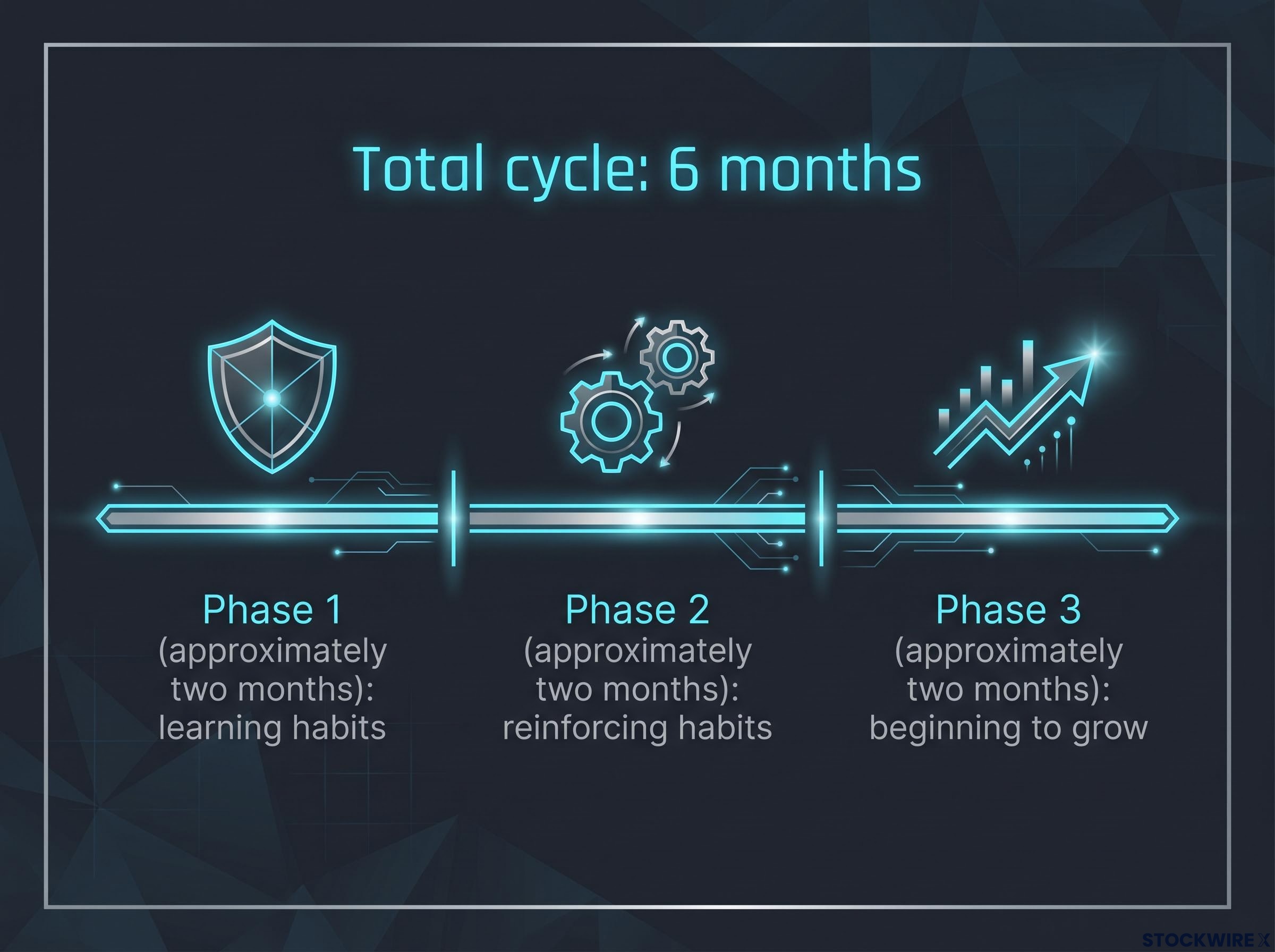
Notice the ordering. Four of those six months go to habits before a trader is meaningfully allowed to grow. Firm leadership treats staying in the game long enough to build proper skills as the precondition for real long-term growth, and the dynamic risk-adjustment skill this produces is one they consider rarely developed outside a professional environment.
How top firms structure their training pipelines
The two most documented institutional examples make the point clearly.
Optiver runs a Global Academy for its graduate trading and research hires. All new hires begin with four weeks of intensive training in Amsterdam within a total 12-week programme, after which they are trained, licensed, and ready for the floor.
The Optiver training model Optiver’s 12-week Global Academy is led by former traders and engineers, blending core trading fundamentals with hands-on application, followed by continued development on local desks.
Jane Street runs multiple structured programmes, including INSIGHT, FTTP, QTC, Bridge, WiSE, and IN FOCUS. Participants learn probability, market structure, arbitrage, and trading research through lectures, group games, and mock trading simulations. These programmes explicitly assume no prior knowledge of finance or markets.
That last detail matters. These firms are building habits from zero rather than recruiting formed traders. Even organisations with the deepest talent pipelines invest months in behaviour before strategy, which tells you the sequence matters more than the content of any single lesson.
The stakes behind these pipelines are real. According to the Acuiti Proprietary Trading Management Insight Report published in May 2024, almost 90% of proprietary trading firms planned to increase trading headcount that year. When firms are expanding this aggressively, how they build new traders becomes a core competitive question, not an afterthought.
When big ASX news breaks, our subscribers know first
Why new traders are kept smaller than they need to be
Here is a practice that confuses almost every developing trader. Professional desks deliberately keep new traders at position sizes smaller than their account could technically support, and they keep them there for months. It looks like timidity. It is the opposite.
The logic is psychological, and the data backs it. A Backtestor analysis published on 22 February 2026, drawing on tens of thousands of trades, found that small positions in the $500 to $5,000 range produced the highest win rate at 74.2% and the best average profit at +$38.50 per trade, outperforming larger size buckets.
Read that number carefully, because the obvious interpretation is wrong. The 74.2% win rate is not evidence that small trading is better trading. It is evidence that the emotional conditions created by small size let traders actually execute their edge. That is precisely what a desk is engineering when it constrains a new trader.
The 74.2% win rate at small size looks impressive in isolation, but trading expectancy, calculated as win rate multiplied by average win minus loss rate multiplied by average loss, is the only metric that reveals whether those wins are large enough to justify the system over a meaningful sample of trades.
The mechanism sits in how your brain processes size. According to The Trading Reset analysis published on 14 March 2026, when position size is manageable, your logical brain treats the market as a set of probabilities. When size gets too large, your survival brain takes over, interprets a normal drawdown as genuine danger, and pushes you to deviate from your plan.
| Position size | Win rate | Average P&L per trade | Emotional condition |
|---|---|---|---|
| $500-$5,000 (small) | 74.2% | +$38.50 | Logical brain engaged; losses register as data points |
| Larger size buckets | Lower | Lower | Survival brain activated; normal drawdowns feel like danger |
The emotional weight of a loss does not scale in a straight line with its size. According to the M1nd platform guide published on 25 January 2026, the difference is sharp:
The nonlinear cost of size Losses at 1% feel like setbacks. Losses at 5% feel like failures.
This is why small sizing builds habits. When each losing trade lands as a data point rather than an emotional event, you develop tolerance for drawdown, and that tolerance is what scales up with experience. A SizeProp article from 12 May 2026 puts numbers to it: a trader risking 1% on a $5,000 account, roughly $50 per trade, experiences real psychology without blowing up real savings. The recommended habits are concrete: 1 to 3 trades per session, a predefined 1:2 risk-reward, and stops set before entry.
There is an honest caveat here. Sources caution that staying permanently undersized limits any chance of meaningful profit. The point of small sizing is not conservatism for its own sake. The explicit expectation is that you increase size gradually as you demonstrate consistent performance and psychological resilience.
The psychological traps that derail developing traders
The failure modes that sink developing traders are not character flaws. They are structural predictabilities. Given the environment, these traps will surface for almost every trader, and naming them in advance is exactly what professional desk culture does that solo self-teaching almost never manages.
The first trap arrives through your peers. Watch a colleague put up a strong number and the impulse to size up hits immediately. Professional desk culture has a name for the result. It is the golf swing: overswing to hit harder, and you lose precision. The TacticalInvestor discussion from 8 July 2025 describes how measuring success against peers rather than personal goals turns disciplined traders into emotional performance chasers.
Revenge trading is the most documented cause of catastrophic drawdown. After a loss, the urge to win it back by escalating size or trade frequency violates the exact sizing discipline you spent the foundational phase building. It is the fastest route from a manageable red day to a blown account.
The disposition effect compounds the peer-comparison problem by creating a second exit distortion: traders hold losers too long because booking a loss feels like confirmation of failure, while cutting winners early to lock in a gain satisfies the emotional need for a win, regardless of whether the trade had further to run.
For retail prop traders working through paid evaluations, a specific set of traps clusters around the challenge structure itself. Here they are, roughly in order of how often they appear:
- Over-sizing after observing peer performance. Watching others win pulls you off your own plan.
- Revenge trading after losses. Escalating to recoup a loss, breaking your sizing rules.
- Drawdown paranoia near limits. Trading too conservatively close to a trailing drawdown limit, cutting winners early or skipping valid setups.
- Sunk cost pressure from challenge fees. Trading to protect a paid challenge fee rather than to execute the strategy.
- Consistency paradox near payout thresholds. Self-sabotaging just as you approach a profit target, often tied to fear of success or imposter syndrome.
The data confirms where the real problem lies. According to a Finance Magnates study cited by JoinProp on 19 April 2026, the two biggest struggles are behavioural, not analytical.
Where developing traders actually fail 37.8% of prop traders struggle with lack of discipline. 37.5% struggle with emotional trading after losses.
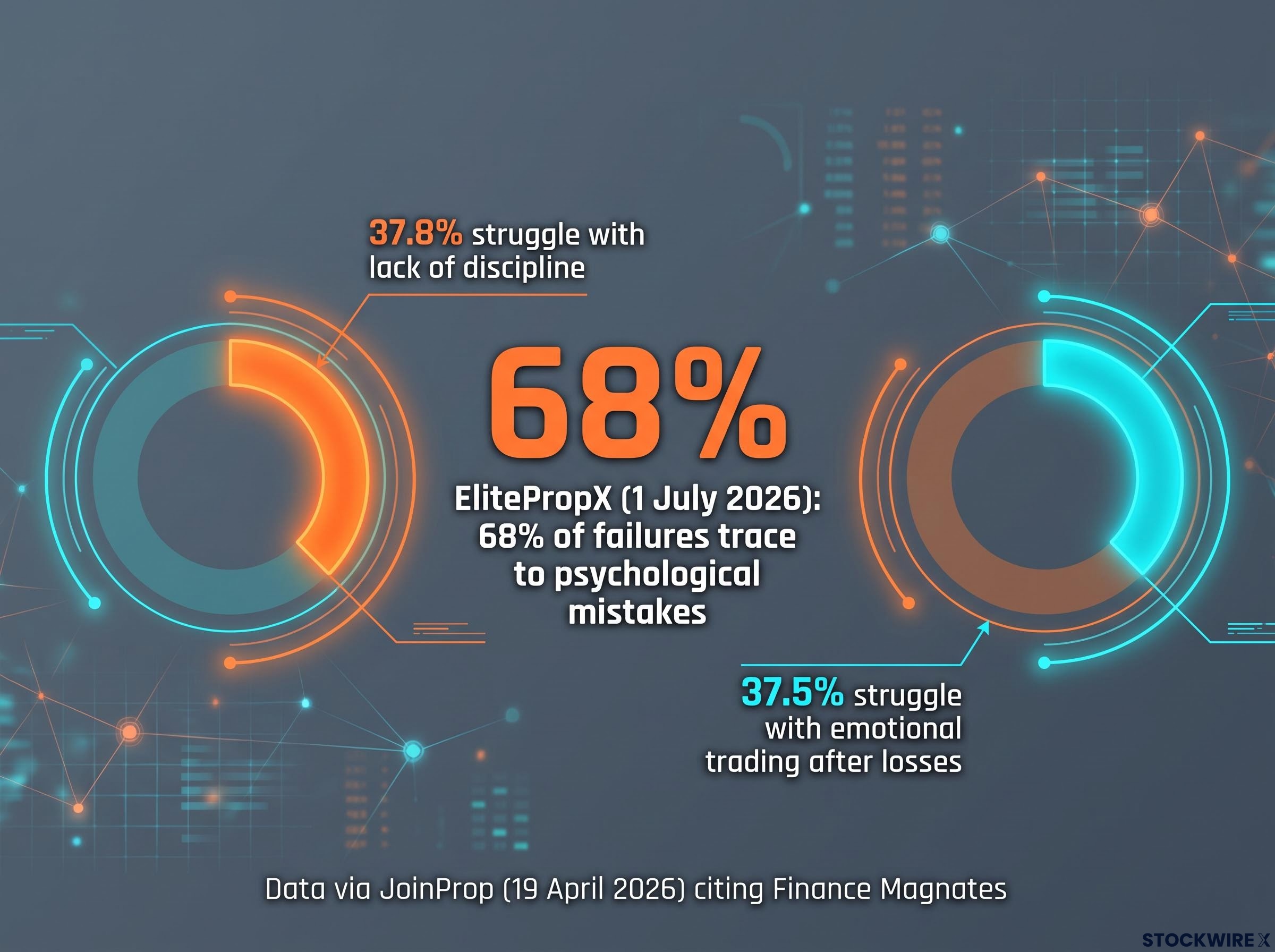
That concentration tells you something important. Most developing traders are not failing because they picked the wrong setups. They are failing because the psychological environment overwhelmed the risk structure they had built.
The SizeProp article from 12 May 2026 catalogues seven cognitive biases that dominate funded-account breaches: loss aversion, the disposition effect, overconfidence, revenge trading, fear of missing out, overtrading, and anchoring. Separately, ElitePropX reported on 1 July 2026 that 68% of failures trace to psychological mistakes. Treat that specific figure as directional rather than definitive, as it has not been independently confirmed, but the direction is consistent with everything else the research shows.
The practical value here is straightforward. Once you understand these traps as structural rather than personal, they become addressable. A trader who knows the peer-comparison impulse is coming can build a pre-commitment to sizing rules before the emotional test arrives, which is worth far more than trying to summon discipline in the moment.
Why professional desk environments build risk discipline that retail self-teaching rarely replicates
The gap between professional and retail outcomes is not about talent or willpower. It is about environment, and being honest about the mechanisms is the only way to work out how to compensate for them.
The structural odds against retail traders extend well beyond psychological traps: SPIVA data shows 85-90% of actively managed equity funds underperform their benchmark after fees over 15-year periods, setting a ceiling for active management that makes the professional desk model’s discipline requirement easier to understand in context.
Three structural features do most of the work. In the ConvergentTrading interview from 12 February 2025, former prop trader “John471” argued that prop firms create discipline through tight structure, limited choices, and immediate behavioural feedback.
- Constrained choice. Prop traders focus on a limited set of markets and setups, which cuts decision fatigue. Retail traders, by contrast, face an overwhelming number of choices across markets, brokers, platforms, indicators, and strategies, often optimising systems they never actually follow.
- Immediate behavioural feedback. A poor morning triggers direct intervention. Traders get pulled aside, sent home, or removed. There is no silent self-review to skip.
- Real capital alignment. On an institutional desk, the firm’s own money is genuinely at risk, which creates stronger incentives than a challenge fee alone.
That last point draws a sharp line between two models. Institutional prop desks such as Jane Street and Optiver trade their own capital, so the firm loses directly when a trader loses. Retail evaluation-based firms generate revenue partly from challenge fees, which critics argue creates weaker alignment around genuine trader development. The Business Insider feature from 13 December 2025 framed the retail sector as a fast-growing $12 billion industry built on strong marketing and challenge fees, which is the context critics point to.
The discipline is enforced mechanically, not left to good intentions. A foundational rule on professional desks is no naked exposure into binary events. Selling volatility outright into an earnings announcement, for instance, breaks core risk rules, and desk managers intervene directly if a trader attempts it. Structured positions with defined risk, such as calendar spreads, are required over uncapped-loss exposures. The standard risk parameters reinforce this: according to MondFx guidance for 2026, professional traders typically risk between 0.25% and 1% of capital per trade, use daily stop limits, and split daily risk across smaller trades, framed as survival mechanisms rather than optional guidelines.
None of this means the professional model is easy or that everyone clears it. Topstep disclosed a 12.4% funding rate in 2024, meaning only that share of traders passed its evaluation and received capital. The professional segment is also expanding from genuine commercial strength: the Acuiti Q1 2025 report found nearly two-thirds of prop firms performed better in 2024 than in 2023, with 39% significantly better.
| Dimension | Institutional prop desk | Retail evaluation-based firm |
|---|---|---|
| Capital at risk | Firm’s own capital | Trader’s challenge fee |
| Feedback mechanism | Direct intervention | Self-review |
| Choice constraint | Limited markets and setups | Open access |
| Training structure | Cohort-based formal programme | Self-directed |
What retail traders can borrow from the professional model
The mechanisms that make professional desks work are not magic. They are constrained choice, external accountability, and genuine capital alignment. Understand that, and you can deliberately engineer versions of each for yourself, even working alone.
- Define a constrained setup menu and do not trade outside it. Write down the only setups you will take, and treat anything else as out of bounds.
- Create an external accountability structure. A trading partner, a coach, or a disciplined journal review substitutes for the desk manager who would otherwise pull you aside.
- Risk genuinely uncomfortable but recoverable amounts per trade. Enough to create real psychological feedback, not so much that a bad run destroys your account.
Fixed-dollar-risk sizing resolves the conviction-versus-size problem mechanically: once a stop is placed, position size is derived from the dollar amount you are willing to lose divided by the distance to that stop, removing the in-the-moment discretion that professional desks eliminate through structural constraint.
This is a documented retail approach, not a theory. PropFirmsFinder describes a checklist-driven risk culture built around a pre-trade checklist, journaling, trading one setup only, and capped trade counts, which is a close approximation of professional desk discipline for someone working without a desk.
What the professional model actually demands, and whether it translates
Strip away the firm names and one principle runs through everything above. The professional desk model is fundamentally an environment designed to slow traders down before they scale up, and the payoff goes only to those who stay in that structured phase long enough. Remember the shape of it: four of the first six months go to habits before growth is even on the table.
Be honest about the limitation. The core advantages, constrained choice, external intervention, and real capital alignment, are structural. Working alone, you cannot assume self-imposed rules will simply hold under emotional pressure the way a desk manager’s intervention would. You have to build the compensating structure deliberately.
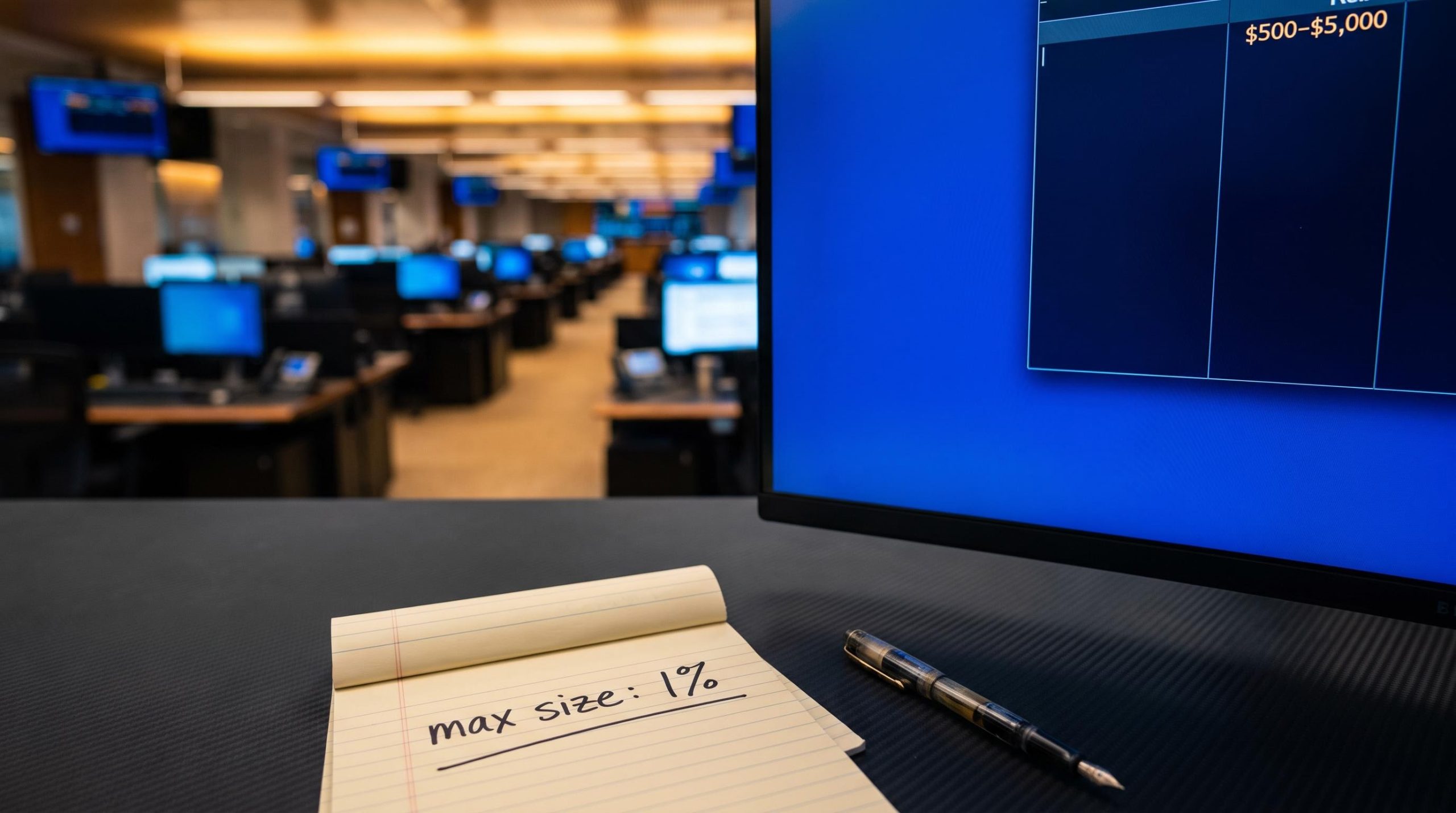
If you install just one professional habit before your next session, make it this: set your maximum position size before you open the chart. According to the M1nd guidance, that means using your account equity, a fixed risk percentage of often 1 to 2%, and your stop distance to fix the size in advance, not on how the setup happens to look in the moment.
Here are three ranked priorities to implement independently:
- Set your maximum position size before opening the chart, based on account equity and a fixed risk percentage.
- Define and write down the only setups you will trade this session.
- Identify the daily loss amount at which you will stop, before the session starts.
Trying to replicate the entire professional model at once is itself a form of the overconfidence this article warned against. Install one habit first. The Acuiti finding that 90% of professional firms planned headcount increases in 2024 tells you the structured model is expanding, not fading, so the principles are worth building on.
This article is for informational purposes only and should not be considered financial advice. Investors should conduct their own research and consult with financial professionals before making investment decisions.
Past performance does not guarantee future results. Trading involves risk, and the psychological and statistical patterns described here are drawn from cited sources rather than any assurance of individual outcomes.