Most PFAS remediation reports say the same thing: concentrations fell below the detection limit. What almost none of them say is where the fluorine actually went.
That distinction is quiet right now, but it is becoming load-bearing. The US Environmental Protection Agency’s (EPA) 2026 Interim Guidance defines PFAS destruction in explicitly molecular terms, requiring that carbon-fluorine bonds are severed and that fluorine is mineralised into stable compounds. Regulators are beginning to formalise what “destroyed” actually means, and that formalisation is pulling apart two claims the industry has long treated as equivalent. More than US$10 billion is spent globally each year on PFAS remediation across an estimated 57,000 contaminated US sites and more than 1,700 identified in Australia. A shift in how destruction is defined and measured has consequences at that scale.
This piece works through the science of why fluorine fate matters, how the regulatory standard is evolving, and what a small ASX-listed company called Environmental Clean Technologies (ECT) is betting on as a result. For investors tracking ASX cleantech stocks, the ECT case is a worked example of how a pre-commercial technology positions itself against a tightening regulatory standard, and what the remaining proof points are before the commercial case becomes demonstrable. As with all pre-revenue cleantech development, speculative risk applies throughout.
How concentration-based reporting falls short of proving PFAS destruction
The standard PFAS remediation report looks reassuring. Concentrations of target compounds dropped below the laboratory’s detection limit. The site passed. The numbers look clean.
But falling below a detection threshold is a measurement outcome, not a chemistry outcome. It tells you what a specific analytical test could no longer find. It does not tell you what happened to the fluorine atoms that were in those PFAS molecules before treatment. That is a materially different question, and one that most remediation reporting does not attempt to answer.
The gap matters because partial PFAS breakdown does not simply yield a reduced quantity of the same contaminants. The process can generate smaller fluorinated fragments that are more mobile in groundwater, potentially as hazardous as the parent compounds, and frequently invisible to the analytical methods used to declare a site compliant. A treatment can return a passing laboratory result while leaving a new category of fluorinated contamination to migrate elsewhere.
The EPA’s own 2026 Interim Guidance explicitly warns that some technologies may transform PFAS into other fluorinated products that are “potentially more mobile or persistent.”
This is not a fringe concern. Regulators are contending with thousands of PFAS species and limited analytical standards for transformation products, which is precisely why concentration-based reporting is an insufficient proxy for destruction. Reporting that PFAS concentrations declined and claiming that PFAS was destroyed are scientifically distinct assertions, yet the remediation industry treats them as interchangeable across the board rather than in isolated cases.
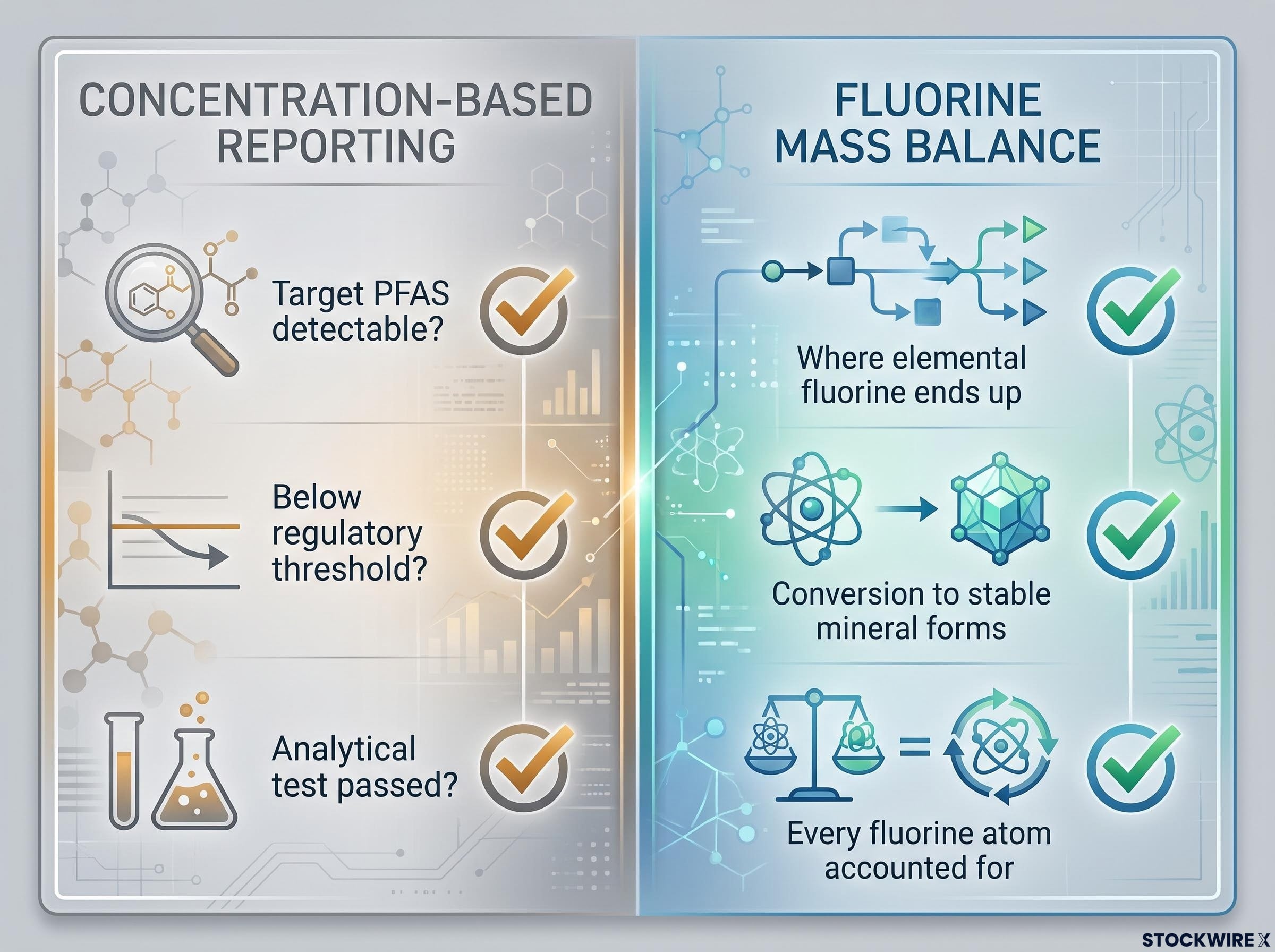
What you are looking at, when you see a remediation result citing reduced PFAS concentrations, is a record of what a test could detect rather than a verified account of what happened to the fluorine. Here is the distinction laid out clearly:
What concentration-based reporting measures:
- Whether target PFAS compounds are detectable after treatment
- Whether measured levels fall below a regulatory threshold
- Whether the specific analytical test returned a passing result
What a fluorine mass balance measures:
- Where the elemental fluorine ended up after treatment
- Whether fluorine was converted to stable, non-reactive mineral forms
- Whether essentially every fluorine atom can be accounted for across known product forms
That credibility gap is the structural weakness that a wave of regulatory tightening is now pressing against, and it defines the commercial opportunity that technologies built around verified destruction are positioning to fill.
When big ASX news breaks, our subscribers know first
What the carbon-fluorine bond actually is, and why breaking it matters
PFAS compounds persist in the environment because of one specific molecular feature: the bond between carbon and fluorine atoms. The carbon-fluorine (C-F) bond is one of the strongest bonds in organic chemistry. That bond strength is the reason PFAS does not break down under the environmental conditions, including sunlight, microbial activity, and weathering, that degrade most other contaminants. The label “forever chemical” is not a loose descriptor. It is a direct consequence of C-F bond stability.
Genuine destruction, then, requires enough energy or chemical force to sever that specific bond. Anything less is rearrangement, not elimination. The EPA’s 2026 Interim Guidance defines PFAS destruction in precisely these terms: severing all carbon-fluorine bonds and mineralising both carbon and fluorine into stable species such as CO₂, hydrogen fluoride (HF), and water.
From separation to destruction: why moving PFAS is not the same as ending it
Separation technologies, including granular activated carbon (GAC) filtration, ion exchange (IX) resins, and reverse osmosis, remove PFAS from water by capturing it in a filter medium. The PFAS is not destroyed. It is transferred from the water to the media. That spent media, now loaded with concentrated PFAS, becomes a secondary waste problem requiring its own disposal or treatment decision.
This is why the regulatory conversation is increasingly distinguishing “PFAS removed from water” from “PFAS destroyed at the molecular level.” The EPA’s broader PFAS strategy explicitly separates these two categories, with destruction remaining a live research and regulatory frontier. Multiple competing approaches are under development, including supercritical water oxidation, electrochemical oxidation, hydrothermal alkaline treatment, non-thermal plasma, and pyrolysis.
For you as an investor evaluating ASX cleantech stocks in this space, the framing is straightforward: any technology claiming PFAS destruction that cannot account for where the fluorine ends up is making a weaker scientific claim than its marketing language typically suggests, and regulators are beginning to formalise that distinction.
A fluorine mass balance tracks this accountability through three stages:
- Quantify what enters treatment: measure total fluorine in the contaminated material before the process begins.
- Identify what forms the fluorine converts into: determine whether fluorine has been mineralised into stable compounds (such as calcium fluoride) or remains in reactive, mobile, or unknown fluorinated forms.
- Close the accounting: verify that the fluorine entering the process can be accounted for across all known output forms, with minimal unaccounted loss.
How ECT’s REM technology is built around the mass balance standard
The problem the technology was designed to answer is the one this article has been building toward: how do you prove that PFAS has been destroyed at the molecular level, not just removed from the sample or transformed into something a standard test cannot detect?
Environmental Clean Technologies Limited (ECT), listed on the ASX, holds an exclusive licence to the Flash Joule Heating process originating from Rice University research conducted under Professor James Tour. Through that licence, ECT’s Rapid Electrothermal Mineralisation (REM) technology drives intense high-voltage electrical current through PFAS-contaminated soil or spent filtration media, producing temperatures above approximately 1,000°C. The heat severs the C-F bond and converts fluorine into stable, inert fluoride salts, primarily calcium fluoride, rather than allowing it to persist in reactive or mobile forms.
ECT’s stated differentiating position is that its process converts fluorine into documented mineral compounds and that testing can account for essentially all fluorine entering the system, rather than simply showing that PFAS concentrations are no longer detectable afterward.
What ECT claims as its differentiating position is not simply that PFAS concentrations fall, but that a full fluorine mass balance can be closed, accounting for where the fluorine goes rather than reporting that it is no longer detectable.
Laboratory performance figures, all company-reported under controlled conditions, include defluorination efficiencies exceeding 96%, PFOA removal of up to 99.98%, and greater than 99.9% PFAS removal from GAC and IX resins with no detectable volatile organic fluorides. For PFAS-contaminated soils, the company reports greater than 99% removal of various PFAS compounds, with fluorine converted to non-toxic calcium fluoride and key soil properties preserved.
ECT’s June 2026 pilot system reached 22 kW, a capacity around 18 times greater than its earlier laboratory-scale unit. The redesigned system uses updated power electronics running at approximately 2,200 V, occupies a smaller footprint, and no longer requires the conductive additives that earlier iterations depended on. Separately, ECT has submitted REM fluorine mass-balance data directly to the US EPA, positioning that dataset within the agency’s own evaluation framework for its ongoing PFAS guidance work.
The engineering path toward pilot-scale deployment required ECT to eliminate the conductive biochar additives that earlier laboratory iterations depended on, a change that materially improves the scalability economics of the REM process and removes a variable that complicated mass-balance accounting in initial test runs.
These are promising figures, but you should hold them in the correct frame: all performance data is company-reported under controlled conditions, independent field-scale validation has not yet occurred, and the EPA data submission constitutes regulatory engagement rather than regulatory endorsement.
ECT’s EPA data submission covered approximately 40 different PFAS types sourced from real AFFF-laden granular activated carbon samples provided by the US Army Corps of Engineers, a detail that strengthens the regulatory credibility of the dataset beyond what synthetic laboratory conditions typically produce.
| Treatment approach | What is measured | Fluorine fate confirmed | Media applicability | Current validation status |
|---|---|---|---|---|
| High-temperature incineration (conventional) | Combustion completeness, stack emissions | Partial; transformation products possible | Concentrated waste streams, spent media | EPA-listed preferred pathway (thermal treatment) |
| Activated carbon filtration | PFAS concentration in treated water | No; PFAS transferred to media, not destroyed | Water treatment (separation only) | Widely deployed; separation, not destruction |
| REM (ECT) | Fluorine mass balance across all outputs | Yes (company-reported, lab scale) | Soils, spent GAC, IX resins | Lab and pilot scale; field trials targeted H2 2026 |
Where the regulatory standard currently sits, and the direction it is heading
The EPA’s 2026 Interim Guidance, released on 23 April 2026, establishes a molecular definition of PFAS destruction and explicitly warns about transformation products. But it is, as the title states, interim and non-binding. Regulated entities can still rely on incumbent disposal pathways today, and most do.
The guidance currently highlights three “lowest-release” preferred options for PFAS wastes:
- Class I underground injection wells
- RCRA-regulated hazardous waste landfills
- Thermal treatment under specified conditions, including hazardous-waste combustors
These are conservative, established methods. None of them requires proof of fluorine mass-balance closure. The field is not yet tilted toward novel destruction technologies, regardless of what the trajectory might suggest.
A public comment period runs through late June 2026, and the EPA has committed to annual updates. The current version updates the 2024 guidance using data through September 2025.
The competitive context matters too. The EPA is monitoring multiple destruction technologies: supercritical water oxidation, electrochemical oxidation, hydrothermal alkaline treatment, non-thermal plasma, pyrolysis, and gasification of PFAS-laden residuals. REM is one entrant in a contested field, and it has not yet joined the small set of technologies with robust independent peer-reviewed validation.
What “destroyed” will need to mean as guidance matures
The trajectory of EPA guidance is toward requiring demonstration of C-F bond severance and mineralisation rather than accepting concentration reduction as a proxy. Providers whose remediation results rest solely on concentration data, without supporting fluorine mass-balance evidence, may find their compliance options narrowing if that trajectory continues.
But that trajectory carries genuine uncertainty. The EPA may continue emphasising conservative disposal pathways, or alternative destruction methods with earlier independent validation may establish the standard first. For you as an investor, the regulatory picture is directionally supportive of mass-balance destruction technologies but is not yet a mandate, and the distance between “directionally supportive” and “commercially required” is where most of the risk and most of the opportunity currently lives.
What investors in ASX cleantech stocks should actually be watching
ECT operates without revenue and without field-validated results, and that is the correct starting point for honest evaluation rather than a qualification to be noted and set aside. All PFAS performance figures come from laboratory and pilot work reported by the company under controlled conditions. The first in-field demonstration has been announced as a goal for the second half of 2026, but that milestone has not yet been reached.
The commercial unknowns are material. Power intensity, throughput per unit, site preparation requirements, and per-tonne cost relative to activated carbon filtration and incineration are variables that field trials will need to answer before competitive positioning can be assessed. No laboratory result, however strong, can substitute for these answers.
Three specific validation events would materially de-risk the thesis:
- Independent field-scale verification: Successful independent validation of REM’s mass-balance results under real-world conditions, beyond company-reported laboratory and pilot data.
- Regulatory recognition beyond interim guidance: EPA or state regulators explicitly recognising fluorine-mass-balance destruction in permits or binding guidance, beyond the current emphasis on injection wells, landfill, and thermal treatment.
- Demonstrated cost and throughput economics: Proven per-tonne cost and processing speed competitive with existing remediation and disposal methods at commercial scale.
The addressable market is substantial. The US Department of Defense has estimated remediation costs of approximately US$9.3 billion across 718 military installations, according to GAO reporting. But a large addressable market does not reduce technology risk; it simply defines the prize if the technology proves out.

Regulatory engagement through EPA data submission is not regulatory endorsement. REM has not been formally recognised by EPA as a verified destruction technology.
Pre-commercial cleantech investment involves substantial uncertainty. No pre-field-validation technology carries an assured path to commercial success, and capital in this category should be assessed accordingly.
The ECT story is most useful to you not as a binary bet on one company but as a template for the questions to ask of any early-stage ASX cleantech stock: what has been demonstrated independently versus reported by the company, what regulatory event would confirm the commercial thesis, and what cost and throughput unknowns does no lab result yet answer?
The framing challenge for ASX cleantech stocks in the PFAS space mirrors a broader shift in how the asset class is evaluated: as regulatory mandates harden and capital cycles lengthen, early-stage environmental technology positions are being assessed less like venture bets and more like infrastructure pre-qualification plays, where the relevant question is which technologies will be embedded in long-term remediation contracts rather than which ones show the best short-term performance figures.
Proving results versus reporting them: what field validation will actually settle
A structural accountability gap runs through the PFAS remediation industry. Conventional practice measures whether concentrations fall. The direction of regulatory travel is toward requiring verified molecular destruction. ECT’s approach is a wager that anchoring the technology’s scientific case to the stricter standard now, building around fluorine mass-balance closure rather than concentration reporting, is the better strategic position for when regulators make that standard compulsory rather than aspirational.
The in-field demonstration period beginning in the second half of 2026 is the first point at which that laboratory thesis meets real-world conditions. A successful field result would need to demonstrate mass-balance closure at field scale, not just PFAS concentration reduction, to advance the commercial case. When field work begins, the central question will not be whether the system generates sufficient power or achieves the throughput targets; it will be whether mass-balance closure holds when the controlled conditions of the laboratory are replaced by real site variability. That answer will either substantiate or undermine the accountability-centred commercial argument on which the company’s positioning depends.
Australia’s 1,700-plus identified contaminated sites, of which more than 28 are classified as high priority, represent a local demand context directly relevant to an ASX-listed company’s near-term commercialisation pathway. The broader competitive field of destruction technologies under EPA review contextualises ECT’s position as one of several contenders rather than a uniquely aligned solution.
The same accountability standard ECT applies to PFAS destruction is the standard you should apply to the technology itself. The question is not whether the numbers look good in a controlled setting, but whether an independent, field-validated, peer-reviewed result confirms them.
Three conditions would confirm the accountability-based commercial thesis:
- Independent field-scale mass-balance closure, replicated and verified by third-party analysis
- Regulatory formalisation requiring fluorine-mass-balance proof beyond interim, non-binding guidance
- Demonstrated cost and throughput economics competitive with incumbent disposal and remediation practices
For investors and market observers, the period from the second half of 2026 into 2027 is when the ECT thesis transitions from a regulatory alignment argument into either a demonstrated result or an unresolved question. Understanding which milestones matter most is what makes this case study instructive beyond any single company.
For investors wanting to place ECT’s pre-commercial position within the broader Australian cleantech funding landscape, our dedicated guide to cleantech capital allocation in Australia covers how domestic infrastructure bottlenecks and global capital flows are reshaping which early-stage environmental technology positions attract institutional backing.
This article is for informational purposes only and should not be considered financial advice. Investors should conduct their own research and consult with financial professionals before making investment decisions. ECT is an ASX-listed company that has not yet generated revenue and has not completed field-scale validation; reported performance figures reflect company-attributed laboratory and pilot data only; the planned in-field demonstration remains a stated target; and investment in early-stage cleantech carries speculative risk. Past performance does not guarantee future results. These statements are speculative and subject to change based on market developments and company performance.