#
Here is a question worth sitting with before you place your next multi-leg options trade: do you know how to manage the position once the market starts moving against your plan, or do you only know how to open it?
For most intermediate options traders, entry logic is the part they have practised. Strike selection, expiration, implied volatility at the moment of the fill. What separates the traders who carry complex positions successfully from those who get surprised by assignment, a gamma swing, or a futures roll gone wrong is what happens after the trade is on.
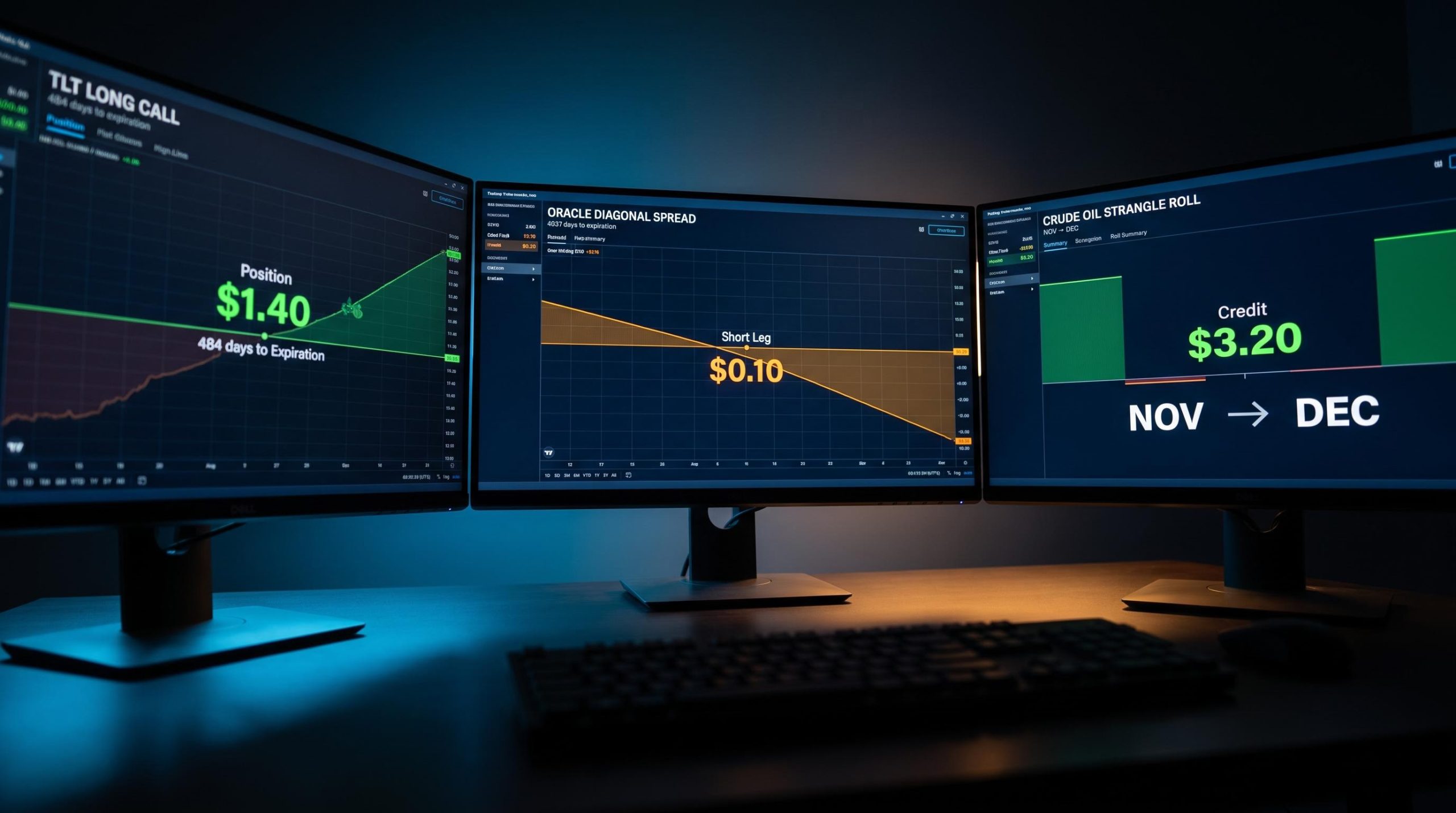
The three trades in this piece each posed a different management decision under real pressure. A long-dated TLT long call bought when implied volatility sat near multi-year lows at 13%. An Oracle diagonal spread with a short leg that had decayed to almost nothing. A crude oil strangle being rolled from the November to the December futures contract.
The backdrop was late October 2023: equity futures selling off, the 10-year Treasury yield pushing past 5.1%, and crude oil trading above $95. Not a calm environment, which is exactly why the decisions taken in it are worth studying.
Work through all three, and you will walk away with a concrete decision framework for three of the most common situations in active options management. Not abstract rules, but specific logic tied to real numbers and real consequences.
Why active options management is a separate skill from trade entry
There is a comfortable assumption baked into most options education: get the entry right, and the rest takes care of itself. Pick the strike, size the trade, collect or pay your premium, and wait.
That assumption holds only for simple, defined-risk trades in calm conditions. For anything with multiple legs, it quietly falls apart.
The reason is that every leg of a multi-leg structure has its own Greeks, the measures of how an option’s price responds to time, price movement, and volatility. Those Greeks evolve at different rates as days pass, the underlying moves, and implied volatility shifts. A diagonal, a strangle, or a LEAPS position (a long-dated option, typically more than a year out) is not one thing you set and forget. It is a set of moving parts that drift out of alignment unless you realign them.
Leaving a position unmanaged is not a neutral act. It is an active choice, and it has consequences. The three techniques in this article each answer a specific way that unmanaged positions go wrong:
- Asymmetric short risk: A short option worth a few cents offers almost no further gain, but a sharp adverse move can turn it into an outsized loss. The reward is tiny; the tail is not.
- Time decay on long-dated positions: Long-dated options carry high vega, meaning a shift in implied volatility moves their value far more than it would a short-dated option. But theta, the daily cost of time, still grinds away, and a thesis that takes too long to play out bleeds value.
- Contract-cycle mismatch in futures options: Options on futures expire against a specific contract month. Ignore the roll from one cycle to the next, and pin and gamma risk near expiration can shift your delta rapidly on small underlying moves.
The techniques that follow, buying cheap convex exposure, closing a near-worthless short, and rolling across contract cycles, are the practitioner’s answers to those three failure modes. Treat the trades below not as isolated stories but as instances of one management philosophy.
When big ASX news breaks, our subscribers know first
The TLT long call trade: buying convex exposure when implied volatility is low
The entry mattered more than the strike here. TLT, the iShares 20+ Year Treasury Bond ETF, was trading near multi-year lows in October 2023, with implied volatility around 13%. Low IV means cheap options, and cheap options on an instrument near the bottom of its range is the setup this trade was built on.
The implied volatility regime of the underlying instrument is the first filter for any options entry: low IV favours premium-buying approaches because you pay less for convexity, while elevated IV tips the balance toward credit-selling structures where theta and vega work in the seller’s favour.
The structure: three long call contracts at the 90 strike, 484 days to expiration, bought at $1.40 each, set to expire 21 January 2025. The macro backdrop was doing the arguing. The 10-year Treasury yield had reached 5.108%, with 5.00% treated as a key psychological level, and bond futures (ZN and ZB) were both declining.
The FRED 10-year Treasury yield series shows that the move past 5% in late October 2023 represented a generational high not seen since the pre-2008 rate environment, a context that shaped the implied volatility regime TLT was trading in at the time of the entry.
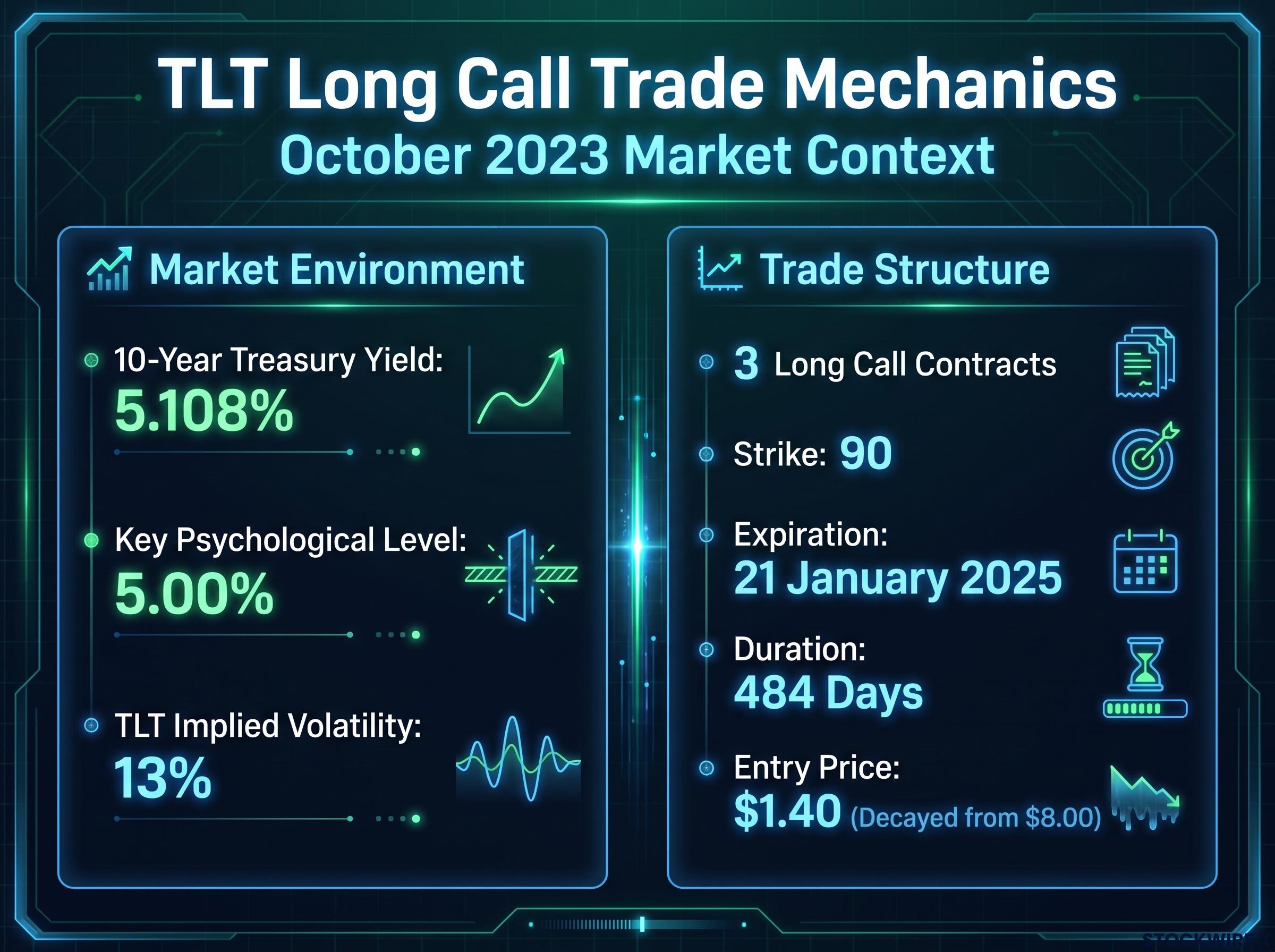
The logic runs through vega and theta. At 484 days, these calls carried high vega, so a rise in implied volatility would lift their value substantially even without a large move in TLT itself. And because theta decay is slow at long maturities, the thesis had time to develop without the steep daily cost you pay on near-term options.
That slow theta is also the trade’s honest tension. The same calls had once traded near $8.00.
The same 90-strike TLT calls that once changed hands near $8.00 had fallen to $1.40 by the time of this session. That is what theta does to a long-dated position when the underlying has not yet moved as expected.
The decay from $8.00 to $1.40 is not evidence the trade was wrong. It is evidence of what time does to long-dated options while you wait, and understanding that distinction is the point before you use a similar structure yourself.
Two camps disagree on whether this is a good approach:
- In favour: Low IV lets you lock in cheap convex exposure. If volatility rises or bond prices mean-revert, long calls with high vega can gain sharply. The defined-risk outlay is small relative to the potential payoff.
- Against: Low IV can stay low or compress further. Theta still accumulates steadily, and a thesis that takes too long to resolve, as the $8.00 to $1.40 slide shows, erodes premium even when the direction eventually proves right.
The choice between short-dated and long-dated options changes how you manage the position:
| Characteristic | Short-dated (30 days) | Long-dated (480+ days) | Implication for management |
|---|---|---|---|
| Theta decay rate | Fast, accelerating into expiry | Slow at the outset, accumulates over time | Long-dated buys time for the thesis |
| Vega sensitivity | Low | High | IV moves matter far more on long-dated calls |
| Management flexibility | Limited, expiry forces action | High, room to roll or restructure | More time to realign strikes with new regimes |
| Primary risk | Rapid time decay | IV compression and slow bleed | Watch volatility regime, not just direction |
Worth noting for anyone eyeing a similar trade today: TLT’s low-teens IV regime has persisted. Its 30-day at-the-money IV was around 12.5% as of 23 September 2026, confirming the structural low-volatility character of this instrument has continued well beyond the original trade.
The Oracle diagonal spread: when to close a near-worthless short leg
The surface logic seems obvious. The short Oracle 210 call had decayed to around $0.10. It is almost worthless, so why pay to close it? Just let it expire and pocket the last few cents.
That intuition is backwards, and here is why. The few cents of remaining value is not the point. What matters is the risk that $0.10 still represents. Professional traders close near-worthless shorts for four specific reasons:
- Asymmetric risk-reward. Holding to expiration earns you a few more cents at best, but a sharp rally in Oracle could push the short call significantly in-the-money, creating losses that dwarf the closing cost.
- Assignment and operational risk. Short options near expiration, even cheap ones, can trigger early assignment, particularly around ex-dividend dates or when they slip slightly in-the-money. That can hand you an unwanted stock position and margin complications.
- Pin and gamma risk near expiration. Very close to expiry, gamma is high, so delta can swing rapidly on small underlying moves. A cheap short option can still produce large P&L swings in the final hours.
- Flexibility for future adjustments. Closing the short frees the long leg to be rolled or restructured without the constraint of an expiring short hanging over it.
Delta polarisation near expiration is precisely what creates the pin and gamma risk described in the Oracle trade: as time runs out, an option that looked safely out-of-the-money can rapidly acquire a delta approaching 1 on small underlying moves, turning a near-worthless short into a directionally dangerous one.
So the management decision was to buy the 210 call back for approximately $0.10 rather than hold it, removing the residual risk while preserving the long leg’s value.
Risking a large, undefined loss to earn an extra $0.05 to $0.10 of premium is a poor trade-off. The $0.10 repurchase price converts that tail risk into a small, known cost.
If you are currently holding near-worthless short legs in diagonals or covered positions, ask yourself whether those few cents of remaining value are worth the asymmetric risk profile they still carry. This trade shows the answer is almost always no.
Rolling a crude oil strangle across contract cycles: managing futures-linked positions
A roll is mechanically simple: close the position in the expiring contract, open it in the next cycle. On options tied to futures, that decision comes with a wrinkle equity traders never face, because each contract month has its own price.
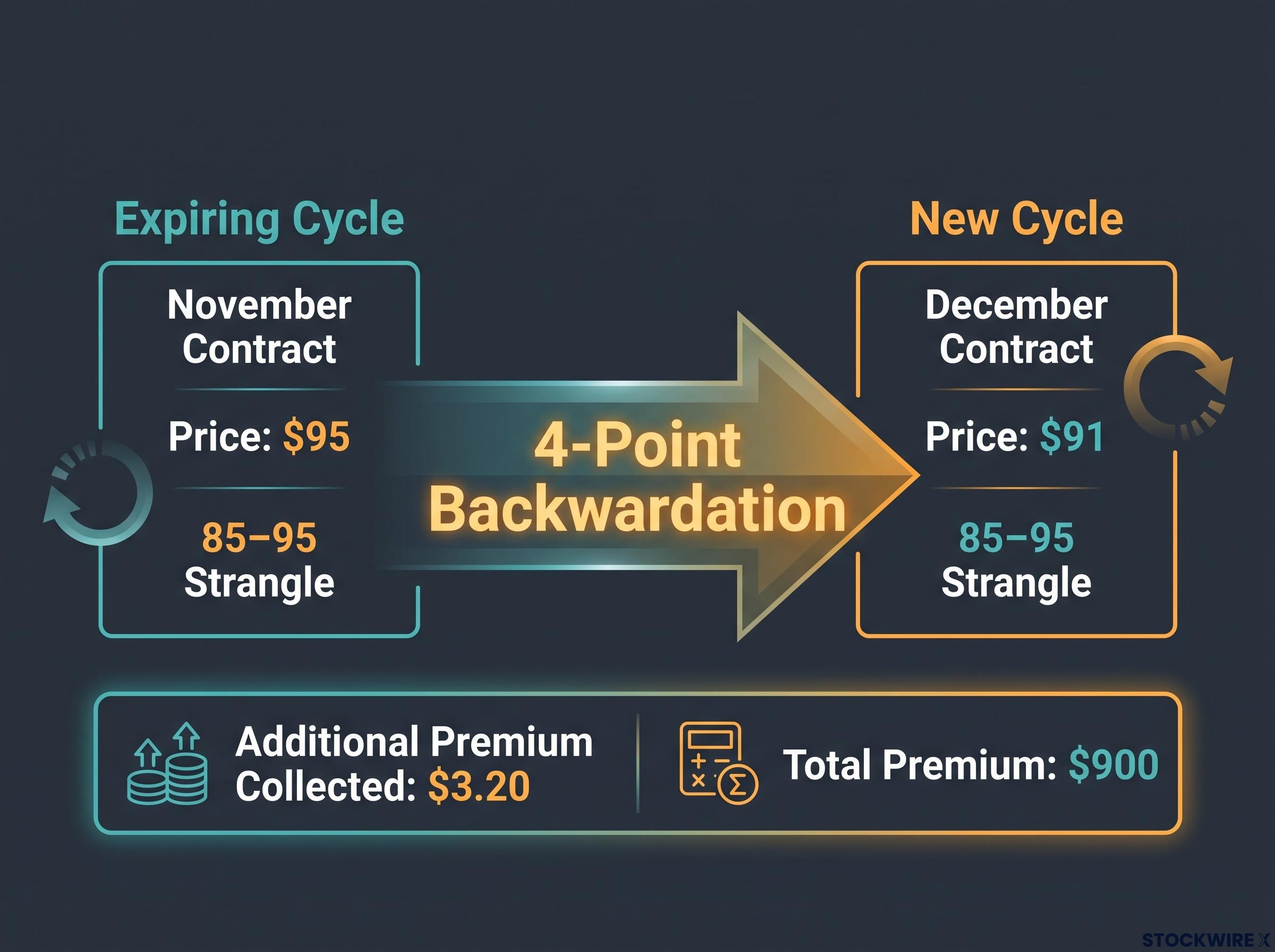
Here the crude oil 85-95 strangle moved from the expiring November contract, trading near $95, to the December cycle, trading at approximately $91. That roll collected $3.20 in additional premium, bringing total premium collected on the strangle to $900. No strike adjustment was made.
The reason no adjustment was needed sits in the numbers. December was trading roughly four points lower than November, a condition called backwardation, where nearer contracts price higher than deferred ones. With the new underlying about $4 lower, both the 85 put and the 95 call sat farther out-of-the-money, which reduced their deltas and kept the position’s risk profile within tolerance without any restructuring.
Flip the term structure and the calculation changes. If the market had been in contango, with December higher than November, holding similar risk exposure might have required strikes further from the new spot, potentially reducing premium or skewing the position’s delta unfavourably.
Before rolling rather than closing, four risks deserve weighing:
| Factor | Roll decision | Close decision | Why it matters |
|---|---|---|---|
| Basis risk | Keeps inter-month basis exposure | Removes it entirely | Contract months react differently to supply-demand shocks |
| Volatility regime (IV change) | May carry higher vega in deferred month | Exits before an IV spike | OPEC meetings and inventory data can lift deferred IV |
| Liquidity and slippage | Wider spreads possible on deferred contracts | Front-month usually more liquid | Slippage on a multi-leg roll adds real cost |
| Margin and duration exposure | Extends overnight and weekend risk | Closes the exposure window | Longer duration keeps margin and gap risk open |
As a practical filter, rolling tends to make sense under specific conditions, and closing under others:
- Prefer rolling when: the thesis is intact, a net credit is available, deltas stay within tolerance, and no major event looms in the deferred month.
- Prefer closing when: the underlying has moved adversely, volatility has spiked, liquidity is thin, or a high-impact event sits ahead in the deferred cycle.
The four-point backwardation was not just a number. It was the market structure condition that made this roll favourable, so before you decide whether to keep or adjust strikes on any futures strangle roll, identify whether you are in backwardation or contango first.
Futures term structure shapes more than the roll arithmetic: the same contango-versus-backwardation question that determined whether the crude strangle roll was favourable also drives the persistent premium of VIX futures over spot VIX, and traders who ignore term structure in either market consistently misprice their risk.
For context, WTI’s front-month continuous contract (CL.1) was around $89.86 on 22 September 2026, a reminder that futures-options traders keep facing these contract-cycle decisions across very different price regimes.
What the three trades have in common, and what that means for your own positions
Strip away the instruments and the three trades share one spine. Each was a specific, rules-based response to a specific market condition, not a reactive or emotional decision, and each response was designed to eliminate an identifiable risk or preserve an identifiable option value.
The $1.40 TLT calls with 484 days to run preserved cheap convex exposure over time. The Oracle 210 call bought back for $0.10 eliminated tail risk for a known small cost. The crude oil strangle rolled for $3.20 in additional credit extended the thesis with a favourable delta adjustment from backwardation. In every case, the call was made on Greeks and market structure, not on how the trader felt about the position.
That shared logic reduces to a three-step filter you can run on any of your own open positions:
- Identify what risk the current structure carries that was acceptable at entry but is no longer acceptable now.
- Identify the smallest mechanical action that removes that risk.
- Execute without anchoring to your entry price or your theoretical profit at expiration.
The one-line takeaway from each trade:
- TLT: Buy cheap convexity when IV is low, and understand that slow theta, not a broken thesis, explains premium decay while you wait.
- Oracle: Close near-worthless shorts, because a few cents of value never justifies an open tail.
- Crude oil: Roll on net credit and term structure, not reflexively to keep a trade alive.
This is the difference between traders who carry multi-leg positions successfully and those who get surprised by assignment, gamma swings, or futures-roll slippage.
Making these techniques your own in real market conditions
Now turn this on your own position log. Each of the three techniques comes with a checklist you can apply the moment one of your positions reaches a decision point.
- Long-dated, low-IV entries.
- Check whether current implied volatility sits in the lower half of the instrument’s 52-week range.
- Confirm the underlying is near a structural support or mean-reversion level, not mid-range.
- Remember the vega trade-off: you profit if IV rises, but slow theta still bleeds you if the thesis stalls.
- Near-worthless short legs.
- Close the short when it is worth less than 10-15 cents and more than 21 days remain to expiration.
- Treat the 10-cent threshold as a commonly cited practitioner heuristic, not a hard rule.
- Weigh assignment risk first around ex-dividend dates or when the short drifts in-the-money.
- Futures strangle rolls.
- Check that the roll delivers a net credit.
- Recalculate the underlying-adjusted delta on both legs against the new contract price.
- Scan the deferred month for scheduled events, OPEC meetings, or inventory releases, before committing.
These thresholds are starting points, not commandments. Calibrate them to your own risk tolerance and position size.
And the specific conditions of October 2023, elevated yields, crude near $95, equity futures selling off, are not required to use any of this. TLT’s low-teens IV persisted into late September 2026, proving the setups recur. These are structural management decisions that hold across market regimes, and applying them consistently is what separates a managed position from a drifting one.
For readers wanting to see the worst-case consequences of undisciplined rolling, our deep-dive into how rolling losing spreads compounds losses documents how a 15,000-contract zero DTE position was wiped out on Christmas Eve 2025 by the exact stacking of losses this article’s roll framework is designed to prevent.
This article is for informational purposes only and should not be considered financial advice. Investors should conduct their own research and consult with financial professionals before making investment decisions. Past performance does not guarantee future results, and options trading carries substantial risk of loss.