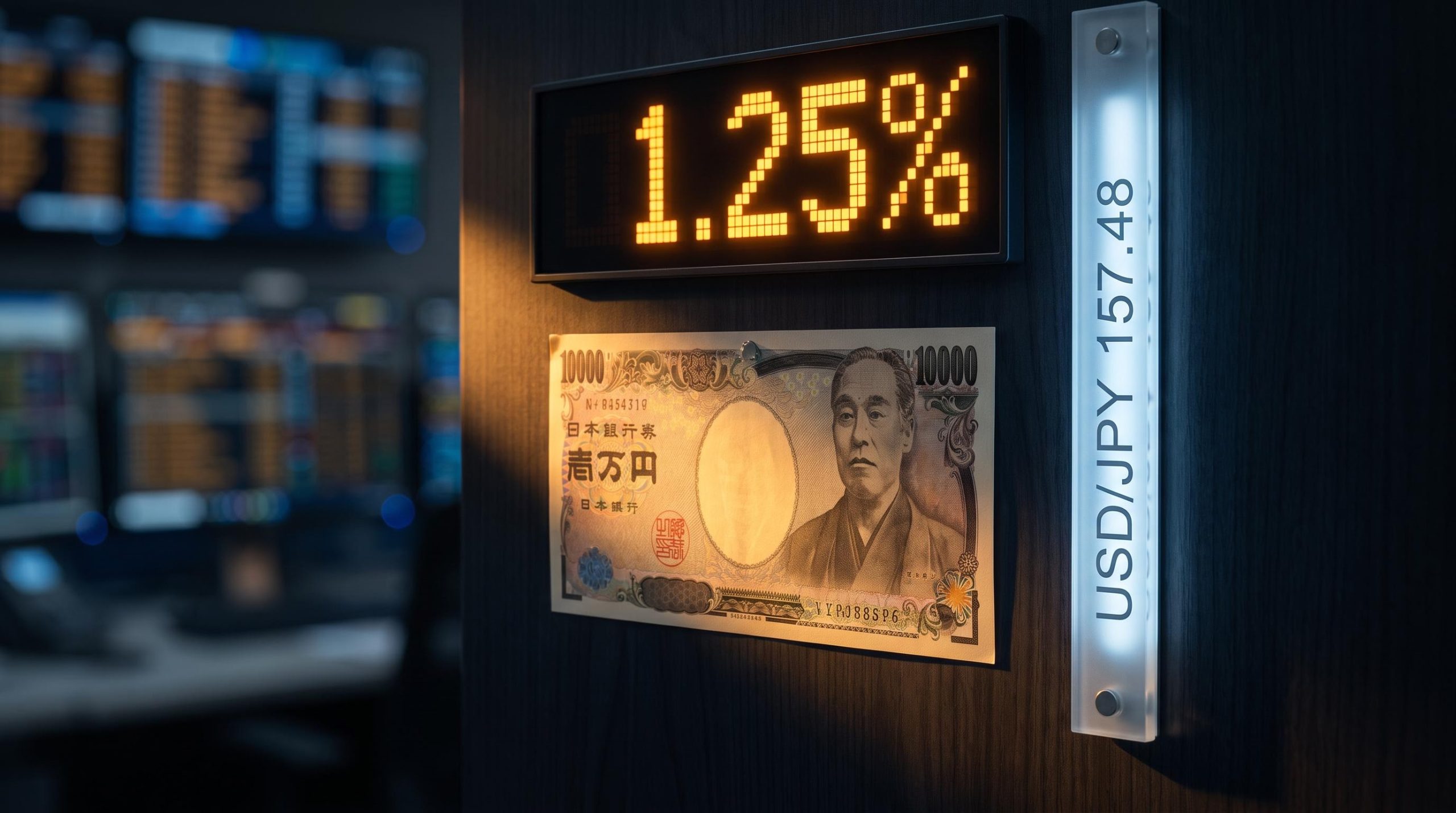
The Bank of Japan just raised interest rates to their highest level in 31 years. The yen is still sitting near 157 per dollar, roughly where it languished before the decision.
That should not happen, at least not according to the assumption most investors carry: higher rates strengthen a currency. On 18 September 2026, the BoJ voted 7-2 to lift its policy rate from 1.00% to 1.25%, stepping into the lower bound of its own estimated neutral range for the first time in a generation. USD/JPY barely flinched.
This is no longer a domestic monetary story. Prime Minister Takaichi has expressed general concern over yen weakness, and Finance Minister Katayama has focused on maintaining close U.S.-Japan coordination on foreign exchange without commenting directly on yen levels, while US President Trump reportedly raised it directly at a bilateral summit. The path from the ultra-loose framework launched in 2013, through the March 2024 lift-off, to this latest step has been slow and deliberate, and the currency has read it accordingly.
The Bank of Japan yen weakness puzzle rewards patience. Currency markets are not ignoring the rate hike. They are pricing a verdict on what it actually means, and that verdict has to be worked through carefully before you form any view on yen-exposed assets.
A rate at a 31-year high, and a currency that refuses to recover
Start with the raw numbers, because the paradox speaks for itself. The BoJ lifted its short-term rate to 1.25%, effective from around 24 September 2026, on a 7-2 board vote. Reuters describes this as a 31-year high; the rate was last at a comparable level in April 1995.
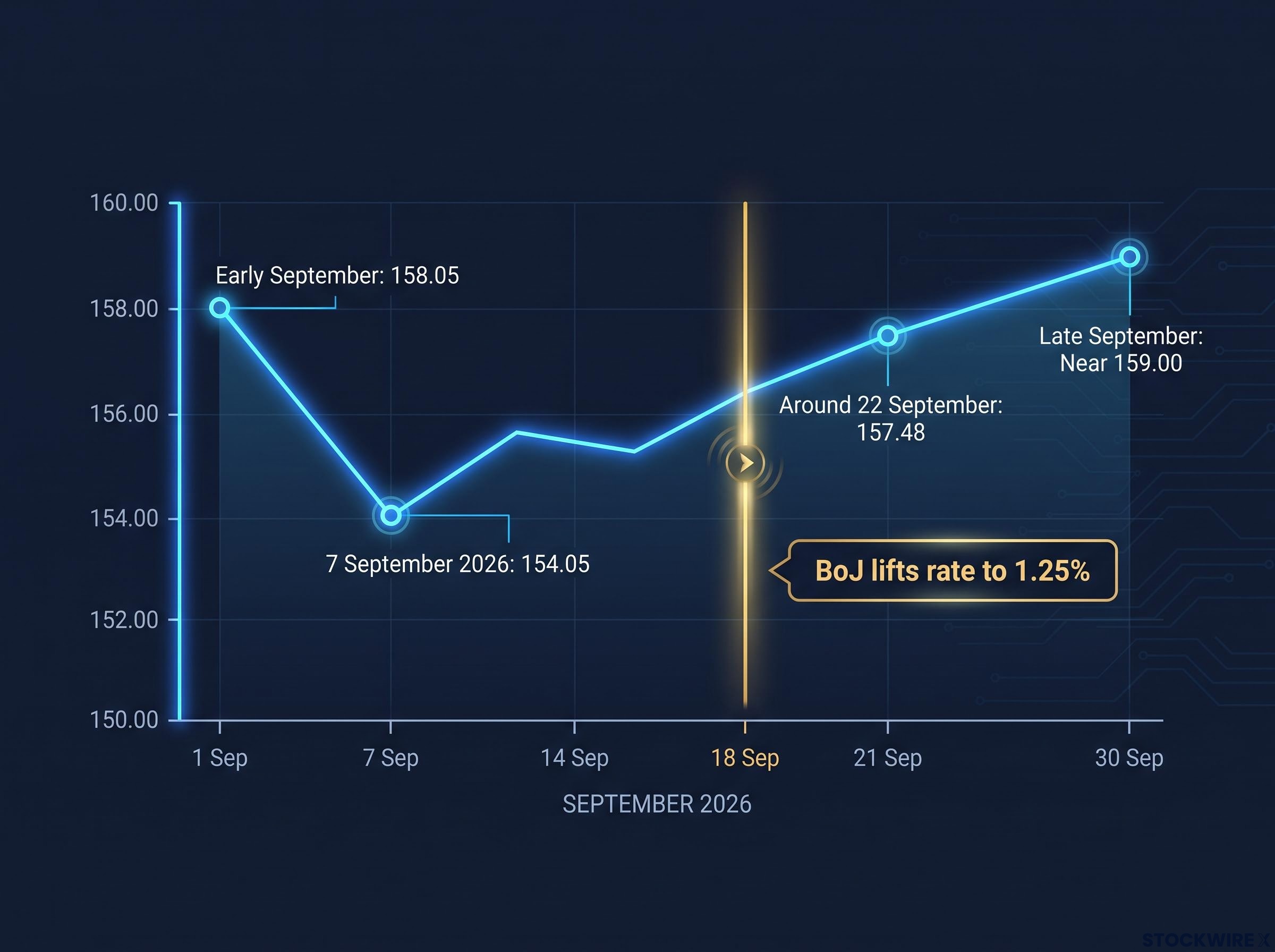
And the yen? It traded near 157.48 per dollar around 22 September, having touched a three-week high near 159.00 before easing back. Earlier in the month, on 7 September, the dollar had briefly slipped to 154.05, the strongest yen level since February. The trading band across the month sat stubbornly in the mid-to-high 150s.
| Date or Period | USD/JPY Level | Context or Driver |
|---|---|---|
| 7 September 2026 | 154.05 | Strongest yen since February, before recovering |
| Early September | 158.05 (intraday high) | Weak yen, intervention watch building |
| Around 22 September | 157.48 | Yen off 0.38% as traders watched for intervention |
| Late September | Near 159.00 | Three-week high before retreating |
The market’s non-reaction is not a failure to notice. It is a rational read on what 1.25% actually buys.
A 31-year milestone that markets shrugged off The last time the BoJ’s policy rate stood this high was April 1995. For most of the three decades since, Japan operated with near-zero rates and unconventional easing. A move of this historical weight moved the currency almost not at all.
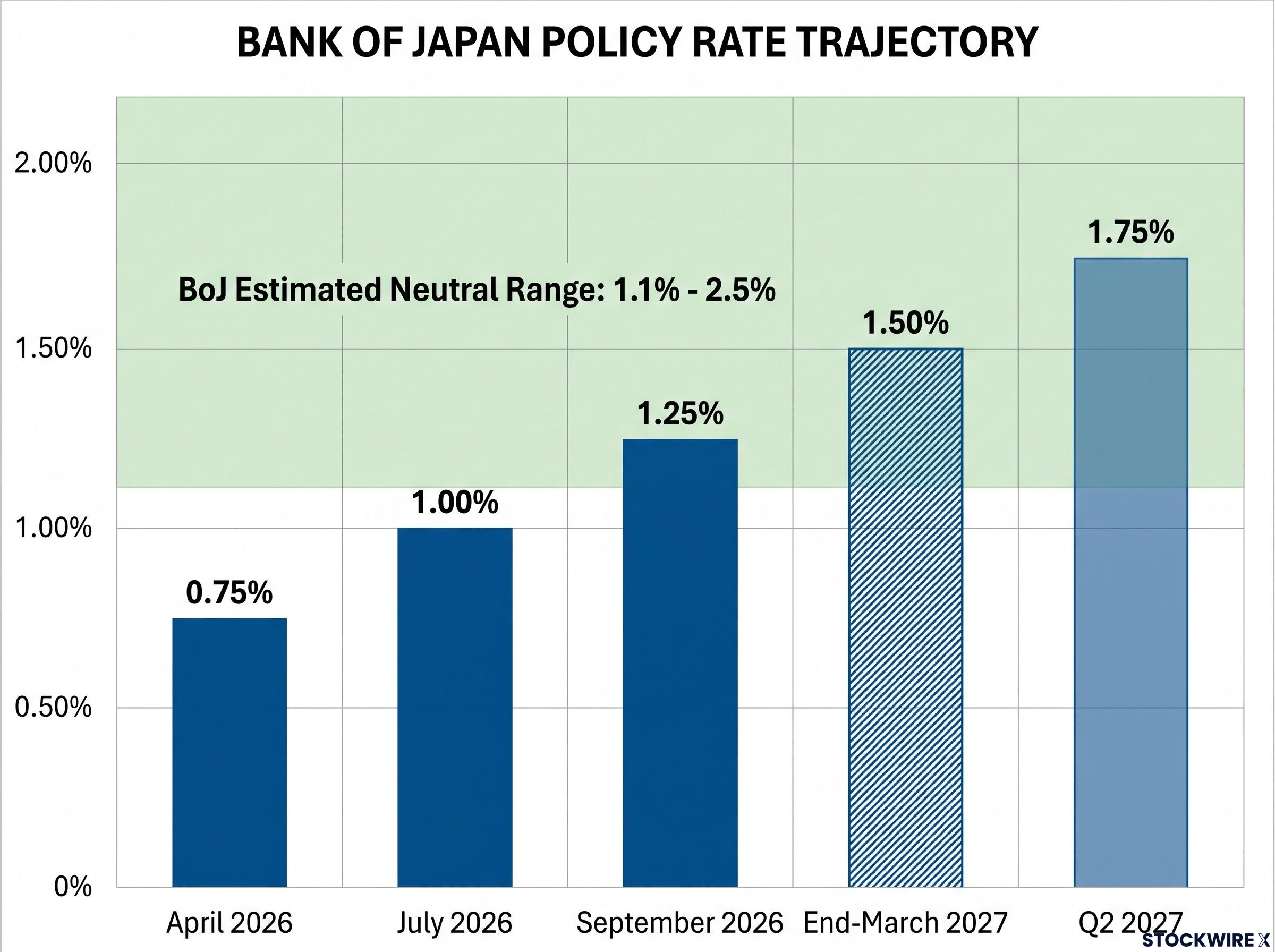
Here is why. The BoJ’s own estimated neutral range sits at just 1.1%-2.5%. Reaching “neutral” for Japan still leaves its rates far below those of peer economies, where policy has been considerably tighter for years. Analysts surveyed by Reuters expect only modest further increases: 1.50% by end-March 2027 and 1.75% in Q2 2027. That is a continuation of the same cautious trajectory, not an acceleration.
For anyone holding yen-exposed positions or watching USD/JPY as a macro signal, the lack of appreciation after a historic rate milestone is the most instructive data point of the cycle. It tells you the market is pricing the BoJ’s normalisation as too slow and too shallow to change the fundamental calculus. Hold that thought, because it anchors everything that follows.
When big ASX news breaks, our subscribers know first
Why a rate hike is not enough: the mechanics of the yen carry trade
To understand why the yen refuses to strengthen, you need to understand the trade that keeps it weak. The yen carry trade works like this: investors borrow in yen, where rates are low, and deploy that capital into higher-yielding assets denominated in dollars or other currencies. The trade stays profitable as long as the interest rate gap between the two holds.
That gap is the whole story. Morgan Stanley Research characterises the yen as a barometer for global rates and liquidity, arguing that its longer-term direction is tied more to US monetary policy than to intervention or anything the BoJ does. As long as US rates stay elevated and the Federal Reserve keeps policy tight, dollar assets retain their yield advantage, carry trades stay attractive, and USD/JPY stays high.
Morgan Stanley also describes the BoJ as broadly “behind the curve.” A move from 1.00% to 1.25% does little to close a differential measured in multiple percentage points. Even if the BoJ reaches 1.75% by mid-2027, the gap with US rates would still leave carry trades intact and the yen elevated, absent a Fed pivot.
The yen driver framework that governs USD/JPY across three time horizons places yield differentials as the medium-term dominant force, which explains precisely why a short-term BoJ policy shift registers so weakly in the spot rate when the structural spread remains wide.
This is the analytical shift the section asks you to make. Three structural forces keep the yen weak despite BoJ tightening:
- Yield differential dominance: The US-Japan rate gap, not the BoJ’s absolute rate, drives FX pricing. A wide gap keeps the yen weak.
- Gradualism of normalisation: The BoJ’s slow, telegraphed path signals convergence over years, not a decisive shift markets can trade on now.
- Limited intervention impact: One-off FX operations displace the currency temporarily but do not reverse the underlying trend.
The most striking figure sits in Morgan Stanley’s fair-value work. It estimates the yen’s fair value at 165-167 per dollar, weaker than where it currently trades, improving only toward 155 as the Fed eventually eases. That tells you the current level is not a screaming undervaluation on fundamentals. Any thesis for yen recovery has to run through US monetary policy, not Japanese rate decisions.
What the joint US-Japan intervention revealed
The clearest real-world illustration came from a joint US-Japan intervention that briefly strengthened the yen from around 163 to roughly 155 per dollar. Within weeks, the currency drifted back toward 159.
That round trip is the lesson. Intervention generates temporary displacement, not sustained reversal, when the rate environment underneath it stays unchanged. Structural yield forces simply overwhelm one-off policy actions.
It reinforces Morgan Stanley’s conclusion: sustained yen recovery follows US easing, not Japanese tightening. If you are waiting for the yen to turn, the Fed is the scoreboard to watch, not the BoJ.
The case for faster hikes versus the case for caution
The pace of BoJ normalisation is a genuine dilemma, and it is worth feeling the weight of the trade-off before drawing any conclusion. On one side sits currency stability. On the other sits domestic financial stability. The two pull in opposite directions.
The “too slow” camp has gathered force. Reuters economist surveys through July to September 2026 show rising calls for the BoJ to speed up its tightening, driven by persistent price pressures and yen weakness. An August Reuters report stated explicitly that the BoJ is considering hiking “more aggressively thereafter” than its earlier pace of roughly twice a year. Morgan Stanley’s “behind the curve” framing aligns with this view.
The BoJ communication shift signalled by Deputy Governor Himino, who stated the bank does not need complete information before acting, lowers the practical threshold for future hikes and changes the risk calculus for carry traders who previously treated inaction as the base case between scheduled meetings.
The caution camp speaks through Governor Kazuo Ueda’s own logic. An economy accustomed to near-zero rates for more than a decade faces real financial stability risks if tightening accelerates too fast. Japan’s high public debt burden and the sensitivity of domestic borrowers and banks to rising rates are the structural constraints holding the pace down.
| Case for faster hikes | Case for gradualism |
|---|---|
| Inflation risks skewed to the upside, driven by yen depreciation and energy costs | Economy long accustomed to near-zero rates faces stability risks from rapid tightening |
| Reuters surveys show economists expecting hikes sooner than previously thought | High public debt burden makes rising rates fiscally sensitive |
| Morgan Stanley labels the BoJ “behind the curve” on the yield gap | Domestic borrowers and banks are exposed to faster rate increases |
| Persistent yen weakness revives import-driven inflation | September hike deliberately confined to the lower end of the neutral band |
Ueda’s revealed preference has been consistent throughout the cycle.
Governor Ueda, April 2026 The BoJ held its rate at 0.75%, with Ueda stating there was “no immediate need to raise rates” despite acknowledged upward inflation risks.
The July 2026 meeting captured the difficulty of this phase perfectly. The BoJ held at 1.00% while simultaneously warning, for the first time, that underlying inflation could overshoot its 2% target. Preemptive on inflation, cautious on pace: that asymmetry is deliberate.
Even at the September hike, the BoJ confined its rate to the lower end of the neutral band and signalled only modest further increases. That positioning tells you something the central bank will not say outright: it does not believe its own economy can absorb faster normalisation without financial stability consequences. Read as forward guidance, that is a signal about how slowly the yield gap will close, and therefore how slowly any yen recovery can arrive.
Beyond the exchange rate: how yen weakness ripples through the global economy
A weak yen is not a contained currency-market curiosity. Its consequences fan out across inflation, corporate earnings, financial stability, and diplomacy. Here is the map before the detail:
- Domestic inflation: A cheaper yen raises the cost of imported energy and food, feeding consumer prices and potentially forcing faster hikes.
- Corporate earnings divergence: Exporters gain on repatriated foreign profits; import-reliant and domestic firms face margin pressure.
- Global financial stability: Yen weakness feeds into US Treasury yields and cross-border funding through carry-trade positioning.
- Bilateral trade and geopolitics: Persistent depreciation raises political friction between Tokyo and Washington.
Take inflation first. Reuters coverage repeatedly links the weak yen to reviving inflation risks, with “soaring oil costs” cited by the BoJ as a key driver. As the yen falls, imported energy and food cost more in yen terms, feeding into household bills. There is a paradox buried here: currency-driven inflation could push prices further above the 2% target and force the BoJ to hike faster than it currently signals.
Then corporate earnings. A weak yen typically flatters export-oriented multinationals when overseas profits are repatriated, while squeezing firms reliant on imported inputs. That opens a sectoral fault line inside Japan’s equity market, globally focused manufacturers on one side, domestically oriented retailers and utilities on the other. Morgan Stanley notes large Japanese institutions and corporates also carry currency exposure through foreign asset and debt holdings.
The carry trade unwind risk
The global stakes sit in the carry trade. When yen-funded positions are unwound rapidly, investors are forced to reposition across unrelated asset classes at once, amplifying volatility in US Treasuries and emerging market equities alike.
Morgan Stanley identifies yen weakness as a factor in US Treasury yields, borrowing costs, and global market volatility, framing this as a genuine stability concern rather than a bilateral FX issue. For investors well outside Japan, that means a sharp yen move in either direction can send ripples through your bond and equity exposure whether or not you hold a single yen-denominated asset.
Carry trade unwind risk is real but historically self-limiting: the 2024 episode resolved within weeks with 40-60% of speculative positioning cleared without cascading into structural equity market breakdown, a pattern that sets a useful baseline for calibrating how much systemic weight to assign to any given yen move.
The geopolitical layer completes the picture. US President Trump reportedly raised yen weakness at a bilateral summit, and Finance Minister Katayama committed to close US-Japan coordination on FX. Persistent depreciation carries diplomatic consequences, not just economic ones, because it feeds US concerns about trade competitiveness. Treating USD/JPY as a single-variable story misses all of it.
What the yen’s path forward actually depends on
Time to reframe the mental model. The yen’s recovery is not primarily a story the BoJ will write. It is a story the Federal Reserve will write, and the practical task is to watch the right scoreboard.
Morgan Stanley’s framework makes the point plainly. Fair value currently sits at 165-167 per dollar and improves toward 155 only as the Fed eventually stops hiking and begins cutting, not as a direct result of BoJ moves. The forward path for the BoJ, 1.50% by end-March 2027 and 1.75% in Q2 2027, still leaves Japanese rates far below major peers.
Morgan Stanley’s yen fair value framework places the currency’s fundamental equilibrium at 165-167 per dollar, a level weaker than where it currently trades, with improvement toward 155 contingent on Federal Reserve easing rather than any action the BoJ is likely to take within its current normalisation path.
Morgan Stanley’s counterintuitive anchor Fair value for the yen is estimated at 165-167 per dollar, weaker than where it trades today. The yen is not cheap at current levels even on fundamentals.
So what should you actually track? Three variables sit above BoJ meeting dates in order of importance:
- Federal Reserve rate direction. This is the dominant input. The yield gap closes decisively only when the Fed pivots, so US inflation data and Fed communication are the primary drivers of USD/JPY.
- BoJ inflation overshoot response. If inflation runs hotter than expected, the BoJ could deviate from its cautious forward path and hike faster, compressing the gap sooner than markets price.
- US-Japan FX diplomacy. With the currency politically sensitive around 157-159, the coordination posture between Tokyo and Washington sets a near-term tone.
There is one wildcard. Japanese authorities have shown willingness to intervene near prior extremes, and markets are already pricing “intervention watch” sentiment. That means the political floor for USD/JPY may sit above the fundamental floor. The clear implication: positioning around yen recovery using BoJ decisions as your primary signal means watching the wrong variable, and the yen’s muted response to BoJ announcements will keep disappointing anyone who forgets that.
For investors wanting to map the full range of credible outcomes, our full explainer on USD/JPY forecast scenarios covers institutional projections from 138 to 160, the role of Japan’s 240% debt-to-GDP ceiling on BoJ hikes, and the intervention thresholds that define the near-term political floor.
This article is for informational purposes only and should not be considered financial advice. Investors should conduct their own research and consult with financial professionals before making investment decisions. Past performance does not guarantee future results. Financial projections are subject to market conditions and various risk factors.
The yen’s recovery belongs to the Fed, not the BoJ
Japan’s most aggressive rate cycle in a generation has lifted the policy rate to a 31-year high and barely moved the currency. The reason sits at the centre of this whole analysis: the dominant force in USD/JPY pricing is the US-Japan yield differential, not BoJ decisions taken in isolation.
Two things could genuinely change the picture. A faster-than-expected BoJ acceleration, driven by a more severe inflation overshoot, would narrow the gap from the Japanese side. A US recession prompting earlier Fed cuts would narrow it from the American side. Either compresses the differential more quickly than the current base case allows.
Absent those, the floor scenario holds: even at 1.75% by mid-2027, Japan’s rate stays far below US levels, and Morgan Stanley’s thesis stands that recovery follows Fed easing rather than BoJ tightening.
The reorientation is simple. Watch Fed communication first and BoJ pace second, and treat the intervention threshold set by Japanese authorities as a political support level, not a fundamental one. The next material yen move will be telegraphed from Washington, not Tokyo.