
A company that holds more Bitcoin than any other public entity just filed a regulatory disclosure revealing it halted all Bitcoin trades for a week, bought back over $132 million of its own preferred securities, and quietly grew a USD cash buffer to $4.8 billion. For most publicly traded companies, a week like this would be unremarkable. For Strategy Inc, it is a precise, deliberate sequence of balance sheet moves that tells a specific story about where the firm is in its capital cycle.
Strategy Inc, formerly known as MicroStrategy and now self-described as the world’s first Bitcoin Treasury Company, operates on a model most investors have never encountered. It raises money from public equity and credit markets, holds that money primarily as Bitcoin, and manages a layered capital structure to service dividends, interest, and repurchase obligations while keeping its BTC stack intact. Understanding any single week of filings requires understanding how all the pieces interact.
Here is a clear framework for reading Strategy’s treasury moves as they happen, starting with the specific transactions disclosed in the 17 August 2026 Form 8-K and working outward to the mechanics that explain why each action was taken and what it means if you hold or are watching MSTR and STRC.
What Strategy’s August 17 filing actually disclosed
The Form 8-K covered three distinct actions during the week of 10-16 August 2026:
- ATM share sales: 3,458,866 MSTR shares sold via the at-the-market programme, generating net proceeds of $333.7 million
- STRC preferred repurchases: 1,388,720 STRC shares repurchased at a cost of approximately $132.2 million
- Bitcoin pause: No BTC bought or sold; holdings unchanged at 840,447 BTC as of 16 August 2026
After these moves, Strategy’s USD reserve increased to $4.8 billion (including unsettled ATM cash).
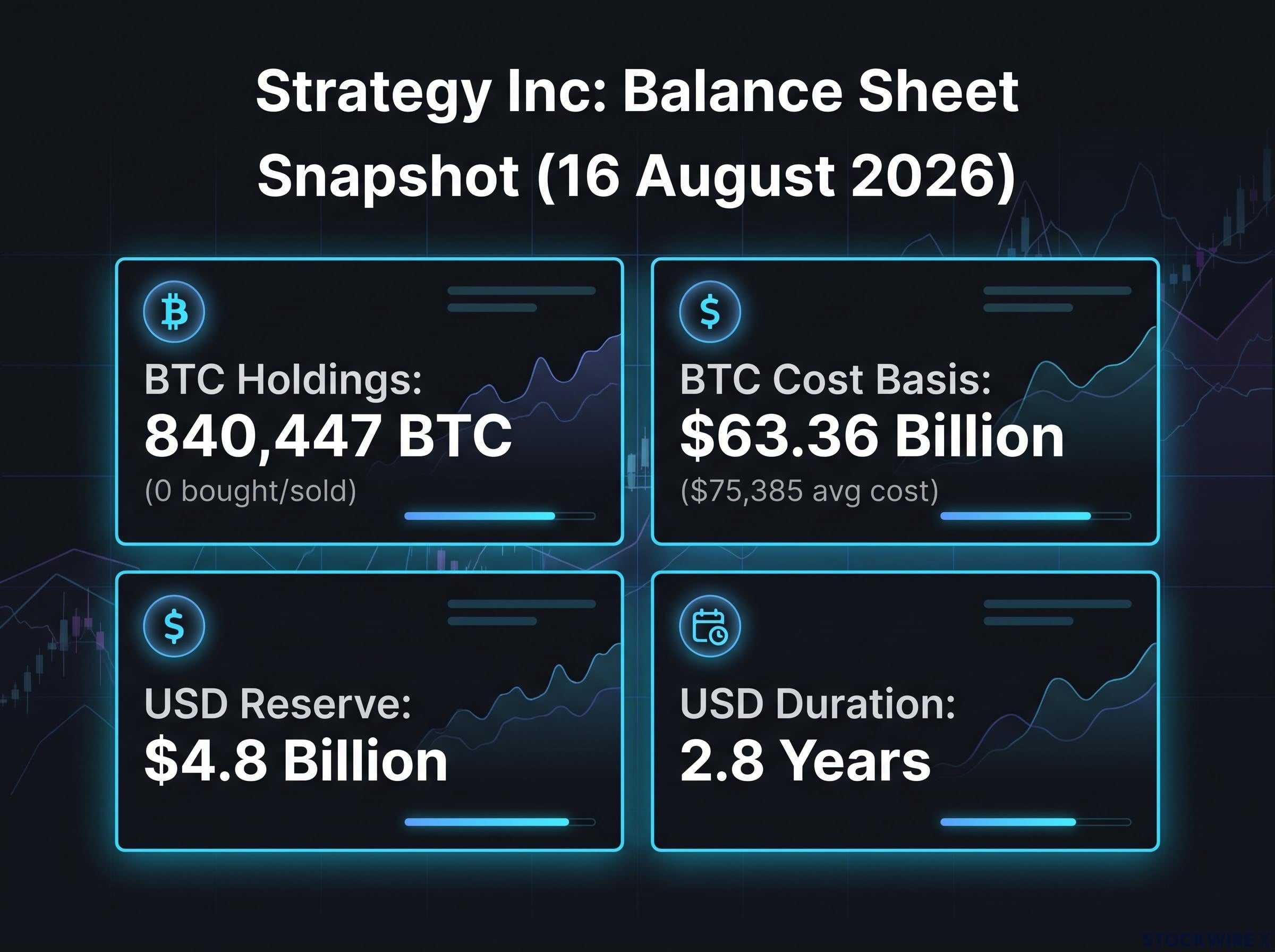
$4.8 billion USD reserve as of 16 August 2026, covering approximately 2.8 years of preferred obligations
These three actions were not independent events. They form an interconnected capital allocation sequence executed across a single week: raise equity, retire higher-cost preferred capital, hold BTC steady, and grow the cash buffer. The simultaneous movement of all three levers tells you this was a planned balance sheet management operation, not a passive week.
If you read only the BTC headline (no change in holdings), you miss the more important story. The real signal sits in how Strategy is actively managing its obligations, and the specifics of each action carry different costs, different beneficiaries, and different implications for what comes next.
When big ASX news breaks, our subscribers know first
How the Bitcoin Treasury Company model works
Strategy’s primary economic engine is not software sales. It is the accumulation of Bitcoin using capital raised from public markets, a model the company formalised through its February 2025 rebrand (announced 5 February 2025, with the legal name change becoming effective 11 August 2025). MSTR (Class A common stock) and STRC (Variable Rate Series A Perpetual Stretch Preferred Stock) continue trading under their existing tickers.
The result is a company that behaves like a levered Bitcoin fund wrapped in a public equity structure. As of 16 August 2026, Strategy’s aggregate BTC purchase price stands at $63.36 billion, at an average cost of $75,385 per BTC. That means MSTR does not trade on earnings revisions or software contract wins. It trades on Bitcoin’s price, amplified by the leverage embedded in Strategy’s capital structure.
Understanding this reframes how you read every capital markets action the company takes. Equity issuance is not dilution for growth investment; it is dilution for Bitcoin exposure. The trade-off is only favourable when BTC appreciation outpaces the dilution cost. If you approach Strategy with a conventional equity analysis framework, you will consistently misread its filings.
The debate over Bitcoin as a reserve asset extends well beyond corporate treasury decisions; institutional classification of Bitcoin as a speculative risk instrument rather than a store of value is precisely why Strategy’s leveraged model amplifies both upside and drawdown exposure relative to a position in the underlying asset itself.
The flywheel in practice
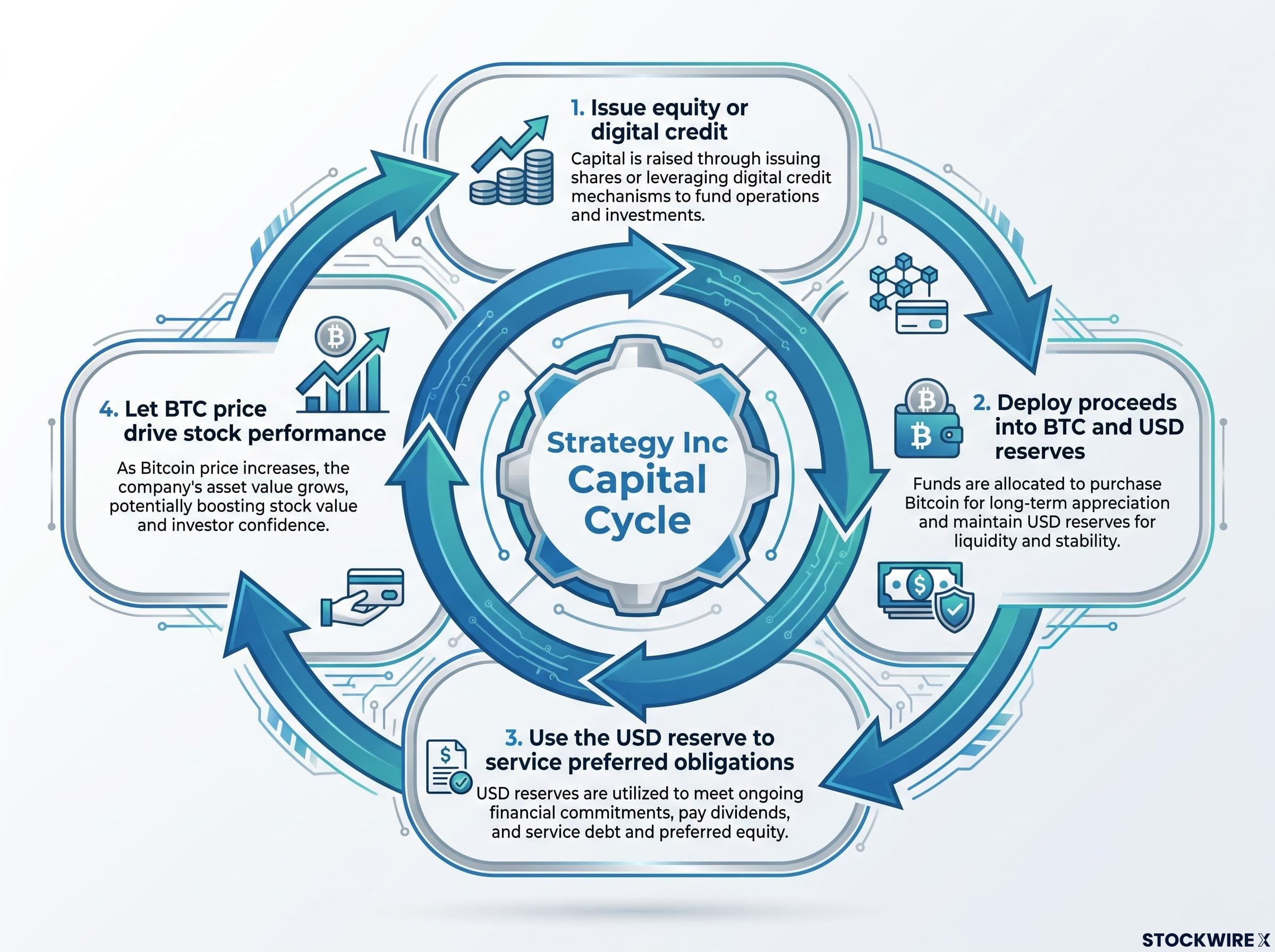
Strategy’s capital cycle operates in four steps:
- Issue equity or digital credit. ATM programmes and digital credit instruments bring in new funds.
- Deploy proceeds into BTC and USD reserves. Earlier periods saw more direct BTC purchases; recent filings show a tilt toward building the cash buffer.
- Use the USD reserve to service preferred obligations. Preferred dividends, interest payments, and repurchases of digital credit securities all draw from this pool.
- Let BTC price drive stock performance. The BTC reserve and layered capital structure amplify moves in the underlying asset, making MSTR a leveraged proxy for Bitcoin.
The August 2026 filing represents Step 3 in action: building the USD reserve and retiring preferred obligations rather than accumulating more BTC. Recognising which step Strategy is executing at any given time is what separates an informed read from a surface-level one.
Breaking down the ATM programme and what $333.7 million actually funded
An at-the-market (ATM) programme is a mechanism that lets a company sell new shares directly into the open market in small increments over time, rather than launching a single large offering that could disrupt the stock price. Strategy uses ATM issuance as its primary equity funding tool because it allows capital to flow in steadily without the pricing concession a traditional follow-on offering would require.
During the week of 10-16 August 2026, Strategy sold 3,458,866 shares for net proceeds of $333.7 million. Here is where those proceeds went:
| Capital Action | Amount | Destination/Purpose |
|---|---|---|
| USD reserve addition | ~$149-150 million | Cash buffer for preferred obligations |
| STRC repurchases | ~$132.2 million | Retiring higher-priority preferred capital |
| Preferred dividends | Remainder | Servicing ongoing dividend obligations |
The total STRC repurchase authorisation stands at $1 billion under an ongoing programme.
The gap between the $333.7 million raised and the $149-150 million added to cash tells you that Strategy is simultaneously growing, servicing, and simplifying its capital structure in a single week’s operation. That is a more sophisticated balance sheet manoeuvre than the headline equity raise suggests.
For you as an investor tracking MSTR share dilution, the allocation breakdown matters. Dilution in this case purchased two things at once: more cash runway and a cleaner liability structure, both of which reduce the company’s vulnerability to Bitcoin price stress.
What the $4.8 billion USD reserve and 2.8-year duration metric mean
“USD duration” in Strategy’s context refers to the number of years the current cash reserve could cover preferred dividends and interest payments without additional capital raises. It is a stress-test metric: how long can the company meet its obligations from cash alone if no new money comes in?
USD duration of approximately 2.8 years as of 16 August 2026
That figure carries weight for multiple audiences simultaneously. For preferred holders of STRC, it signals near-term payment security. For equity investors in MSTR, it signals that forced BTC liquidation risk is low. For credit watchers, it signals a company actively managing its liability stack rather than letting obligations accumulate uncovered.
The same bitcoin-treasury model that makes the $4.8 billion reserve a sign of operational strength is the precise configuration flagged under MSCI’s proposed non-operating company screen, meaning MSCI index exclusion risk for MSTR sits alongside the balance sheet metrics as a live consideration for investors tracking the October 2026 methodology decision.
The USD reserve has a specific constraint you should understand. Its current framework limits permitted uses to:
- Preferred dividend payments
- Interest payments on digital credit securities
- Repurchases of digital credit securities (including STRC)
- Not permitted: direct BTC purchases from the existing reserve
This means the $4.8 billion is not freely available for new Bitcoin accumulation. Large new BTC purchases would still require incremental capital raises rather than simply drawing down the cash pile.
For your risk assessment, the 2.8-year duration is as important as the BTC stack itself. With 840,447 BTC at an average cost of $75,385, Strategy’s equity is highly sensitive to Bitcoin’s price. A multi-year cash buffer means the company can absorb a sustained Bitcoin bear market without being forced to sell BTC at depressed prices, which is precisely the scenario that would be most damaging to MSTR holders.
Risks that do not disappear behind a $4.8 billion cash pile
The filing reads well in isolation. But each piece of positive news has a specific counterweight worth understanding.
- Dilution risk: Every ATM issuance increases the share count. The model only works net-positive for existing shareholders when Bitcoin appreciation outpaces dilution cost. In flat or declining BTC markets, each new share sold erodes your claim on the underlying BTC reserve without growing its value.
- Capital structure complexity: Multiple classes of digital credit securities, preferred instruments, and an active repurchase programme create scenarios where covenants, priorities, and dividend adjustments matter more than headline reserve size. The $1 billion STRC repurchase authorisation is both a risk mitigation tool and an indicator of how much preferred capital had accumulated to the point of requiring active management.
- Bitcoin macro and regulatory exposure: With one of the largest corporate BTC treasuries in existence, Strategy is exposed to long-term Bitcoin price cycles and evolving regulatory treatment of crypto, leverage, and securities. The USD reserve mitigates near-term stress but does not remove this core exposure.
Bitcoin price cycles carry a well-documented pattern of drawdowns exceeding 50%, and the framework for sizing exposure to a levered proxy like MSTR requires accounting for that historical volatility rather than treating the current USD reserve as a permanent offset against cycle risk.
What the recent BTC trading pattern signals
The most telling detail in the August 17 filing is what Strategy did not do: it neither bought nor sold Bitcoin. In prior weeks, the company had been selling modest amounts of BTC while simultaneously raising capital and repurchasing STRC. This week, both directions paused while the focus shifted entirely to the USD reserve and preferred retirement.
That contrast tells you the accumulation-first narrative has conditions attached. Strategy’s BTC allocation posture is more dynamic and conditional than the company’s public framing suggests. Whether this represents a temporary defensive phase or a more permanent rebalancing of priorities is not yet clear from a single filing.
Your action here is to track future filings for the pattern. If BTC sales resume while equity issuance continues, the signal strengthens that Strategy is in a liability-management mode rather than an aggressive accumulation phase.
Reading Strategy’s next filing with a sharper framework
Strategy files Form 8-Ks regularly, and each one contains the same categories of information. Here are the three variables that will tell you the most when the next one arrives:
- Net BTC position change: Did the company buy, sell, or hold? The direction tells you whether Strategy is in accumulation mode, defensive mode, or neutral.
- USD reserve level and duration trend: Is the cash buffer growing, stable, or shrinking? A rising reserve with stable BTC suggests balance sheet management. A falling reserve with rising BTC suggests aggressive accumulation. Both carry different risk profiles.
- ATM programme activity relative to new STRC or digital credit issuance: Is the company raising equity to fund BTC, to service existing obligations, or to retire higher-cost capital? The allocation breakdown is where the real signal sits.
The interplay between these three variables signals which phase Strategy is operating in: accumulation, defensive balance sheet management, or liability restructuring. Each phase has different implications for whether the current MSTR premium to net asset value is justified.
The discipline of reading capital cycle phases applies across asset classes: just as hyperscaler AI spending requires distinguishing between investment, monetisation, and correction phases to avoid misreading quarterly results, Strategy’s filings require the same phase-identification logic to separate a balance-sheet-management week from an accumulation signal.
BTC unchanged, USD reserve up, preferred retired: a balance-sheet-management week, not an accumulation week
The August 17 filing is a concrete example of how to apply this framework. BTC unchanged plus rising USD reserve plus preferred repurchases equals a balance-sheet-management phase. The premium compresses when the company is managing liabilities rather than aggressively accumulating the asset that drives the premium.
Having this framework turns a complex regulatory document into a clear, repeatable signal about where Strategy sits in its capital cycle, which is the most practical takeaway you can carry from filing to filing.
Strategy Inc in 2026 is a balance sheet company that happens to hold Bitcoin
Strategy’s August 2026 filing is best understood not as a Bitcoin story but as a capital structure management story. The BTC stack is the asset. The ATM programme, the preferred repurchases, the $4.8 billion USD reserve, and the 2.8-year duration metric are all instruments in service of a single goal: keeping 840,447 BTC on the balance sheet through any market condition, without forced selling.
The variables that will tell you whether Strategy’s next phase is accumulation or continued defence are already identified. Watch the BTC position direction, the reserve trend, and the ATM allocation. Those three numbers, read together, are more informative than any headline about the company’s Bitcoin holdings alone.
This article is for informational purposes only and should not be considered financial advice. Investors should conduct their own research and consult with financial professionals before making investment decisions. Past performance does not guarantee future results. Financial projections are subject to market conditions and various risk factors.