
Strategy disclosed a $4.8 billion USD Reserve in a Form 8-K filed on Monday 17 August 2026, the product of a $333.7 million capital operation completed during the prior week. The timing is difficult to ignore. Two days earlier, on Friday 15 August, MSCI released a consultation paper outlining proposed eligibility criteria that would exclude certain non-operating firms from its Global Investable Market Indexes, and when those draft criteria were applied to current holdings, Strategy emerged as one of only three ACWI IMI constituents at risk of removal.
Both developments flow from the same source: the bitcoin-treasury model that defines Strategy as a company. That model is simultaneously producing balance sheet strength and drawing scrutiny from one of the most influential index providers in the world. For investors holding or evaluating MSTR, these are not separate stories. They are two consequences of the same corporate identity.
Here is what both developments actually mean for your position in MSTR, and which timeline matters more. The near-term liquidity signal and the medium-term structural risk require different frameworks, and this piece covers both without conflating the two.
How Strategy built its $4.8 billion USD Reserve
The capital raise was a deliberate sequence, not a single transaction. In the week before the 17 August filing, Strategy raised $333.7 million in net proceeds through the sale of approximately 3.458 million Class A MSTR shares. What matters is how those proceeds were split.
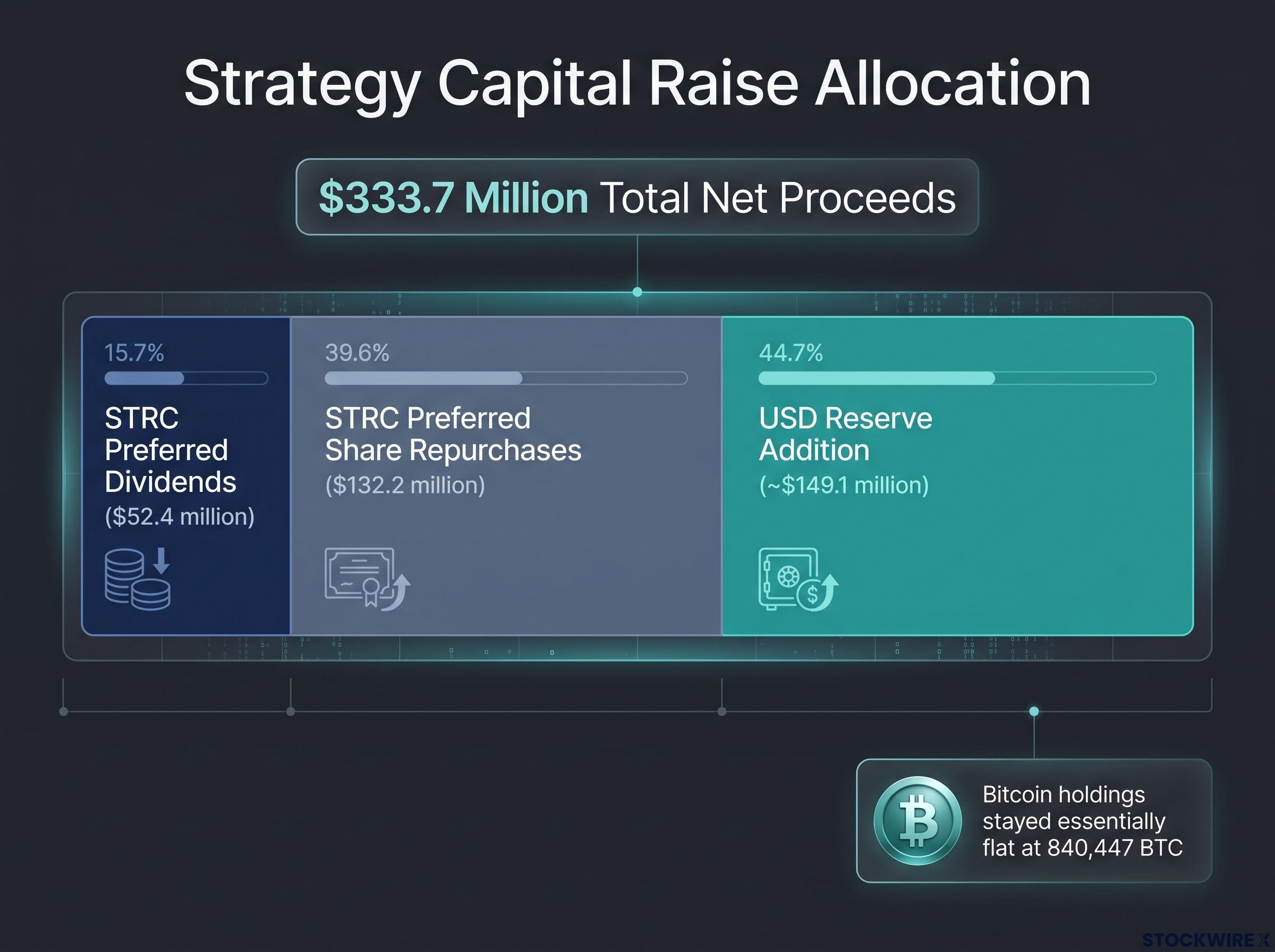
| Use of proceeds | Amount |
|---|---|
| STRC preferred dividends | $52.4 million |
| STRC preferred share repurchases (1.388 million shares) | $132.2 million |
| USD Reserve addition | ~$149.1 million |
| Total net proceeds | $333.7 million |
Bitcoin holdings stayed essentially flat at 840,447 BTC. No new coins were acquired. The allocation across dividends, buybacks, and reserve growth tells you this capital raise was designed to reduce near-term obligations and strengthen the balance sheet, not to bet more aggressively on bitcoin.
USD Reserve total: approximately $4.8 billion
The preferred share repurchases shrink the outstanding STRC float and reduce the senior claims sitting above common equity, which is modestly accretive to MSTR holders over time. This was liability management, executed with precision.
When big ASX news breaks, our subscribers know first
What the enlarged reserve actually buys Strategy
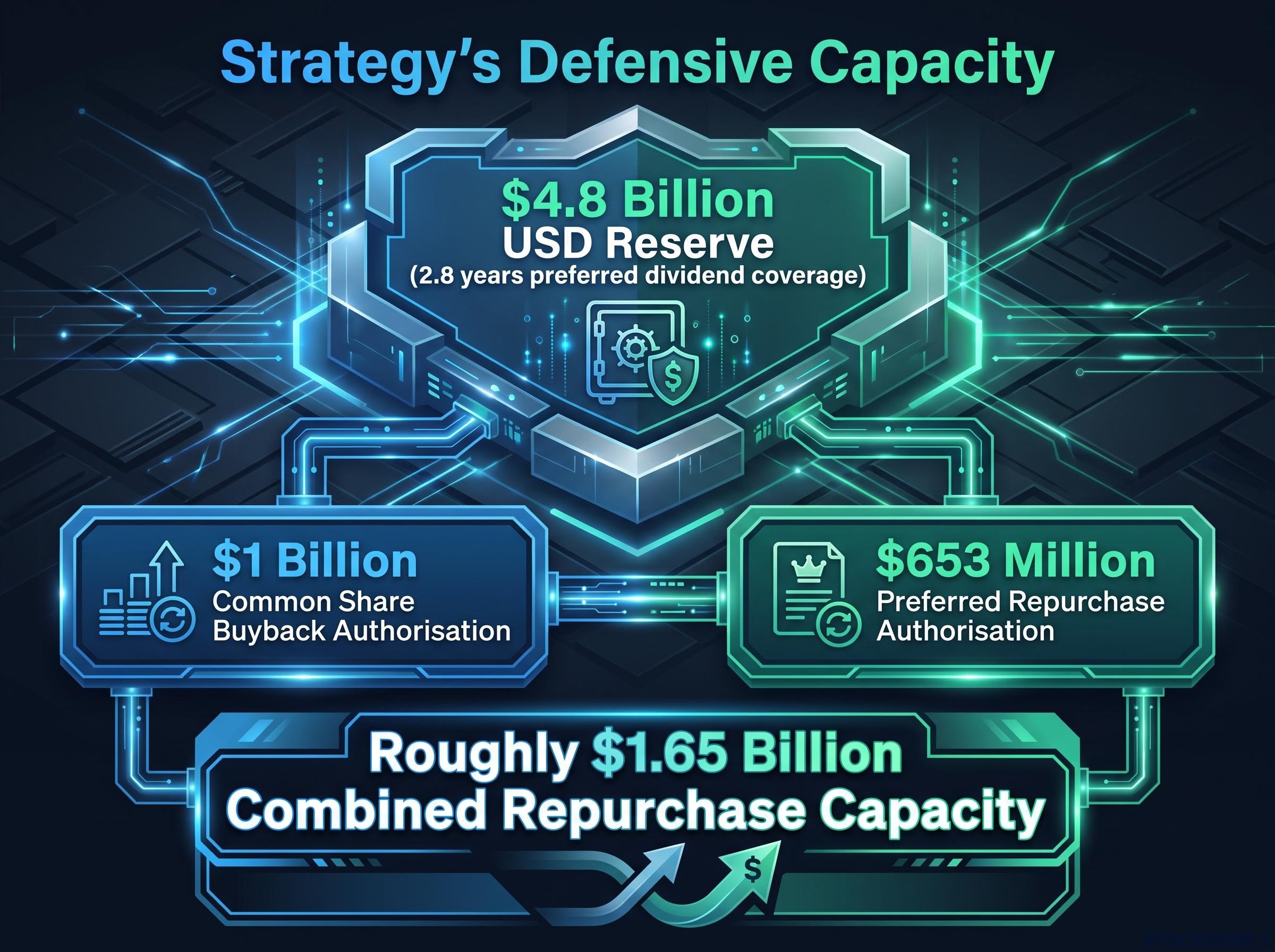
The $4.8 billion reserve now covers approximately 2.8 years of preferred dividend obligations. That is the headline number, but the full picture includes two additional authorisations that remain available:
- 2.8 years of preferred dividend coverage from the USD Reserve
- $653 million still undeployed within the preferred stock repurchase programme
- $1 billion under the MSTR common stock buyback authorisation (currently untouched)
Together, these figures describe a company with genuine room to manoeuvre. Strategy can now time bitcoin purchases and share repurchases around market dislocations rather than being forced by near-term cash obligations.
For a shareholder evaluating MSTR‘s downside durability, 2.8 years of preferred dividend coverage means the company can absorb a sustained BTC drawdown without being forced into dilutive capital raises at the worst moment. That flexibility becomes particularly relevant if index-driven selling creates forced price dislocations later in the year.
Bitcoin drawdown history is directly relevant to sizing the downside scenario: bitcoin fell more than 50% from its October 2025 peak to below $62,500 by mid-2026, and Strategy’s 2.8 years of preferred dividend coverage was built precisely to prevent that magnitude of BTC decline from forcing dilutive equity issuance at distressed prices.
Why MSCI’s proposed rules put Strategy on a deletion watchlist
MSCI announced on 15 August 2026 that it is consulting on a methodology to exclude “non-operating companies” from its Global Investable Market Indexes (GIMI), including the ACWI IMI. The screen works in two steps:
Index provider methodology shapes portfolio composition in ways most investors never examine directly: the same company can be classified as eligible or ineligible depending on which framework an index provider applies, and MSCI’s proposed non-operating screen is precisely this kind of definitional decision with binding consequences for every passive fund that tracks its benchmarks.
- Step 1, the core asset test: checks whether operating assets represent more than 50% of total assets. Companies that fail this threshold are treated as candidates for non-operating status.
- Step 2, the five-ratio test: evaluates a company across five criteria:
- Operating asset intensity
- Operating expense structure
- Cash-flow generation from operations versus investments
- Reliance on external capital to fund growth
- Contribution of fair-value changes to income
Failing four or more of the five ratios flags a company as non-operating. Current index constituents must generally fail these screens for two consecutive annual assessment periods before actual deletion, meaning removal is a process with formal observation windows, not an overnight event.
MSCI’s non-operating company consultation paper specifies that the five-ratio exclusion screen evaluates operating expense structure, cash-flow sourcing, and reliance on external capital alongside asset intensity, giving index analysts a precise quantitative basis for classifying bitcoin-treasury firms as non-operating.
The two-step screen is not a technicality. It is MSCI making a deliberate judgement that bitcoin-treasury companies function more like investment vehicles than operating businesses, and that judgement is the core challenge to Strategy‘s long-term index eligibility.
The three companies MSCI’s simulation flagged
When MSCI applied this draft methodology to the ACWI IMI using May 2026 data, the simulation identified exactly three existing constituents as potentially ineligible:
- Strategy (bitcoin-treasury company)
- Metaplanet (Japanese bitcoin-treasury firm)
- Yellow Cake PLC (uranium investment vehicle)
All three share a defining characteristic: balance sheets dominated by a single asset class, with business activity centred on capital markets and treasury operations rather than conventional revenue-generating operations. Strategy is the largest and most widely held of the three among US investors, making its potential exclusion the most consequential for ACWI IMI-linked funds.
What index exclusion would mean for MSTR’s price
The risk here is mechanical, not sentimental. Funds, ETFs, and institutional mandates that track the ACWI IMI must hold constituents at benchmark weights. If Strategy is ultimately excluded, those funds would be required to sell MSTR as part of index rebalancing, regardless of any view on the company’s fundamentals or bitcoin’s trajectory.
Index removal mechanics operate the same way regardless of company size or the reason for removal: passive funds and ETFs tracking the affected benchmark are required to sell the delisted constituent before the rebalance date, creating concentrated selling pressure that is unrelated to the underlying company’s fundamentals or any discretionary investor view.
Forced, date-clustered selling tends to amplify short-term volatility and can push prices below what the underlying assets justify until discretionary buyers absorb the flow. This is not a speculative scenario. When a stock is deleted from a major benchmark, the selling is non-negotiable for passive funds, and that distinction matters for how you think about downside risk management in the months ahead.
The November 2026 index review is the first possible implementation window for any methodology changes.
When bitcoin weakness and index selling collide
Strategy‘s share price has historically shown high sensitivity to BTC price movements. If index-driven selling were to coincide with a bitcoin drawdown or broader risk-off conditions, the combined pressure creates a compounding scenario that is qualitatively different from either risk in isolation. That dual exposure is a structural variable that sits alongside the bitcoin price risk investors already model.
The connection between the reserve build and the index threat
The same bitcoin-treasury model generating the $4.8 billion reserve is the precise configuration MSCI‘s proposed rules classify as non-operating. These two stories are not running in parallel; they are causally linked by the same business model.
The reserve and repurchase authorisations function as a defensive buffer against the very institutional disruption the MSCI proposal threatens. Strategy‘s three pillars of defensive capacity:
- USD Reserve: approximately $4.8 billion
- Preferred repurchase authorisation: $653 million available under the preferred stock repurchase programme
- Common share buyback authorisation: $1 billion allocated under the MSTR common stock repurchase programme, as yet untouched
Combined, that is roughly $1.65 billion in repurchase capacity plus multi-year dividend coverage. If index-linked institutional demand were to shrink, Strategy has the internal capital to absorb selling pressure without being forced into new equity issuance at distressed prices.
The reserve build is not just balance sheet management. Read alongside the MSCI threat, it signals that Strategy‘s leadership understands the company may need internal capital buffers to replace what index-linked institutional demand currently provides. MSTR is no longer purely a leveraged BTC proxy. Classification risk, meaning how index providers define Strategy‘s business model, has become an additional factor in the investment thesis.
Three variables that will determine the outcome before year-end
The risk is real but staged, and three specific variables will determine how it resolves:
- MSCI consultation outcome (end of September 2026, results expected October 2026): The final language on how “non-operating” is defined, whether digital asset treasury firms receive carve-out treatment, and whether transition rules delay removals for existing constituents will shape the entire risk profile.
- Strategy’s response during the consultation window: Any moves to grow operating revenues, restructure assets to pass the operating-asset test, or publicly engage with MSCI are signals worth tracking closely.
- November 2026 index review: This is the first possible implementation date for any methodology changes. Subsequent annual assessment periods govern whether Strategy crosses the multi-period failure threshold required for actual deletion.
October 2026 is the decision moment. When MSCI publishes its final methodology, the exclusion risk moves from overhang to either resolved or confirmed.
MSTR investors do not need to price the full deletion risk today. They need to know when the information arrives that changes the calculus, and the timeline above provides that map.
Investors who want a structured framework for tracking the October 2026 MSCI decision and its downstream portfolio effects will find our full explainer on mapping policy-driven market risk useful, which walks through how to calibrate exposure ahead of known policy announcement dates rather than reacting after the fact.
This article is for informational purposes only and should not be considered financial advice. Investors should conduct their own research and consult with financial professionals before making investment decisions. These statements regarding potential index exclusion outcomes are speculative and subject to change based on MSCI’s final methodology decisions and Strategy’s corporate actions.