Singapore’s central bank does not set an interest rate. It manages a currency band, and right now that band is quietly doing the heavy lifting while global energy markets spike and food prices climb.
Most investors outside the region have never encountered a monetary tool quite like the S$NEER, and even inside Singapore, few have seen it explained from first principles. That gap matters, because it is the reason analysts at UOB broadly expect no further policy tightening despite mounting external pressures. UOB’s latest macro assessment concludes the Monetary Authority of Singapore is likely to hold its current settings through the rest of 2026 and into early 2027, a call that rests on core inflation staying within the projected band, a labour market absorbing cost pressures before they reach wages, and the absence of any trigger for another adjustment.
This gives you a clear framework for reading MAS policy signals, assessing the specific conditions that would force the central bank’s hand, and understanding why Singapore’s monetary toolkit behaves so differently from the rate-setting central banks that dominate the headlines.
How Singapore’s exchange-rate policy actually works
Most central banks fight inflation by moving interest rates up or down. The Monetary Authority of Singapore does something that sounds almost backwards: it leaves interest rates to the market and manages the value of its currency instead.
Singapore’s exchange-rate framework sits in deliberate contrast to the central bank rate mechanics that govern the Fed, ECB, and Bank of England, where a single overnight rate cascades through mortgage costs, deposit rates, and equity valuations rather than working through the currency channel MAS relies on.
The logic is rooted in the shape of the economy. Singapore is small and extraordinarily open, and imports make up a large share of what its households consume. When your shopping basket is mostly foreign goods, the exchange rate is a far more direct lever on prices than the cost of domestic borrowing.
The MAS monetary policy framework explains this design choice directly: because Singapore’s domestic interest rates are determined by capital flows and external conditions rather than central bank decisions, the exchange rate is the only lever MAS can reliably deploy to influence inflation at the household level.
So MAS manages the Singapore dollar nominal effective exchange rate, or S$NEER, which measures the local currency against an undisclosed basket of trading-partner currencies. Because that basket composition is never published, the exact S$NEER level is not directly observable by market participants, which is part of why the framework can feel opaque.
The mechanism itself is straightforward once you see it. A stronger Singapore dollar makes imported goods cheaper in local currency terms, which dampens the passthrough from global commodity and energy prices into what households actually pay. Appreciation is the primary inflation-fighting tool.
A 2024 IMF report characterised this “basket, band and crawl” system as a forward-looking, Taylor-rule-like reaction function, meaning MAS calibrates the exchange rate to minimise the output gap and keep expected inflation stable rather than reacting only to what inflation has already done.
The three levers MAS actually controls
The policy stance is defined by three parameters, and each one shows up in MAS statements as a specific, quantifiable signal rather than bureaucratic language.
Slope is the rate at which the S$NEER is allowed to appreciate over time. Steepening the slope means a faster pace of appreciation, which is the standard tightening move for a moderate inflation problem.
Mid-point is the central value of the band. Re-centring it upward causes an immediate strengthening of the currency, a heavier tool reserved for sharper, broader shocks.
Width is the range around the mid-point within which the S$NEER can move, reported by analysts at approximately plus or minus 2.0% though not officially confirmed by MAS. Widening it gives the currency more room to absorb volatility.
| Parameter | What it controls | Effect of an upward adjustment |
|---|---|---|
| Slope | Pace of currency appreciation over time | Faster appreciation, gradual disinflation |
| Mid-point | Central level of the band | Immediate currency strengthening |
| Width | Room to move around the mid-point | Greater tolerance for volatility |
The practical takeaway is that MAS has fewer levers than a rate-setting central bank but more precise control over imported inflation. Once you understand the three parameters, its policy statements become far more legible than they first appear.
When big ASX news breaks, our subscribers know first
Where policy settings stand right now, and how they got here
The current expectation of a hold is not arbitrary. It reads clearly once you follow the recent decision sequence as a deliberate slowing of pace.
At the 29 January 2026 review, MAS left the slope, width, and mid-point all unchanged. On 14 April 2026, it chose to increase the slope slightly, holding width and mid-point steady. Then on 27 July 2026, its most recent formal statement, it went smaller still.
MAS chose to “increase the rate of appreciation of the policy band very slightly,” holding the width and mid-point unchanged.
That wording matters. Each incremental step tells you MAS is managing a real but contained inflation episode, not the kind of shock that demands aggressive action.
| Decision date | Slope change | Mid-point change | Width change |
|---|---|---|---|
| 29 January 2026 | No change | No change | No change |
| 14 April 2026 | Increased slightly | No change | No change |
| 27 July 2026 | Increased very slightly | No change | No change |
UOB estimates the current slope at approximately 1.25% per annum, though the research shows some disagreement on this figure, with an earlier UOB note putting it nearer 0.5%, so treat it as an analyst estimate rather than an MAS-published number.
USD/SGD range dynamics in late August and early September 2026 reflect the S$NEER ceiling in real time: UOB’s neutral band of 1.2680-1.2780 is structurally capped by the MAS appreciation path, meaning any sustained USD rally runs directly into the policy headwind the three-parameter framework creates.
Now put that sequence against the last major tightening cycle. Between October 2021 and October 2022, MAS moved on five separate occasions, including three upward mid-point re-centrings, twice off-cycle. That was the response to a broad-based inflation shock.
The contrast is the whole point. The current approach is incremental where the earlier one was rapid-fire, which tells you MAS judges today’s inflation as manageable rather than alarming.
The analyst community reads it the same way. A Reuters poll released on 25 January 2026 found 15 of 16 analysts expected no change at that review. Looking further out, the June 2026 MAS Survey of Professional Forecasters showed 38% anticipating a slope increase in July, 30% expecting tightening in October, and the rest expecting a hold.
Why Singapore’s labour market is acting as a shock absorber
The hold call needs a defensible reason, and UOB’s Labour Market Pressure Index (LMPI) is the analytical tool that provides it. The LMPI tracks how tight or slack the labour market is, and it carries a meaningful statistical relationship with both core and services inflation.
The logic runs through wages. When the labour market has slack, employers face less pressure to raise pay, which limits the second-round inflation effects that show up in services and other domestically produced items.
UOB’s index shows a gradual reduction in labour-market tightness from the post-pandemic peak in Q2 2022. A UOB note ahead of the January review described conditions as “soft but stable,” with employers adjusting through slower hiring and smaller wage increments rather than layoffs. Ministry of Manpower reporting on 21 September 2026 similarly found the labour market “remained resilient” with low unemployment despite external shocks.
The Ministry of Manpower Q2 2026 labour market report confirmed total employment continued to grow through the quarter while overall unemployment remained low, providing the statistical basis for characterising current conditions as soft but stable rather than deteriorating.
That buffer is why an acceleration in core inflation has not yet triggered a policy response. MAS core inflation rose to 2.0% year-on-year in July 2026, up from 1.6% in June and from roughly 1.0% to 1.6% earlier in the year, its highest reading in nearly two years.
MAS projects core inflation will “step up from July and remain elevated” before moderating discernibly from around mid-2027.
MAS also revised its 2026 forecast band for both core and headline inflation up to 1.5% to 2.5%, from a prior 1.0% to 2.0%. Three drivers pushed July’s reading higher:
- Electricity and gas
- Services
- Food
What the buffer does not cover
Here is the honest limit. Labour market slack works on wages, but it does nothing for costs that arrive directly from abroad.
Global energy prices feed straight into Singapore’s electricity, transport, and food supply chains, and those channels bypass the domestic wage mechanism entirely. No amount of hiring softness stops an oil spike from reaching the household bill.
This distinction is what you should watch in MAS’s risk language. The buffer buys time by containing wage-driven inflation, but it is not a ceiling. If commodity shocks persist or intensify, its moderating effect on core inflation fades, and the case for another slope adjustment strengthens.
What could force MAS to move: the two tail-risk scenarios
Two external shocks could push MAS off its hold, and neither is theoretical in September 2026. The data is already sitting close to the thresholds that matter.
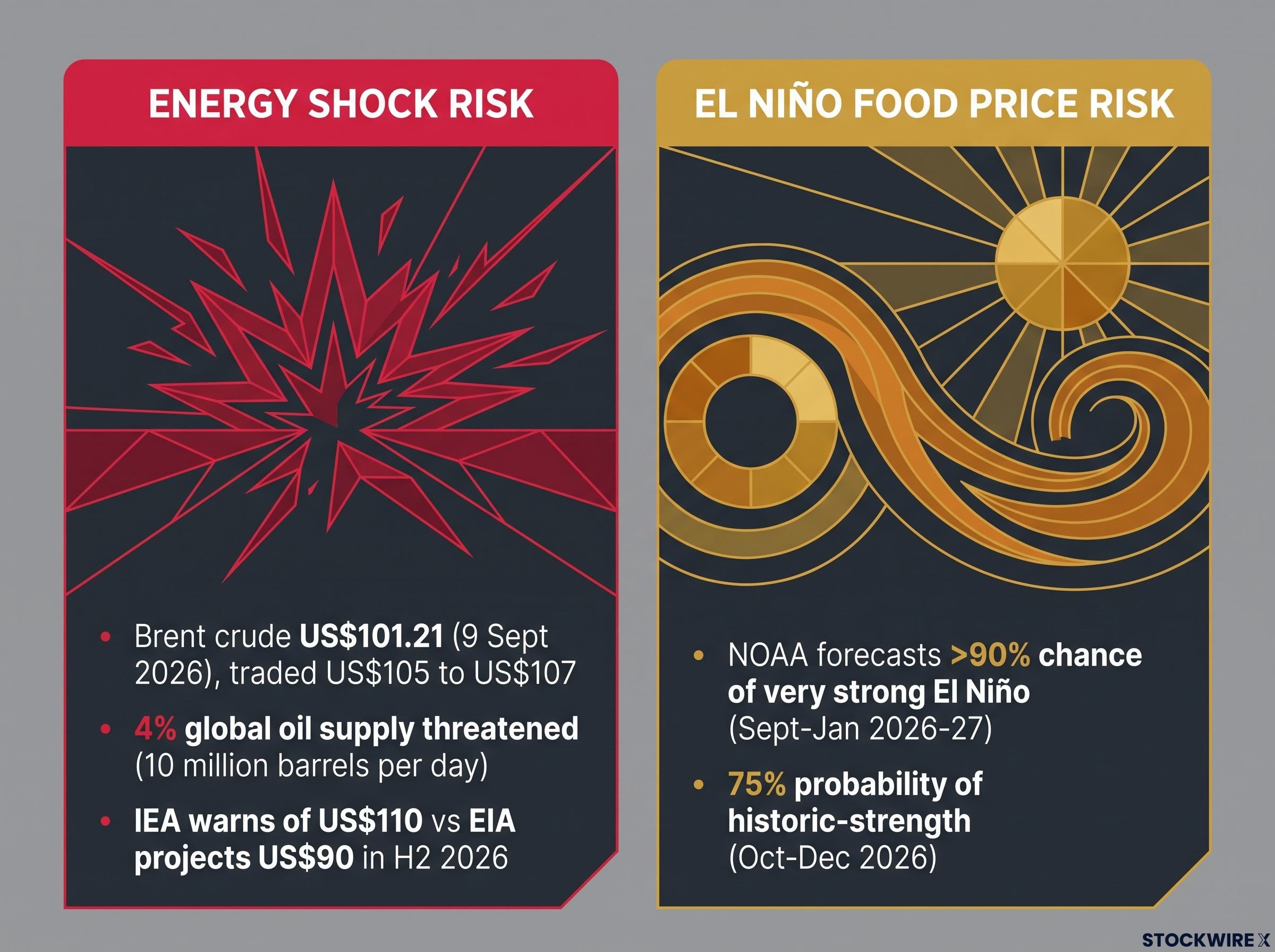
The first is a Middle East energy shock. Brent crude closed at about US$101.21 per barrel on 9 September 2026, and following mid-September attacks on Saudi Arabian infrastructure that threatened up to 4% of global oil supply, it traded in the US$105 to US$107 range. Roughly 10 million barrels per day of exports were reported missing relative to pre-war levels.
The International Energy Agency warned on 11 September 2026 that crude prices could move toward US$110 per barrel.
The threshold that matters is MAS’s 2.5% core inflation ceiling for 2026. Sustained energy costs at these levels would keep feeding the electricity, gas, and transport components that already drove July’s reading higher, and a durable overshoot of that ceiling is exactly the condition that turns a tail risk into a live decision.
Energy-driven inflation readings can be misleading even when the headline number looks alarming: August 2026 US CPI of 3.4% was dominated by a gasoline spike tied to the same Middle East supply disruptions that are feeding Singapore’s electricity and transport cost channels, while core inflation in both economies told a more contained story.
Not every forecaster agrees on the direction. The US Energy Information Administration projected Brent to average around US$90 per barrel in the second half of 2026, a reminder that the energy scenario is a risk, not a certainty.
UOB identifies three formal conditions that would move a slope steepening of roughly 25 basis points from tail risk to central scenario:
- A persistent overshoot of core inflation above the 1.5% to 2.5% band
- A widening positive output gap feeding services inflation and wage growth
- A prolonged commodity shock that durably shifts the inflation trajectory
The El Niño food price channel
The second scenario is weather. A historic-strength El Niño disrupts agricultural output across Southeast Asia, and because Singapore imports almost all of its food, that disruption passes straight through to local prices with little to cushion it.
The probabilities are unusually high. NOAA’s Climate Prediction Center forecasts a greater than 90% chance of a very strong El Niño during the September-November to November-January 2026-27 window, and a 11 September 2026 summary reported a 75% probability of a “historic-strength” event during October-December 2026.
That timing is what makes it relevant. The strongest phase overlaps directly with MAS’s October 2026 and January 2027 decision cycles, layering a food-price impulse on top of the energy risk exactly when the central bank is next reviewing policy.
Reading the next two MAS decisions with clearer eyes
The baseline is still a hold. MAS is most likely to keep its settings unchanged, and the reasoning sits at the intersection of labour market slack, inflation still within the projected band, and external shocks that have not yet translated into durable domestic price pressure.
What you now have is a way to read the signals yourself. Watch the verbs in the statement: “increase slightly” and “increase very slightly” are deliberate gradations, and a return to firmer language, or any hint of a mid-point re-centring, would confirm a move is coming rather than another incremental step.
The Singapore equity market outlook is directly connected to where MAS policy lands: a further slope steepening would strengthen the Singapore dollar, benefit import-dependent consumer sectors, and compress funding costs for domestically focused banks, but it would also introduce headwinds for export-oriented semiconductor and precision engineering stocks riding the AI infrastructure cycle.
Treat the October 2026 and January 2027 cycles as genuine decision points, not formalities. The 30% of professional forecasters who already expected October tightening tell you the debate is live, and the 2021-2022 precedent shows MAS is willing to act off-cycle if energy or food data deteriorates sharply between reviews.
Three data series will tell you which way the probabilities are shifting:
- Brent crude’s trajectory, particularly whether it sustains above US$105 to US$110
- Singapore’s monthly MAS core inflation releases
- NOAA’s El Niño strength updates through year-end
UOB frames a roughly 25 basis point slope steepening as a conditional scenario, not a baseline, contingent on those pressures becoming durable.
The consensus hold is a probability, not a certainty. With this framework, you can update that probability in real time rather than waiting for analyst notes to interpret each statement for you.
This article is for informational purposes only and should not be considered financial advice. Investors should conduct their own research and consult with financial professionals before making investment decisions. Past performance does not guarantee future results, and financial projections are subject to market conditions and various risk factors. Forward-looking scenarios discussed here are speculative and subject to change based on economic developments.