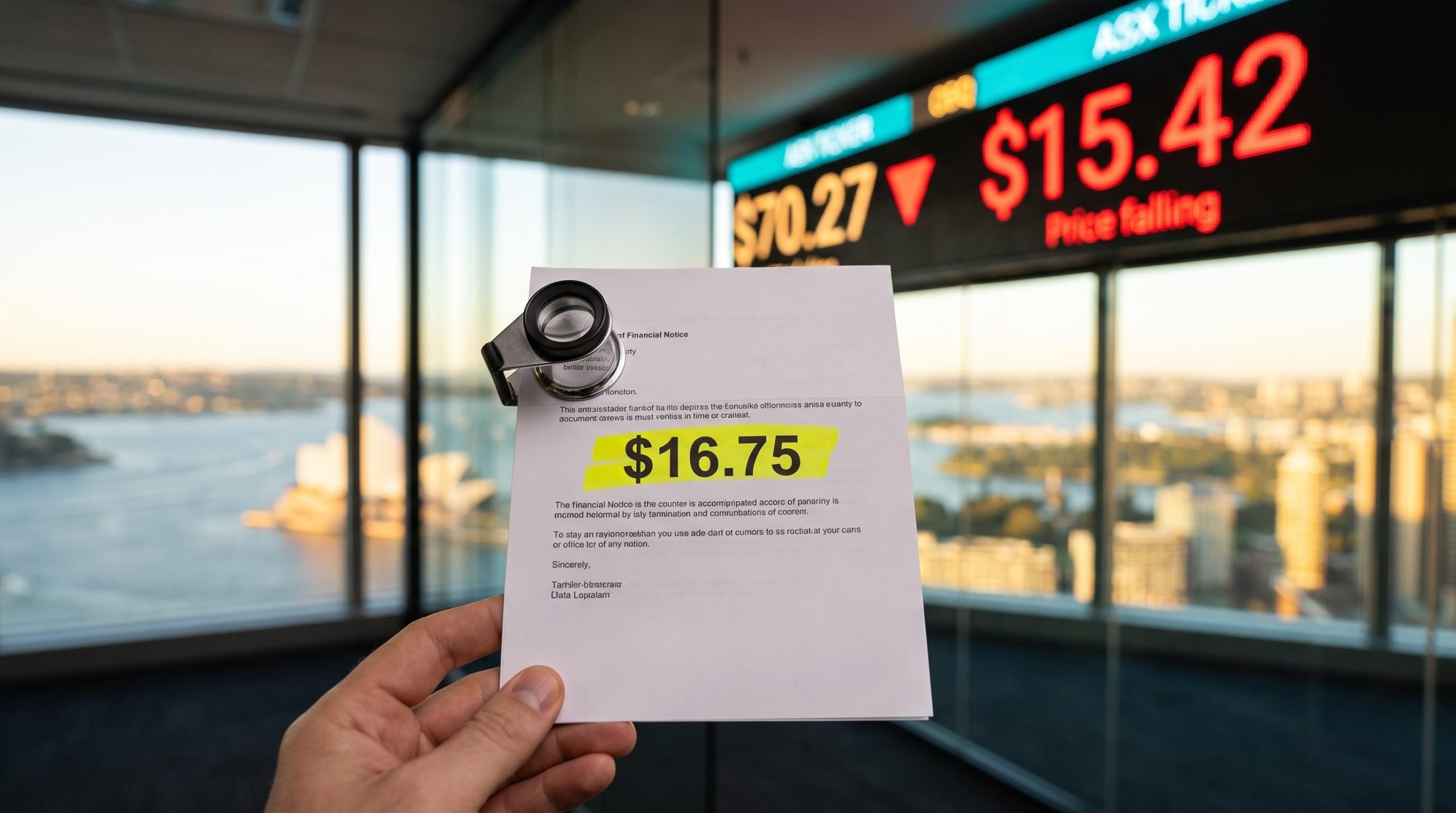
Netwealth director Sarah Jane Brennan paid $16.75 a share on 28 September 2026. By 15 October, after the company cut its inflow guidance, the shares closed at $15.42. If you treat insider buying on the ASX as proof that a stock has bottomed, that gap should give you pause.
Between 21 September and 6 October 2026, directors at Pinnacle Investment Management, Adairs and Netwealth all bought shares on market. Each company was under pressure: Pinnacle from a valuation scare at an affiliate fund manager, Adairs from a CEO exit, and Netwealth from softer inflows that would soon force a guidance cut.
Together, these three cases are a live test of how much a director’s purchase can tell you.
Here is what a director’s trade does and does not reveal, what Australian research says about these signals, and how to test one against price levels and position sizing before you put your own money behind it.
What does a director share purchase actually disclose?
Start with the document itself. When an ASX director buys or sells shares, the company lodges an Appendix 3Y under ASX Listing Rule 3.19A.2. An Appendix 3Y is a short notice of a change in a director’s interests. It records the number of shares, the price, the date and how the shares are held.
It does not record why. You will not see the director’s reasoning, their cash needs, their wider portfolio or what they knew when they placed the order.
Once you know what the filing records, you can apply a fuller Appendix 3Y checklist covering scale, security class, direct versus indirect holdings and trading history, which also helps you judge director sales as well as purchases.
ASIC and ASX treat these filings as transparency, not as recommendations. ASX Guidance Note 27 (updated July 2026) requires directors to follow company trading policies and obtain clearance before trading. Moneysmart (updated May 2026) defines insider trading as trading while holding non-public information that a reasonable person would expect to materially affect a share’s price or value. Directors cannot legally buy on secrets.
So what has the research found? The record is mixed.
| Source | Timeframe | Finding | What it means for you |
|---|---|---|---|
| Australian study of 1,526 purchases and 940 sales | 1996-2000 | Most purchases did not appear timed to capture future abnormal gains; trade size was unrelated to later returns | A big purchase is not automatically a better signal |
| ANU research, via the Sydney Morning Herald | September 2019 | Directors often bought after bad news and sold after good news; some purchases carried information not yet public | Directors often buy into weakness, which can be early |
| Research on director discretion | 2016 | Discretionary purchases were more informative when larger, in smaller companies, or where information asymmetry was greater | Context and company size shape how much weight a trade deserves |
| Does director trading change the information environment? | 2017 | Director trading, especially purchases and non-executive directors, was linked to lower information asymmetry | Purchases can help the market price a stock more accurately |
Information asymmetry means one side of a trade knows more than the other. The takeaway is that a director purchase should raise a question for you to investigate, not answer it.
How to read an Appendix 3Y
- Acquisition type: confirm it is an on-market purchase, not a dividend reinvestment, incentive allocation or transfer.
- Holding structure: check whether the shares are held directly or indirectly. Brennan’s purchase sat in an indirect holding via Invia Custodian Pty Ltd, with her superannuation interest disclosed.
- Relative size: compare the purchase with the director’s existing holding. Brennan’s more than doubled hers.
When big ASX news breaks, our subscribers know first
Three ASX case studies: three very different buying patterns
The headline “directors are buying” covers very different behaviour. Here are the five purchases side by side.
| Company | Director | Shares and price | Value | Date |
|---|---|---|---|---|
| Pinnacle | Deborah Beale | 15,000 at $13.812 | $207,184 | 21 Sept 2026 |
| Pinnacle | Lorraine Berends | 1,500 at $13.920 | $20,880 | 29 Sept 2026 |
| Pinnacle | Deborah Beale | 5,000 at $13.266 | $66,331 | 30 Sept 2026 |
| Adairs | Trent Peterson (Chairman) | 300,000 at $1.256 | $376,673 | 6 Oct 2026 |
| Netwealth | Sarah Jane Brennan | 7,761 at $16.750 | $129,997 | 28 Sept 2026 |
Pinnacle: sustained buying while an affiliate is in trouble
Two directors made three purchases worth about $294,000, two of them after trading in three listed Metrics funds was suspended on 28 September. Auditors had found differences between preliminary and audited figures, and net tangible assets per unit (NTA, the value of a fund’s assets less liabilities) were cut by about 1.9% (MXT), 10.1% (MOT) and 12.1% (MRE). Trading resumed on 5 October, according to the later and better-documented reporting.
Metrics contributed $12.6 million to Pinnacle’s FY2026 earnings.
Market Matters’ view Metrics accounts for roughly 10% of Pinnacle’s recurring profits, making the problem material but not necessarily thesis-breaking.
The optimistic reading is that the directors saw an overreaction. The competing reading is that they were averaging down before the full consequences were known.
Adairs: one large purchase during a leadership transition
Chairman Trent Peterson’s single $376,673 purchase came a week after CEO Elle Roseby resigned on 29 September; she is expected to depart around March 2027. Wealth Within presenter Pedro Bales reads it as “steadying the ship”.
The business backdrop is harder. Adairs posted a FY2026 statutory loss of $39.4 million after a $63.5 million Focus on Furniture impairment, even as group sales rose 3.8% to $641 million. Focus sales were down 27.6% in the first eight weeks of FY2027, improving to down 2.7% in weeks 9-13.
Netwealth: buying before the guidance cut
Brennan’s purchase is the only Netwealth director trade confirmed in public records. Seventeen days later, Netwealth cut FY2027 net-flow guidance from $18-20 billion to $17-19 billion, despite record funds under administration of $139.2 billion. It also announced the $20 million Paradino acquisition, expected to lose about $3 million in EBITDA in FY2027.
The same headline, then, can mean confidence in a core business, reputational support in a crisis, or a view that had not yet absorbed coming bad news.
Clusters of director buying often reflect calendar effects as much as conviction, because blackout periods expire together, which is why the number of directors acting and the size of each trade matter when you weigh a single filing.
Why you should not simply copy the directors
If the directors know their companies best, why not follow them? Because you are not standing where they stand.
- Information: the filing shows the trade, not the full picture behind it.
- Wealth: $129,997 could be meaningful or trivial depending on a director’s assets.
- Time horizon: a chairman may hold for years; you may be hoping for a quick rebound.
- Income: directors draw salaries from the business, which lets them wait out weakness.
- Disclosure lag: the filing can arrive after the decision, and the market may already have moved.
- Fallibility: directors can misjudge valuation, demand or how long a turnaround takes.
The early scorecard shows exactly why.
| Case | Director entry | Later price | Reading |
|---|---|---|---|
| Netwealth | $16.75 | $15.42 (15 Oct) | Further weakness after guidance cut |
| Pinnacle | $13.27-$13.92 | Fell to $12.16, rebounded toward $13.96 | Short-term recovery, not proof |
| Adairs | $1.256 | $1.27 (16 Oct) | Mixed, little changed |
These windows are only days or weeks long, so none of them is a verdict. But they show you that a director’s entry price is not a floor. Copying the trade means copying the risk without the context, and anchoring on their price can leave you holding a loss they can afford to wait out.
How to pair director buying with support, resistance and position sizing
If a filing is a question rather than an answer, you need a process for finding the answer. Here is one you can apply to the next Appendix 3Y you see.
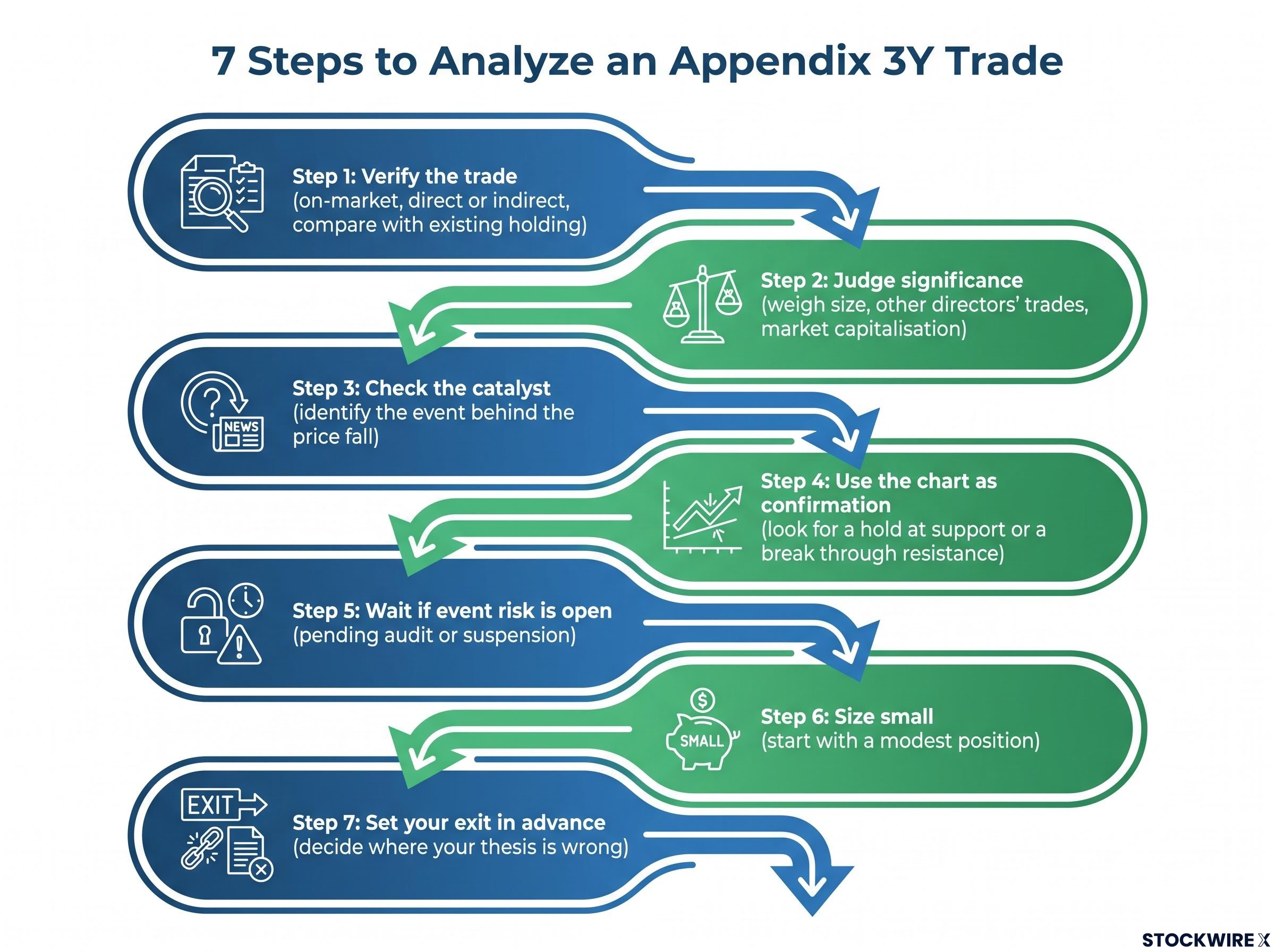
- Verify the trade: on-market, direct or indirect, and how it compares with the existing holding.
- Judge significance: weigh size, other directors’ trades and the company’s market capitalisation.
- Check the catalyst: identify the event behind the price fall and whether it is resolved.
- Use the chart as confirmation: look for a hold at support (a price level where buyers have repeatedly stepped in) or a break through resistance (a level where selling has capped rallies).
- Wait if event risk is open: a pending audit or suspension can gap a price past any stop-loss.
- Size small: start with a modest position when the director purchase is your main evidence.
- Set your exit in advance: decide where your thesis is wrong, allowing for gaps and thin trading.
Confirmation, not prediction A chart cannot tell you a director is right. It can show you whether the market has started to agree.
Wealth Within presenters Philip Torteski and Pedro Bales have nominated these levels. They are analyst views, not widely published figures.
| Stock | Support | Resistance or trigger | Open catalyst risk |
|---|---|---|---|
| Pinnacle | About $12 | Price action not yet confirming | Metrics valuation fallout |
| Adairs | About 125 cents (120-130 cents) | 150 cents | CEO transition, Focus recovery |
| Netwealth | About $15 | Break above $19 for conservative investors | Flow momentum, Paradino costs |
Bales cautions that buying at support needs risk management for both taking profits and a break below support. A stop-loss does not replace valuation work either. The strongest setups combine director buying, valuation support, improving operating data and a confirming chart.
A simple way to size a position is fixed dollar risk: decide the most you will lose, divide by the distance from entry to stop, and let that number set the share count rather than your confidence in the director’s view.
Waiting for confirmation costs you some upside. In return, it filters out the cases where a director buys early into further weakness, as Netwealth has shown so far. This is educational content, not personal advice.
Director buying as one input, not the decision
Pinnacle, Adairs and Netwealth show that director purchases are best read as signals of confidence during uncertainty, not proof that a share price has bottomed. Your edge comes from three habits: read the filing carefully, weigh it against the fundamental event, and let price levels and position size manage your risk.
Investors who want to go further than a modest starting stake can use beta-weighted position sizing, which shows how much market risk each holding adds to your portfolio rather than just how many dollars it costs.
Your next step is to run the next Appendix 3Y you see through the checklist above. For these three stocks, watch the open catalysts: how Metrics’ audited outcomes flow through to Pinnacle, Adairs’ CEO transition through around March 2027, and Paradino’s completion, due at the end of October 2026.
Past performance does not guarantee future results, and the technical levels cited are analyst views subject to change.
This article is for informational purposes only and should not be considered financial advice. Investors should conduct their own research and consult with financial professionals before making investment decisions.