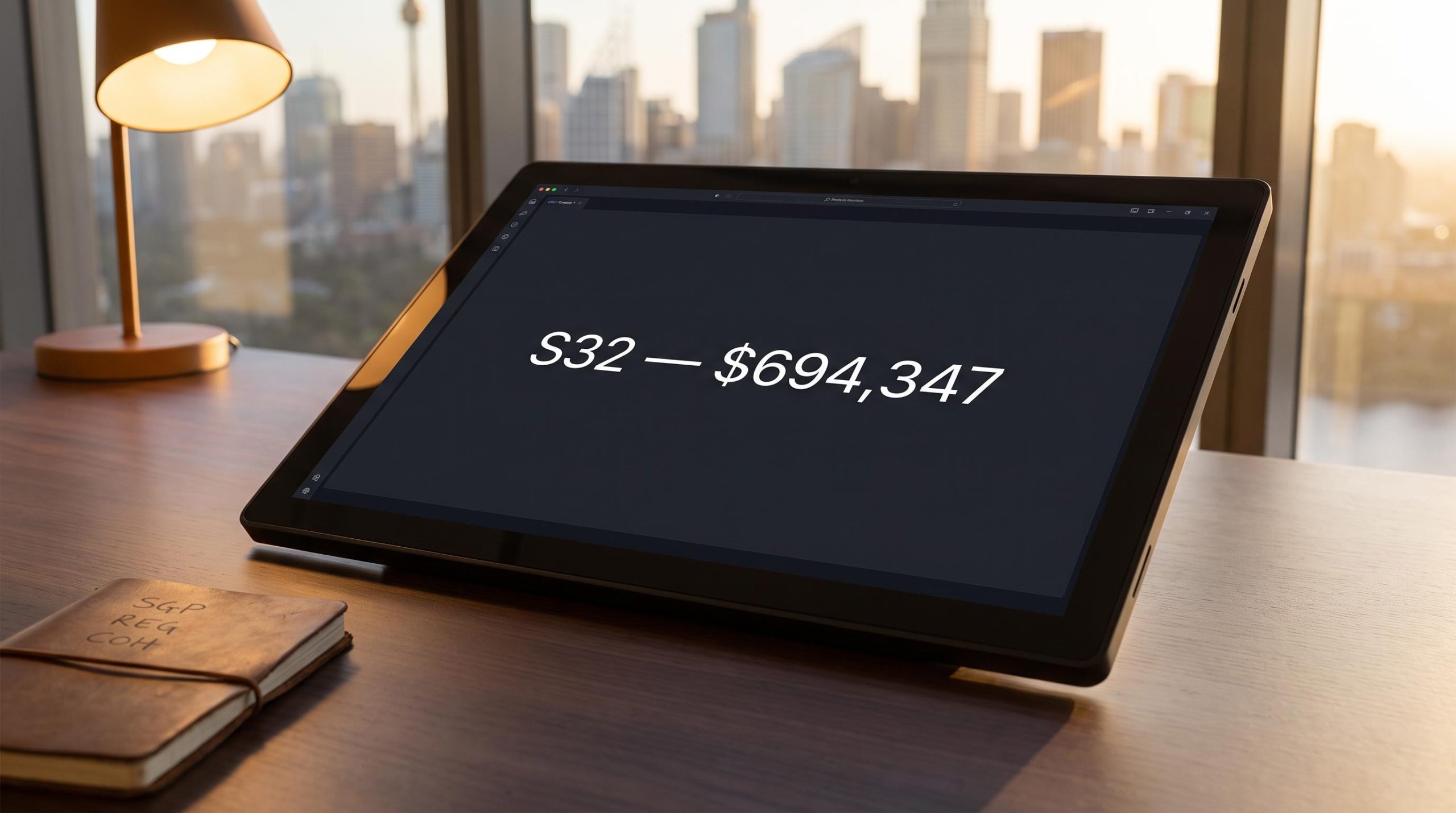
Thirteen ASX 200 directors opened their personal brokerage accounts and bought shares in their own companies during the first three trading days of September 2026, spending amounts that ran from just under $5,000 to nearly $700,000. The purchases spanned sectors as different as aged care, rail freight, and cochlear implants. That breadth is the story worth reading closely.
The timing was not coincidental. Australia’s August 2026 reporting season had just closed, and with it the formal trading restrictions that bar directors from dealing in their own company’s shares in the weeks before results are published. When those restrictions lifted, a period of enforced silence turned into an observable, measurable expression of confidence.
Whether that confidence is predictive is a separate and more complicated question. This piece maps what was bought, by whom, and in what earnings context. It then hands you an honest framework for deciding how much weight to attach to ASX 200 director purchases as a market signal before you act on any of them.
Why September always brings a cluster of director buying
The cluster is partly a product of policy design, not purely spontaneous conviction. Understanding that mechanism first changes how you read the transaction data that follows.
ASX-listed directors are legally prohibited from trading in their own company’s shares during a defined blackout period preceding results announcements. That window typically covers the four to six weeks before a release date, and it exists to prevent directors from dealing while they hold financial information the market has not yet seen.
The August 2026 reporting season compressed most ASX 200 result dates into a four-to-six week band. That meant the blackout windows for a large cohort of directors expired at almost the same time, in the final days of August and the opening days of September.
The informational character of purchases made in this window is specific. Earnings, guidance, and strategic announcements are already fully public, so the director is not trading on private information. They are trading on an informed private view of whether the market has correctly priced the updated fundamentals.
Three features define this post-blackout window:
- Fully informed directors: results, outlook statements, and strategy shifts are all disclosed, so any purchase reflects a view formed after the market saw everything the director saw.
- A legal compliance architecture: Australian insider trading law carries penalties of up to 15 years imprisonment, which is why the trading windows exist and why they open at a predictable point in the calendar.
- A compressed calendar effect: because most ASX 200 companies report inside the same few weeks, a large group of blackout windows lift together, producing a visible spike in buying.
Insider trading penalties in Australia scale up to 15 years imprisonment and financial sanctions of up to three times the proceeds generated by the offence, a legal architecture that shapes the entire calendar of trading windows and blackout periods ASX directors must navigate.
Across the week of 31 August to 3 September 2026, a total of 23 ASX 200 directors conducted on-market transactions, and 13 of them were buying. A report published by Market Index on 7 September 2026 noted that three individual stocks accounted for nine of the 23 transactions, which points to clustering inside the cluster.
Here is what that structural cause tells you. The mechanism does not neutralise the informational content of these trades, but it does reframe them. The lifting of blackout windows creates a reliable, calendar-driven signal window you can monitor each year, rather than a random scatter of disclosures to chase one at a time. What still varies, and varies a lot, is the strength of the signal in any single trade.
When big ASX news breaks, our subscribers know first
The week’s transactions, sector by sector
Look at breadth first, then scale. The buying ran across resources, property, healthcare, infrastructure, financial services, and consumer and technology names, which tells you something before a single dollar figure enters the picture.
The full record, sorted by total value, sits below.
| Company (ASX code) | Director | Shares / Price | Total Value | Date |
|---|---|---|---|---|
| South32 (S32) | Mandla Bavumile | $60.91 | $694,347 | 31 Aug 2026 |
| Stockland (SGP) | Robert Johnston | $4.57 | $411,300 | 31 Aug 2026 |
| Regis Healthcare (REG) | Andrew Kinkade | $6.15 | $245,832 | 31 Aug 2026 |
| Atlas Arteria (ALX) | Laura Hendricks | $4.62 | $175,560 | 1 Sep 2026 |
| Cochlear (COH) | Richard Freudenstein | $135.48 | $149,028 | 1 Sep 2026 |
| Praemium (PPS) | Matthew Quinn | $0.65 | $129,400 | 31 Aug 2026 |
| SiteMinder (SDR) | Patrick O’Sullivan | $2.93 | $73,250 | 1 Sep 2026 |
| a2 Milk (A2M) | Kathryn Mitchell | $8.00 | $72,000 | 1 Sep 2026 |
| Bendigo and Adelaide Bank (BEN) | Alistair Muir | $10.77 | $66,774 | 31 Aug 2026 |
| Stockland (SGP) | Christopher Lawton | $4.40 | $22,000 | 3 Sep 2026 |
| Aurizon (AZJ) | Andrew Adam | $3.69 | $19,999 | 1 Sep 2026 |
| WAM Capital (WAM) | Katherine Thorley | $1.25 | $10,582 | 1 Sep 2026 |
| Brambles (BXB) | James Miller | $19.23 | $4,999 | 3 Sep 2026 |
The spread runs from a diversified miner to a listed investment company to a hospitality technology platform. That range tells you this was not a sector rotation call, where investors move money from one part of the market to another. It was a set of company-level conviction signals, and that is exactly the frame to apply when you evaluate it.
Three transactions worth a closer look
South32’s purchase is the largest of the week at $694,347. Mandla Bavumile bought four days after the company detailed its FY26 results and its agreement to sell its entire aluminium value chain to Alcoa. A director increasing personal exposure immediately after a large portfolio restructuring is a pointed vote on the direction the company has just chosen.
SiteMinder sits at the other end of the mood spectrum. Patrick O’Sullivan bought at $2.93 after the stock had fallen roughly 13% on the market’s reassessment of its results. A purchase made into that kind of post-selloff weakness reads as a contrarian signal, a director putting personal money against the market’s verdict.
Stockland is the reinforcement case. Two independent directors, Robert Johnston and Christopher Lawton, bought within three days of each other inside a narrow price band of $4.40 to $4.57. When more than one director acts in the same window at similar prices, the conviction read strengthens, because it is harder to explain two independent decisions as coincidence.
How to read the results backdrop behind the buying
The raw list matters less than the earnings context sitting behind each trade. Read against the numbers, the purchases split into two very different signal types.
The August 2026 season was, on balance, better than feared but uneven, a two-speed picture in which resources and selected industrials delivered strongly while more domestically exposed sectors carried margin pressure and cautious outlooks. Forward guidance, rather than the backward-looking financial figures, was the main driver of share price moves.
That split matters because it separates directors buying into strength from directors buying into weakness:
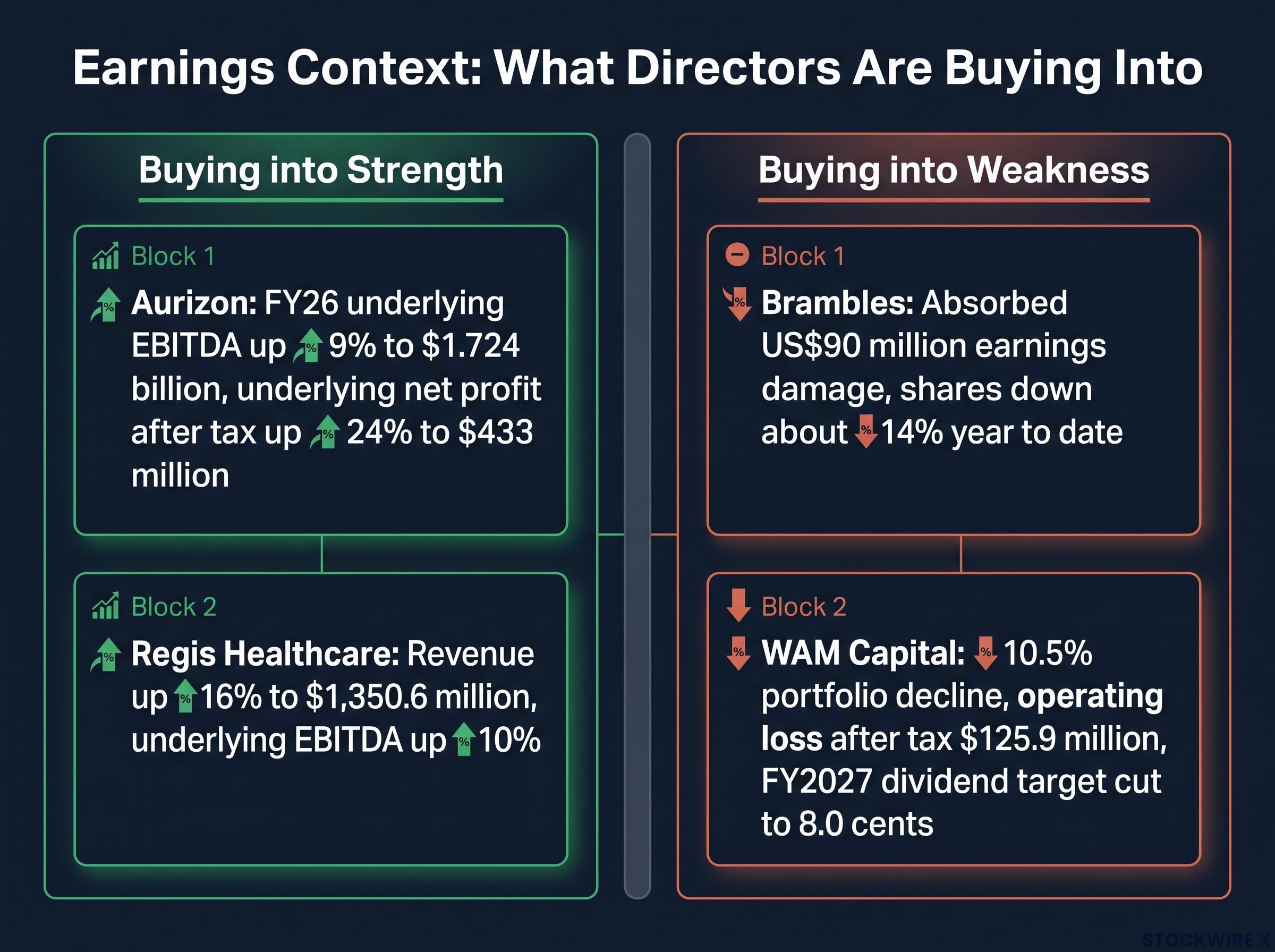
- Buying into strength: South32, Aurizon, Regis Healthcare, Praemium, and Stockland all followed results the market received well.
- Buying into weakness: SiteMinder, Brambles, and WAM Capital all came after share price falls, in some cases despite operational improvement underneath.
The strength cases are backed by hard numbers. Aurizon reported FY26 underlying EBITDA up 9% to $1.724 billion, underlying net profit after tax up 24% to $433 million, and a dividend lifted by roughly 46%. Regis Healthcare posted revenue up 16% to $1,350.6 million, underlying EBITDA up 10%, and underlying net profit up 4%. Praemium grew funds under administration by 21.1% to $77.9 billion, with underlying EBITDA up 14.5% and net inflows up 130%. Directors buying into that kind of print are reinforcing a story the market already likes.
The weakness cases carry a different weight. Brambles absorbed roughly US$90 million of earnings damage from problems in its US repair network, and its shares were down about 14% year to date when James Miller bought. WAM Capital reported a 10.5% portfolio decline and an operating loss after tax of $125.9 million, and cut its FY2027 dividend target to 8.0 cents per share.
Katherine Thorley bought WAM Capital shares in the same window the company confirmed it was cutting its forward dividend target. A director increasing exposure as the payout guidance falls is the sharpest contrarian gesture in the week’s data.
Analyst consensus adds a final layer. As of 4 September 2026, South32 held a Buy consensus from 13 analysts with an average target near $5.07, though note this sits below the $60.91 Bavumile paid, a reminder to check exactly which line of a company’s stock a figure refers to before leaning on it. Cochlear’s 16-analyst consensus averaged roughly $140.0, above the $135.48 Richard Freudenstein paid.
Here is the read to take. When a director buys after a share price fall driven by market reassessment rather than genuine fundamental deterioration, as with SiteMinder and Brambles, that purchase is a direct counterpoint to the market’s own verdict. You should treat it as a higher-conviction signal than a purchase made after strong results and rising prices, where the director is simply agreeing with a crowd that has already moved.
Separating sentiment-driven versus fundamental declines is the critical analytical step when evaluating contrarian director purchases like those at SiteMinder and Brambles, because a director buying into a share price fall is only a high-conviction signal if the fall reflects market reassessment rather than genuine impairment of the business.
What research and governance guidance say about insider buying as a signal
Now the sober counterweight. The evidence on director buying is more mixed than the optimistic read suggests, and knowing why leaves you better equipped rather than deflated.
Research from the UNSW Business School has found an asymmetry that matters here. Undisclosed director sales are significantly associated with negative future performance, but director purchases generally show no statistically significant association with future outperformance.
Director share sale disclosures require an entirely different interpretive lens, because sales are driven as often by diversification, tax timing, or options mechanics as by any negative fundamental view, and the six-point Appendix 3Y checklist developed around the DroneShield case illustrates how raw filings can mislead without that context.
The reason for that gap is intuitive once you sit with it. A director usually has one reason to sell into a private negative view, but many reasons to buy that have nothing to do with believing the stock is cheap.
Governance guidance from the Australian Institute of Company Directors sets out those other reasons plainly. A director might buy to satisfy a minimum shareholding requirement under their remuneration structure, to time diversification around tax, to manage governance optics after a selloff, or to comply with a board-mandated alignment policy. None of those is a valuation call.
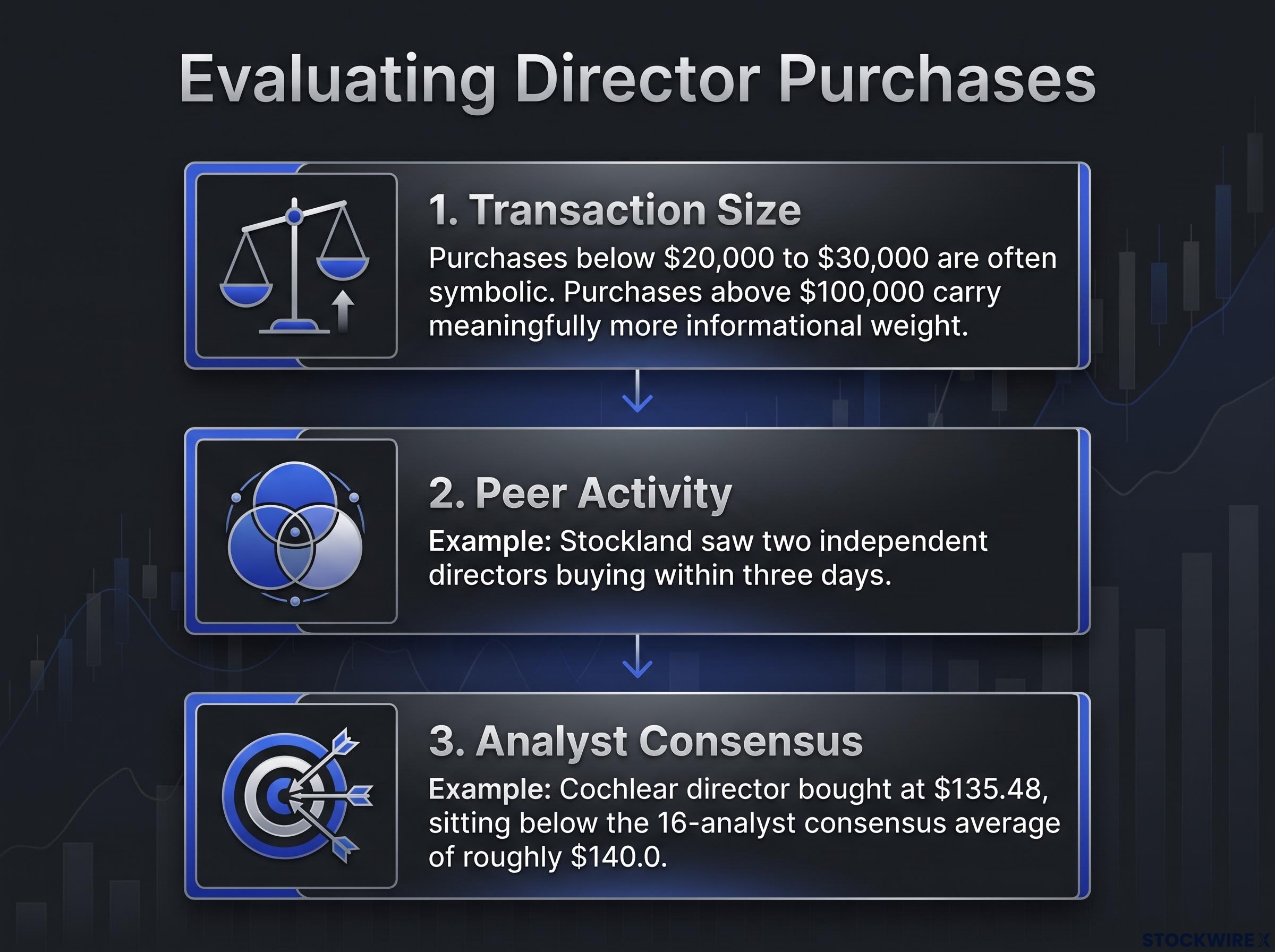
Transaction size is the other complication. The $5,000 to $694,347 range in this single week is the problem in miniature. Market practitioners widely treat purchases below roughly $20,000 to $30,000 as symbolic or compliance-driven, while purchases above $100,000 by a non-executive director using personal funds carry meaningfully more informational weight.
The insider trading framework that produces these clusters, with penalties of up to 15 years imprisonment, is also what forces the trades into narrow calendar windows in the first place. That structure is worth remembering when a cluster looks like a wave of spontaneous enthusiasm rather than the predictable release of pent-up, policy-delayed activity.
So the takeaway is not that director buying is uninformative. It is that three things together determine how much signal any single disclosure actually holds: the transaction size, the number of independent directors acting at once, and the relationship between the purchase price and current analyst consensus.
The four questions most useful for separating a high-signal director trade from a compliance gesture — prompt disclosure, blackout proximity, a stated public rationale, and trade size relative to total holding — are examined in detail through the WiseTech and GYG cases, which together define the ASX director trading red flags that separate genuine conviction from noise.
A practical checklist for evaluating any director purchase disclosure
Turn that into three questions you can ask of any disclosure:
- Is this director spending enough to matter personally? Weigh the transaction size against what you can infer about their remuneration. A purchase that is small relative to their pay is closer to a compliance gesture than a conviction bet.
- Are they buying alone or alongside peers? One independent director buying is a data point. Two or more inside the same window, as at Stockland, is a pattern.
- Does the purchase price sit below or above analyst consensus? Buying below the consensus target, as Freudenstein did at Cochlear, suggests the director sees value the market has not yet marked in.
All three questions can be answered from publicly available ASX announcements and broker consensus databases, which makes this a genuinely usable framework rather than a theoretical one.
What this week’s buying pattern signals heading into the final quarter of 2026
Pull the threads together and a picture forms. The buying spanned resources (South32), property (Stockland), healthcare (Regis Healthcare, Cochlear), infrastructure (Atlas Arteria, Aurizon), financial services (Bendigo and Adelaide Bank, WAM Capital, Praemium), and consumer and technology names (a2 Milk, SiteMinder, Brambles).
That is 12 distinct companies across at least six sectors of the index, which points to broad rather than thematic conviction. Directors were not collectively betting on one corner of the market.
The scale pattern is just as telling. The two largest purchases, South32 at $694,347 and Stockland at $411,300, landed in companies where results were unambiguously strong and analyst consensus was constructive. The contrarian purchases at SiteMinder, Brambles, and WAM Capital were all smaller, which is meaningful when you are weighting the signals rather than just counting them.
Across the week, the 13 directors deployed personal capital across a range of company-level conviction calls. This followed a season in which forward guidance, not historical financials, moved share prices, meaning directors buying on updated outlooks were acting on the most current information available to anyone.
For your own portfolio work heading into the final quarter of 2026, treat this data as a list of companies where the people with the deepest operational knowledge chose to increase personal exposure. Interest rate trajectory, commodity prices, and domestic consumption data will remain the primary drivers of where the index goes. The director purchases sit alongside those inputs as candidates for independent due diligence, not ahead of them.
Use this data as a research shortlist, not a buy signal
You now hold a sharper lens rather than a simple conclusion. The breadth and post-blackout timing of this week’s buying make it worth taking seriously as a research prompt, but no single transaction on this list is enough on its own to justify a position without your own fundamental analysis.
The sequence to apply is straightforward. Identify the large-value, non-executive purchases first. Check the purchase price against analyst consensus. Verify whether more than one director acted in the same window. Then cross-reference all of that against your own view of the company’s valuation and sector outlook.
On that filter, four names from the week stand out for further diligence:
- South32: the largest purchase of the week, made into strong FY26 results and a Buy consensus from 13 analysts.
- Stockland: two independent directors buying within three days across a narrow price band, following well-received results.
- Regis Healthcare: a material $245,832 purchase into revenue up 16%, with aged care reform providing a sector tailwind.
- Cochlear: a purchase at $135.48, sitting below the analyst consensus average of roughly $140.0.
The collective weight of the week’s buying shows the breadth of the signal without overstating any single trade. The next comparable window will follow the February 2027 reporting season, so treat this as a recurring habit rather than a one-off event: same checklist, next cluster.
This article is for informational purposes only and should not be considered financial advice. Investors should conduct their own research and consult with financial professionals before making investment decisions.
Past performance does not guarantee future results. Financial projections and analyst targets are subject to market conditions and various risk factors, and any forward-looking view here is speculative and may change as company performance and market developments unfold.