How Dual-Class Shares Put $24 Billion in Gulf Capital at Arm’s Length
22 hrs ago


SpaceX has confidentially filed with the SEC, a June 2026 Nasdaq listing is in view, and retail investors still cannot buy a single share through any public exchange today. With prediction markets currently estimating the likelihood of a mid-2026 listing at somewhere between 61% and 72%, and the company targeting a valuation above $2 trillion, the pre-IPO window is narrowing. Investors who want exposure before the opening bell have three realistic options available right now, each with meaningfully different mechanics, costs, and risks.
This guide walks through each vehicle, ARK Venture Fund (ARKVX), Baron Partners Fund (BPTRX), and Alphabet (GOOGL), compares them across the dimensions that matter most for a commercial decision, and provides a framework for choosing the option that fits a given investor’s situation.
SpaceX filed confidentially with the SEC on 1 April 2026 under the internal codename “Project Apex.” Public S-1 excerpts confirmed a dual-class share structure as of 21 April 2026, and the company is targeting a Nasdaq listing in June 2026, with a roadshow expected during the week of 8 June.
The offering is large. SpaceX aims to raise up to $75 billion at a valuation exceeding $2 trillion, implying approximately 3.75% dilution. Twenty-one banks have been enlisted, with five serving as senior bookrunners:
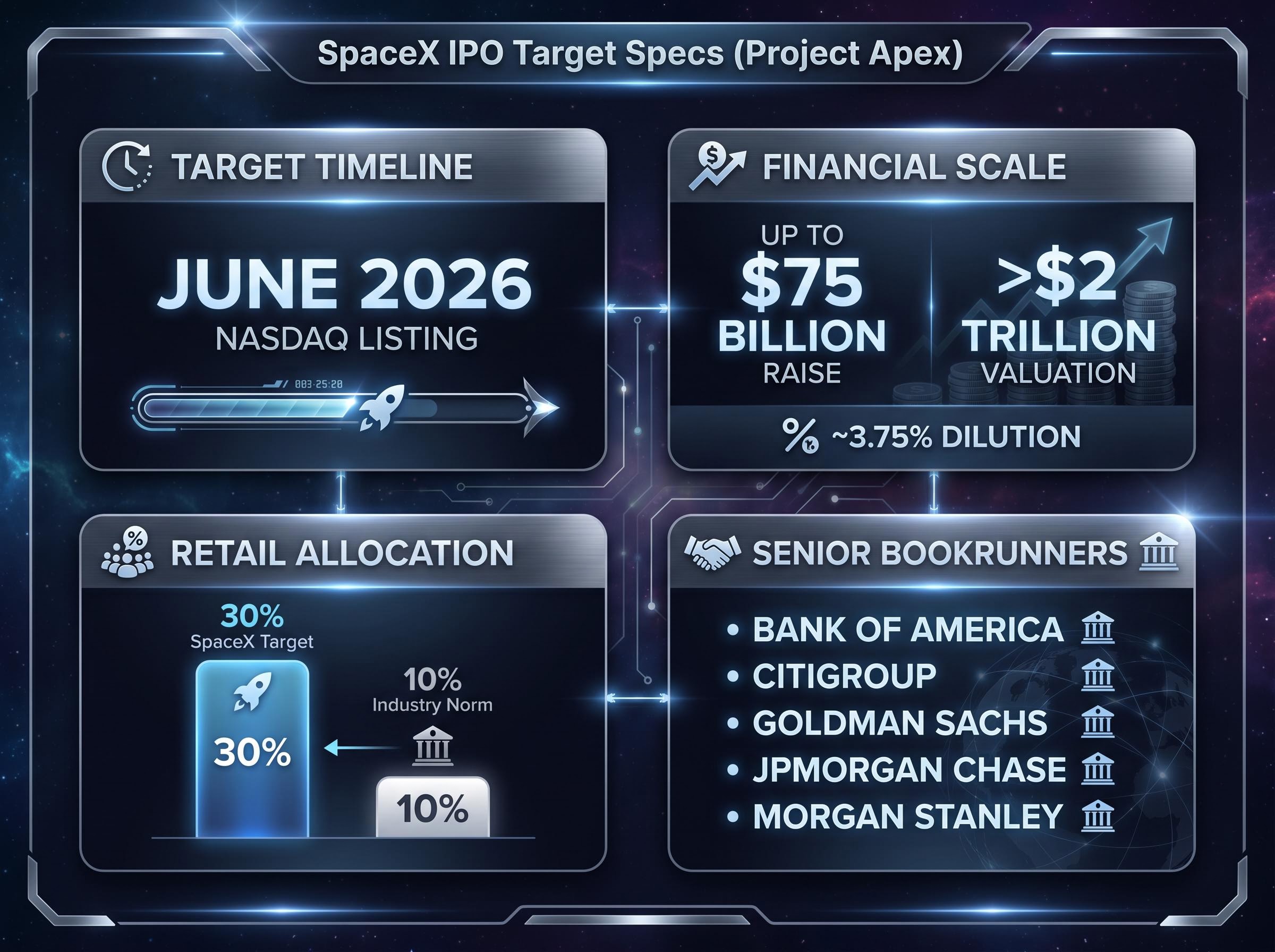
According to prediction markets, the odds of a mid-2026 listing currently sit between 61% (Polymarket) and around 72% (Kalshi-adjacent sources), pointing to a probable but not certain IPO.
For retail investors, the problem is access. Direct share purchases are unavailable today. Secondary market platforms such as Forge Global and EquityZen list SpaceX shares, but both require accredited investor status (net worth above $1 million or annual income above $200,000), and minimum investments often exceed $100,000.
The SEC accredited investor criteria covering net worth and income thresholds set the $1 million net worth standard (excluding primary residence) and the $200,000 annual income requirement that secondary market platforms such as Forge Global and EquityZen apply when gatekeeping access to private SpaceX shares.
SpaceX has committed up to 30% of IPO shares for retail investors, significantly above the industry norm of roughly 10%. That commitment, however, does not solve the access gap today; no allocation mechanism has been publicly confirmed. For investors unwilling to wait passively, three proxy vehicles offer a way to participate in SpaceX’s growth trajectory before any listing occurs.
Indirect exposure means owning shares in a fund or publicly traded company that itself holds SpaceX equity, rather than owning SpaceX shares directly. None of the three vehicles covered in this guide provide direct SpaceX share ownership. All carry additional layer risks, including fund management fees and portfolio dilution.
Before evaluating each option, it helps to establish the four comparison dimensions that will recur throughout this guide:
Closed-end fund structures and IPO access mechanics have become increasingly visible to retail investors through 2026, as high-profile offerings including the Pershing Square dual-listing demonstrated that funds holding private company stakes can give public market participants economic exposure to assets they could not otherwise access, while introducing their own layer of fees and discount-to-NAV risk.
The three options fall into two structural categories. ARKVX and BPTRX are regulated investment funds that hold SpaceX as a private company position within a broader portfolio. Alphabet (GOOGL) is a publicly traded equity that holds a SpaceX stake acquired through a historical funding round. Each type carries a different risk and fee profile, which the following sections examine in detail.
ARK Venture Fund (ARKVX) offers the highest SpaceX concentration of the three options. As an interval fund managed by ARK Invest, ARKVX holds private-market positions that are typically inaccessible to retail investors, including stakes in OpenAI and Anthropic alongside its SpaceX holding.
SpaceX accounts for 17.02% of ARKVX’s portfolio, making it the single largest holding and the most concentrated indirect SpaceX exposure available through a regulated fund.
The 2.9% expense ratio is meaningfully higher than a passive index fund, but the fee reflects what the vehicle provides: active private-market access to companies that do not trade on public exchanges. Substantial gains in 2025 were driven by rising valuations of SpaceX, OpenAI, and Anthropic.
ARKVX operates as an interval fund, which means redemptions are only permitted during specific quarterly windows. An investor who needs to exit between those windows cannot do so. This stands in contrast to daily-liquid alternatives such as BPTRX or GOOGL, where shares can be sold on any trading day.
The SEC guidance on interval fund repurchase rules and liquidity constraints specifies that interval funds are only required to repurchase between 5% and 25% of outstanding shares during each periodic window, which means investors in ARKVX cannot assume full redemption will be available even within a quarterly window.
For investors whose primary goal is maximum SpaceX concentration in a regulated, accessible vehicle, ARKVX is the most direct option available. The quarterly redemption structure is the cost of that directness, a structural constraint rather than a flaw, but one that must be weighed against the benefit of 17% SpaceX exposure.
Alphabet acquired a 6.1% stake in SpaceX during a $1 billion funding round in 2015. That stake now represents one of the simplest ways for any investor to gain indirect SpaceX exposure, with no minimums, no special fees beyond standard brokerage costs, and daily liquidity.
At SpaceX’s projected valuation, Alphabet’s 6.1% stake could be worth more than $100 billion, yet this represents only approximately 2.5% of Alphabet’s $4.02 trillion market capitalisation.
That dilution math is worth sitting with. A $100 billion stake sounds substantial in isolation, but spread across a $4 trillion company with dozens of other revenue drivers (Google Search, YouTube, cloud, Waymo, proprietary silicon), SpaceX upside becomes a modest component of GOOGL’s total value.
Post-IPO, Alphabet could potentially liquidate part of its SpaceX position, with proceeds possibly directed toward AI initiatives across its business units. For investors seeking low-friction, zero-minimum access, GOOGL is the simplest entry point. The trade-off is that it functions as a broad technology holding with a SpaceX footnote, not a concentrated pre-IPO play.
AI capital expenditure ROI risk in large-cap tech is directly relevant to evaluating Alphabet as a SpaceX proxy: Google’s hyperscaler investments and cloud buildout represent the dominant value drivers in GOOGL’s $4 trillion market cap, and if those AI bets underperform, the broad tech exposure surrounding the SpaceX stake could weigh on returns even as SpaceX itself performs well.
Baron Partners Fund (BPTRX) offers the highest reported SpaceX weighting of the three options, combined with something ARKVX cannot match: daily redemptions at net asset value.
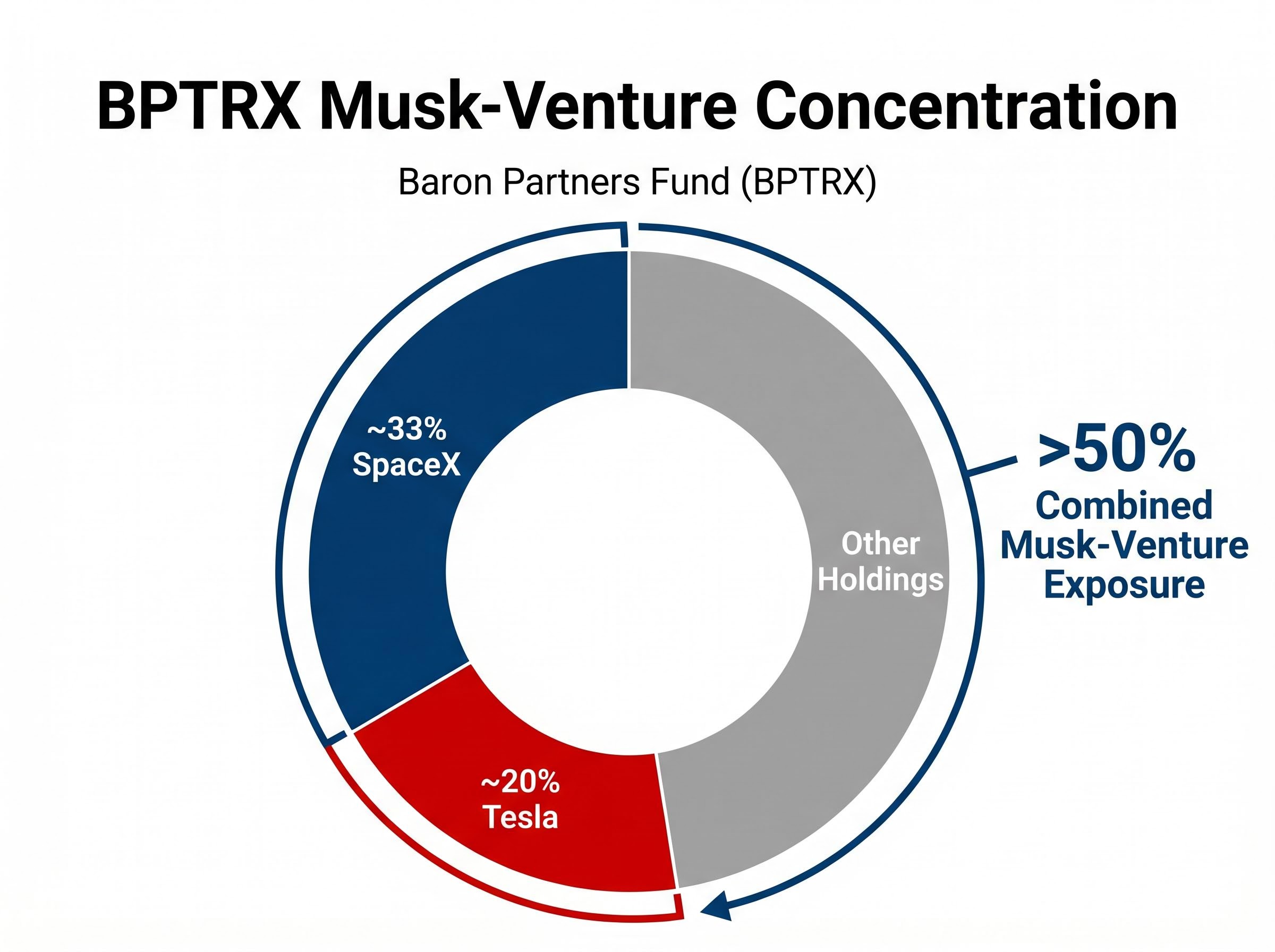
More than 50% of BPTRX’s portfolio is concentrated in SpaceX and Tesla, two companies led by Elon Musk. That level of single-person exposure is rare in a regulated mutual fund.
Tesla’s AI and robotaxi narrative has increasingly become the primary driver of how analysts and fund managers value the stock, meaning that BPTRX’s roughly 20% Tesla weighting is as much an AI bet as it is an automotive one; shifts in sentiment around Musk’s autonomous vehicle and chip timelines can move the Tesla position independently of SpaceX news.
For investors who believe in Musk’s leadership across both companies, that concentration is a feature. Ron Baron’s long-term track record, including the 15.6% annualised return since 1992, provides context for the fund’s approach, though past performance does not guarantee future results.
Concentration risk, in practical terms, means that a disproportionate share of a portfolio’s value depends on a narrow set of outcomes. In BPTRX’s case, the risk extends beyond standard sector concentration. SpaceX and Tesla are correlated not through industry overlap but through Elon Musk’s personal reputation and leadership. A single adverse event involving Musk, whether regulatory, reputational, or operational, could affect both holdings simultaneously.
Investors wanting meaningful SpaceX exposure with daily exit flexibility may find BPTRX the most practical fund option. The concentration trade-off, however, is genuine. Over 50% of the fund’s value rests on two companies led by one person.
| Vehicle | SpaceX Exposure | Fees | Liquidity | Best For |
|---|---|---|---|---|
| ARKVX | 17.02% of portfolio (private-market holding) | 2.9% net expense ratio | Quarterly redemption windows | Investors prioritising maximum SpaceX concentration in a regulated fund |
| BPTRX | ~33% of portfolio (private-market holding) | Higher than standard ETFs (verify at SEC EDGAR) | Daily redemption at NAV | Investors wanting high SpaceX exposure with daily exit flexibility |
| GOOGL | ~2.5% of market cap (6.1% ownership stake) | Standard brokerage fees only | Daily (publicly traded) | Investors seeking low-friction SpaceX adjacency within a broad tech holding |
None of these vehicles provides direct SpaceX share ownership. The June 2026 IPO, if it proceeds as targeted, represents the first opportunity for direct retail ownership. The 30% retail allocation commitment is meaningful but unconfirmed in its specific mechanism.
ARKVX suits investors who prioritise maximum SpaceX concentration within a regulated vehicle and can tolerate the structural constraint of quarterly liquidity windows. The 2.9% expense ratio is the price of private-market access.
BPTRX suits investors who want meaningful SpaceX exposure with the flexibility to exit on any trading day, provided they are comfortable with heavy Musk-venture concentration across more than 50% of the fund’s holdings.
GOOGL suits investors seeking the lowest-friction, zero-minimum entry point to SpaceX adjacency as part of a broader technology position. The trade-off is clear: SpaceX represents approximately 2.5% of Alphabet’s total market capitalisation, making it a complement to a tech thesis rather than a standalone SpaceX bet.
The right choice depends on personal priorities: concentration, liquidity, or simplicity. Match the vehicle to the priority rather than defaulting to whichever option has the most press coverage.
Three vehicles offer pre-IPO exposure today. Each carries a different fee, liquidity, and concentration profile. None provides direct SpaceX share ownership.
The June 2026 IPO timeline, if it holds, represents the first opportunity for direct retail ownership. Monitoring the public S-1 filing on SEC EDGAR remains the most reliable way to track definitive terms, including how the retail allocation will be administered. Financial projections and IPO timelines are subject to market conditions and various risk factors; past performance does not guarantee future results.
SEC disclosure requirements for newly listed companies determine how much financial information SpaceX will be obligated to publish after its IPO, and proposed regulatory changes moving through the agency in 2026 could affect the frequency and depth of reporting that post-IPO SpaceX shareholders receive, a consideration that sits alongside valuation and allocation mechanics when assessing whether to hold through the listing or take a pre-IPO position through one of the proxy vehicles.
The most productive next step is straightforward: identify whether concentration, liquidity, or simplicity matters most, then evaluate the corresponding vehicle on its own terms. Independent research and professional financial advice are strongly recommended before committing capital to any of these vehicles.
Retail investors can gain indirect SpaceX exposure today through three vehicles: ARK Venture Fund (ARKVX), which holds SpaceX at 17.02% of its portfolio; Baron Partners Fund (BPTRX), which allocates approximately 33% to SpaceX; or Alphabet (GOOGL), which owns a 6.1% stake in SpaceX. None of these options provide direct SpaceX share ownership.
An interval fund is a type of regulated fund that only permits redemptions during specific quarterly windows, meaning investors cannot sell their shares on any given trading day. For ARKVX holders, this means liquidity is restricted to those periodic windows, and the SEC requires the fund to repurchase only between 5% and 25% of outstanding shares per window.
SpaceX filed confidentially with the SEC on 1 April 2026 and is targeting a Nasdaq listing in June 2026, with a roadshow expected during the week of 8 June. The company is aiming to raise up to $75 billion at a valuation exceeding $2 trillion, implying approximately 3.75% dilution.
Alphabet holds a 6.1% stake in SpaceX, which at a $1.75-$2 trillion SpaceX valuation could exceed $100 billion in value, but this represents only approximately 2.5% of Alphabet's $4.02 trillion market capitalisation. This makes GOOGL a broad technology holding with SpaceX as a minor component rather than a concentrated pre-IPO play.
BPTRX allocates approximately 33% to SpaceX and roughly 20% to Tesla, meaning over 50% of the fund is concentrated in two companies both led by Elon Musk. This creates a unique risk where a single adverse event involving Musk, whether regulatory, reputational, or operational, could negatively affect both holdings simultaneously.