Inside Pershing Square’s Unusual $10B US Market Debut

Key Takeaways
- Bill Ackman's Pershing Square launched its combined IPO roadshow on April 13, 2026, targeting between $5 billion and $10 billion through a rare dual-listing of a closed-end fund (PSUS) and hedge fund management company (PSI) on the NYSE.
- The offering has already secured $2.8 billion in committed private placements from family offices, pension funds, and ultra-high-net-worth investors, signalling strong institutional confidence ahead of the public launch.
- Public investors can access both securities with a $5,000 minimum (100 PSUS shares at $50 each), receiving 20 PS shares per 100 PSUS purchased, while private placement investors receive a 50% enhanced allocation of 30 PS shares per 100 PSUS.
- Ackman plans to deploy IPO proceeds within weeks, with recent portfolio additions including Meta (at approximately 22x earnings) and Amazon (at approximately 32x earnings), both expected to deliver 20% or more annual EPS growth.
- Investors should note that SEC registration statements are still under review, closed-end funds can trade at discounts to NAV, and the concentrated portfolio strategy carries higher volatility than diversified index approaches.
Bill Ackman’s Pershing Square has officially launched a combined IPO roadshow as of April 13, 2026, seeking between $5 billion and $10 billion through a rare dual-listing structure. This represents one of the largest hedge fund-related public offerings in recent memory and marks a significant strategic shift for the firm.
The offering involves two entities: Pershing Square USA, Ltd. (PSUS), a closed-end investment fund, and Pershing Square Inc. (PSI), the hedge fund management company. Both will trade simultaneously but separately on the NYSE under tickers PSUS and PS respectively. The structure has already attracted $2.8 billion in committed private placements from family offices, pension funds, and ultra-high-net-worth investors. Pershing Square currently manages approximately $20 billion in assets, and Ackman has stated he intends to deploy IPO proceeds within weeks of raising them, suggesting the offering could close rapidly following the active roadshow.
How Closed-End Funds and Hedge Fund IPOs Work
Unlike mutual funds or exchange-traded funds, closed-end funds issue a fixed number of shares that trade on exchanges. Their market price can trade at premiums or discounts to the underlying net asset value (NAV), the per-share value of the fund’s actual holdings. PSUS will operate as this type of vehicle, meaning investors buy shares representing ownership in an investment portfolio managed by Ackman’s team, not a stake that can be redeemed directly with the fund.
The SEC’s official investor education guidance on closed-end funds explains how these vehicles issue a fixed number of shares that trade on exchanges, distinguishing them from open-end mutual funds that continuously issue and redeem shares at NAV.
Hedge fund management companies earn fees from running investment funds, typically charging a percentage of assets under management plus a performance fee based on profits generated. By taking PSI public, Ackman is offering investors ownership in the fee-generating business itself, not just exposure to the underlying investment returns. This is rare because most hedge fund managers prefer private ownership of their lucrative fee streams, which can generate substantial revenue independent of portfolio performance.
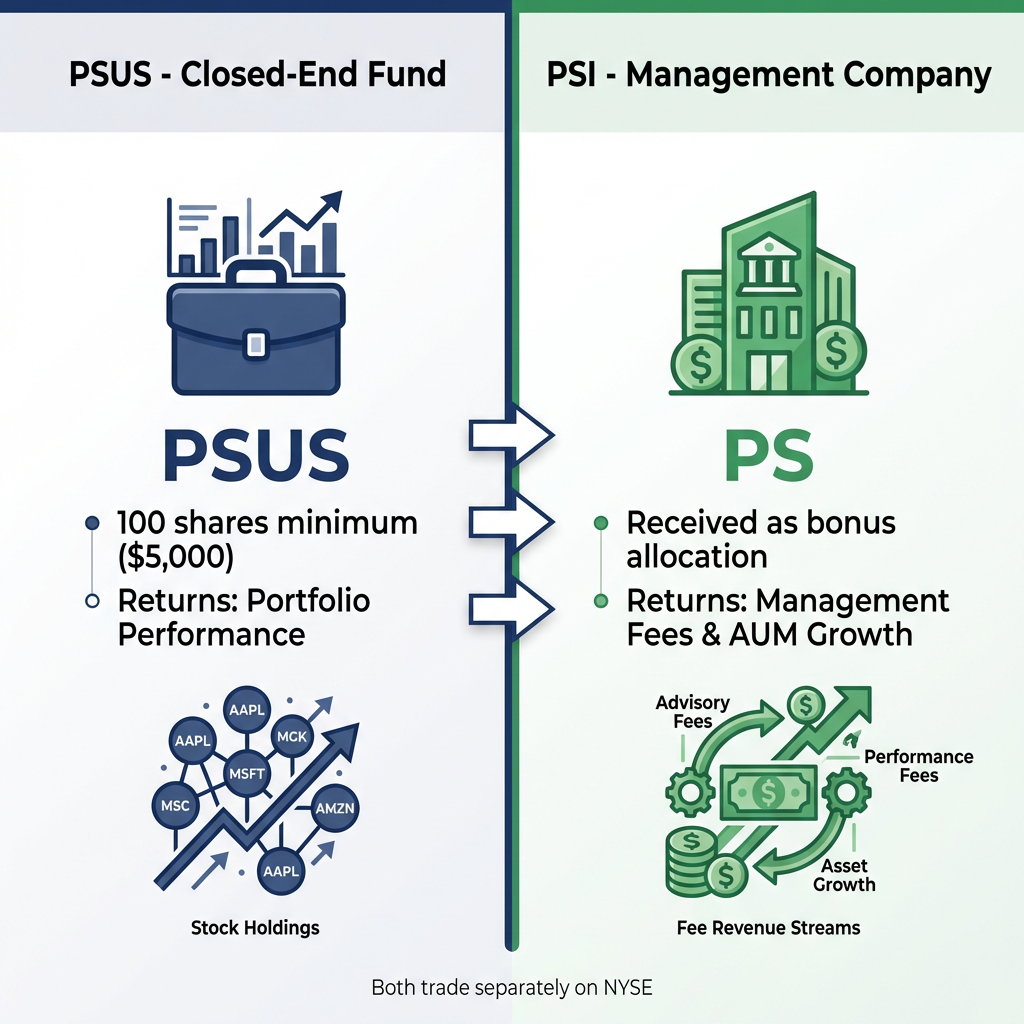
| Entity | What You Own | Ticker | Return Driver |
|---|---|---|---|
| PSUS (Closed-End Fund) | Shares in investment portfolio | PSUS | Portfolio performance |
| PSI (Management Company) | Ownership in fee business | PS | Management fees and asset growth |
PSUS trades at $50 per share on the NYSE. PSI shares are distributed as bonus allocations to PSUS purchasers, creating a linked incentive structure. The risk profiles differ materially: PSUS returns are tied directly to Ackman’s investment decisions and market performance, while PSI returns depend on the business economics of managing assets, fee income growth, and the firm’s ability to attract capital.
When big ASX news breaks, our subscribers know first
IPO Structure and Investment Terms
The dual offering has specific linkages designed to encourage PSUS participation. Public investors must purchase at least 100 PSUS shares (a $5,000 minimum at $50 per share) to qualify for the PS IPO. This creates a built-in demand floor for the closed-end fund while allowing retail access to hedge fund economics. Both securities will trade simultaneously but separately on the NYSE, enabling investors to manage positions independently after the initial purchase.
| Investor Type | PSUS Purchase | PS Shares Received | Bonus Ratio |
|---|---|---|---|
| Public Investors | Minimum 100 shares ($5,000) | 20 PS shares per 100 PSUS | Standard allocation |
| Private Placement Investors | Larger commitments ($2.8B total) | 30 PS shares per 100 PSUS | 50% enhanced allocation |
Private placement investors, including family offices, pension funds, and ultra-high-net-worth individuals, receive 30 PS shares per 100 PSUS shares purchased, a 50% better ratio than public investors. The $2.8 billion already committed through private placements demonstrates institutional confidence in the structure and Ackman’s strategy.
The underwriting syndicate includes Academy Securities, Huntington Capital Markets, Loop Capital Markets, Oppenheimer & Co., Piper Sandler, Roberts & Ryan, and Wedbush Securities as co-lead managers. Registration statements on Form N-2 (for PSUS) and Form S-1 (for PSI) have been filed with the SEC and are currently under review. The combined offering will not exceed $10 billion before underwriter overallocation options. Given the April 13 roadshow launch, the offering is expected to close within weeks, subject to SEC effectiveness.
Ackman’s Investment Thesis and Current Portfolio Strategy
Ackman favours dominant large-cap companies with durable competitive advantages, often referred to as economic moats. He argues that these companies warrant premium valuations despite elevated index-level price-to-earnings ratios because their structural advantages justify higher multiples. The S&P 500 is currently trading at approximately 7,126 with a 20.4x forward P/E ratio, above the historical mid-to-high teens average.
FactSet’s industry-standard valuation methodology for calculating forward P/E ratios provides the authoritative basis for market-level valuation assessments cited by major financial institutions.
Ackman contends that elevated index-level valuations are driven by concentration among a small number of highly valued companies, not broad overvaluation across all sectors. This concentration reflects market recognition of exceptional businesses with lasting competitive positioning.
Recent portfolio additions include Meta and Amazon. Meta shares were acquired following investor concerns about capital spending plans, trading at roughly 22x earnings (approximately $689 per share, around $1.7 trillion market capitalisation). Amazon was added when investors reacted negatively to announced $200 billion expenditure plans, trading at approximately 32x earnings (around $250 per share) after recovering from March lows of roughly 26x. Both companies are expected to deliver 20%+ annual EPS growth, which Ackman believes justifies their current multiples.
Ackman’s stated investment criteria include:
- Enormous scale and industry leadership positions
- Significant capital available for AI and other strategic investments
- Durable competitive moats that protect market share
- Growth trajectories that justify premium multiples relative to earnings
- Resilience to hold through market volatility while awaiting improved sentiment
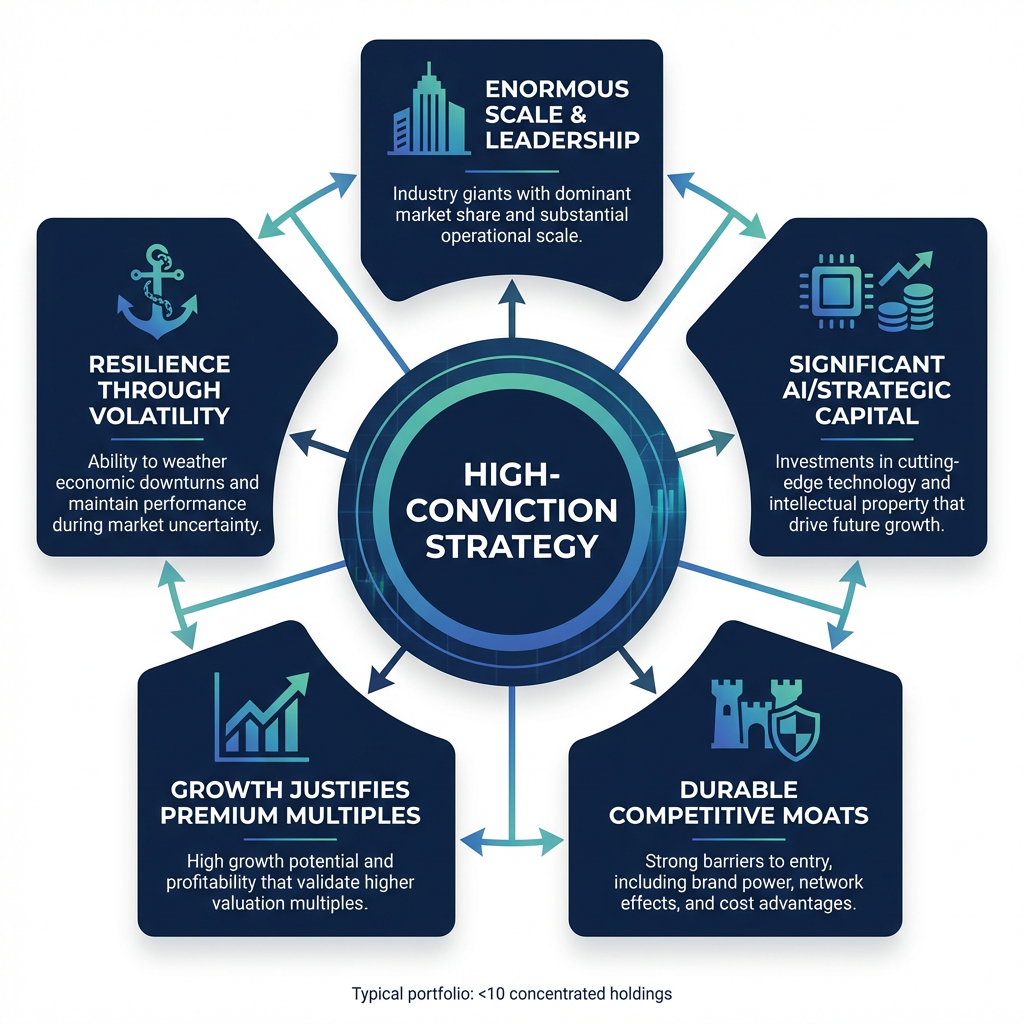
This concentrated, high-conviction approach differs materially from diversified index strategies. Portfolio positions are typically limited to fewer than 10 holdings, amplifying both potential returns and risks.
The next major ASX story will hit our subscribers first
Market Outlook and Deployment Timeline
Ackman expects the latter half of 2026 to generate favourable conditions for equity investors. However, he acknowledges near-term headwinds from the Iran conflict’s impact on oil prices and resulting inflation pressure, which could prevent the Federal Reserve from cutting rates as markets had anticipated. Rate cut expectations have deteriorated materially over approximately six weeks prior to mid-April.
The Iran conflict’s impact on oil prices has created near-term inflation pressure that complicates Federal Reserve policy decisions and affects equity market sentiment.
Ackman’s market outlook for the latter half of 2026 includes specific expectations around Fed policy, inflation trajectories, and corporate earnings dynamics that inform his deployment timeline.
The Strait of Hormuz reopening around April 17 has provided some relief, with oil prices declining from recent peaks. This easing reduces one source of inflation pressure and may improve the outlook for monetary policy flexibility.
Ackman has stated he intends to deploy IPO proceeds within weeks of raising them, suggesting he views current valuations as attractive entry points despite near-term uncertainty. The first complete year under revised tax legislation could positively affect corporate profits and stimulate merger and acquisition activity and business investment, creating additional catalysts for equity performance. High-quality holdings like Meta and Amazon are considered resilient enough to hold through near-term market uncertainty while awaiting improved sentiment and macroeconomic conditions.
The anticipated increase in merger and acquisition activity could create opportunities for activist investors and concentrated portfolios positioned to capitalize on corporate restructuring trends.
Key Considerations for Prospective Investors
This offering presents both opportunities and considerations that investors should evaluate carefully before participating.
Potential Advantages
- Access to Ackman’s concentrated, high-conviction strategy typically reserved for institutional investors
- Rare opportunity to own hedge fund management economics (fee stream exposure) through PSI
- Bonus PS shares create additional value proposition beyond the closed-end fund investment
- Rapid capital deployment promises quick exposure to market opportunities Ackman identifies
Potential Considerations
- Concentrated portfolio carries higher volatility than diversified index approaches
- Closed-end funds can trade at discounts to NAV, creating potential misalignment between market price and underlying value
- SEC review still in progress (registration statements not yet effective)
- $5,000 minimum and linked structure require commitment to both offerings simultaneously
- Manager risk: returns depend heavily on Ackman’s continued decision-making and the firm’s ability to identify attractive opportunities
Interested investors should monitor SEC filing status (Form N-2 for PSUS, Form S-1 for PSI), review final prospectus documents when available, and consult financial advisors regarding portfolio fit and risk tolerance. The roadshow is underway as of April 13, suggesting the offering window may open within weeks. The combined structure is rare in public markets and warrants careful due diligence regarding both the investment strategy and the mechanics of closed-end fund trading.
> This article is for informational purposes only and should not be considered financial advice. Investors should conduct their own research and consult with financial professionals before making investment decisions.
Frequently Asked Questions
What is the Pershing Square US IPO and how does it work?
The Pershing Square US IPO is a dual-listing offering involving two entities: Pershing Square USA, Ltd. (PSUS), a closed-end investment fund, and Pershing Square Inc. (PSI), the hedge fund management company. Both will trade separately on the NYSE, with public investors able to buy PSUS shares at $50 each and receive bonus PS shares as part of the linked structure.
How much is the minimum investment for the Pershing Square IPO?
Public investors must purchase a minimum of 100 PSUS shares, which equals a $5,000 minimum at the $50 per share offering price, to qualify for the PS IPO allocation of 20 PS shares per 100 PSUS shares purchased.
What is the difference between PSUS and PSI in this offering?
PSUS is a closed-end fund where investors own shares in Ackman's investment portfolio, with returns driven by portfolio performance. PSI is the management company itself, where investors own a stake in the fee-generating business, with returns driven by management fees and asset growth.
How can retail investors participate in the Pershing Square US IPO?
Retail investors can participate by purchasing a minimum of 100 PSUS shares ($5,000) during the IPO, which also qualifies them to receive 20 PS shares. Investors should monitor SEC filing status for Form N-2 and Form S-1 and review the final prospectus when available.
What stocks does Bill Ackman plan to invest IPO proceeds in?
Ackman recently added Meta and Amazon to his portfolio and favours dominant large-cap companies with durable competitive advantages. He has stated he intends to deploy IPO proceeds within weeks of raising them, targeting companies with 20% or more annual EPS growth expectations.