How to Evaluate Any ASX Stock Before You Buy It
1 hr ago


More than 10 million Australians now hold investments outside superannuation, yet many first-time investors freeze at the same practical question: once the decision to start picking stocks has been made, how does a portfolio actually come together? Participation among younger Australians has surged, with 18 to 24 year olds nearly tripling their investment rates between 2020 and 2023. But deciding to invest and knowing how to structure a portfolio are two different things. The mechanics of portfolio construction, how many stocks to own, how to choose between two similar companies, and how to stay calm when prices fall, rarely get answered in one place. This guide covers the practical decisions beginner investors face after the first buy button gets pressed: how to structure holdings, how to size a portfolio, how to handle a price decline without panic-selling, and how platforms like Stake, Superhero, and CommSec make starting genuinely accessible.
Buying a share means acquiring fractional ownership in a real business. That ownership comes with the full spectrum of outcomes: the company might grow its earnings for decades, or it might fail entirely.
This is where individual stocks diverge sharply from index funds. A single company can go to zero. AMP fell from above $5 in 2017 to below $1.50 by 2020 following misconduct revelations. Blue Sky Alternative Investments collapsed from over $10 in 2017 to near zero by 2019 after a short-seller attack and liquidity issues. The ASX 200 or S&P 500, by contrast, cannot reach zero; the systemic economic collapse required to produce that outcome would extend far beyond any single portfolio.
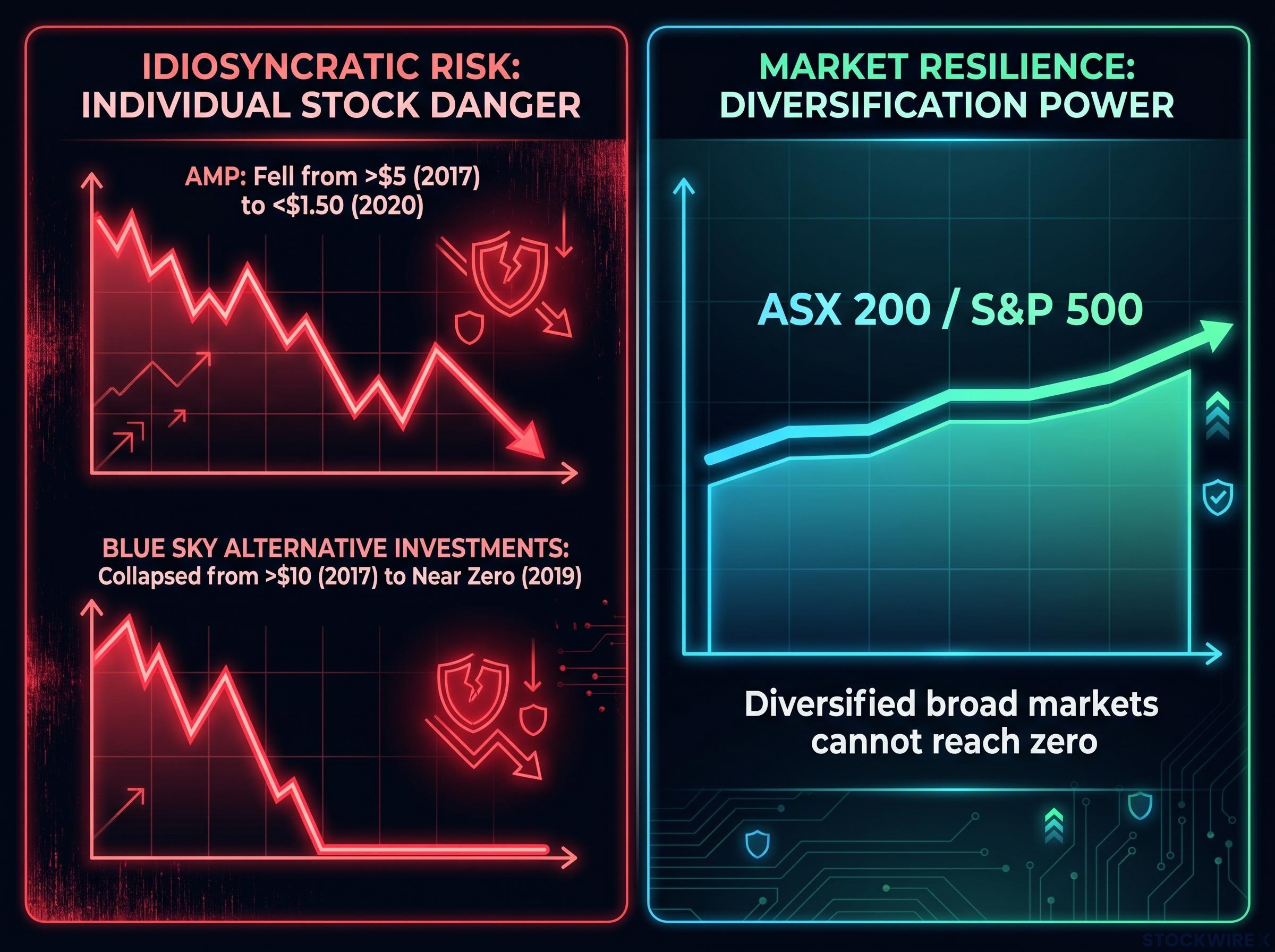
The risk that belongs to one company, or one sector, is called idiosyncratic risk. It is the risk that something goes wrong with a specific business, its management, its product, or its regulatory environment, rather than with markets broadly. Understanding idiosyncratic risk is the foundation on which every other portfolio decision rests.
The distinction between permanent capital loss and temporary price decline sits at the heart of how experienced investors evaluate individual companies; a business whose share price has fallen 40% due to sector-wide sentiment may represent lower risk than one that fell 15% due to a structural competitive failure.
Three characteristics distinguish direct share ownership from holding a diversified fund:
During the GFC and COVID drawdowns, diversified balanced options experienced large but ultimately recoverable falls. Portfolios concentrated in a handful of individual names did not always recover at all.
Most beginners want to skip straight to choosing stocks. The structurally smarter starting point is building a foundation first.
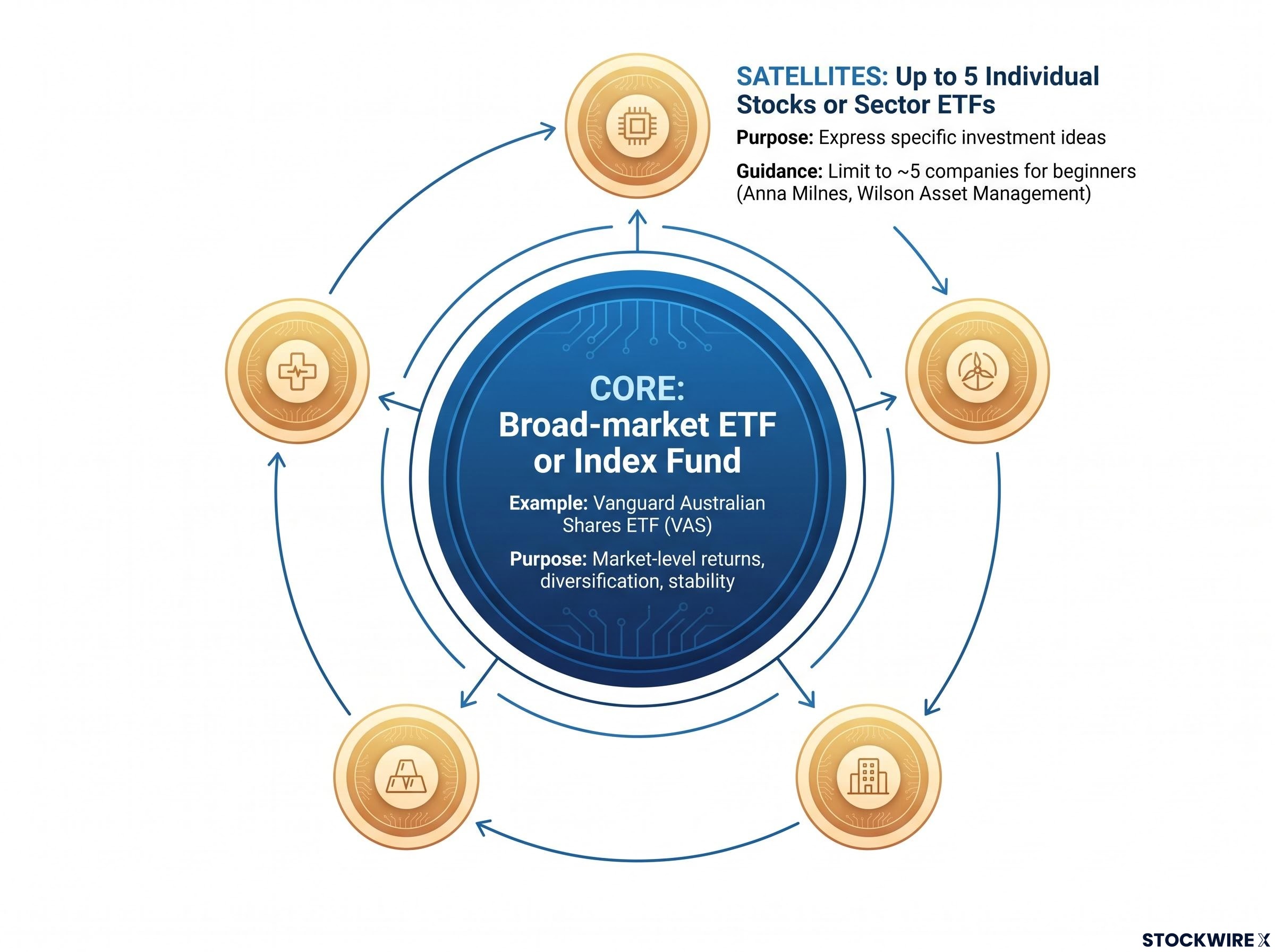
The core-and-satellite framework places a broadly diversified ETF or index fund at the centre of the portfolio, typically representing the majority of invested capital. Around that core, smaller satellite positions in individual stocks allow the investor to act on specific ideas. The core delivers market-level returns, provides broad sector exposure across hundreds of companies, and serves as a psychological anchor during downturns. The satellites are where stock-picking conviction gets expressed, but without dominating portfolio risk.
The failure mode of skipping the core entirely is well documented. According to Morningstar Australia (2023), investors who bypass a diversified foundation “often end up concentrated in a handful of familiar names,” exposing them to sector and single-company risk. BetaShares (2024) notes that core exposure via broad-market ETFs provides “instant diversification to hundreds of securities,” a benefit that is structurally impossible to replicate by picking five or six individual stocks.
“Jumping straight into individual shares without a core can mean your portfolio behaves like a single stock.” — Financial Advice Association Australia (FAAA) consumer guidance
Vanguard Australia advocates a core-satellite structure where the core is a broadly diversified index fund and satellites are smaller, active tilts. The logic is straightforward: if a satellite position fails, the core absorbs the impact. If an investor skips the core, every position is a satellite, and every satellite carries the potential to drag the entire portfolio.
| Component | What It Is | Purpose | Example |
|---|---|---|---|
| Core | Broad-market ETF or index fund | Market-level returns, diversification, stability | Vanguard Australian Shares ETF (VAS) |
| Satellite | Individual stocks or sector ETFs | Express specific investment ideas | Individual ASX-listed company |
Getting this architecture right means individual stock mistakes stay contained rather than threatening the whole portfolio.
Investors wanting to move beyond the framework introduced here will find our full explainer on building a core-satellite portfolio with ASX ETFs covers the specific sizing decisions in detail, including how to determine the right split between core and satellite, how to evaluate whether a satellite position expresses a thesis the core does not already capture, and how to rebalance without triggering unnecessary capital gains events.
There is no single correct answer, but the competing views cluster into three schools of thought:
The practical recommendation for beginners sits at school two. Start with approximately five individual stocks, held alongside a core ETF. As CommSec guidance notes, owning just a small number of individual shares “can expose you to greater volatility and the risk of larger losses if one company performs poorly,” which is precisely why the core-satellite structure described earlier matters.
Five stocks all in the same sector provide far less protection than five stocks spread across different industries. The ASX Australian Investor Study 2023 found that a portion of direct shareholders hold only one or two shares, typically banks or large miners, which exposes them to sector-specific risk.
Consider the practical consequence: if all five holdings are major banks, a single credit event or regulatory change could see every position decline simultaneously. Spreading across sectors, say healthcare, technology, financials, consumer staples, and industrials, ensures that the forces acting on one holding are unlikely to act identically on the others.
The ASX Australian Investor Study 2023 documents this concentration pattern in detail, finding that a meaningful share of direct shareholders hold positions in only one or two companies, typically large banks or miners, leaving their portfolios exposed to the sector-specific forces that broad diversification is designed to offset.
Once the portfolio has a structure and a sector spread, the stock-picking decision often narrows to a specific comparison: two companies in the same industry, both with reasonable credentials. Coles versus Woolworths in grocery retail. Telstra versus TPG in telecommunications.
The investor’s job is to form a view on which company is better positioned from today forward, not based on historical performance alone. Ask four questions when comparing competitors:
If a clear preference genuinely cannot be established after working through these questions, buying a small position in both is a valid approach. The goal is to prevent comparison paralysis from stopping the portfolio from being built at all.
Anna Milnes made her first investment of approximately $500 in Infratil at age 16, holding it for an extended period. Infratil subsequently became a notable data centre business, though the position was sold before that outcome materialised. The lesson is not that every early investment must be perfect; it is that starting, even modestly, builds the pattern recognition that improves every subsequent decision.
Chad Warner’s first stock was Telstra, arranged by his mother when he was 15. The holding had risen roughly 30% by the time he became more actively engaged with his investments. Neither Warner nor Milnes started with a perfect pick. Both started.
The first real decline in a portfolio’s value is the moment most beginner investors discover whether their strategy is emotionally sustainable. The instinct to sell is not irrational; it is biological.
Research by Kahneman and Tversky on prospect theory demonstrates that losses feel approximately twice as painful as equivalent gains feel good. A $500 loss produces a sharper emotional response than a $500 gain produces pleasure. Compounding this, research by Benartzi and Thaler on myopic loss aversion finds that investors who check portfolios frequently during volatile periods are more likely to react to short-term losses and de-risk at precisely the wrong time.
Loss aversion bias costs investors an estimated 1-2 percentage points in annual returns according to Morningstar’s Mind the Gap research, driven primarily by the pattern of selling near market lows and re-entering after prices have already recovered, the exact sequence the urge-to-sell instinct produces when left unchecked.
The question a long-term investor must answer during a price decline is not “should I sell?” but rather “has the underlying business deteriorated fundamentally, or has only the share price moved?” These are two entirely different situations requiring opposite responses.
“Selling just because prices have fallen can turn a paper loss into a real loss.” — ASIC Moneysmart
Chad Warner’s practice during price dips has been to increase his position rather than reduce it, though this carries its own risk and is not suitable for all investors. Both Warner and Anna Milnes advocate holding through price declines provided no fundamental deterioration in the business has occurred.
Before acting on the urge to sell, apply two questions: (1) Has anything changed in the underlying business since the purchase? (2) If the stock were not already held, would it be bought at today’s price? If the answers are no and yes respectively, the case for holding, or even adding, remains intact.
Four practical tools reduce the likelihood of panic-selling:
The practical mechanics of starting have never been simpler or cheaper. Four steps cover the entire process:
ASX trade settlement operates on a T+2 cycle, meaning cash from a sale is unavailable for two business days and shares must be registered before a dividend record date to qualify for the payment; understanding this timing prevents surprises on the first trade and informs decisions about when to move funds between accounts.
The major Australian platforms offer materially different fee structures. For beginners starting with small amounts, the brokerage cost as a percentage of the trade matters more than the absolute dollar figure.
| Platform | Min Trade Size | Brokerage Fee (ASX) | Best Suited For |
|---|---|---|---|
| Stake | $50 | $3 per trade | Small starting balances, frequent small trades |
| Superhero | $100 | $2 per trade (up to $20,000) | Low-cost ASX trades with slightly higher minimum |
| CommSec | $50 (Pocket) / standard ASX rules | $5 (trades up to $1,000) / $2 (Pocket) | CBA customers, ETF-focused beginners (Pocket) |
| Pearler | $5 (Micro) / standard ASX rules | $6.50 per trade / $1.50 (Micro auto-invest) | Automated long-term investing |
The CommSec Generation Report 2023 found that the median starting balance for Gen Z clients was $700. Stake reports that 1 in 3 customers said it was their first investing platform. Small starting amounts are not the exception; they are the norm.
A beginner placing a $100 trade on Superhero pays $2 in brokerage, or 2% of the trade value. The same trade on CommSec’s standard platform costs $5, or 5%. At small balances, that difference compounds meaningfully over multiple trades.
The goal of a first portfolio is not to identify perfect stocks. It is to establish the structural habits that make every subsequent decision better: a core ETF foundation, a limited number of satellite positions, and sector spread across those satellites.
Five actions to carry away from this guide:
Investing knowledge compounds alongside capital. Anna Milnes’ $500 in Infratil at age 16 did not produce a life-changing return, but it started a process that led to a career in portfolio management. Chad Warner’s small Telstra holding at 15 sparked an interest in macroeconomic and political developments that had been entirely absent before. The returns on early positions are rarely the point. The pattern recognition those positions build is.
ASIC recommends having a written investment plan and time horizon before committing meaningful capital. The first portfolio is the vehicle for learning how to build the second one.
This article is for informational purposes only and should not be considered financial advice. Investors should conduct their own research and consult with financial professionals before making investment decisions.
The core-and-satellite approach places a broadly diversified ETF or index fund at the centre of your portfolio, representing the majority of invested capital, while smaller individual stock positions called satellites are held around it to express specific investment ideas without dominating overall portfolio risk.
Practitioner advice for Australian retail beginners, including guidance from Wilson Asset Management Deputy Portfolio Manager Anna Milnes, suggests limiting direct holdings to approximately five individual stocks held alongside a core ETF, as tracking more than five companies becomes difficult without professional research infrastructure.
Idiosyncratic risk is the risk specific to a single company or sector, such as a management failure, regulatory action, or competitive loss, rather than a broad market event; unlike a diversified index fund, an individual stock carries no structural floor and can fall to zero, as seen with Blue Sky Alternative Investments and AMP on the ASX.
Stake, Superhero, CommSec, and Pearler are the main platforms for Australian beginners; Superhero charges $2 per ASX trade with a $100 minimum, Stake charges $3 with a $50 minimum, and CommSec Pocket charges $2 for ETF-focused investors, making fee percentage relative to trade size the key consideration at small balances.
Before selling, ask whether anything has changed in the underlying business and whether you would buy the stock at today's price if you did not already own it; if the business has not fundamentally deteriorated, the price decline may be a temporary market movement rather than a reason to sell, and panic-selling risks turning a paper loss into a permanent one.