
Gold has a reputation problem. To most people, it is the asset you run to when everything else is on fire, a nervous investor’s insurance policy, a relic from an older monetary age.
So here is the dissonance worth sitting with. If gold is nothing more than a fear trade for jittery retail buyers, why have the world’s most analytically disciplined institutions, the central banks and reserve managers who move slowly and hate surprises, been buying it for 15 years straight, through good markets and bad?
The numbers are not subtle. Central banks added 863 tonnes of gold to reserves in 2025, according to the World Gold Council, extending a net-buying streak that has now run for over a decade. Family offices, meanwhile, are edging their allocations up from a long-standing 2% average. These are structural decisions made by institutions with time horizons measured in decades, set against a backdrop of persistent fiscal deficits, inflation now in its fifth year above target, and a sanctions environment that has forced reserve managers to ask a harder question: which assets can they actually access in a crisis?
Here is the analytical framework for reading gold’s role in your own portfolio. Not a call to buy or sell, but a clear look at what the data actually says about gold as a diversifier, and the specific conditions under which that diversification benefit is most and least reliable.
Fifteen years of buying: what central banks are actually doing with gold
Start with the scale, because the scale is the story. Central banks and official institutions have been net buyers of gold every single year since 2009, a streak of 15 consecutive years through 2024. That is not a trade. That is a policy.
The pace tells you something too. The 2010-2021 annual average sat at 473 tonnes. In 2024, official-sector buying hit 1,092 tonnes, and 2025 came in at 863 tonnes. Even the lower 2025 figure runs at nearly double the pre-2022 norm.
| Period | Annual Central Bank Buying | Macro Context |
|---|---|---|
| 2010-2021 average | 473 tonnes | Pre-2022 reserve norms |
| 2024 | 1,092 tonnes | Post-Russia sanctions surge |
| 2025 | 863 tonnes | Sustained elevated buying |
What changed in 2022? Russia’s foreign exchange reserves, held in G7 currencies and custodied within G7 systems, were frozen after the invasion of Ukraine. ECB researchers point to that moment repeatedly as the catalyst that made reserve managers reconsider what a reserve asset is actually for.
The reasoning that emerged is consistent across official commentary:
- Sanctions risk: Reserves held in another government’s currency can be frozen. Gold held outside G7 jurisdictions cannot.
- A counterparty-free asset: Gold is nobody’s liability. It does not depend on a foreign government honouring its obligations.
- A geopolitical hedge: In a world of US-China rivalry and active conflicts, an asset that is liquid, globally accepted, and default-free carries a premium.
That structural re-weighting shows up in the demand data. According to ECB analysis, central banks now account for over 20% of global gold demand, up from roughly one-tenth during the 2010s.
The forward signals point the same way. The OMFIF Global Public Investor Survey found a net 30% of reserve managers expect to raise gold allocations within 12 to 24 months, and a World Gold Council survey found 43% of central banks expect their own holdings to grow.
De-dollarisation is the structural force underneath the headline buying figures: the OMFIF Global Public Investor survey released June 2026 recorded the first instance where net dollar-reduction intent outnumbered net dollar-increase intent among central banks, a threshold crossing that Goldman Sachs cited as the primary driver behind its end-2026 gold price target of $4,900 per ounce.
The clearest forward signal In the OMFIF survey, 51% of reserve managers cited protection against geopolitical risk as a reason for holding gold, up 11 percentage points year-on-year. This is an intensifying motivation, not a background one.
There is a counter-case worth holding. Some economists argue central bank demand is partly cyclical, concentrated among a subset of emerging-market buyers, and could slow if real yields climb and macro conditions stabilise. Central banks were, after all, net sellers in the 1990s and 2000s.
What this tells you is that the world’s most conservative pool of capital has made a deliberate structural bet on gold. Understanding why they made it is far more useful than simply noting that they did.
When big ASX news breaks, our subscribers know first
What portfolio research actually says about gold as a diversifier
Central bank conviction is one thing. Whether gold actually improves a portfolio is a separate question, and the research gives you a more nuanced answer than either camp usually admits.
Portfolio strategists identify three mechanisms through which gold has historically earned its place:
- Low or negative correlation with equities and bonds. Long-run studies, including World Gold Council research and academic work by Baur and Lucey, show gold moving independently of major stock and bond indices over multi-decade horizons, especially during equity bear markets.
- Positive performance in risk-off environments. When real yields fall or growth expectations sour, safe-haven flows tend to support gold while risk assets struggle.
- Currency and inflation hedge properties. Because gold is priced globally and tied to no single currency, it can offset depreciation in your home currency and has roughly held purchasing power over very long periods.
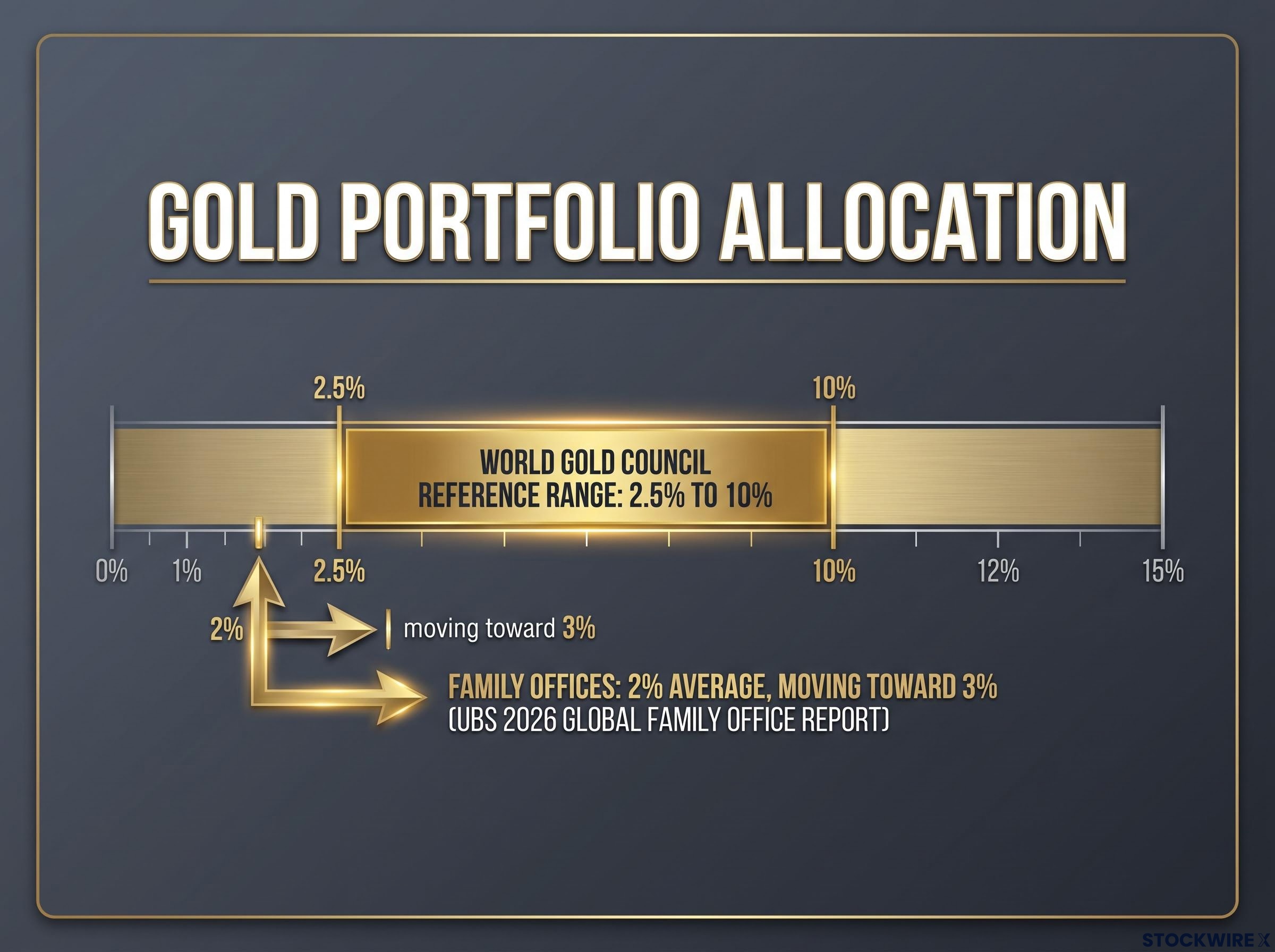
The quantified finding matters here. World Gold Council research indicates that portfolios holding a gold allocation between 2.5% and 10% have historically achieved improved risk-adjusted returns during market downturns. Modest, not dominant.
When the diversification benefit fades
Now the caveats, because they define the conditions under which gold earns its keep rather than undermining the case for it.
- Rapid real-rate increases. When central banks hike sharply and real yields surge, the opportunity cost of holding a non-yielding asset rises. Gold collapsed from its 1980 peak during the Volcker tightening cycle.
- Strong, broad-based dollar rallies. Prolonged dollar strength, as seen across 2013-2015, has coincided with weak or negative gold returns.
- Forced liquidation in liquidity crises. In the 2008 financial crisis and the March 2020 COVID shock, gold initially sold off with everything else as investors raised cash, before recovering later.
- Regime shifts in inflation credibility. If central banks re-establish firm anti-inflation credibility and hold positive real rates, gold’s inflation-hedge role can be muted.
- Structural demand changes. Shifts in jewellery or technology demand, or the rise of alternative stores of value, could reshape gold’s long-term demand profile.
Real interest rates, not nominal ones, determine gold’s opportunity cost most directly: when inflation erodes bond returns below zero in real terms, a zero-yield asset becomes directly competitive with government debt, which is why the 2022-2023 tightening cycle produced the sharpest gold headwinds of the past decade.
The useful thing about that list is that the two most important failure modes, rising real yields and dollar strength, are observable in advance. That makes them navigable conditions rather than random risks.
Private wealth is beginning to act on the nuance. The UBS 2026 Global Family Office Report found the average gold allocation among family offices sits at 2%, with discussion in the sector pointing toward movement to around 3%.
What the research says, in plain terms, is that gold works best as a moderate, long-term allocation rather than a concentrated bet. Use the failure-mode conditions as your checklist for when to expect underperformance, not as a reason to avoid the asset altogether.
The macroeconomic backdrop that is keeping institutional demand elevated
Institutional behaviour looks rational only when you name the forces it is responding to. Right now those forces are specific and stubborn.
The first is inflation persistence. US inflation has run above the official target continuously since 2021, entering what would be its fifth consecutive year above target. The second is fiscal pressure, and here the numbers get pointed.
The most visceral fiscal signal The US federal budget deficit stands at approximately 6% of GDP, and US government interest payments now exceed defence spending in dollar terms, according to Tapper Strickland, chief market strategist at Mumu. Independent corroboration of these specific figures was not available.
When a government’s interest bill outweighs its defence budget, policymakers face a real constraint on how aggressively they can raise rates to fight inflation. That tension, high debt servicing costs bumping up against the need for tighter policy, is precisely the environment in which a store of value that no government can debase becomes relevant.
Sovereign debt levels are reshaping the portfolio diversification case for gold in a second way: the breakdown in stock-bond correlation documented by the BIS in 2022-2023 has led institutions including BlackRock and Swiss pension funds to increase gold allocations specifically to replace the hedging role that government bonds no longer reliably provide.
The structural tailwinds stack up as follows:
- Persistent above-target inflation, now in its fifth year in the US.
- Large fiscal deficits, with the US running around 6% of GDP.
- A hard supply constraint, with annual mine production equating to roughly 2% of all gold ever extracted, so demand growth is not swamped by new supply.
- Growing institutional demand, as central banks and family offices re-weight toward gold.
These conditions explain why family offices are re-examining allocations that were long underweight. The UBS finding of a 2% average edging toward 3% sits alongside World Gold Council research suggesting the 2.5-10% range is gradually filtering into the models used by multi-family offices and private banks.
None of this is abstract. These are the concrete fiscal and monetary pressures that give the gold thesis institutional backing beyond short-term sentiment, and they show no sign of resolving quickly.
How retail investors can think about gaining exposure
The institutional case is useful only if it translates into your own decisions. So here is the practical frame, sizing first, then vehicle.
On sizing, the evidence-based reference range is the World Gold Council’s 2.5-10%. Family offices currently sit at the lower boundary, averaging 2% and drifting toward 3%. That gives you a range grounded in institutional practice rather than speculation, though where you land within it depends on your own risk tolerance and existing holdings.
Four considerations should shape the decision:
- Target range: Anchor to the 2.5-10% evidence base, sized to your conviction and time horizon.
- Vehicle type: Decide whether you want direct gold price exposure or the amplified swings of mining equities.
- Existing portfolio overlaps: Check what gold or mining exposure you already hold before adding more.
- Income expectations: Gold pays no cash flow, so its return is entirely price-based. That is the strongest argument for keeping it moderate rather than dominant.
Physical ETFs vs miner ETFs: understanding the difference
The vehicle choice matters as much as the size, because two products both labelled “gold exposure” can behave very differently.
Physically backed ETFs track the gold price directly. They are low-cost, highly liquid, and move roughly in line with the metal itself. Gold miner ETFs are equity instruments, so they respond to the gold price amplified by operating leverage, cost structures, and company-specific factors, giving you higher beta in both directions.
Miners have shown strong cost discipline in recent years, with major producers described as generating substantial free cash flow. That makes them a different vehicle rather than an inferior one, depending on your objectives.
| Vehicle Type | Example Products | Key Characteristics | Risk Profile |
|---|---|---|---|
| Physically backed ETF | GOLD, PMGOLD, QAU, NUGG | Direct gold price exposure, low cost, high liquidity | Tracks gold price closely |
| Gold miner ETF | GDX, MNRS | Equity exposure, higher beta, sensitive to margins and capital discipline | Amplified upside and downside |
| Allocated physical gold | Vaulted or allocated bars | Direct ownership, custody and storage considerations | Tracks gold price, operational overhead |
On entry, the structural case is considered intact by Strickland despite near-term volatility. Gold traded around $4,148 at the time of research, having slipped roughly 4% overnight, with the $4,000 level flagged as the near-term technical reference to watch. Buying into pullbacks is the strategy cited for building exposure.
One practical note: some miner-focused funds are structured to exclude Australian gold miners, which helps if you already hold Australian mining exposure and want to avoid doubling up.
What the structural gold case means for a long-term portfolio
Pull the three threads together and the picture sharpens. Institutional demand is structural and forward-looking, with 863 tonnes bought in 2025, a 15-year streak behind it, and 51% of reserve managers now citing geopolitical risk. The portfolio research supports a moderate allocation, the 2.5-10% range, with clearly identifiable failure modes. And the macro conditions underpinning the thesis, fiscal strain, sticky inflation, and geopolitical risk, are not resolving quickly.
That resists both the triumphalism and the dismissal. The benefit sits in the sizing and the patience, not in the metal itself.
Three signals tell you whether the structural case remains intact:
- Real yields: A sharp, sustained rise is gold’s clearest headwind.
- Dollar dynamics: A strong, broad-based dollar rally tends to weigh on the price.
- Pace of central bank buying: A meaningful slowdown would signal the structural bid is fading.
The strategic investors in this piece are not trading gold around short-term moves. The pullback thesis is about entry price, not about turning gold into a speculative position. Family offices moving from 2% toward 3% are adjusting sizing, not chasing momentum.
Gold price prediction carries a structurally poor track record precisely because gold lacks cash flows, earnings, or dividends: without a valuation floor, no discounted-cash-flow model can anchor its price, and the World Gold Council’s GRAM model attributes the dominant share of recent returns to geopolitical risk and investor positioning rather than measurable economic fundamentals.
So the question is not whether gold belongs in a diversified portfolio. It is how much, and in what form. The most common error is sizing it too large when conviction runs high, or too small when the price is soft.
This article is for informational purposes only and should not be considered financial advice. Investors should conduct their own research and consult with financial professionals before making investment decisions. Past performance does not guarantee future results. Financial projections are subject to market conditions and various risk factors.