
You chose an active fund because the manager ran a high-conviction growth portfolio. Three years later, the biggest sector bets look more like a resources fund than a technology-focused strategy. The investment thesis that justified the fee premium has quietly changed, and nobody sent a memo. This is fund manager style drift, and for Australian self-directed investors and SMSF trustees, it is one of the least discussed risks in active management. Investors typically select a fund based on a stated investment style, and that style is often the primary reason they pay higher fees than an index alternative. Yet the question of whether a manager is still doing what they were hired to do rarely comes up until performance deteriorates. This article explains what style drift means in practice, why it happens, how Australian regulation addresses it, and what steps investors can take this week to check whether their manager is still on mandate.
Active fund underperformance over long time horizons is the structural backdrop that makes mandate fidelity so consequential: SPIVA data shows 87% of Australian equity funds underperformed their benchmarks over 15 years, meaning investors who pay a fee premium for active management have limited margin for the additional risk of a manager who is no longer executing the strategy they were hired to run.
What style drift actually means for your portfolio
Style drift is the gradual or sudden departure of a fund manager’s actual portfolio behaviour from its stated investment mandate, philosophy, or benchmark category. The concept sounds abstract until it hits a real portfolio.
An investor holding five funds, each selected to fill a distinct role, relies on each manager staying in their lane. A growth-oriented mandate typically favours capital-light, high-return-on-capital businesses. If that manager begins building large structural positions in capital-intensive cyclical sectors, the investor’s planned growth allocation is no longer doing its job. Worse, it may now duplicate exposure the investor already holds through a separate resources or value fund.
The same problem appears in different market segments. A fund labelled “defensive income” that begins exhibiting equity-like drawdowns has drifted from its stated risk profile, leaving the conservative sleeve of a portfolio exposed in ways the investor never intended.
Not every positioning change qualifies as drift. The distinction matters:
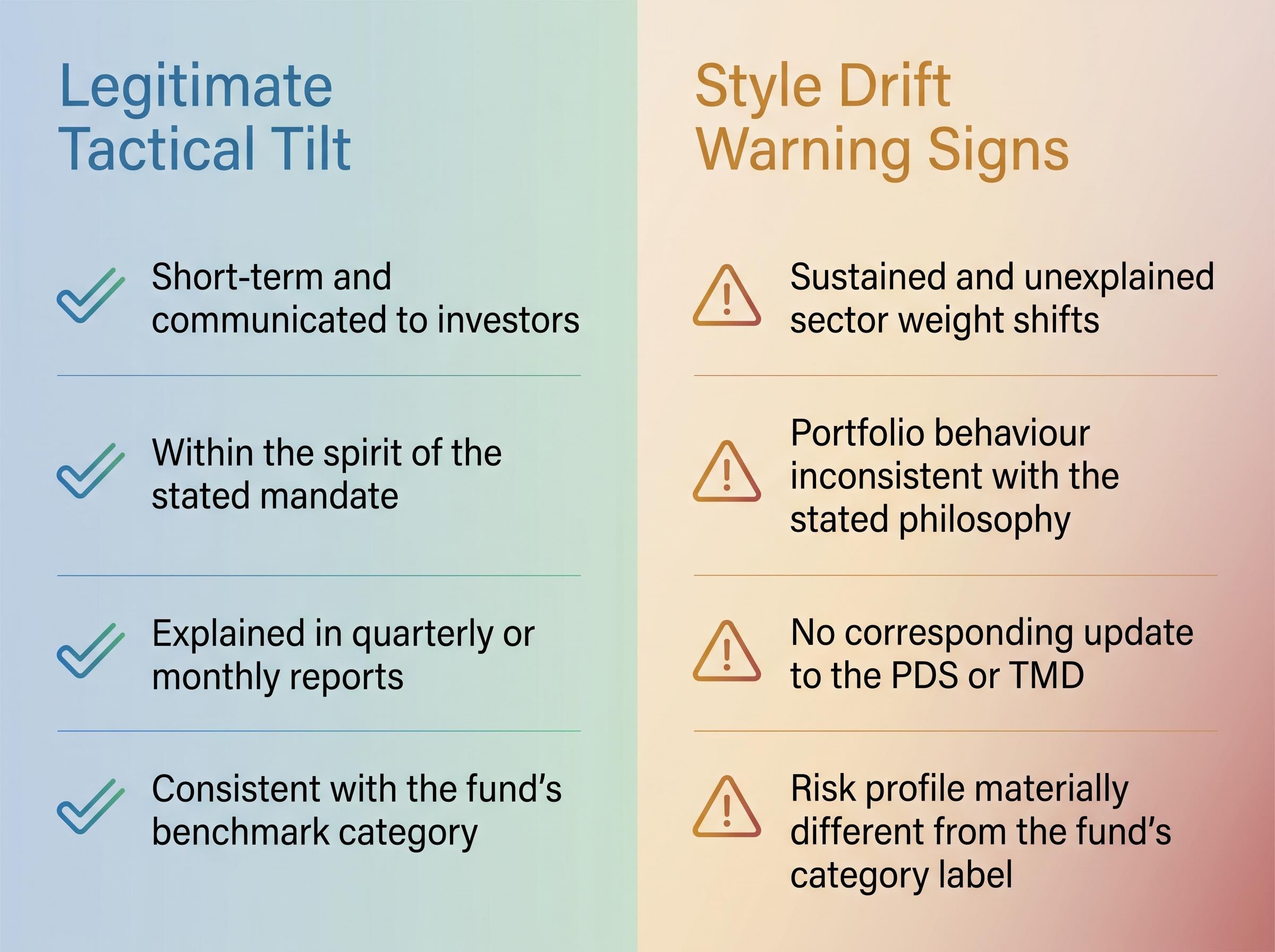
Legitimate tactical tilt:
- Short-term and communicated to investors
- Within the spirit of the stated mandate
- Explained in quarterly or monthly reports
- Consistent with the fund’s benchmark category
Style drift warning signs:
- Sustained and unexplained sector weight shifts
- Portfolio behaviour inconsistent with the stated philosophy
- No corresponding update to the PDS or TMD
- Risk profile materially different from the fund’s category label
When big ASX news breaks, our subscribers know first
Why it happens: the pressures that push managers off mandate
Style drift is not always bad faith. More often, it is a predictable response to structural pressures that build inside a fund management business. Understanding those pressures helps investors interpret what they are seeing.
Performance pressure and fee economics
A manager suffering extended underperformance faces a feedback loop. Poor returns trigger fund outflows. Outflows reduce funds under management. Reduced FUM means reduced revenue, because management fees are calculated as a percentage of assets. The revenue decline intensifies pressure to do something, anything, to recover performance.
Passive ETF alternatives have absorbed much of the capital that has exited active management in recent years, with Australia’s ETF industry reaching a record $346 billion in funds under management in April 2026 and net inflows of $5.2 billion in that month alone, a structural shift that reflects growing investor scepticism about active managers justifying their fee premiums.
That pressure can override philosophical discipline. A growth manager watching value and resources outperform for two or three consecutive years faces a choice: stick to process and accept further outflows, or tilt toward what is working and hope to stem the bleeding.
Outperforming a benchmark by 3% annually over 10 years generates approximately 30% cumulative outperformance. A single year of severe underperformance can substantially erode that entire decade of compounding, which is why managers feel acute pressure to recover quickly rather than wait for their style to rotate back into favour.
Financial adviser commentary has referenced a prominent Australian growth manager that reportedly increased its materials sector weighting significantly during a period described as its worst performance in approximately three decades. This observation, attributed to adviser discussions rather than the manager’s own disclosures, illustrates the pattern precisely. The manager’s March 2026 factsheet confirmed zero Materials sector weight, so investors reviewing only official documents would see no evidence of such a shift. The discrepancy itself is instructive: what advisers observe in real-time positioning and what appears in published factsheets may not always align.
Personnel and ownership changes as drift triggers
A new portfolio manager or chief investment officer often brings a different worldview. If the fund’s stated mandate and PDS language remain unchanged while the decision-making culture shifts, investors are effectively holding a different product under the same label.
Macquarie’s fund manager notification service flags exactly these changes for advisers, covering personnel departures, strategy changes, PDS updates, and fee amendments. The existence of such a tool reflects industry recognition that personnel turnover is a leading indicator of mandate change.
Two Australian cases that show what this looks like in practice
Theory is useful. Cases are better. Three recent Australian examples illustrate how style drift manifests across different fund structures, each with distinct implications for investors.
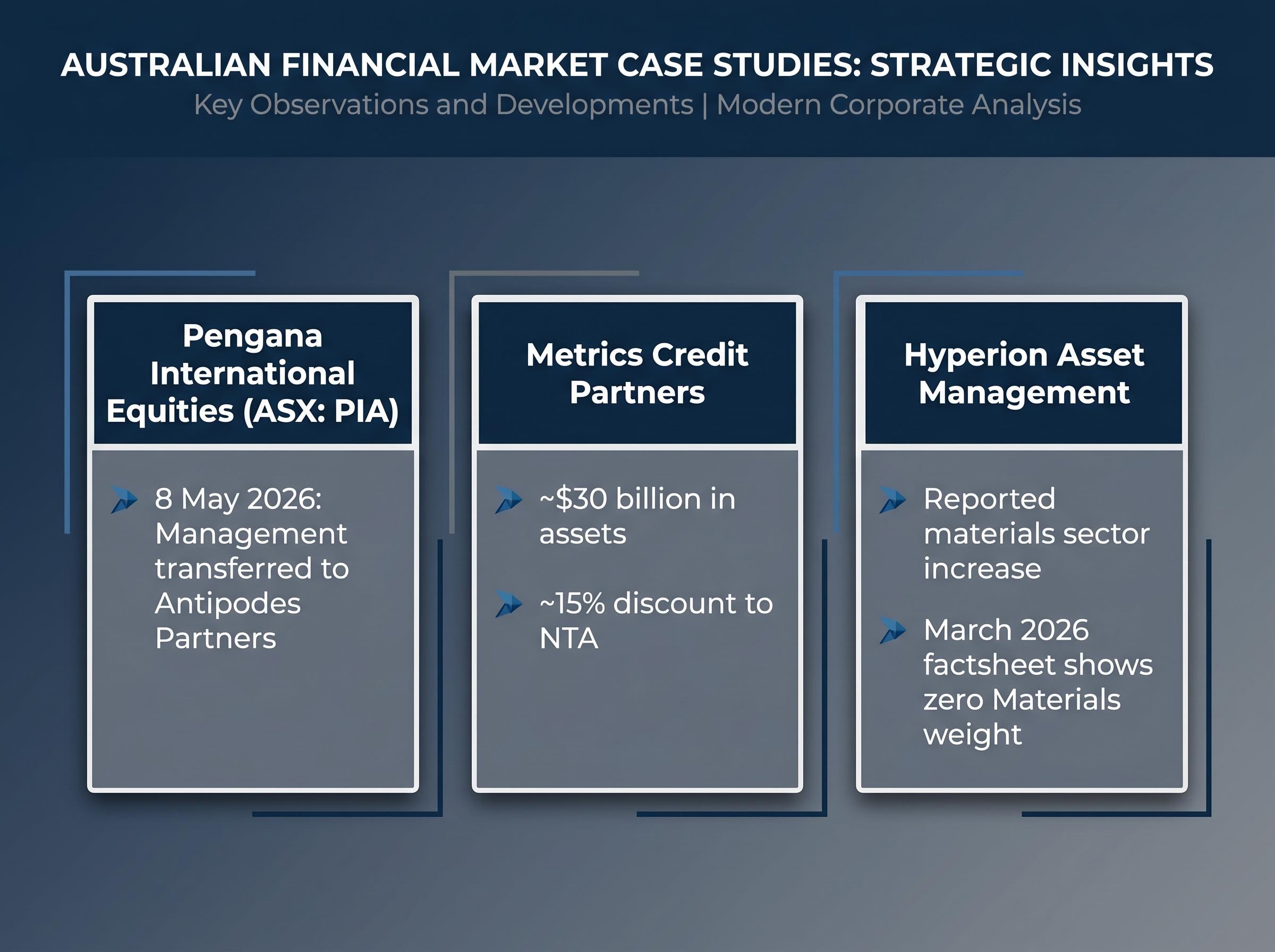
Pengana International Equities Limited (ASX: PIA) announced on 8 May 2026 that management of the listed investment company would transfer to Antipodes Partners, a value-oriented manager. For investors who held PIA as a growth or style-neutral international equity allocation, this structural governance change effectively handed them a different investment philosophy without any active decision on their part. The shift occurred at the vehicle level, not through gradual portfolio repositioning, making it a distinct flavour of mandate change.
Metrics Credit Partners, managing approximately $30 billion in assets, illustrates another pattern. Originally positioned as a lending vehicle, the fund accumulated equity-like exposures over approximately a decade as loan defaults resulted in ownership stakes in underlying businesses. According to reporting by Joe Aston at Rampart News and adviser commentary, this gradual shift moved the fund’s risk profile away from its original credit mandate. Listed Metrics funds were trading at approximately a 15% discount to net tangible assets at the time of reporting, a market signal that investors were pricing in concern about the gap between the stated strategy and the actual portfolio.
| Fund / Manager | Original Mandate | Apparent Shift | Investor Impact Signal |
|---|---|---|---|
| Pengana International Equities (ASX: PIA) | International equities (growth / style-neutral) | Management transferred to Antipodes Partners (value-oriented) | Structural philosophy change via governance decision |
| Metrics Credit Partners | Private credit / lending | Accumulated equity-like exposures through loan defaults | ~15% discount to NTA on listed funds |
| Hyperion Asset Management (adviser commentary; not confirmed in published factsheets) | High-conviction global growth | Reported materials sector increase during underperformance period | March 2026 factsheet shows zero Materials weight; discrepancy between adviser observations and published data |
These cases span listed investment companies, private credit funds, and active equity managers. Style drift is not confined to one structure or asset class.
What Australian regulation requires managers to tell you
Australia’s regulatory framework provides some protection against undisclosed mandate changes, but it has gaps that investors should understand honestly.
What the PDS and Significant Event Notice rules require
ASIC’s Regulatory Guide 168 (RG 168) sets out disclosure obligations for managed investment products. Material changes to investment strategy or mandate must be reflected in an updated Product Disclosure Statement (a document that describes how a fund invests, its risks, and its fees). Where changes are material, existing investors are typically entitled to receive a Significant Event Notice (SEN), a formal communication alerting them that something about the product has changed.
ASIC’s Regulatory Guide 274 (RG 274) adds a second layer through Design and Distribution Obligations. A substantially changed investment strategy or risk profile may require the manager to update its Target Market Determination (TMD), a document that defines what type of investor the product is designed for. If a defensive income fund has taken on growth-like risk, its TMD may no longer accurately describe the investor it suits.
ASIC’s Regulatory Guide 274 sets out the specific obligations managers must meet when designing products and maintaining Target Market Determinations, including the requirement to review and update a TMD when a product’s risk or return characteristics shift substantially from the profile on which the original determination was based.
- Updated PDS: Managers must update the Product Disclosure Statement when investment strategy, risk profile, or fees change materially.
- Significant Event Notice: Existing investors are entitled to formal notification when a material change occurs that could affect their decision to remain invested.
- Updated TMD: If the product’s risk or return characteristics shift substantially, the Target Market Determination must be revised to reflect the new investor suitability profile.
Where the regulatory framework has limits
The regulatory requirements apply to material changes. The word “material” carries significant weight in that sentence. A gradual drift that never triggers a single threshold event can occur without formal disclosure. A fund that shifts its sector weights by a few percentage points each quarter over three years may end up with a fundamentally different portfolio without any individual change qualifying as material under the rules.
AFCA (the Australian Financial Complaints Authority) maintains the general principle that financial firms must act fairly and notify clients appropriately when product features change. However, the enforcement mechanism depends on investors identifying the drift and raising a complaint, which brings the burden back to the investor.
How to check whether your manager is still on mandate
The regulatory framework provides a floor, not a ceiling. Proactive monitoring using freely available tools is the most reliable way to detect style drift before it causes material portfolio damage.
Holdings-level drift typically precedes performance-level signals. Sector weights and top positions shift before returns diverge from the benchmark, which means investors who wait for performance disappointment to trigger a review are already behind.
The following five-step framework draws on guidance from Morningstar Australia, InvestSMART, Macquarie fund manager notifications, and ASX education materials:
- PDS and TMD review. Download the current PDS and TMD from the fund’s website at least every 12-24 months, and immediately after any manager announcement. Compare the investment objective, asset class ranges, benchmark, derivatives usage, and risk description against the previous version. Pay particular attention to the sections labelled “How we invest your money” and “Target Market.”
- Holdings and sector weight comparison. Compare sector weights and top 10 holdings over at least 2-3 years using fund websites, Morningstar portfolio tools, or InvestSMART’s managed fund pages. Large, unexplained shifts from growth to value, from domestic to offshore, or from investment-grade to higher-risk exposures without corresponding explanation in the fund’s reports are the clearest early warning.
- Personnel and ownership monitoring. Track announcements about portfolio manager changes, team turnover, and ownership changes at the management company level. Macquarie’s fund manager notifications provide a structured tool for this. ASX announcements serve the same function for listed vehicles such as Pengana International Equities (ASX: PIA).
- Risk and return profile analysis. Use platform-level metrics including volatility, maximum drawdown, beta, and correlation to assess whether the fund has become materially more or less volatile relative to its stated category. InvestSMART recommends comparing 3-year and 5-year returns against both the benchmark and peer group alongside risk metrics.
- Communication quality audit. Review monthly and quarterly reports for transparency about positioning changes. A manager who explains why their sector weights shifted and how the change remains consistent with their mandate is behaving differently from one whose portfolio changes appear without commentary.
When drift is a dealbreaker and when it is just a conversation
Not every positioning change warrants redemption. The distinction between drift and evolution matters, and investors benefit from a framework rather than a reflex.
An explained, communicated repositioning, where a manager openly discusses why their thesis has evolved and how it remains consistent with the mandate’s spirit, is a different situation from unexplained drift. Sector weights that shift without commentary, personnel changes without announcement, or PDS language that no longer matches portfolio reality are signals of a different kind.
Opaque active management communication is not unique to retail fund managers; Australia’s largest super funds have faced similar criticism for reframing tactical positioning as sophisticated strategy, a pattern that AustralianSuper’s outgoing CIO acknowledged directly when admitting the fund had underweighted AI and digital stocks at significant cost to members since approximately 2022.
The role duplication problem deserves direct attention. If a growth manager starts behaving like a value manager, an investor who already holds value exposure elsewhere now has unintended concentration in one style and a gap where their growth allocation used to be. Adviser commentary on this point is direct: investors in that position are better served by appointing a dedicated manager for the new allocation rather than relying on the drifting manager to execute a style outside their stated expertise.
Portfolio rebalancing after drift is a tax-sensitive exercise that follows a specific execution sequence: new contributions and dividend redirection first, superannuation and SMSF account sales second, and taxable account sales only as a final step, an order that can meaningfully reduce the capital gains tax impact of correcting a misallocated position.
Lakehouse Global Growth Fund was cited by advisers as an example of a growth-oriented Australian manager that maintained its stated approach during the same period of market volatility, providing a constructive comparison point for investors assessing whether their own growth managers have stayed on mandate.
SMSF trustees carry a specific obligation here. The fiduciary responsibility to document investment decisions and review fund manager mandates periodically makes this not just a preference but a governance task.
When potential drift is detected, these questions provide a starting framework:
- Has your investment thesis changed, and if so, why?
- Has your PDS or TMD been updated to reflect this positioning?
- How does this positioning remain consistent with your stated mandate?
- What is the expected timeframe for this tilt, and under what conditions would you reverse it?
- Has there been any change in key investment personnel or ownership structure?
Style drift will not announce itself
Style drift is rarely disclosed proactively, which places the monitoring burden squarely on the investor. Self-directed investors and SMSF trustees lack the institutional resources of a large super fund’s investment committee, but the tools to do this work are freely available.
Two actions matter most: read the PDS and TMD at regular intervals (not just when performance disappoints), and compare sector weights and holdings over time using Morningstar, InvestSMART, and ASX announcements.
The practical step is to schedule a specific date, annually at minimum, to review each active fund holding against its manager’s stated mandate. Treat it as a routine trustee task, not a reaction to bad news. The managers who are genuinely sticking to their process will pass the review easily. The ones who are not will show it in the data before they show it in the returns.
This article is for informational purposes only and should not be considered financial advice. Investors should conduct their own research and consult with financial professionals before making investment decisions.