
40 Income ETFs on the ASX, but Only 2-4 Are Worth Holding
3 mins ago


A Macquarie Bank savings account currently pays 5% per annum with no fees, no market risk, and no brokerage costs. Most fixed interest ETFs in Australia cannot beat that number after fees. The ones that appear to beat it often do so by taking on risks that most income investors do not realise they are carrying.
Australian fixed income ETF shelves have expanded to approximately 70 products, spanning categories from Treasury bills to sub-investment-grade corporate debt. The breadth creates an illusion of choice. For a conservative income investor, the honest answer is that most products fail a simple, systematic evaluation, and the current rate environment makes that evaluation more demanding than ever.
This guide walks through a five-step filtering framework that eliminates unsuitable fixed interest ETFs before a dollar is invested. It explains why government bond and cash products such as AAA and BILL typically outlast corporate bond ETFs in the process, and shows exactly how to apply the risk-free benchmark test that does most of the heavy lifting.
Macquarie Bank currently pays 5% p.a. on savings account balances under $2 million. That rate comes with no management fee, no bid-ask spread, no market price risk, and no brokerage cost.
The benchmark: Any fixed interest ETF must clearly beat 5% p.a. after fees to justify its additional complexity, volatility, and operational overhead.
This is not a background fact. It is a hurdle, and most ETFs do not clear it. The structural advantages of a savings account over a fixed interest ETF are worth stating plainly:
The RBA cash rate target sits at 4.35% as of the most recent Board decision, and that official rate sets the floor from which all deposit products and fixed income benchmarks are priced in Australia.
Most income investors begin their ETF search by scanning yield tables. That is the wrong starting point. Setting the hurdle first means any ETF that cannot clear it is eliminated before the investor spends time, attention, or money evaluating it. The majority of available fixed interest ETFs fail this test.
Unhedged global bond ETFs expose investors to two separate sources of return: bond yields and foreign currency movements. The second source is structurally incompatible with stable, predictable income.
Bond yields in a global ETF might sit at 3-5% p.a., but currency movements can run to plus or minus 10-20% over a two-year period. That range easily swallows the entire income stream. Holding these products means effectively speculating on foreign exchange rates, with bonds as a side effect rather than the primary driver.
The AUD/USD movement alone produced a 13-percentage-point performance gap between hedged and unhedged international equity ETFs over a single year to May 2026, and hedged vs unhedged ETF returns in fixed income contexts follow exactly the same mechanics, with currency swings capable of swallowing a full year of bond income in a matter of months.
The filter rule is mechanical:
If the answer to the first question is yes and the answer to the second is no, exclude it from an income shortlist without further analysis. Currency risk has no place in a conservative income sleeve, and the ETF’s name or marketing material may not make the exposure obvious.
Currency-hedged global bond ETFs remove the foreign exchange problem. They pass the currency test. They must still, however, clear the benchmark rate and credit quality tests before earning a place on a shortlist.
Because Australian fixed income markets are reasonably deep, there is rarely a compelling income case to reach offshore as a core holding. Hedged international ETFs can function as diversifiers, but for most Australian income investors, comparable domestic government bond or cash ETFs already cover the core allocation at lower cost and with simpler tax treatment.
Income investors often treat anything labelled “fixed income” as safe. That assumption conflates two separate dimensions of risk that behave differently and demand different responses.
Credit risk is the chance that the issuer of a bond does not repay. The Commonwealth government carries a AAA sovereign credit rating and can issue currency to service its debt, a capacity fundamentally different from any private company borrower. That is why Australian government bonds anchor the safety end of the credit spectrum.
Duration risk is the sensitivity of a bond’s price to changes in interest rates. When rates rise, bond prices fall. Longer-duration bonds fall more. Even a portfolio of AAA-rated government bonds carries duration risk; a rate increase will push unit prices down, sometimes meaningfully.
Duration risk in Australian bond ETFs is not abstract: in February 2026, ALTB fell 3.5% on a single day when IAF and BOND each returned +0.1%, a divergence driven entirely by the difference in effective duration between the funds and not by any difference in credit quality.
Investment grade refers to bonds rated BBB- or above by major credit rating agencies. Bonds rated below that threshold are classified as sub-investment-grade, sometimes called “junk” or high-yield. The distinction matters because it separates issuers with a high statistical probability of repaying their debt from those where default risk is materially elevated.
| Dimension | Credit risk | Duration risk |
|---|---|---|
| What it is | The chance the bond issuer does not repay principal or interest | The sensitivity of bond prices to changes in interest rates |
| What drives it | Issuer financial health, economic conditions, default probability | Central bank rate decisions, inflation expectations, bond maturity length |
| Which ETF categories carry it | Corporate bond, high-yield, and mixed ETFs; minimal in government and cash ETFs | All bond ETFs; higher in long-duration government and corporate ETFs, minimal in cash and bills ETFs |
| How large the impact can be | Drawdowns of 20-40% in stress episodes for corporate and high-yield portfolios | Unit price declines of 5-15% in a rising rate cycle for longer-duration portfolios |
Understanding these two dimensions allows readers to classify any ETF they encounter by asking two questions: what credit quality does it hold, and how much duration risk does it carry? The answers determine whether the product belongs on an income shortlist.
The marketing proposition is straightforward: slightly more risk, noticeably more yield. The problem is that the additional risk is not linear with the additional yield.
In normal conditions, an investment-grade corporate bond portfolio may yield only 0.5-1.5% p.a. more than a comparable government bond portfolio. High-yield portfolios offer a larger premium, but virtually all of that premium is compensation for default and liquidity risk, not a free lunch.
The trade-off collapses in the scenarios that matter most. During episodes such as the Global Financial Crisis and the COVID-19 shock, certain corporate fixed interest instruments experienced drawdowns of approximately 20-40%, while high-quality government bond portfolios remained far more resilient. For a retiree drawing income, a 30% drawdown in something labelled “fixed income” is not a minor inconvenience. It is a catastrophic timing risk, arriving precisely when equity portfolios are also under pressure.
The non-linear maths are worth working through explicitly. Suppose an extra 1.5% p.a. is earned by holding a corporate ETF instead of a government bond ETF. Over five years, that produces 7.5% cumulative extra income, but only if nothing bad happens. If a single credit event produces a 30% drawdown in the corporate ETF versus a 5% drawdown in the government equivalent, the resulting 25-point capital gap completely overwhelms years of incremental income.
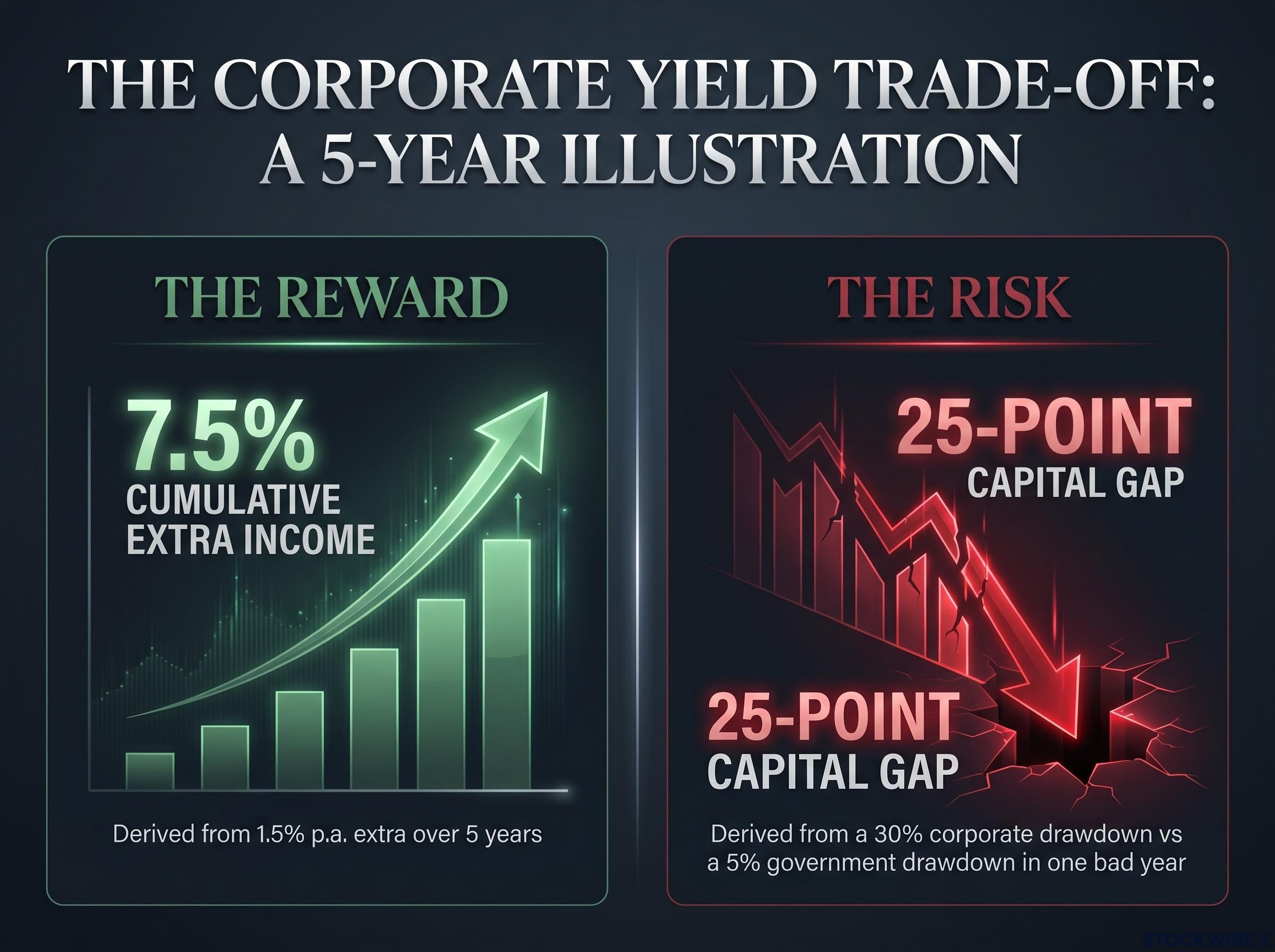
The five-year illustration: 7.5% cumulative extra income versus a potential 25-point capital gap from one bad year. Recovery from that single episode may require a decade of favourable conditions.
Among Australia’s approximately 70 fixed interest ETFs, roughly 10 have assets under management (AUM) below $10 million, and approximately half sit below $100 million. Many corporate and high-yield products fall into these smaller cohorts, which introduces operational risks beyond the credit question.
Small AUM in a fixed income ETF is not merely inconvenient. It produces wider bid-ask spreads, greater deviations from net asset value during periods of market stress, and material closure risk. A fund wound up by its issuer forces unexpected reinvestment at potentially unfavourable terms.
Practical AUM guidance: above $100 million is generally acceptable, below $100 million warrants extra scrutiny, and below $10 million should generally be avoided for income purposes. By contrast, the largest cash and government bond ETFs on the ASX carry AUM in the billions, with tighter spreads and stronger secondary-market liquidity.
After applying the benchmark test, currency filter, credit quality assessment, and scale check, the shortlist for a conservative Australian income investor is short by design. Three categories consistently survive:
Two products deserve specific attention because they represent the category and illustrate how the filters work in practice.
| Dimension | AAA (BetaShares Australian High Interest Cash ETF) | BILL (iShares Core Cash ETF) |
|---|---|---|
| Underlying holdings | Diversified bank deposit accounts | Australian government Treasury bills and short-dated government securities |
| Management fee | 0.18% p.a. | 0.07% p.a. |
| AUM | Approximately A$5.01 billion | Approximately A$1.19 billion |
| Credit quality | Bank deposit credit quality (reliant on issuing banks) | Australian government credit quality (AAA sovereign) |
| Duration risk | Near zero | Near zero |
The distinction between the two matters. AAA holds bank deposit accounts and relies on bank credit quality. BILL holds Australian government Treasury bills and short-dated government securities, making it more conservative on credit risk. Both carry near-zero duration, both are among the largest fixed income ETFs on the ASX by AUM, and both clear the scale and liquidity test comfortably.
These products are not exciting. That is precisely the point. Their role is to provide reliable, low-risk income and act as ballast when equity markets fall, not to chase yields that carry equity-like downside.
For investors evaluating whether AAA is genuinely the better income vehicle in their portfolio, the comparison is not always straightforward: cash ETF yield versus blue-chip dividends produces materially different after-tax outcomes depending on whether franking credits can be received as cash refunds, particularly for SMSF investors in pension phase.
With approximately 70 fixed interest ETFs available in Australia, a repeatable filtering process saves time and prevents costly mistakes. The following five steps work as a sequential elimination, not a scoring system. Each step is a potential disqualification.

The summary principle: If a cash ETF or short-duration government bond ETF already clears the benchmark with minimal volatility, any more complex product must articulate a clear advantage to earn its place.
This sequence works in any rate environment. When the RBA cash rate changes, the benchmark in Step 2 moves with it, but the framework itself remains portable. Readers can apply it to any new fixed interest ETF they encounter without revisiting first principles each time.
For investors who have worked through the five-step filter and are questioning whether passive fixed income ETFs are the right structure at all, our full explainer on active bond funds versus passive ETFs examines Morningstar data covering Australian fixed income fund performance to December 2025, including the specific rate cycle conditions under which active managers outperformed and the core-satellite framework that resolves the trade-off.
The goal of this framework is not to find the highest-yielding fixed interest ETF. It is to find products that reliably deliver income without hidden capital risk. For most conservative Australian income investors, the answer is a short list dominated by government and cash-based products. That brevity is a feature, not a limitation.
The benchmark rate is not static. As the RBA cash rate environment shifts, the hurdle that eliminates most products will move with it. Revisiting the savings account comparison periodically keeps the filter current.
This framework is designed specifically for income-focused investors. Readers pursuing different objectives, such as total return, portfolio diversification, or inflation hedging, may reach different conclusions about which categories and products are appropriate. The filtering criteria above do not apply universally across all investment strategies.
This article is for informational purposes only and should not be considered financial advice. Individual circumstances vary, and readers should consider seeking professional advice before making investment decisions.
—
A fixed interest ETF in Australia is an exchange-traded fund that holds income-generating assets such as government bonds, Treasury bills, or corporate debt, and trades on the ASX like a share. There are approximately 70 such products available, ranging from low-risk cash ETFs to higher-risk high-yield corporate bond funds.
The current hurdle rate is 5% per annum, based on the Macquarie Bank savings account rate available on balances under $2 million, which carries no management fee, no market price risk, and no brokerage cost. Any fixed interest ETF must clearly beat this figure after fees to justify the additional complexity and volatility it introduces.
Unhedged global bond ETFs expose investors to foreign exchange movements that can run to plus or minus 10-20% over a two-year period, easily swallowing the entire income stream from bond yields. For a conservative income investor, this effectively means speculating on currency rates rather than earning stable fixed income.
Credit risk is the chance that a bond issuer fails to repay principal or interest, while duration risk is the sensitivity of a bond's price to changes in interest rates, meaning prices fall when rates rise. Corporate and high-yield ETFs carry higher credit risk, while all bond ETFs carry some duration risk, which is greatest in longer-maturity funds.
AAA (BetaShares Australian High Interest Cash ETF) holds diversified bank deposit accounts with a management fee of 0.18% p.a. and AUM of approximately $5.01 billion, while BILL (iShares Core Cash ETF) holds Australian government Treasury bills at a lower fee of 0.07% p.a. and AUM of approximately $1.19 billion. Both carry near-zero duration risk and pass the scale and liquidity test comfortably, with BILL offering slightly stronger credit quality as it relies on AAA sovereign rather than bank credit.