A part-time teacher, not a surgeon or a fund manager, crossed the million-dollar mark in invested assets. She did it on a modest salary, over roughly a decade, using two low-cost ETFs and a deliberate decision about which assets to hold inside superannuation and which to hold outside it.
That fact sits awkwardly against what most people believe about wealth. The assumption is that a seven-figure portfolio requires a high income. The data tells a different story: a sustained savings rate of 40-60% of take-home pay turns out to be far more predictive of success than the size of your pay packet.
Her tools were not exotic. VAS and VGS formed the core, supplemented by listed investment companies and bank shares, all arranged around a specific superannuation structure. This is a real Australian case study, grounded in actual portfolio decisions rather than theory.
Here is the practical blueprint, laid out so you can hold it against your own situation. This covers how the portfolio was built, the inside-versus-outside super split that makes the income work, the household budget that funded it, and the risks worth understanding before you copy any of it.
From five stock picks to a million-dollar portfolio: how the strategy evolved
It started with five individual stock purchases, $500 each, funded by five free trades her broker was offering at the time. That is where most of us begin: with a broker promotion and a handful of company names that sound promising.
Then the prices moved, and she had no idea why.
That anxiety, not knowing when to buy, when to sell, or what any given move actually meant, is the quiet reason so many first-time investors either freeze or churn. She did neither for long. Roughly two months after those first purchases, about a decade ago, she began shifting toward ETFs.
Single-stock concentration risk in a real 2025 example produced individual share declines of up to 68.9%, which erased most of a concentrated investor’s capital, while the same decline in a 1% ETF holding produced only a 0.69% portfolio drag, making the structural case for broad index ownership concrete rather than theoretical.
The logic was simple once she felt it. Owning many companies at once meant no single share price could ruin her week.
The relief was structural, not emotional. When you own a slice of the whole market, one company’s bad day is absorbed by hundreds of others. The volatility that made individual stocks stressful largely disappears when diversification does the work for you.
Over time, she sold every individual stock. Some closed at a profit, some at a loss, but the direction of travel was clear: away from picking winners and toward owning the market.
Why VAS and VGS became the core
The two ETFs she settled on cover different ground, and that is the point.
- VAS (Vanguard Australian Shares Index ETF): tracks the S&P/ASX 300, the top 300 ASX-listed companies. Management fee (MER) around 0.07% p.a., distributions paid quarterly, dividend yield recently in the range of approximately 2.2-3.2%.
- VGS (Vanguard International Shares ETF): tracks the MSCI World ex-Australia Index, a broad basket of developed-market companies (unhedged). MER around 0.18% p.a., equity yield approximately 1.4%.
VAS gives you Australian shares broadly. VGS gives you the developed world outside Australia. Held together, they reduce both single-stock risk and single-country risk in one clean structure.
The VGS ETF holds approximately 1,265 securities across 23 developed markets, allocating around 24.8% to Information Technology and 11.8% to Health Care, two sectors with minimal representation on the ASX, which is precisely why it counterbalances a VAS-heavy income portfolio.
This is not niche thinking. Both Scott Pape (the Barefoot Investor) and the blogger behind Aussie Firebug independently land on the same conclusion: low fees, broad market, hold for decades.
The pivot from stock-picking to ETFs was the moment the strategy became repeatable for someone without financial expertise. The simplicity of the final structure is not a compromise you settle for. It is the feature that makes the whole thing work.
When big ASX news breaks, our subscribers know first
What CoastFIRE actually means, and how you calculate whether you have reached it
CoastFIRE is one of those concepts that, once you understand it, immediately makes you want to run your own numbers.
CoastFIRE is the point at which your existing invested assets can compound to fund full retirement by your target age, without you needing to make any further voluntary contributions.
The arithmetic behind full financial independence is the 25 times rule. You multiply your estimated annual retirement spending by 25, and that is the portfolio size that should sustain you.
Apply it to the subject’s own numbers. Her full financial independence target is approximately $3 million, which is 25 times her estimated annual retirement expenses. Her total invested assets, including superannuation, now exceed $1 million, which puts the remaining gap at roughly $2 million, a distance she expects to close within 5-10 years.
Here is the worked example laid out.
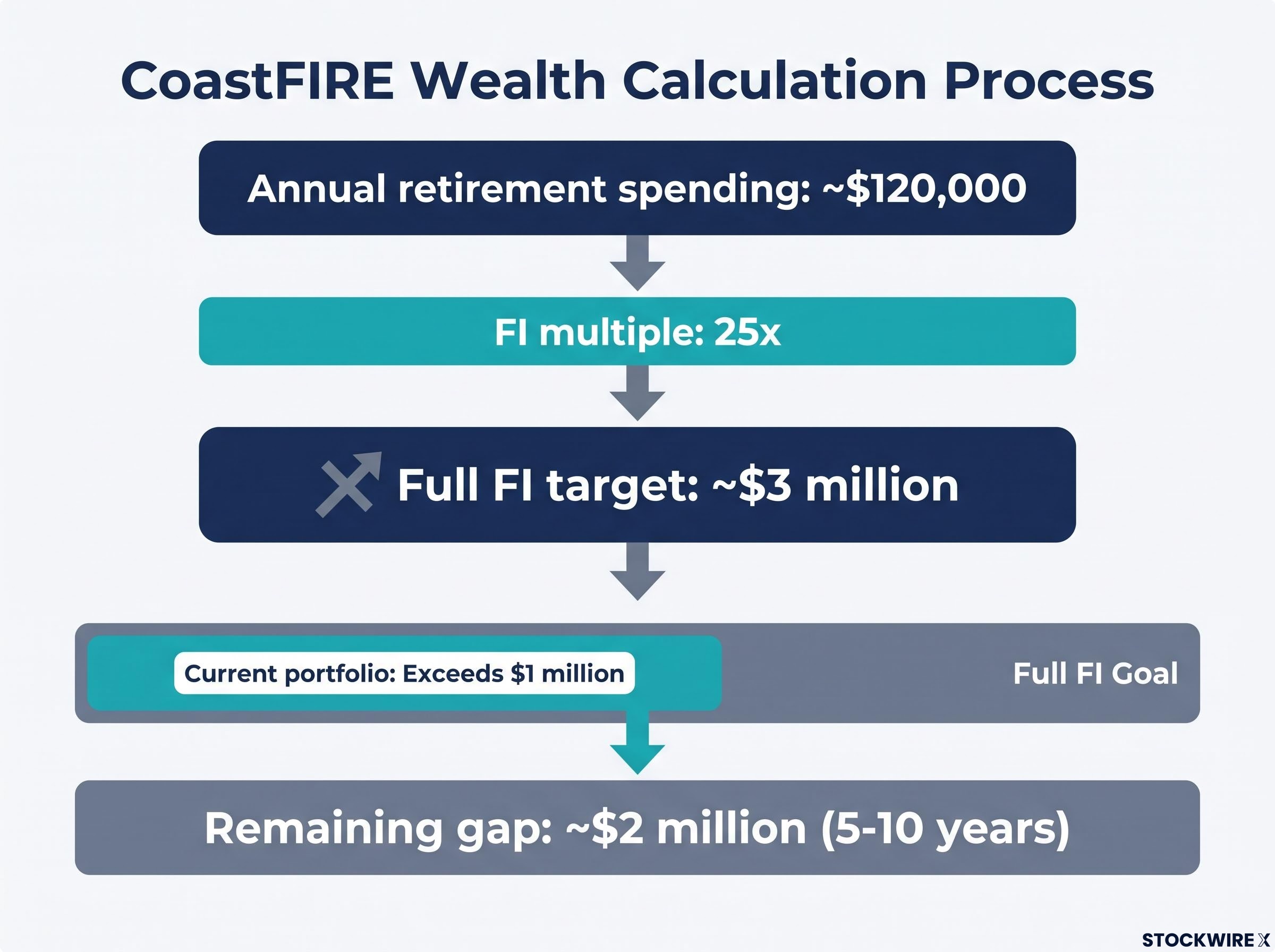
| Annual retirement spending (est.) | FI multiple | Full FI target | Current portfolio | Remaining gap |
|---|---|---|---|---|
| ~$120,000 | 25x | ~$3 million | Exceeds $1 million | ~$2 million |
For context on scale, her current household spending is capped at $10,000 per month. That is present-day spending, not a retirement figure, but it anchors the size of the calculation.
The practical payoff of reaching CoastFIRE is the part that changes everything. Once your existing assets can coast to the finish line on their own, voluntary contributions become optional rather than obligatory. That shift is what let her take an entire year away from work without derailing the plan.
Reaching CoastFIRE does not mean you stop. It means your compulsory savings burden lifts, and what you do with your income becomes a choice. You can run these numbers yourself: free online CoastFIRE calculators let you enter your age, current balance, target retirement age, and annual expenses to find your own figure. Most people have no idea whether they are already close or years away until they do this.
The inside-versus-outside super split that makes the income strategy work
Every Australian chasing financial independence before their 60s runs into the same wall: superannuation is locked away.
For anyone born after 30 June 1964, preservation age is 60. If you reach CoastFIRE in your 40s or early 50s, that creates a gap of 10 to 20 years where you need income but cannot touch your super.
Her solution is elegant because it uses that constraint rather than fighting it.
Income-generating Australian assets, VAS, LICs, and bank shares, sit outside super to fund the bridge years. Higher-growth international equities sit inside super, where they compound untouched until retirement. Each side is placed where the tax system treats it most kindly.
Splitting assets by access timing
The outside-super portfolio is the income engine. It throws off franked dividends you can live on before preservation age, which is exactly when you need cash flow and cannot legally reach your super.
The inside-super portfolio is the growth bucket. With decades before you access it, aggressive global equities have room to compound, and the temptation to tinker is removed simply because the money is out of reach.
The planned drawdown sequence follows from this. She intends to live on dividends from the outside-super portfolio first, then draw on superannuation once she passes preservation age.
To see how deliberate this is, consider the starting point for most people. According to APRA data (December 2025, via ASIC Moneysmart, updated May 2026), the average super balance for Australians aged 40-44 is $118,700. Her total position above $1 million is not luck. It is the compounding result of a structural decision made early and held consistently for a decade.
The APRA quarterly superannuation statistics confirm that the average super balance for Australians aged 40-44 sits at $118,700 on December 2025 figures, which anchors just how large the gap is between typical accumulation and a seven-figure outcome reached on a part-time salary.
How franking credits and the 15% super tax rate interact with this split
The tax logic is where the split earns its keep.
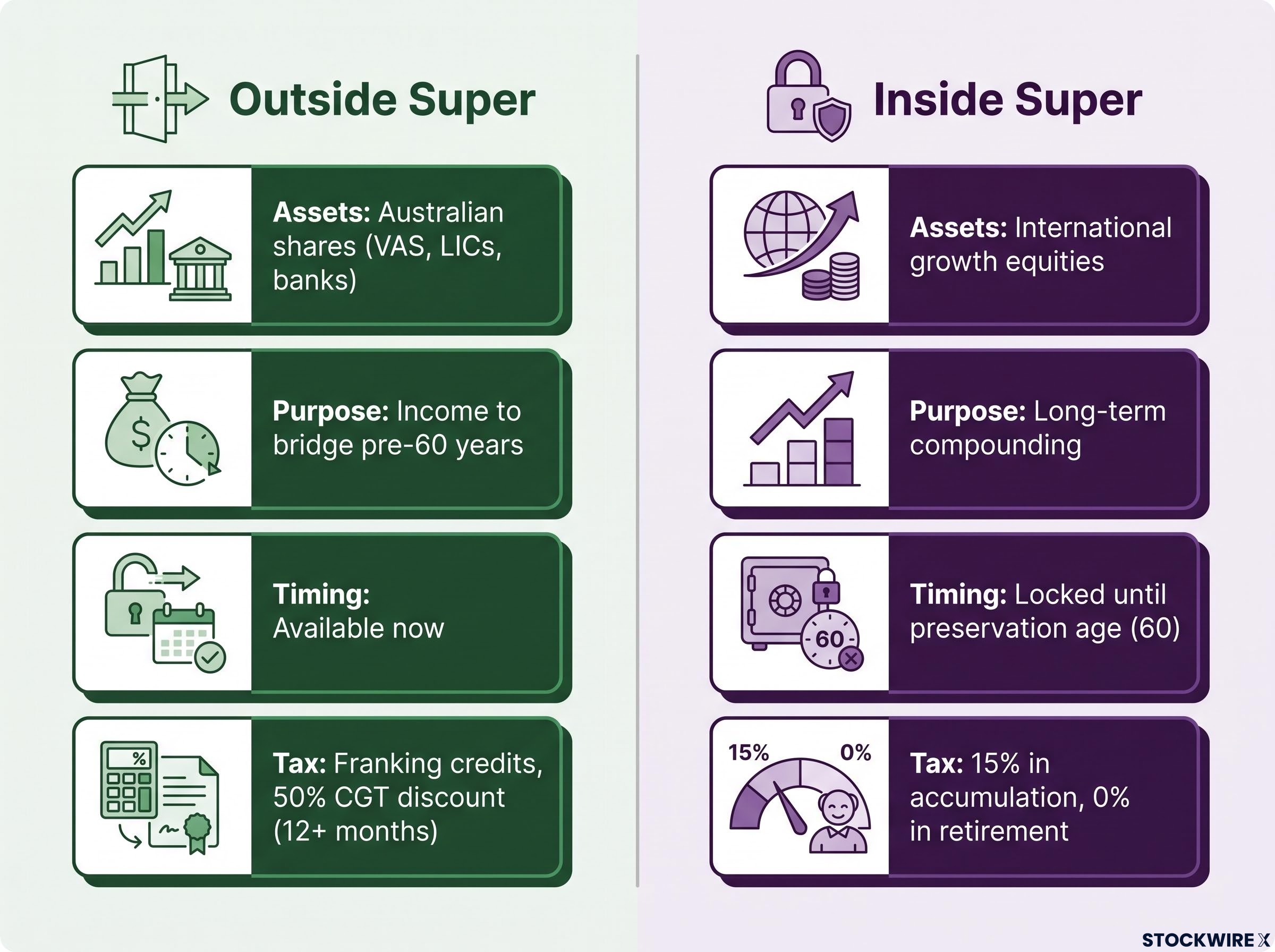
| Dimension | Outside super | Inside super |
|---|---|---|
| Asset type | Australian shares (VAS, LICs, banks) | International growth equities |
| Primary purpose | Income to bridge pre-60 years | Long-term compounding |
| Tax treatment | Franking credits; 50% CGT discount if held 12+ months | 15% in accumulation, 0% in retirement phase |
| Access timing | Available now | Locked until preservation age (60) |
Franked Australian dividends carry imputation credits that reduce your personal income tax, which is particularly valuable for households on medium incomes. Meanwhile, holding high-growth international equities inside super shelters foreign-source income and capital gains from the higher marginal rates they would attract outside.
One more lever to know: the concessional contributions cap (the amount you can put into super at the concessional 15% rate) is $30,000 for 2025-26, rising to $32,500 for 2026-27, indexed to wage growth.
The concessional contributions cap sits at $30,000 for 2025-26 and rises to $32,500 for 2026-27, and a well-structured superannuation strategy uses payday super, salary sacrifice, and carry-forward provisions together to maximise the tax concession at every stage of accumulation.
The household budget that made it possible on a part-time income
Strip away the portfolio and you find the real engine: cash flow discipline. The million-dollar outcome was not a function of exceptional income. It was the predictable result of a specific set of spending decisions.
The evolution of the household’s saving ran in three stages.
- Live on one income, invest the other. In the early years, the household covered all its costs with one partner’s salary and directed the second salary entirely toward saving and investing.
- Split both incomes roughly 50/50. As both salaries grew, the household moved to spending roughly half of combined income and investing the rest.
- Pause during the property purchase. When they bought an investment property, reduced cash flow meant voluntary contributions paused temporarily.
Today the numbers sit at a household spending cap of $10,000 per month, leaving roughly $5,000-$5,500 available to invest, split between outside-super investments and voluntary super contributions.
That surplus is not the product of a huge salary. It is the product of low spending. She identifies as a minimalist, rarely spends on clothing or consumer goods, and treats holidays as sinking funds, anticipated expenses tracked separately rather than lumped in with savings.
A savings rate of 40-60% of take-home pay is more predictive of CoastFIRE success than investment sophistication or income level. The maths is blunt: how much you keep matters more than what you pick.
This is worth testing against your own household. A monthly investment surplus of $5,000-$5,500 is within reach for a dual-income Australian family spending $10,000 a month. The relevant question is not whether you earn enough. It is what your actual surplus is once you cap your spending deliberately.
The pattern holds beyond this one case. Aussie Firebug has documented consistently investing $3,000-$5,000 per month into broad ETFs, and repeatedly identifies savings rate, not fund selection, as the variable that decides the outcome.
What the strategy gets right, and where it carries real risk
The ETF core is sound. But an honest blueprint names the weak points before you go looking for them, and this strategy carries three that deserve scrutiny.
- Home-country concentration. A VAS-heavy portfolio leans hard on an ASX dominated by financials and resources, with thin exposure to global technology, healthcare, and consumer sectors. A prolonged Australian downturn could hurt returns meaningfully.
- LIC underperformance. Traditional Australian listed investment companies, including AFIC (ASX: AFI) and Argo (ASX: ARG), have trailed broad index ETFs after fees over the past decade. Note that Milton Corporation is now part of Washington H. Soul Pattinson (ASX: SOL).
- Bank dividend fragility. Bank dividends are discretionary, not guaranteed.
Take the concentration point first. The performance cost of underweighting global equities is visible in the numbers. VGS delivered an annualised return of approximately 16.25% over the three years to August 2026, and approximately 11.76% over five years to the same date. Every dollar tilted toward Australian income over global growth carries an opportunity cost.
VGS performance over FY26 illustrates the opportunity cost the article flags: approximately 14% capital growth driven by AI-linked technology holdings, against VAS at roughly 3%, a four-to-one spread that compounds materially over a decade of income-tilted allocation.
The subject herself acknowledges the LIC issue. She holds them for income timing, spreading dividend payments across more months of the year, not for total return. Strong Money Australia makes the same admission: LICs underperformed ETFs through strong bull-market periods.
When APRA pushed the major banks to conserve capital during COVID in 2020, the banks cut dividends sharply. Retirees who had built their income around bank shares saw that income shrink overnight. It is the clearest illustration you will find of why a single-sector income strategy is fragile.
The total-return versus dividend-income tension
Chasing Australian dividend income feels rewarding. The franking credits are tangible, the payments arrive on schedule, and the whole thing feels like proof the plan is working. But over decades, a globally diversified, total-return approach may well outperform it.
The subject’s own thinking is shifting here, and that is a useful signal. Her original plan, fund living costs through dividends plus gradual capital drawdown, has evolved toward growing dividend income instead. The strategy is not static.
These risks are not reasons to abandon the approach. They are calibration signals. They tell you the ETF core, VGS in particular, deserves a larger weight than it might intuitively get when Australian dividends and franking credits feel so immediately rewarding. Review periodically whether your income weighting still matches your drawdown timeline.
What this blueprint actually tells you about building wealth without a high salary
Strip the case study down and three variables did the work: a high sustained savings rate, a structurally simple ETF portfolio, and a deliberate inside-versus-outside super split aligned to access timing and tax treatment.
Here is the part that gets overlooked: time did the heavy lifting a high income would otherwise have to. Over a decade, compound growth substituted for a big salary. Starting earlier at a moderate savings rate beats starting later at a higher one, almost every time.
The three transferable principles are these.
- Set and defend a savings rate target before you optimise investments. The surplus decides the outcome, not the fund.
- Resolve the inside-versus-outside super split before adding complexity. Match your assets to when you can access them and how they are taxed.
- Let the ETF core do the compounding. Resist the pull of active products bought for their income appeal.
Once you reach CoastFIRE, your employer’s super contributions keep arriving regardless of any voluntary decisions you make. Even in a year when you contribute nothing yourself, the portfolio never actually stops growing.
The distance between $118,700, the average super balance for a 40-44-year-old Australian, and a total position above $1 million is not explained by income. It is explained by the compounding of specific structural decisions, made consistently. Her full FI target of roughly $3 million sits 5-10 years away, the endpoint of a journey that began on a part-time salary.
You do not need to copy her portfolio. You need to answer the two questions she answered early: what belongs inside versus outside super, and what savings rate your household can actually sustain.
This article is for informational purposes only and should not be considered financial advice. Investors should conduct their own research and consult with financial professionals before making investment decisions.
Past performance does not guarantee future results. Financial projections are subject to market conditions and various risk factors, and forward-looking targets described here are the subject’s own plans rather than certainties.