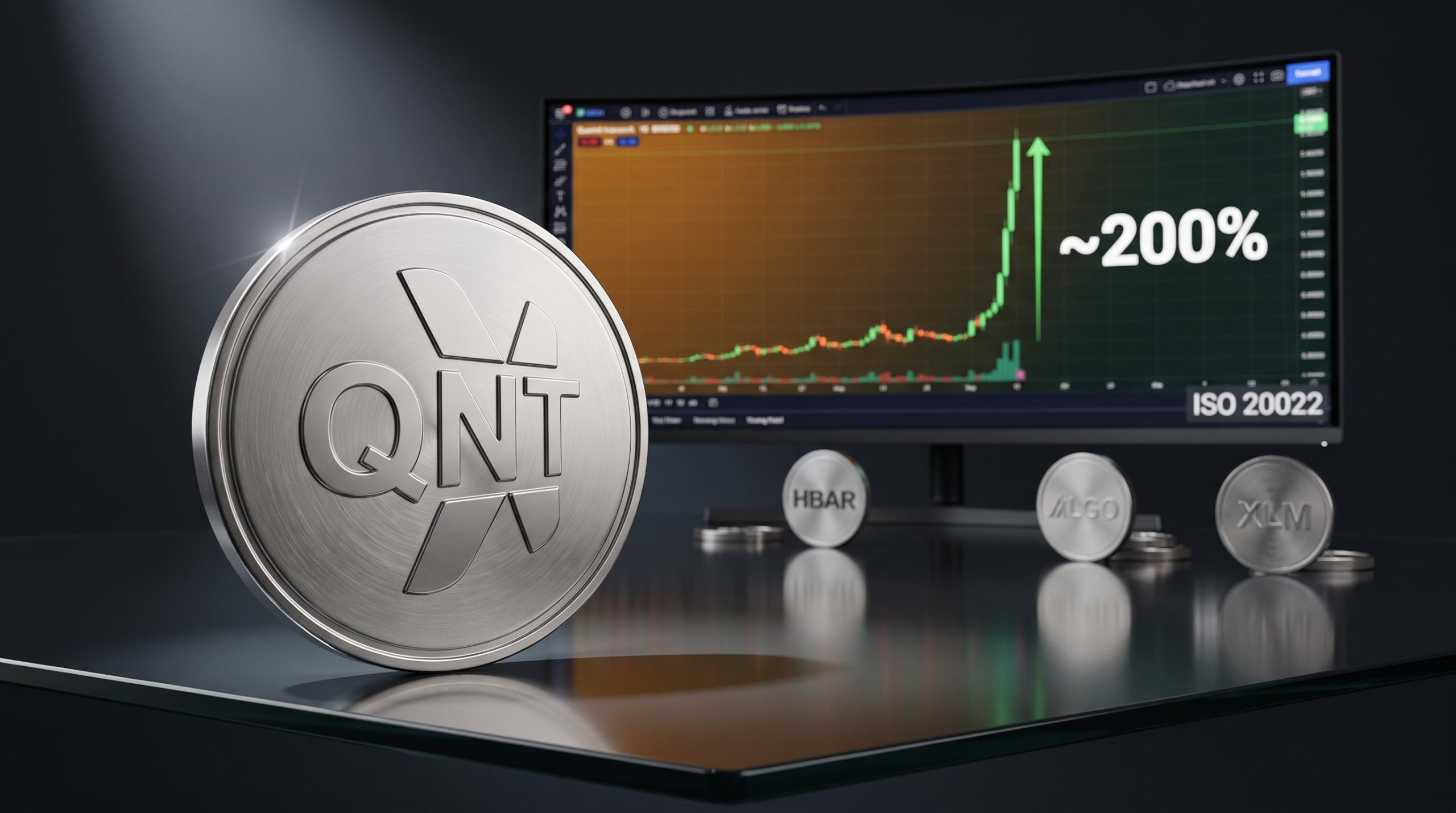
On 24 September 2026, a single press release from The Clearing House, the consortium behind some of America’s most important payment infrastructure, sent one relatively obscure altcoin up roughly 200% in a single day.
Within hours, traders were piling into a half-dozen other tokens they had never directly connected to banking infrastructure, buying anything labelled “ISO 20022-compliant” before the window closed.
The Quant partnership is a genuine institutional development with real infrastructure implications. But the price action it triggered across a broader category of digital assets raises a question that matters far beyond this one event: when a single token surges on real news, what actually drives the others, and how much of what follows is signal versus noise?
This piece gives you an analytical lens for separating institutional substance from speculative spillover, using the ISO 20022 altcoin rally as the worked example. By the time you finish, you will know how to apply that same lens to the next thematic crypto rally you encounter, before the momentum has resolved.
What The Clearing House-Quant deal actually involves
Start with what is verified, because everything downstream depends on getting this right.
The Clearing House is not a fringe player. It is the consortium operator behind two of the most important payment rails in the United States: the Real-Time Payments (RTP) network and the Clearing House Interbank Payments System (CHIPS). When an institution of that weight selects a technology partner, the selection is material on its own terms.
On 24 September 2026, The Clearing House announced it had chosen Quant to power its On-Chain Money Initiative. The initiative is an interoperable network for clearing and settling tokenised bank deposits, which are digitised claims on regulated bank balances, moved and settled across a shared blockchain-based network rather than through legacy messaging alone.
Quant’s role is specific. It provides the interoperability, orchestration, and transaction-management layers that let institutions of different sizes plug into the same rail.
The On-Chain Money Initiative sits inside a broader structural shift: tokenised settlement eliminates the T+1 gap through atomic transactions where asset and payment transfer simultaneously on a shared ledger, collapsing toward T+0 and removing the window during which investor capital sits exposed between a trade and completed ownership transfer.
Verified language The Clearing House describes Quant as “a leading provider of programmable money infrastructure,” powering a network for financial institutions to clear and settle tokenised deposit transactions.
Here are the three confirmed components of the deal:
- The initiative: an interoperable network for clearing and settling tokenised bank deposits, connected to existing RTP and CHIPS rails.
- Quant’s role: the back-end infrastructure provider supplying the interoperability, orchestration, and transaction-management layers.
- The timeline: institutional access is expected in the first half of 2027.
Now the distinction that carries the whole analysis. Quant the company won a major infrastructure contract. That is verified. But QNT, the publicly traded token, is a separate thing, and no official documentation states that QNT is required for transactions on the On-Chain Money network.
That gap between “the company won a contract” and “the token is now institutionally backed” is the single most important idea to absorb before evaluating any of the price action that followed. Build a thesis on the headline alone, and you are building on a misreading.
When big ASX news breaks, our subscribers know first
What ISO 20022 actually is, and why banks care
Most investors have absorbed the vague sense that ISO 20022 matters to banking without ever being told precisely what it is. Closing that gap changes how you read the entire rally.
ISO 20022 is a data and messaging standard. It defines a richer, more structured format for the information that travels alongside a payment: who is paying whom, why, and with what compliance detail attached. It is not a blockchain specification, and it is not a list of approved cryptocurrencies.
Banks care because richer data solves real operational problems. More structured fields mean better compliance and sanctions screening, faster reconciliation, and smoother cross-border settlement. Those are genuine efficiency gains, which is exactly why adoption has moved quickly across the major U.S. rails.
Here is where that adoption actually stands.
| Rail | ISO 20022 status | Effective date |
|---|---|---|
| Fedwire Funds Service | Fully migrated | 14 July 2025 |
| SWIFT cross-border | Fully migrated, coexistence ended | 22 November 2025 |
| RTP (The Clearing House) | Already live | Pre-2025 |
| FedNow (Federal Reserve) | Already live | Pre-2025 |
| FedACH | Not adopting | Not applicable |
| Fedwire Securities | Not adopting | Not applicable |
The Fedwire Funds Service completed its single-day migration on 14 July 2025. SWIFT’s coexistence period, during which old and new messaging formats ran side by side, ended on 22 November 2025, making ISO 20022 the default for cross-border instructions. RTP and FedNow were already operating on the standard before 2025. FedACH and Fedwire Securities are not making the transition at all. From November 2026, SWIFT and Fedwire begin stricter address enforcement, requiring Town and Country fields on payments.
The load-bearing observation ISO 20022 is a data standard, not a blockchain specification and not a register of approved tokens. Bank adoption of the standard says nothing, by itself, about whether any public token accrues value from it.
Read the timeline closely and the implication sharpens. ISO 20022 is already the operational reality across most major U.S. rails. If there was ever an investable moment tied purely to the standard, it is largely priced into institutional plumbing already, not sitting ahead of it. Anyone treating “banks are adopting ISO 20022” as a fresh catalyst for a basket of tokens is responding to a real trend with the wrong instrument.
How one token’s rally becomes a category-wide event
The mechanism that turned one contract into a category-wide event is worth watching in motion, because it repeats.
The reflexive engine behind the spread
It starts with a real signal. Quant’s verified institutional news triggered a surge of roughly 200%, and that move became its own advertisement. Attention spread to other tokens sharing the ISO 20022 label, and retail buyers, wary of missing a repeat, began chasing anything in the category that had not yet moved.
Social media accelerated the loop. Each new green candle became evidence for the narrative, which pulled in more buyers, which produced more green candles. Leverage did the rest; perpetual futures and options magnify moves in both directions, so thin liquidity turned modest buying into sharp spikes.
This is reflexivity: price action feeding the story, the story feeding price action, with fundamentals largely absent from the loop. The tell is that assets which had not updated a single fundamental were being assigned upside targets purely on category membership.
The reflexive loop behind the ISO 20022 spillover is one expression of a broader dynamic: speculative risk appetite, amplified by automated trading strategies increasingly connected to crypto markets through programmable tokenised assets, can transmit a single narrative across otherwise unrelated tokens in hours.
The asset-by-asset picture during the ISO 20022 rally
The clearest way to see the spread is to lay the assets side by side, using the real-time analysis from Nick Valdez at Verified Investing.
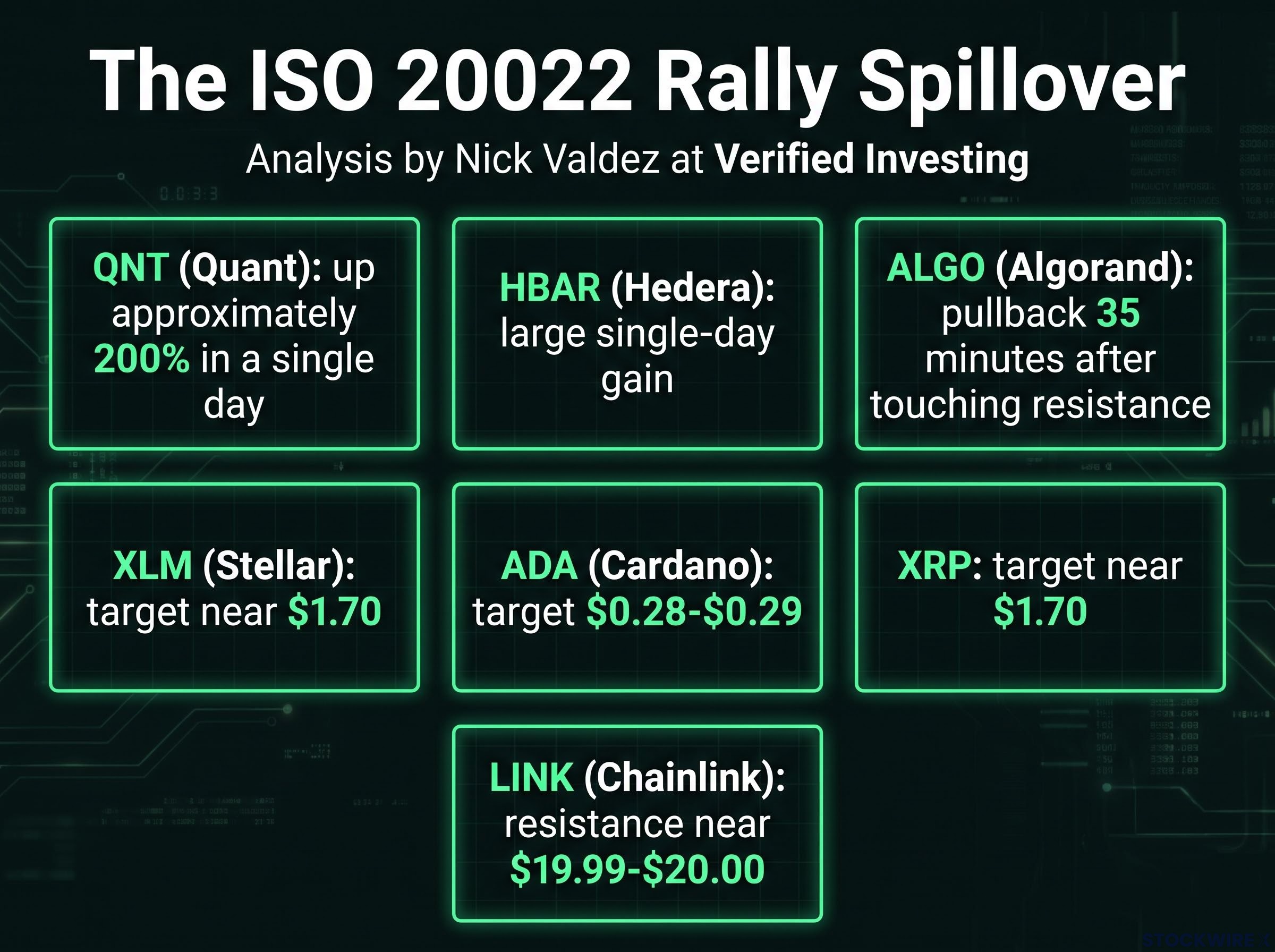
- QNT (Quant): the lead asset, up approximately 200% in a single day on the verified Clearing House news, then beginning to pull back toward a nearby pivot level.
- HBAR (Hedera): posted a large single-day gain, surpassing its prior bull flag target.
- ALGO (Algorand): a significant daily candle reaching a prior pivot high, then a sharp pullback that began roughly 35 minutes after touching resistance.
- XLM (Stellar): rising, with a measured-move target near the $1.70 level based on an inverse head-and-shoulders pattern.
- ADA (Cardano): had not yet rallied, with a potential upside target of approximately $0.28-$0.29 on a channel breakout.
- XRP: had not yet moved significantly, with a potential target near $1.70 based on an ascending trend line from 17 April and a pivot high from 22 August.
- LINK (Chainlink): beginning to move, with key resistance near $19.99-$20.00, where a descending trend line dating to 2021 converges with a round-number level.
The Chainlink caveat Chainlink is primarily an oracle and interoperability network, delivering off-chain data and cross-chain communication to smart contracts. It is not a payment-messaging protocol, which makes LINK the clearest example of the narrative stretching well past a token’s actual function.
Note what ADA and XRP have in common. Neither had rallied, yet both were drawing analyst attention and price targets based on nothing more than category membership. That is the most visible marker of narrative driving positioning ahead of evidence. Spotting the loop while it is forming, rather than after it resolves, is what separates a deliberate position from an impulsive chase.
A four-filter framework for evaluating thematic crypto rallies
Unease is only useful if you can convert it into a decision. These four filters do that, applied in order, each one testing a different layer of the narrative-versus-fundamentals question. Run them on the Quant case and watch the theme thin out.
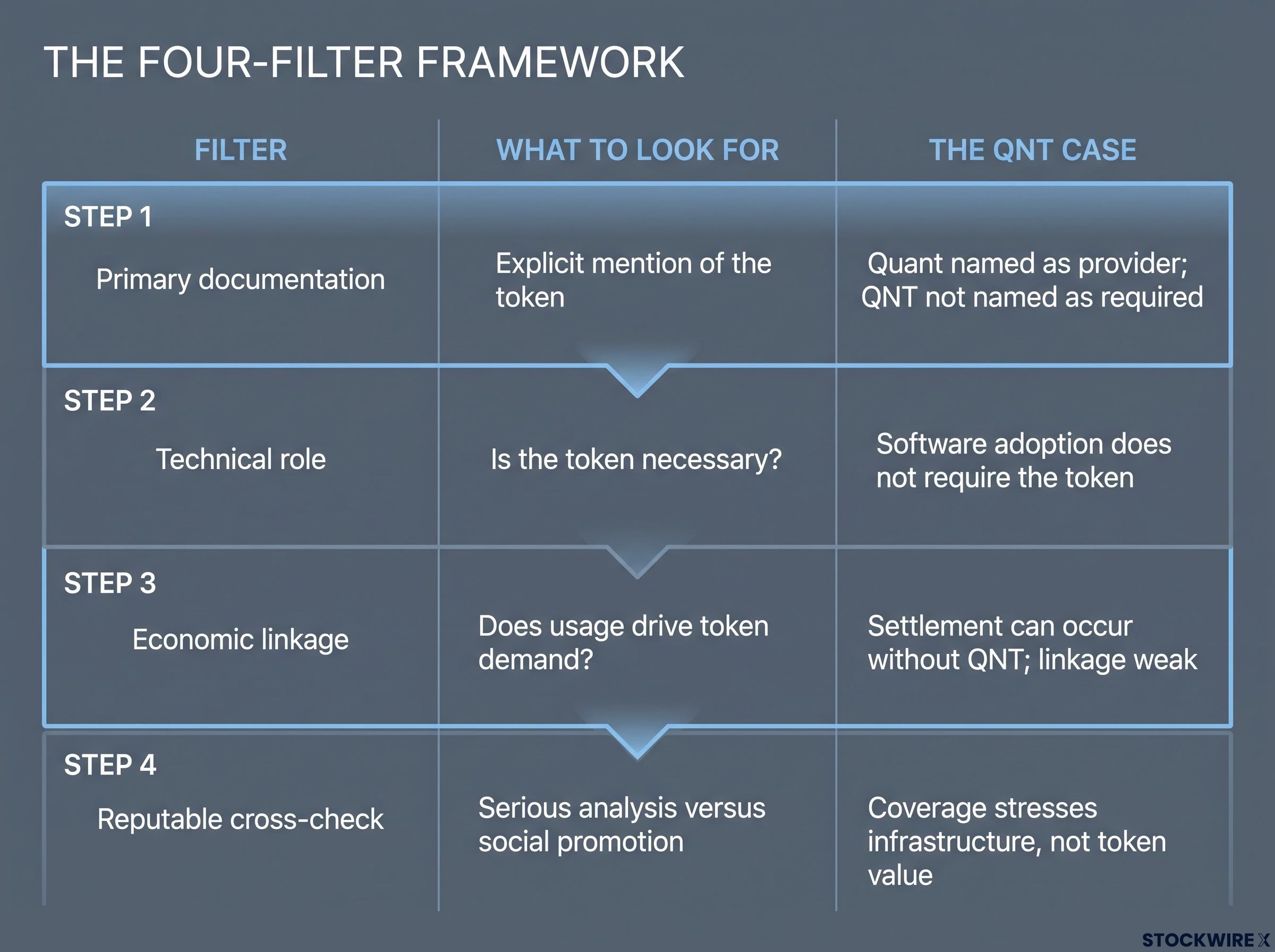
- Check the primary documentation. Look for explicit mention of the token in press releases, technical standards, or filings. In the Quant case, official communications name Quant as the infrastructure provider but never state that QNT or any other public token is required for settlement.
- Verify the token’s technical role. Separate a company providing software from its traded token. Institutional adoption of Quant’s software does not imply demand for QNT unless the contracts and architecture require the token, and nothing in the public record says they do.
- Assess the economic linkage. Ask whether more usage of the underlying rail translates into measurable token demand through fees, staking, or burns. If settlement can happen entirely in fiat or tokenised deposits without the token, the linkage is structurally weak.
- Cross-check against reputable analysis. Look for established research firms or major exchanges explaining how a token captures value from the theme. Heavy promotion from informal social accounts, paired with silence from serious analysts, is a recurring warning sign.
| Filter | What to look for | How it resolves in the QNT case |
|---|---|---|
| Primary documentation | Explicit mention of the token in official material | Quant named as provider; QNT not named as required |
| Technical role | Is the token necessary to operate the system? | Software adoption does not require the token |
| Economic linkage | Does usage drive token demand? | Settlement can occur without QNT; linkage weak |
| Reputable cross-check | Serious analysis versus social promotion | Coverage stresses infrastructure, not token value |
This pattern is not new to crypto. The 2017 ICO boom lifted anything branded “blockchain,” the DeFi and NFT waves of 2020-2021 carried weak protocols alongside strong ones, and the dot-com era did the same for earnings-less “internet” companies. In each case, a genuine innovator dragged up weaker peers that later mean-reverted hard.
Run these four filters before you act, and you gain a structural edge over the majority of participants who are responding to price momentum and social amplification alone.
The economic linkage question the four-filter framework raises also applies further up the payment stack: card network displacement by regulated blockchain corridors is most actionable in cross-border B2B payments, where all-in acceptance costs of 1.5-3.5% compare unfavourably with 0.1-0.5% for stablecoin settlement, though the absence of standardised chargeback mechanisms keeps the displacement horizon at 10-20 years for consumer rails.
What this rally reveals about thematic crypto investing going forward
Step back from the tickers and the core insight is straightforward. Institutional adoption of a messaging standard or an infrastructure layer is a real event with real consequences for payment efficiency. But its translation into durable token value requires direct, verifiable economic linkage, not category proximity.
That produces a clear asymmetry. The lead asset in a thematic rally, here Quant, has the most direct exposure to the actual development. The peripheral assets carry the narrative risk: when the sentiment cycle completes, their prices tend to revert toward pre-news levels, often faster than the lead asset does. Central-bank and BIS research reinforces the point, noting that tokenised deposits and regulated payment systems can run on permissioned infrastructure without any reliance on volatile public tokens.
This is not the last announcement of its kind. Two temporal anchors are worth keeping in view:
- November 2026: SWIFT and Fedwire begin stricter address enforcement across payments.
- First half of 2027: institutional access to the Quant-Clearing House On-Chain Money network is expected to open.
As tokenised deposits and on-chain settlement mature toward that 2027 window, more headlines of this exact shape are coming. Readers who have internalised the four-filter framework now are better positioned for every one of them than those still reacting to category labels. The goal is not to relive this rally, but to read the next one with a sharper mental model of how institutional news and token markets actually interact.
The Quant-Clearing House initiative is one node in a wider on-chain settlement buildout: tokenised repo markets are simultaneously being developed to handle intraday collateral movement, with the DTCC targeting a full tokenisation service launch in October 2026 that covers Russell 1000 constituents, major ETFs, and U.S. Treasuries.
This article is for informational purposes only and should not be considered financial advice. Investors should conduct their own research and consult with financial professionals before making investment decisions. Past performance does not guarantee future results, and price targets referenced are analyst projections subject to market conditions and various risk factors.