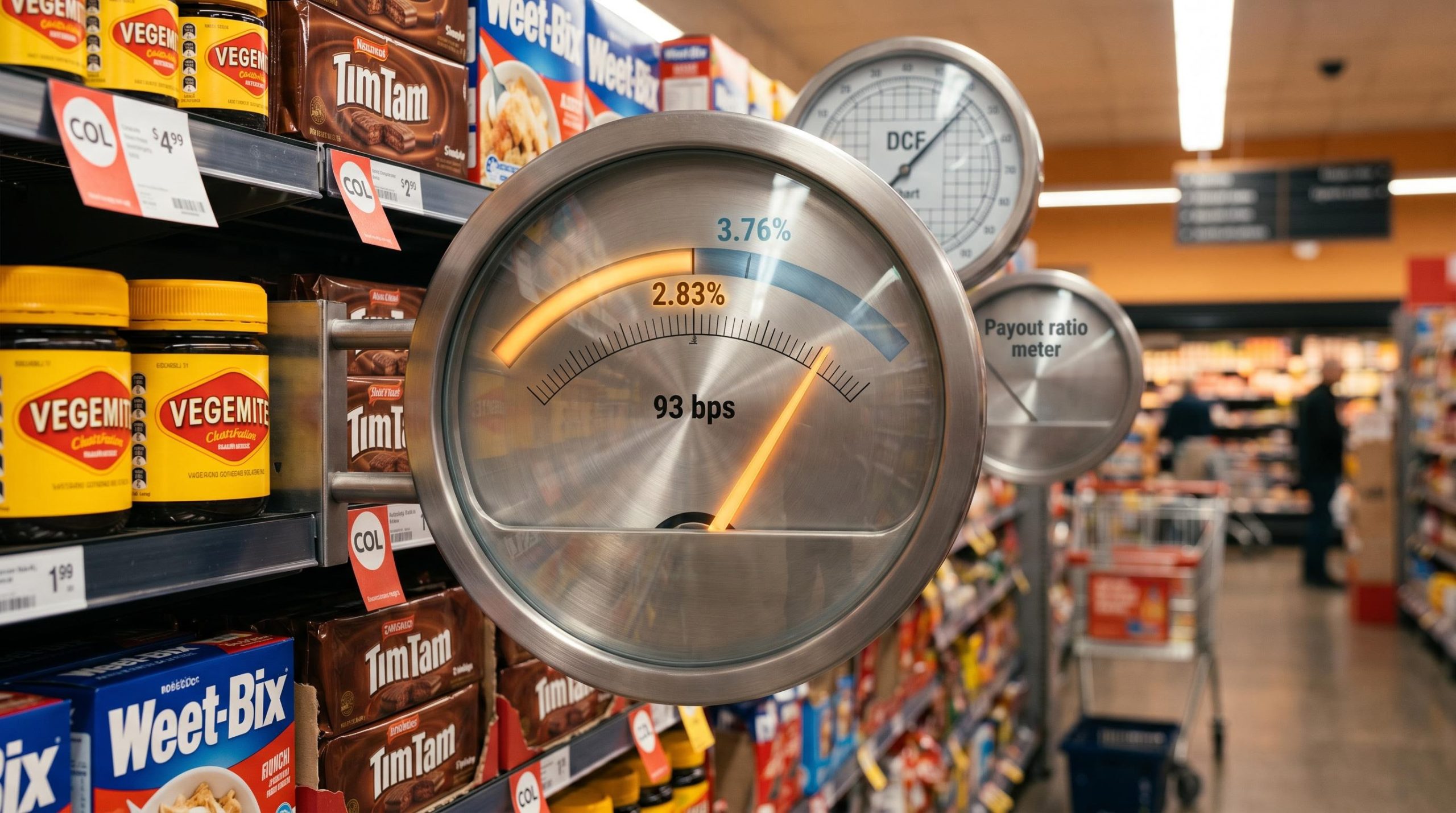
Coles Group (ASX: COL) is currently yielding approximately 2.83%, nearly a full percentage point below its five-year historical average of 3.76%. For income-focused investors, that gap raises a direct question: is the stock expensive, or has the business simply improved? Dividend yield is one of the most widely used and widely misunderstood metrics in Australian retail investing. It is intuitive, quick to calculate, and appears on almost every broker platform. Used without context, however, it leads investors to draw conclusions the data does not support. This guide explains how dividend yield works as a valuation signal, walks through the Coles example with concrete numbers, identifies the specific conditions under which yield-based analysis breaks down, and introduces the more rigorous tools, Discounted Cash Flow (DCF) and Dividend Discount Models (DDM), that should follow any yield-based screen.
What dividend yield actually tells you (and what it does not)
The formula itself is disarmingly simple.
Dividend Yield = (Annual Dividends Per Share ÷ Current Share Price) × 100
A stock paying $0.50 per share annually and trading at $10 has a 5% yield. That number tells an investor how much cash income each dollar invested is generating right now. Where the formula becomes misleading is in what it conceals.
Yield moves in two directions, but for two very different reasons:
- Yield rises when the share price falls (potentially a warning, not a bargain) or when the company raises its dividend (a genuine improvement in income).
- Yield falls when the share price rises (potentially reflecting stronger business quality) or when the company cuts its dividend (a deterioration the headline number obscures).
Without knowing which side of the fraction moved, the number alone is ambiguous. A 6% yield could signal deep value or a business in decline.
One Australian-specific consideration: local investors typically evaluate grossed-up yields that include franking credits, which can materially increase the effective income return. Franking does not change the underlying mechanics, though. The same ambiguity about what drove the yield applies whether the investor is looking at the headline figure or the grossed-up equivalent.
One Australian-specific layer adds further complexity: franking credit mechanics can make a fully franked dividend worth materially more than its headline cash amount for investors in lower tax brackets, including superannuation funds and retirees who can receive excess credits as a direct refund from the ATO, effectively boosting the real income return well above what the stated yield implies.
The ATO guidance on franking credits outlines how the imputation system works for individual investors, including the holding period rule that must be satisfied before a shareholder can claim a franking credit offset against their tax liability, a condition that affects the effective after-tax income return for Australian shareholders evaluating grossed-up yields.
When big ASX news breaks, our subscribers know first
Using Coles Group as a real-world yield valuation case study
Coles Group is an Australian supermarket business commanding approximately 28% of the domestic grocery market. Separately listed on the ASX since 2018 following its demerger from Wesfarmers, Coles has developed a reputation for consistent dividend distributions, making it a natural candidate for yield-based analysis.
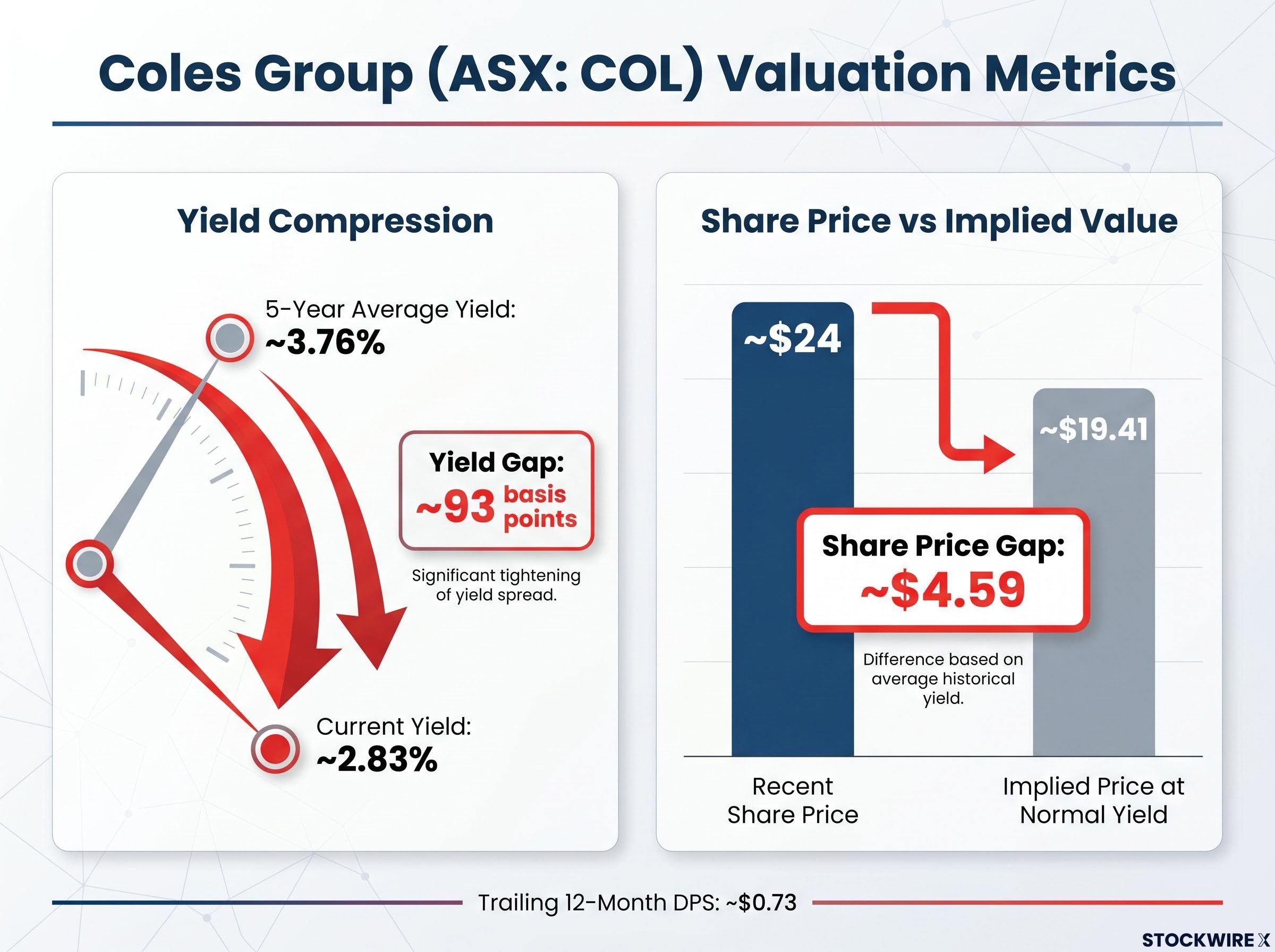
The core yield gap tells the initial story. Coles’ current yield of approximately 2.83% sits roughly 93 basis points below its five-year historical average of approximately 3.76%. On a trailing twelve-month basis, Coles has distributed approximately $0.73 per share, with the share price recently near $24, sitting 19.5% above its 52-week low.
| Metric | Value |
|---|---|
| Current dividend yield | ~2.83% |
| Five-year average yield | ~3.76% |
| Yield gap | ~93 basis points |
| Trailing twelve-month DPS | ~$0.73 |
| Recent share price | ~$24 |
| Share price vs 52-week low | 19.5% above |
Those figures can be turned into a simple implied fair value estimate. The formula works as follows:
Implied Price at Normal Yield = Current DPS ÷ Five-Year Average Yield
Dividing $0.73 by 0.0376 produces an implied price of approximately $19.41. The actual share price near $24 sits materially above that figure, a gap of roughly $4.59 per share. Under the yield-reversion framework, this suggests Coles is trading at a premium relative to its own history. Investors are receiving less income per dollar invested today than they typically received over the past five years.
That is a signal, not a verdict. What follows is the context that determines whether the signal holds.
Five reasons dividend yield misleads without proper context
Each of the following limitations maps to a mistake investors regularly make when treating yield as a standalone valuation tool.
- Yield does not reveal which side of the fraction moved. A high yield from a falling share price may look like a bargain on the surface. In practice, it can be a yield trap, where the market is correctly pricing in future earnings pressure and an eventual dividend cut. The headline yield looks attractive; the business reality is deteriorating.
A yield trap occurs when a stock’s yield rises because the share price is falling in anticipation of a dividend cut. The yield appears generous right up until the dividend is reduced or eliminated, at which point both income and capital are lost.
Dividend trap identification is especially difficult on the ASX because the franking credit system can shift investor attention toward gross yield and away from payout sustainability, creating conditions where a position is held far longer than the underlying fundamentals justify.
- Yield says nothing about dividend sustainability. Coles has recently shown a payout ratio near 91% of earnings, though lower relative to free cash flow. A payout ratio that high warrants scrutiny regardless of how appealing the yield appears. If earnings dip even modestly, the buffer to maintain the dividend narrows considerably.
- Mean-reversion analysis assumes the business is fundamentally unchanged. Comparing today’s yield to a five-year average only works if Coles’ risk profile, competitive position, and growth trajectory are broadly similar to what they were over that period. If the business has genuinely improved, a permanently lower yield (reflecting a higher valuation multiple) could be justified rather than a sign of overpricing.
- Yield is backward-looking. It is calculated from dividends already declared. It does not capture future capital allocation decisions, reinvestment needs, or shifts in earnings trajectory. For a stable supermarket business this limitation is less acute than for a cyclical name, but it remains a blind spot.
- Cross-stock yield comparisons are unreliable. A 4% yield on a slow-growth defensive stock and a 4% yield on a high-growth technology name represent very different risk-return propositions. Without adjusting for growth profiles and business risk, comparing yields across stocks leads to false equivalences.
Beyond yield: how Discounted Cash Flow and Dividend Discount Models estimate intrinsic value
Yield-reversion analysis asks: “Is this stock expensive or cheap relative to its own history?” DCF and DDM ask a fundamentally different question: “What is this business actually worth?” That shift in framing is the upgrade.
Discounted Cash Flow analysis
DCF values a business by estimating all future free cash flows and discounting them back to the present using a required rate of return. The process follows four steps: forecast free cash flows over a finite period (typically five to ten years), estimate a terminal value for cash flows beyond that horizon, discount all cash flows to present value using a discount rate reflecting risk, and divide by shares on issue to arrive at a value per share.
For Coles specifically, the model requires taking a view on variables that dividend yield ignores entirely:
- Revenue growth from the store network, inflation, and volume
- Operating margins and cost pressures
- Capital expenditure on distribution centres, technology, and store refurbishments
- A conservative long-run growth rate for terminal value
DCF’s advantage is that it forces explicit assumptions about the future. Its limitation is that small changes in the discount rate or growth rate assumptions can shift the output materially. Results should be treated as a range of plausible values, not a single price target.
Dividend Discount Model
The DDM is a special case of DCF that uses future dividends as the cash flows. In the Gordon Growth Model, assuming dividends grow at a constant rate in perpetuity:
Intrinsic Value = D₁ ÷ (r – g)
Where D₁ is next year’s expected dividend, r is the required rate of return, and g is the long-term dividend growth rate.
For a mature, stable, dividend-paying business like a major supermarket, this can be a reasonable approximation. The model also reveals a useful relationship: dividend yield plus dividend growth rate approximately equals the long-term return an investor can expect, assuming the valuation multiple stays roughly constant. That makes DDM a secondary check on return expectations as well as a valuation tool.
Both methods share one important caveat. The output is highly sensitive to the gap between r and g. A small change in either assumption can produce a substantially different intrinsic value. The discipline lies in stress-testing those inputs across a range of scenarios rather than relying on a single set of assumptions.
A practical six-step framework for evaluating any dividend stock
The following sequence is designed to be applied this weekend to a stock already in a portfolio. Each step is anchored to the Coles example to make the framework concrete rather than abstract.
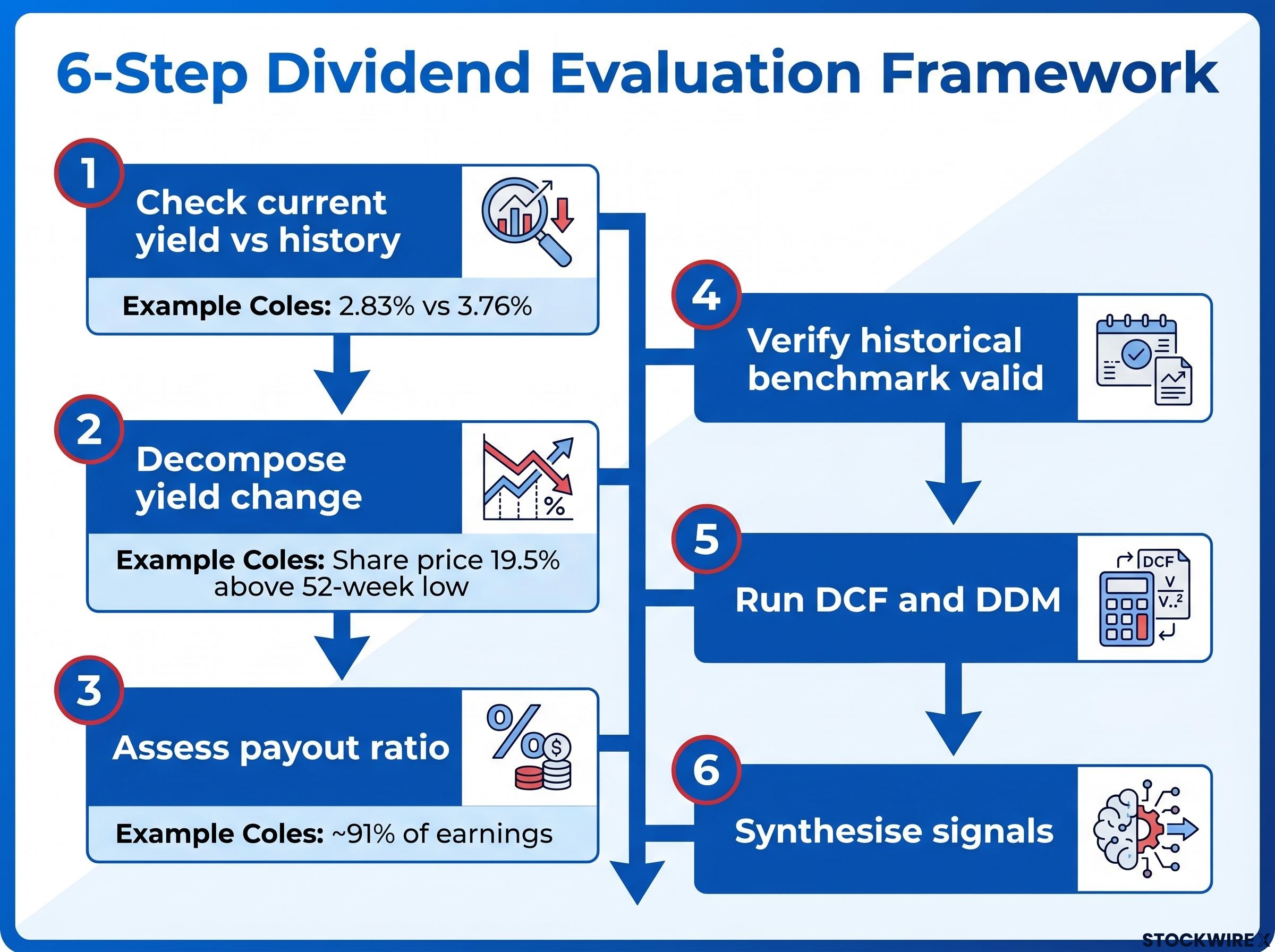
- Check current yield versus history. Coles’ yield of 2.83% is 93 basis points below its five-year average of 3.76%. That flags a potential premium. A yield materially above the historical average would flag potential undervaluation, or a possible yield trap.
- Decompose what drove the yield change. Has the share price risen sharply, or has the dividend been cut? For Coles, the share price sits 19.5% above its 52-week low while dividends have remained relatively stable, meaning the yield compression is predominantly price-driven.
- Assess payout ratio and dividend coverage. Coles’ payout ratio near 91% of earnings means the dividend consumes most of reported profit. Examine whether free cash flow coverage tells a more comfortable story, and whether debt levels or reinvestment needs add further pressure.
- Verify whether the historical yield band remains a valid benchmark. Have competitive dynamics shifted? Has cost inflation altered margins? Has management signalled a change in capital allocation? If the business today is fundamentally different from the business that produced the five-year average, the historical yield band may no longer represent fair value.
- Run or review a DCF and DDM. Build a basic model using explicit assumptions for growth, margins, and required return. Compare the intrinsic value range from those models with both the current share price and the price implied by a “normal” yield.
- Synthesise all signals into a judgement. This is where the framework delivers its most important output.
When all three methods, yield-reversion, DCF, and DDM, point in the same direction, the investment case strengthens. When they conflict, the disagreement itself reveals the assumption the investor is implicitly making.
If yield-reversion says “expensive” but DCF says “fairly valued,” the investor is effectively betting on margin expansion or a structural rerating. Making that bet explicit is more valuable than any single price target.
What the Coles yield gap really signals for Australian income investors
The yield gap of approximately 93 basis points below the five-year average is a clear premium signal under the yield-reversion framework. Whether that premium is justified depends on questions the yield number cannot answer.
The open questions investors must resolve before drawing a conclusion include:
- Are Coles’ operating margins structurally improving, or has recent share price strength outpaced fundamental improvement?
- Is the competitive position strengthening or weakening relative to Woolworths Group and the growing presence of discount entrants in the Australian grocery market?
- Is a payout ratio near 91% of earnings sustainable given ongoing reinvestment needs in supply chain infrastructure and technology?
- Has management signalled any shift in dividend policy that would alter future payout expectations?
The Coles and Woolworths valuation divergence that emerged through 2025 offers a concrete illustration of how genuine earnings differences, rather than sentiment, can drive peer stocks in opposite directions: Coles reported supermarkets EBIT growth of 14.6% in H1 FY2026 while Woolworths delivered only a partial recovery from a depressed prior-year base, a gap that makes yield comparison between the two names particularly unreliable without earnings context.
The yield number alone cannot resolve any of these. What it can do, and what this guide has demonstrated, is flag the right questions. The hierarchy matters: yield is a useful first filter, not a final answer. The discipline of moving from yield to payout coverage to intrinsic value modelling is what separates informed income investing from yield-chasing.
Yield is a starting point, not a destination
Dividend yield remains a fast, accessible signal that flags potential over- or under-pricing relative to a stock’s own history. It belongs in every income investor’s toolkit, but never as the sole tool. Used without context from payout analysis, business fundamentals, and intrinsic value modelling, it cannot support an investment decision.
The Coles example offers a repeatable template. Calculate the yield gap, decompose what caused it, check the payout ratio, and run a DCF or DDM before reaching a conclusion. Apply that same sequence to the next ASX dividend stock under consideration, and the one after that.
Investors who build this habit across multiple positions are building genuine analytical literacy, not simply collecting income.
For investors applying this framework with a specific retirement income target in mind, our dedicated guide to living off dividends in Australia works through the capital requirements at different yield levels, how franking credits reduce those targets in pension-phase superannuation, and which portfolio structures maximise after-tax income across different account types.
This article is for informational purposes only and should not be considered financial advice. Past performance does not guarantee future results. Investors should conduct their own research and consult with financial professionals before making investment decisions.